






Latest Version
October 27, 2026
CO AND EF LIMITED
Card
iOS
0
Report a Problem
More About :game
Classic Solitaire: Calm Cards offers a fresh way to enjoy one of the world's most familiar single-player card games. Built around traditional Klondike Solitaire, the game challenges you to organize a shuffled deck, uncover hidden cards, and arrange every suit in the correct order. Its straightforward gameplay makes it approachable for beginners while giving experienced Solitaire players plenty of opportunities to improve their decision-making.
The main objective is to move all 52 cards into four foundation piles, arranging each suit from Ace to King. Reaching that goal requires more than simply moving cards whenever a legal move appears. Players must think ahead, uncover useful cards, manage the stockpile, and create opportunities to rearrange the tableau.
Classic Solitaire: Calm Cards is designed for players who enjoy thoughtful puzzles without complicated controls. Whether you have a few minutes to spare or want to settle into a longer card session, the game provides a familiar challenge that rewards patience, observation, and careful planning.
What Is Classic Solitaire: Calm Cards?
Classic Solitaire: Calm Cards is a mobile card game developed by CO AND EF LIMITED. It focuses on the classic Klondike Solitaire experience, where the objective is to sort cards by suit while arranging the visible tableau in descending order and alternating colors.
The game combines traditional card-solving mechanics with a clean, accessible mobile experience. Players can enjoy familiar Solitaire rules, choose between Draw 1 and Draw 3 gameplay, use hints and undo options, and work through daily challenges. Additional features described in the game listing include customizable card appearances, different backgrounds, progress statistics, and automatic completion when the remaining moves are straightforward.
The game is suitable for casual players who appreciate simple rules and strategic decisions. It also offers a useful way for experienced Solitaire fans to practice planning, improve their card management, and explore different approaches to challenging deals.
Main Features of Classic Solitaire: Calm Cards
Classic Klondike Solitaire Gameplay
The game follows the familiar rules of Klondike Solitaire. Players move cards between columns, reveal hidden cards, and build four foundation piles in ascending order. Every move can affect future possibilities, making it important to consider how each decision changes the board.
Draw 1 and Draw 3 Modes
Draw 1 and Draw 3 provide different levels of challenge. Draw 1 reveals one card at a time from the stockpile, making it easier to examine available options. Draw 3 introduces a more demanding puzzle because the order of the cards in the stockpile can influence which cards become accessible.
Helpful Hints and Undo Options
Hints can help identify possible moves when the next step is unclear. Undo allows players to reverse a previous move and explore a different approach. Used thoughtfully, these tools can help beginners understand the rules and experienced players test alternative strategies.
Daily Solitaire Challenges
Daily challenges provide fresh opportunities to practice Solitaire and approach new card arrangements. They encourage players to develop consistent habits, recognize useful patterns, and improve their decision-making across different deals.
Customizable Cards and Backgrounds
Personalization options let players adjust the appearance of their card table. Different card faces, card backs, and backgrounds can make the playing area feel more comfortable and visually appealing.
Progress Statistics
Game statistics help players review their performance and track improvement over time. Depending on the available statistics, players can compare completed games, win rates, move counts, or completion times to understand where their strategy is improving.
Simple Mobile Controls
Players can move cards using tap or drag controls. These familiar interactions make it easier to learn the game and focus on the puzzle instead of complicated inputs.
A Relaxing Single-Player Experience
Classic Solitaire: Calm Cards is centered on individual play. There is no need to coordinate with teammates or learn complicated multiplayer systems. Players can concentrate on the cards, take their time, and enjoy each deal at a comfortable pace.
How to Play Classic Solitaire: Calm Cards
Understand the Solitaire Board
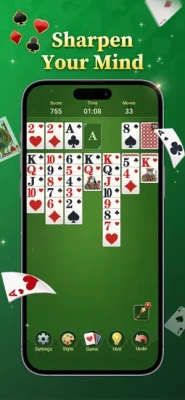
A standard Klondike Solitaire game uses a 52-card deck without jokers. The board contains three important areas: the tableau, the stockpile, and the foundation piles.
The tableau consists of seven columns of cards. The first column contains one card, the second contains two, and each following column contains one additional card, giving the seventh column seven cards. Only the top card of each column is initially face up.
The stockpile contains the remaining cards that have not been dealt into the tableau. Players draw cards from this pile to find additional moves.
The foundation area contains four piles, one for each suit: hearts, diamonds, clubs, and spades. Each foundation begins with an Ace and grows upward through the Two, Three, and subsequent cards until it reaches the King.
Learn the Basic Card-Moving Rules
Cards in the tableau must be arranged in descending rank while alternating between red and black suits. For example, a black Nine can be placed on a red Ten, while a red Seven can be placed on a black Eight.
You can move a single face-up card or a correctly ordered sequence of face-up cards when the destination column allows it.
An empty tableau column can generally be filled only with a King or a sequence beginning with a King. Creating empty columns is particularly valuable because it gives you more flexibility to reorganize cards.
Aces should be moved to the foundation piles as soon as doing so is strategically appropriate. The remaining cards are then added to the matching suit in ascending order.
Use the Stockpile Carefully
When no useful tableau move is available, draw cards from the stockpile. Depending on the selected mode, one or three cards are revealed at a time.
Examine the available cards before drawing again. A card in the stockpile may unlock a move that allows you to reveal a hidden tableau card or build a useful sequence.
Avoid drawing automatically after every move. Check whether another tableau arrangement could create a better opportunity first.
Complete the Foundation Piles
Your ultimate objective is to transfer all cards to their appropriate foundation piles. Each pile must contain one suit, arranged from Ace to King.
Although moving cards to the foundations is essential for winning, it is sometimes better to leave a card in the tableau temporarily. A card that appears ready for the foundation may still be useful for placing another card or creating a longer sequence.
The strongest approach balances immediate progress with the need to preserve future moves.
Complete Strategy Guide for Classic Solitaire: Calm Cards
Plan Before Making Your First Move
Start each deal by examining all seven tableau columns. Look for exposed Aces, available cards that can be moved immediately, and opportunities to uncover face-down cards.
Do not automatically choose the first legal move. Two moves may both be valid, but one might reveal a hidden card while the other merely rearranges cards already visible.
Prioritize moves that improve your knowledge of the board. The more hidden cards you uncover, the more information you have for making effective decisions.
Prioritize Uncovering Face-Down Cards
Revealing hidden cards is one of the most important strategies in Klondike Solitaire. Every newly exposed card creates another possible source of information and may unlock additional moves.
When choosing between two moves, consider which one will uncover a face-down card sooner. A move that reveals a useful card can open several new possibilities and prevent the game from becoming blocked.
Pay particular attention to columns containing many hidden cards. These columns often provide valuable opportunities because uncovering one card may expose another card beneath it.
Empty Tableau Columns Strategically
An empty column provides considerable flexibility. It allows you to relocate a King or a sequence beginning with a King, helping you reorganize the tableau and expose previously blocked cards.
However, creating an empty column is not automatically beneficial. Consider whether you have a King available and whether moving cards into the empty space will actually improve your position.
Before clearing a column, identify a useful destination for the newly available space. An empty column is most valuable when it helps uncover hidden cards or makes an important sequence accessible.
Choose the Right King for an Empty Column
When multiple Kings are available, choose carefully. The color and cards beneath each King can determine how useful the resulting column will become.
A King that allows you to move a long sequence of alternating colors may create more flexibility than one that offers few follow-up moves.
Whenever possible, choose the King that helps reveal hidden cards or separates blocked sequences. Avoid filling an empty column simply because a King is available.
Balance Foundation Progress With Tableau Flexibility
Moving Aces and low-ranking cards to the foundations is usually beneficial because it creates room in the tableau. However, advancing every card immediately can sometimes remove useful building blocks.
For example, a low-ranking card may be needed temporarily to support a descending sequence. Moving it to the foundation too early could prevent you from arranging another card.
Before moving a card upward, check whether it is supporting other cards or providing an important link between columns. If the move creates more opportunities than it removes, it is generally a good decision.
Pay Attention to Card Colors
Color management is central to Klondike Solitaire. Because tableau sequences must alternate between red and black, the color of a card can determine whether a move is possible.
When a column becomes blocked, inspect the cards above it and identify which color and rank would allow the sequence to continue. You may need to uncover a particular card or move another sequence to create the required space.
Keeping track of visible red and black cards can also help you decide which columns to prioritize and which stockpile cards are most useful.
Make the Most of the Stockpile
The stockpile can provide essential cards, but its usefulness depends on the order in which cards become accessible.
In Draw 1 mode, you can inspect each revealed card individually. Take advantage of this by checking whether a card can improve the tableau before moving on.
In Draw 3 mode, the order of the cards matters even more. A card that appears behind two others may not be immediately usable, so consider how moving cards from the tableau could change your access to the stockpile.
Avoid cycling through the stockpile without a purpose. Use each pass to identify useful cards, test possible arrangements, and plan your next sequence of moves.
Use Undo as a Learning Tool
Undo is valuable when you discover that a move has blocked an important sequence or failed to reveal the card you expected.
Instead of repeatedly reversing moves at random, use undo to compare specific alternatives. Ask yourself what would happen if you moved a different card first or cleared another column.
This approach turns mistakes into useful information and helps you understand why certain moves are stronger than others.
Use Hints Without Losing Your Own Strategy
Hints can be especially useful when the board appears stuck. They may draw attention to a legal move you overlooked or remind you that a stockpile card can be played.
However, a suggested move is not necessarily the best strategic move available. Before accepting a hint, consider whether it will reveal hidden cards, create an empty column, or improve access to important cards.
Over time, try to predict the available moves before requesting a hint. This helps develop independent problem-solving skills.
Avoid Moving Cards Without a Clear Purpose
Not every legal move improves your chances of winning. Rearranging cards repeatedly without uncovering hidden cards or creating useful sequences can waste opportunities.
Before making a move, identify its likely benefit. It might expose a hidden card, free a column, advance a foundation pile, or reveal a useful stockpile card.
If a move achieves none of these goals, consider whether it can safely wait.
Reconsider Your Plan When the Board Changes
Solitaire requires flexibility because a newly revealed card can change the best course of action. A move that seemed useful earlier may become unnecessary after a different sequence opens up.
After uncovering a hidden card, pause to review the entire tableau. Check whether new foundation moves are possible, whether an empty column can be created, and whether previously blocked cards can now be moved.
Regularly reassessing the board prevents you from following an outdated plan.
Draw 1 Strategy Guide
Draw 1 is a good starting point for beginners and players who prefer a more accessible Solitaire experience.
Because one card is revealed at a time, the stockpile is generally easier to manage. You can inspect the available card, decide whether to use it, and continue looking for other opportunities.
Focus on uncovering hidden tableau cards before cycling through the stockpile unnecessarily. If a useful card becomes available, consider how it might unlock another move rather than immediately placing it wherever it fits.
Draw 1 also provides a useful environment for learning the importance of empty columns, card colors, and foundation timing. Once these principles become familiar, players can apply them to more challenging modes.
Draw 3 Strategy Guide
Draw 3 introduces a greater planning challenge because three cards are drawn at a time, although the exact accessibility of those cards depends on the stockpile rules used by the game.
Study the visible card and consider whether playing it will change the cards available during the next draw. Sometimes, leaving a card in place temporarily is more useful than moving it immediately.
Try to remember the order of cards as you cycle through the stockpile. This can help you anticipate when an important card will become available again.
Tableau moves are especially important in Draw 3. Revealing hidden cards and reorganizing columns can make it easier to use cards that would otherwise remain inaccessible.
When a deal becomes difficult, revisit earlier decisions with the undo feature if available. A different sequence may expose a useful card or make a previously inaccessible stockpile card playable.
Daily Challenge Strategy
Daily challenges offer an opportunity to practice with a fresh deal. Instead of focusing only on speed, concentrate on making consistent, well-considered decisions.
Begin by reviewing the tableau and identifying the most promising columns. Prioritize moves that uncover hidden cards and create flexibility.
If you encounter a difficult position, review your recent decisions. Look for opportunities that were missed because a card was moved too early or a column was cleared without a clear purpose.
Tracking your results can help you identify patterns in your play. If you frequently reach blocked positions, pay closer attention to stockpile management and the order in which you move cards to the foundations.
Common Mistakes to Avoid
Moving Every Card to the Foundation Immediately
Moving cards to the foundations is necessary, but some cards are more useful in the tableau while they support other sequences. Check whether a card is needed to maintain a valuable arrangement before moving it upward.
Ignoring Hidden Cards
Players sometimes focus on rearranging visible cards instead of revealing hidden ones. This can leave important options unavailable for too long.
Whenever possible, favor moves that expose face-down cards and expand your available choices.
Filling Empty Columns Too Quickly
An empty column should provide strategic value. Filling it with the first available King may prevent you from using it for a more helpful sequence later.
Consider which King will create the strongest arrangement before committing to a move.
Drawing Cards Without Checking the Tableau
Repeatedly drawing from the stockpile can distract you from moves already available on the board. Examine the tableau before each draw and look for opportunities to uncover cards or rearrange sequences.
Relying Too Heavily on Hints
Hints are useful, but accepting every suggestion without understanding its purpose can limit your strategic development. Use them to learn possible moves, then decide which move best supports your overall plan.
Focusing Only on Speed
Fast play can be satisfying, but speed is not always the best measure of progress. A deliberate approach can help you avoid unnecessary moves and improve your chances of completing difficult deals.
Tips for Beginners
Start with Draw 1 if you are unfamiliar with Klondike Solitaire. Learn the descending-order rule, the alternating-color requirement, and the purpose of the four foundation piles.
Make revealing hidden cards a priority. When two moves are available, consider which one will uncover more information or create more room on the tableau.
Use the undo feature to understand the consequences of your decisions. If a move blocks your progress, reverse it and try another approach.
Do not worry about completing every game quickly. Focus on understanding the board, recognizing useful sequences, and making each move count.
As your confidence grows, try Draw 3 and daily challenges to develop stronger planning skills.
Advanced Solitaire Techniques
Think Several Moves Ahead
Experienced players consider not only the immediate result of a move but also the opportunities it creates afterward. Before moving a sequence, examine how the remaining cards will fit together and whether the move will help uncover hidden cards.
You do not need to predict the entire game. Planning two or three moves ahead can be enough to avoid common mistakes and identify stronger combinations.
Preserve Important Building Cards
Certain cards become especially useful when they connect sequences of alternating colors. Moving these cards to the foundations too early can remove a link that the tableau needs.
Before advancing a card, inspect the visible columns and consider whether it supports a sequence that cannot yet be rebuilt.
Compare Alternative Moves
When several legal moves are available, compare their likely outcomes. One move may offer immediate foundation progress, while another may expose a hidden card or make an empty column available.
The best choice depends on the current board. Favor moves that expand your options rather than simply changing the arrangement.
Manage Risk in Difficult Deals
Some deals offer several promising moves, while others become constrained quickly. In difficult positions, avoid committing to a sequence that closes off important options without a clear benefit.
Use undo to test alternatives when available, and pay attention to the cards you have not yet exposed. A more cautious approach can help preserve flexibility until additional information becomes available.
Is Classic Solitaire: Calm Cards Good for Casual Players?
Classic Solitaire: Calm Cards is well suited to players who enjoy familiar card puzzles and prefer a straightforward mobile experience. Its basic rules are easy to understand, and the game offers room for improvement through more thoughtful planning.
New players can learn at their own pace, while experienced players can challenge themselves with Draw 3 and daily deals. Customization options and familiar controls add convenience without changing the central objective of the game.
The single-player format also makes it easy to enjoy a short session during a break or spend longer working through a difficult deal.
Can You Improve Your Solitaire Skills by Playing Regularly?
Regular practice can help you become more familiar with card patterns, tableau management, and stockpile sequencing. As you play more deals, you may begin to recognize situations in which a move is likely to reveal useful cards or create a better arrangement.
Reviewing your mistakes is particularly valuable. When a game becomes blocked, consider whether you could have uncovered a hidden card earlier or preserved a useful card in the tableau.
Using hints occasionally and experimenting with undo can also help you compare different approaches. Over time, these habits can make your decisions more consistent and improve your understanding of the game.
Winning is never guaranteed because the available moves depend on the deal and the game's rules. However, careful planning can help you make better use of the opportunities presented by each hand.
Frequently Asked Questions
What Is the Main Goal of Classic Solitaire: Calm Cards?
The goal is to move all 52 cards into four foundation piles, with each suit arranged from Ace through King. To achieve this, players build descending sequences of alternating colors in the tableau, uncover hidden cards, and use the stockpile to find additional moves.
Is Classic Solitaire: Calm Cards Easy to Learn?
Yes. The basic rules are straightforward, making the game approachable for beginners. Learning when to move cards, how to manage empty columns, and how to use the stockpile effectively takes more practice.
What Is the Difference Between Draw 1 and Draw 3?
Draw 1 reveals one stockpile card at a time, making individual cards easier to access. Draw 3 reveals three cards at a time and requires more attention to their order and availability.
How Do You Win a Solitaire Game?
Build four foundation piles, one for each suit, starting with the Aces and continuing in ascending order until every pile reaches a King. Successful play requires uncovering hidden cards, building valid tableau sequences, and managing the stockpile carefully.
When Should You Move a Card to the Foundation?
Move a card to the foundation when doing so supports your progress without unnecessarily blocking tableau moves. Aces are usually strong early moves, but other cards may be worth keeping in the tableau temporarily if they help build important sequences.
Why Are Empty Columns Important?
An empty tableau column allows you to place a King or a sequence beginning with a King. This can help reorganize cards, uncover hidden cards, and create additional opportunities for future moves.
How Can Hints Help You Play Better?
Hints can reveal legal moves you may have overlooked. Use them to understand your options, but consider the strategic value of each move before accepting a suggestion.
Is Draw 3 More Challenging Than Draw 1?
Draw 3 generally requires more careful planning because cards are revealed in groups, making their order and accessibility more important. Players must pay closer attention to stockpile cycles and the effects of tableau moves.
Does Classic Solitaire: Calm Cards Offer Daily Challenges?
The game's listing describes a Daily Challenge feature that provides additional opportunities to play and practice. These challenges can help players develop consistent habits and test their strategies on different deals.
Can Beginners Use Undo?
Undo is useful for beginners and experienced players alike. It allows players to review decisions, reverse unhelpful moves, and explore alternative strategies when the game provides that option.
Is Classic Solitaire: Calm Cards Suitable for Short Gaming Sessions?
Yes. Solitaire can be played one deal at a time, making it suitable for short breaks as well as longer sessions. Players can focus on completing a hand without needing to learn complicated controls or coordinate with others.
What Is the Best Strategy for Winning More Games?
There is no single strategy that guarantees a win. In general, prioritize uncovering hidden cards, create empty columns when useful, manage the stockpile carefully, and avoid moving cards without considering their effect on future options.
Final Thoughts on Classic Solitaire: Calm Cards
Classic Solitaire: Calm Cards brings traditional Klondike gameplay to mobile players who appreciate a familiar, thoughtful card puzzle. Its combination of accessible rules, Draw 1 and Draw 3 modes, daily challenges, and helpful gameplay tools makes it a practical choice for casual sessions and more focused Solitaire practice.
The key to becoming a stronger player is to look beyond the next available move. Uncover hidden cards, preserve useful tableau sequences, choose Kings carefully when creating empty columns, and think about how each decision affects future opportunities.
With patience and consistent practice, players can develop a better understanding of card order, improve their decision-making, and enjoy the satisfaction of completing increasingly challenging Solitaire deals.
Rate the Game
User Reviews








Popular Games



















 Android
 iOS
 Windows
 Xbox