

Latest Version
September 25, 2026
MoonDrip FZ-LLC
Card
iOS
0
Report a Problem
More About :game
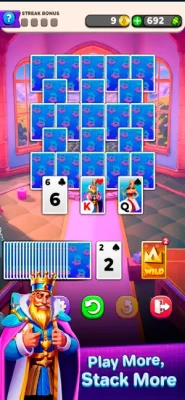
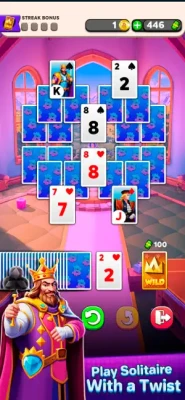
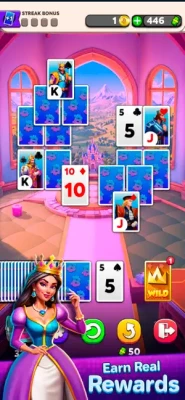
Royal Bitcoin Solitaire takes the familiar Solitaire format and adds Bitcoin-related rewards to the progression loop.
Rather than simply completing card layouts for a score, players can progress through levels and objectives while accumulating Satoshis. The developer also highlights daily streaks, multipliers and level-based earnings as part of the reward system.
The basic gameplay remains recognizable to anyone familiar with Klondike-style Solitaire:
Reveal cards → build sequences → move cards strategically → expose hidden cards → complete the foundations.
The additional reward layer gives players another reason to maintain regular play.
Main Gameplay Features
Classic Solitaire Gameplay
The central experience is a familiar card-based puzzle. Your goal is to organize the cards correctly while revealing hidden cards and building the foundation piles.
Bitcoin Rewards
The App Store promotes real Bitcoin rewards in the form of Satoshis, rather than merely giving players virtual points. According to the listing, Satoshis can be redeemed using the ZBD app.
Daily Streaks
Daily play is an important part of the reward structure. Maintaining a streak can provide additional progression benefits according to the game's current system.
Multipliers
The listing specifically mentions multipliers, giving players an incentive to make efficient progress rather than simply completing isolated games.
Level-Based Earnings
Rewards are connected to level and objective progression, making successful Solitaire play part of the earning loop.
Simple Controls
The game is designed around straightforward card interactions and is intended to be accessible to both experienced Solitaire players and newcomers.
ZBD Integration
The developer states that Bitcoin rewards are powered by ZBD and that Satoshis can be redeemed through the ZBD app. Availability of rewards can vary by country or state.
Complete Royal Bitcoin Solitaire Strategy Guide
1. Reveal Hidden Cards First
One of the most important Solitaire principles is exposing face-down cards.
When choosing between two legal moves, consider which one reveals a hidden card.
For example, if moving one card opens a face-down card while another move simply rearranges cards you can already see, the move that reveals hidden information is often more useful.
More visible cards mean more possible moves.
2. Don't Automatically Move Every Available Card
Seeing a legal move does not mean it is always the best move.
Before moving a card, ask:
- Does it reveal a hidden card?
- Does it create an empty tableau space?
- Does it help build a useful sequence?
- Does it prevent another important move?
- Does it help advance a foundation?
- Could the card be more useful somewhere else?
Good Solitaire play is about future possibilities, not just immediate moves.
3. Build Empty Tableau Spaces Carefully
An empty tableau column can be extremely valuable because it gives you more flexibility.
However, don't create an empty column without considering what you will put there.
A vacant column can allow you to move a long sequence, but the wrong timing can leave you with an empty space that cannot be used effectively.
Whenever possible, plan the move that will fill the empty space before creating it.
4. Prioritize Moves That Expose Face-Down Cards
If you have several legal choices, prioritize moves that increase your available information.
A practical priority system is:
Reveal hidden card → create useful space → improve sequence → move foundation card.
This is not an absolute rule, but it is a useful way to think through difficult positions.
5. Don't Rush Cards Into the Foundation
Moving cards to the foundation is usually good, but sometimes a card is more useful in the tableau.
For example, a card may currently be helping you expose another card or maintain a sequence.
Before sending it to the foundation, consider whether you still need it for tableau movement.
This is particularly important in more complicated layouts.
How to Improve Your Solitaire Win Rate
Think One or Two Moves Ahead
Don't stop your analysis at the current legal move.
Ask:
“What does this move allow me to do next?”
A move that appears unimportant can sometimes unlock several additional moves.
Look for Hidden Information
Face-down cards are unknown variables.
The more of them you reveal, the easier it becomes to plan.
Protect Useful Cards
Avoid moving cards simply because you can.
Some cards are strategically valuable because they allow you to build alternating-color sequences or expose another card.
Use the Stock Carefully
When the stock or draw pile gives you multiple possibilities, consider which available card should be played first.
Don't automatically choose the first playable card.
Best Royal Bitcoin Solitaire Strategy for Beginners
If you're new to Solitaire, use this simple approach:
Step 1: Find Immediate Legal Moves
Look for obvious moves that can be made safely.
Step 2: Reveal Hidden Cards
Prioritize moves that expose face-down cards.
Step 3: Build Tableau Sequences
Organize cards so that more cards become movable.
Step 4: Create Empty Spaces
Use empty columns strategically rather than creating them randomly.
Step 5: Advance the Foundations
Move cards toward the foundation when doing so doesn't interfere with useful tableau moves.
Step 6: Check the Board Again
After every major move, reassess the entire layout.
The board can change dramatically after one card is revealed.
Advanced Solitaire Tips
Alternate Colors Carefully
Traditional Solitaire tableau sequences are built using alternating colors.
When deciding where to place a card, don't look only at the immediate move. Consider which cards will become movable after the placement.
Build Downward Strategically
Longer sequences can be powerful because moving one sequence can expose multiple cards.
However, don't build a sequence simply to make it longer.
A shorter sequence that exposes a hidden card may be more useful.
Save Flexible Cards
Cards that can be placed in several locations are strategically valuable.
Avoid locking them into a position unless doing so creates a clear advantage.
Don't Empty a Column Without a Plan
An empty tableau column can be powerful, but only if you can use it.
Before clearing a column, look for a King or another sequence that can eventually occupy the space.
How to Maintain Daily Streaks
Royal Bitcoin Solitaire specifically promotes daily streaks as part of its reward system.
If you want to maintain your streak:
- Open the game regularly.
- Complete the required activity for the day.
- Avoid leaving a session unfinished if the game requires a completed level.
- Check the reward screen after completing your objective.
- Confirm that your streak has been recorded before closing the app.
A streak is only useful if the game successfully registers the activity.
How to Maximize Multipliers
Multipliers can make successful play more valuable within the game's reward structure.
Rather than playing randomly, focus on completing levels efficiently.
A good routine is:
Start carefully → avoid unnecessary moves → maintain your streak → complete objectives → collect the applicable reward.
Don't take unnecessary risks simply because a multiplier is active.
A failed or incomplete level can be more frustrating than a slightly slower successful run.
Royal Bitcoin Solitaire Reward Guide
The official App Store listing states that players can earn Satoshis by completing levels and objectives. It also says that Satoshis can be redeemed using ZBD.
The listing further says that rewards are not supported in some countries or states. Therefore, reward availability should be checked for your location before relying on the reward system.
The important distinction is:
The game advertises Bitcoin rewards, but that does not mean every player has identical reward availability or redemption conditions.
Does Royal Bitcoin Solitaire Really Pay Bitcoin?
The App Store listing explicitly advertises real Bitcoin rewards in the form of Satoshis and states that they can be redeemed through ZBD.
There are also user reports describing successful ZBD withdrawals, while other users report problems with redemption or account connection. One review says the user successfully withdrew using a ZBD wallet, while other reviews describe withdrawal problems. These are individual experiences and should not be treated as a guarantee for every player.
The safest approach is to verify:
- Whether rewards are available in your region
- The current minimum redemption amount
- Whether your ZBD account connects correctly
- Current reward limits
- Any current eligibility requirements
Important Reward and Progress Advice
Some recent App Store reviews report problems involving Satoshi balances, redemption and progression. One user reported losing a previously accumulated Satoshi balance after an update, while another reported difficulty withdrawing rewards. Other users reported successful rewards.
These reports are not proof that the same problem will happen to every player, but they are worth knowing about.
If you accumulate a significant reward balance, regularly check that:
- Your account is connected correctly.
- Your current balance is displayed correctly.
- Redemption is working.
- Your game progress is synchronized.
- The current app version is behaving normally.
Smart Way to Play for Rewards
If your main reason for playing is the reward system, don't sacrifice the Solitaire experience chasing a small reward.
A sensible approach is:
1. Learn the game
Become comfortable with the card mechanics.
2. Improve your completion rate
Winning more consistently makes your play more efficient.
3. Maintain your daily activity
Take advantage of the game's streak mechanics when available.
4. Check reward conditions
Know what the current level and objective requirements actually are.
5. Redeem when appropriate
If the game allows redemption, follow the current ZBD instructions.
6. Don't spend money expecting guaranteed profit
The app offers optional purchases, but purchases should not be treated as an investment or guaranteed route to earning more Bitcoin.
Banknotes and In-App Purchases
The current U.S. App Store listing includes optional purchases such as:
- 1,000 Banknotes — $3.99
- 2,000 Banknotes — $5.99
- 3,000 Banknotes — $7.99
- 4,000 Banknotes — $9.99
- 5,000 Banknotes — $11.99
- 6,000 Banknotes — $13.99
- Royal Bundle — $9.99
These purchases are separate from the basic Solitaire gameplay.
Before spending money, check exactly what the current version provides for the purchase and whether it actually improves the part of the game you care about.
Ads and Monetization
Royal Bitcoin Solitaire contains advertising and optional in-app purchases.
Player reviews mention an experience that can involve alternating between gameplay and advertisements. Other users say the ads are manageable.
This means the practical experience can vary depending on how frequently you play and which reward opportunities you use.
Royal Bitcoin Solitaire Tips and Tricks
Tip 1: Reveal Face-Down Cards
Information is one of your most valuable resources.
Tip 2: Don't Make Every Legal Move
A legal move can still be strategically weak.
Tip 3: Protect Empty Columns
Use them to create useful sequences rather than clearing columns randomly.
Tip 4: Think Ahead
Try to identify the consequence of your next move before committing.
Tip 5: Avoid Premature Foundation Moves
A card in the tableau can sometimes be more valuable than immediately moving it to the foundation.
Tip 6: Maintain Your Daily Streak
The game specifically includes daily streak mechanics.
Tip 7: Check Your Rewards
Don't assume a completed level automatically means the reward has been successfully redeemed.
Tip 8: Verify ZBD Connection
If you're playing for Satoshis, make sure the ZBD connection works before accumulating a large balance.
Tip 9: Don't Chase Rewards at Any Cost
Treat the Bitcoin component as an additional feature rather than guaranteed income.
Tip 10: Update Carefully
The App Store currently lists version 1.4, and previous releases include bug fixes. Recent user reviews have also mentioned progression and reward issues, so checking your balance after updates is sensible.
Common Solitaire Mistakes
Moving Cards Without a Plan
Don't move a card simply because the move is available.
Blocking Important Cards
A poorly positioned sequence can prevent you from reaching a hidden card.
Ignoring the Stock
The draw pile can contain the card needed to unlock your next sequence.
Creating Empty Columns Too Early
An empty space is only valuable if you can use it.
Playing Too Quickly
Speed is less important than making the correct sequence of moves.
Royal Bitcoin Solitaire Progression
The game's progression combines traditional Solitaire completion with reward mechanics.
The core progression loop is:
Play Solitaire → complete objectives → advance levels → earn Satoshis → maintain streaks → use multipliers → continue playing.
The App Store specifically identifies daily streaks, multipliers and level-based earnings as features of the reward system.
Player Feedback
The current U.S. App Store listing shows 3.1 out of 5 from 8 ratings.
The written reviews are mixed.
Some users report that the Solitaire gameplay is enjoyable and that they have received Satoshis through ZBD. Other users report difficulties connecting ZBD accounts, redeeming rewards or retaining accumulated balances.
Because the rating sample is currently small, it should not be treated as a broad measure of the entire player base.
Pros and Cons
Pros
- Familiar Solitaire gameplay
- Simple controls
- Daily streak system
- Level progression
- Reward multipliers
- Bitcoin-related Satoshi rewards
- ZBD redemption support according to the store listing
- Free core gameplay
- Available on iPhone and iPad
- Multiple languages supported
Cons
- Advertising is part of the experience
- Optional purchases are available
- Reward availability varies by region
- Some players report redemption problems
- Some users report lost or missing Satoshi balances
- The current U.S. rating is based on a small number of ratings
- Reward mechanics may change with updates
Game Information
Game: Royal Bitcoin Solitaire
Developer: MoonDrip FZ-LLC
Category: Card
Platforms: iPhone, iPad
Age Rating: 13+
Size: 215 MB
Compatibility: iOS 16.0 or later
Languages: English plus 32 additional languages
Advertising: Yes
In-App Purchases: Yes
Latest App Store Version Listed: 1.4
Current U.S. App Store Rating: 3.1/5 from 8 ratings
Reward System: Satoshis / Bitcoin rewards
Reward Wallet: ZBD, according to the App Store listing
Royal Bitcoin Solitaire FAQ
What is Royal Bitcoin Solitaire?
Royal Bitcoin Solitaire is a Solitaire card game that adds Satoshi-based rewards, daily streaks, multipliers and level-based progression.
Can you earn real Bitcoin from Royal Bitcoin Solitaire?
The official App Store listing says players can earn real Bitcoin in the form of Satoshis and redeem them through ZBD. However, reward availability and conditions can vary by location and current game rules.
What are Satoshis?
Satoshis are the smallest unit of Bitcoin. One Bitcoin contains 100,000,000 satoshis.
Does Royal Bitcoin Solitaire require Bitcoin knowledge?
No. The developer describes the game as requiring no previous crypto knowledge. The actual card gameplay works like a conventional Solitaire game.
Do I need a ZBD account?
The game's listing states that Satoshis can be redeemed using the ZBD app, so players interested in redemption should follow the current ZBD connection process.
Is Royal Bitcoin Solitaire free?
Yes. The App Store lists it as free with optional in-app purchases.
Does Royal Bitcoin Solitaire have ads?
Yes. The App Store listing indicates that the game contains advertising.
Are Bitcoin rewards available everywhere?
No. The developer explicitly states that player rewards are not supported in some countries or states.
What is the best Solitaire strategy?
Prioritize revealing hidden cards, creating useful tableau spaces, protecting flexible cards and thinking about the consequences of each move before committing.
Can I play Royal Bitcoin Solitaire without spending money?
The game is listed as free, and the developer says the reward system is free to play. Optional in-app purchases are available, but they are not presented as mandatory for basic Solitaire gameplay.
Final Royal Bitcoin Solitaire Strategy
Royal Bitcoin Solitaire is easiest to approach as two connected systems: a traditional Solitaire puzzle and a reward progression layer.
For the card game itself, focus on revealing hidden cards, preserving useful tableau positions and thinking ahead before making moves. Don't sacrifice a strong Solitaire position simply to make a quick move.
For the reward side, maintain your daily activity when practical, pay attention to multipliers and objectives, and verify that your ZBD connection and reward balance are functioning correctly.
Most importantly, remember that the official listing promotes Satoshi rewards but also says availability varies by country or state. Player reviews show both successful reward experiences and reports of redemption or balance problems.
The strongest overall approach is simple:
Play carefully → reveal hidden cards → build strong sequences → complete levels → maintain your streak → check your rewards → redeem through the current supported process.
Rate the Game
User Reviews












Popular Games



















 Android
 iOS
iOS Windows
 Xbox
Xbox