
Latest Version
September 28, 2026
UNICO STUDIO
Card
iOS
0
Report a Problem
More About :game
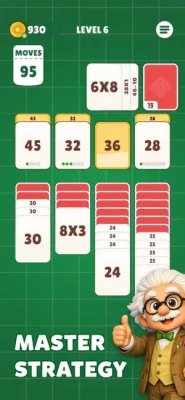
The game is designed for short sessions as well as longer puzzle runs. Its progression includes hundreds of levels, increasing mathematical difficulty, daily missions, achievements, collections, themes, and card backs.
What Makes Math Solitaire Different?
Traditional solitaire focuses heavily on suits, colors, and card order. Math Solitaire replaces much of that familiar structure with numbers, equations, calculation, and logical grouping.
That creates an unusual combination of:
- Solitaire-style card management
- Math puzzles
- Number sorting
- Memory challenges
- Logic puzzles
- Strategic decision-making
- Progressive difficulty
- Daily missions
- Achievement and collection systems
The game is particularly suited to players who enjoy casual card games but want something more mentally active than conventional solitaire.
How to Play Math Solitaire
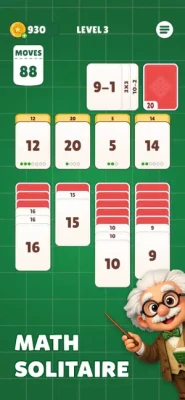
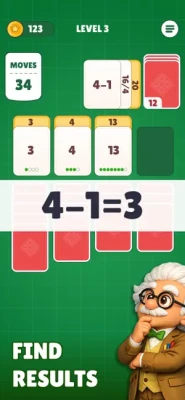
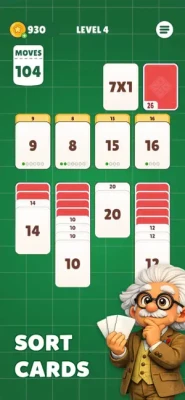
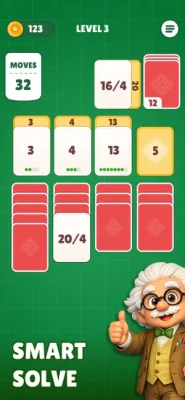
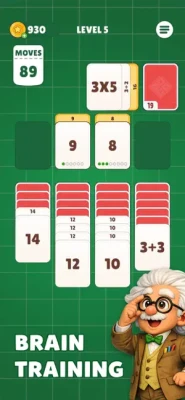
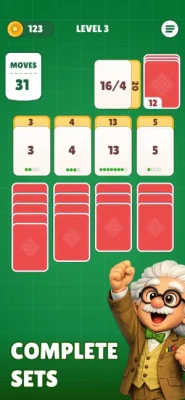
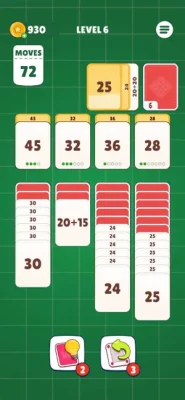
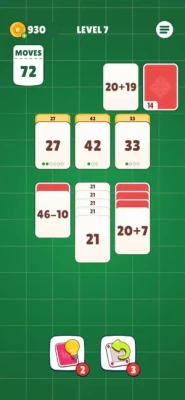
Each level gives you a collection of cards containing mathematical problems or numbers. Your objective is to analyze the cards, solve the equations, and move them into the appropriate groups.
The basic gameplay loop is:
Read the card → solve the math → identify its group → make the move → reveal new possibilities → clear the board.
The important part is that solving an individual equation is only half the challenge. You also need to decide when to move a card.
A mathematically correct move can still be strategically poor if it blocks a more useful card or wastes one of your available moves.
Core Gameplay Features
Math-Based Card Sorting
Cards contain equations and mathematical challenges rather than relying only on traditional solitaire symbols. You must determine the correct result or category before making your move.
Increasing Puzzle Difficulty
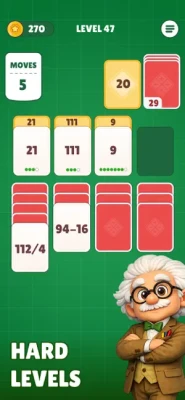
The early levels introduce the basic concept gradually, while later stages are intended to provide more complicated mathematical and logical challenges. The game describes its progression as moving toward increasingly difficult “Math Genius” levels.
Hundreds of Levels
There is a large collection of puzzles to work through, giving the game a progression-based structure rather than a collection of completely independent casual rounds.
Daily Missions
Daily objectives give you additional short-term goals beyond simply completing the next level. Completing these challenges can provide rewards and another reason to return regularly.
Collections and Customization
The game includes collectible resources, card backs, themes, and a gallery-style collection system that develops alongside your progress.
Achievements
Math Solitaire also supports Game Center achievements, allowing players to track accomplishments as they progress through the game.
Full Math Solitaire Strategy Guide
The key to progressing through Math Solitaire is not simply doing calculations quickly. Efficient card management is just as important as mathematical accuracy.
1. Read the Entire Board Before Moving
Don't immediately move the first card that appears obvious.
Take a few seconds to examine:
- Available equations
- Potential matching results
- Cards that may become useful after another move
- Cards blocking access to other cards
- The number of moves available
- Which cards appear to have multiple possible uses
A short pause at the beginning of a level can prevent several unnecessary moves later.
2. Solve Easy Equations First—but Don't Automatically Play Them
Simple calculations are useful because you can recognize their answers quickly.
However, don't assume the easiest card should always be your first move.
Ask yourself:
“What does this move unlock?”
If moving a card opens another important equation, it may be more valuable than immediately placing a different card that doesn't change the board.
3. Think Several Moves Ahead
Math Solitaire rewards players who think beyond the current card.
For example, imagine you have three possible moves:
- Move A clears one card.
- Move B reveals another useful equation.
- Move C creates a potential grouping but leaves the rest of the board unchanged.
Move B may be strategically stronger because it increases the number of options available afterward.
This is the difference between solving cards and solving the level.
4. Avoid Wasting Moves
Move efficiency becomes increasingly important as puzzles become harder.
Before moving a card, check whether the action actually improves the board.
Avoid moves that:
- Rearrange cards without creating progress
- Use a useful card too early
- Leave valuable cards inaccessible
- Break a potential sequence
- Create unnecessary extra work
A good strategy is to treat every move as a limited resource.
5. Use Mental Math Efficiently
You don't always need to calculate every equation from scratch.
Train yourself to recognize common patterns quickly.
For example:
25 + 25 = 50
8 × 5 = 40
72 ÷ 8 = 9
100 − 25 = 75
The faster you recognize familiar relationships, the more attention you can dedicate to the strategic part of the puzzle.
6. Be Careful With Negative Numbers
Negative results can be easy to overlook when you're concentrating on positive values.
When an equation involves subtraction, carefully check the direction of the operation.
For example:
5 − 12 = −7
not +7.
A single calculation error can lead you to place a card incorrectly and disrupt your planned sequence.
7. Check Your Calculation Before Committing
Speed is useful, but accuracy is more important.
Before confirming an important move, quickly perform the calculation one more time.
This is especially useful with:
- Multi-step equations
- Subtraction
- Division
- Larger numbers
- Negative results
- Equations that look visually similar
A one-second verification can save an entire failed attempt.
8. Prioritize Moves That Reveal New Information
When several moves appear equally useful, prefer the one that gives you more information about the remaining puzzle.
A card that exposes another equation or opens a new part of the board can create a chain reaction of useful moves.
Think of these cards as information cards.
They don't necessarily give you the biggest immediate reward, but they improve your future choices.
9. Don't Chase Speed
Math Solitaire is designed around logic and calculation rather than reflexes.
There is little benefit in rushing through an equation simply because you already recognize the answer.
A better rhythm is:
Observe → Calculate → Plan → Move → Reassess.
This becomes increasingly valuable on difficult levels.
How to Handle Difficult Levels
Eventually, you may reach a puzzle where the obvious moves no longer work.
Don't simply repeat the same sequence.
Instead:
Step 1: Identify the first mistake
Look at the point where your previous attempt stopped progressing.
Step 2: Find an alternative
Try changing the order of your first few moves rather than only changing the final move.
Step 3: Protect useful cards
If a card can potentially solve several future problems, don't spend it unnecessarily.
Step 4: Look for dependencies
Ask which cards need to be moved before another card becomes useful.
Step 5: Restart with a new plan
If the board becomes inefficient early, starting over with a different opening sequence may be better than trying to repair a poor position.
Daily Missions Strategy
Daily missions are useful because they provide objectives outside the normal level progression.
Instead of treating them as an afterthought, incorporate them into your normal play session.
A practical routine is:
- Check the daily objectives.
- Note which ones overlap with normal level progression.
- Complete the overlapping objectives first.
- Collect the available rewards.
- Continue your normal levels.
This minimizes unnecessary grinding.
How to Improve Your Math Puzzle Skills
Math Solitaire can also be approached as a short daily mental exercise.
Try to improve three areas:
Calculation Speed
Practice recognizing common arithmetic patterns without hesitation.
Working Memory
Remember useful results while examining several cards.
Strategic Planning
Don't focus only on the current equation. Think about what your move will create two or three turns later.
The combination of these skills is more useful than simply trying to calculate faster.
Common Mistakes to Avoid
Moving the First Obvious Card
An obvious move isn't necessarily the best move.
Ignoring the Whole Board
Looking only at the selected card can cause you to miss a much better sequence.
Calculating Too Quickly
Fast mental math is useful only when it is accurate.
Wasting Useful Cards
Some cards can become important later. Don't spend them simply because they are currently available.
Repeating the Same Failed Sequence
If an attempt fails, change the order of your early moves rather than repeating everything exactly.
Focusing Only on the Equation
Math Solitaire combines calculation with card management. Getting the answer right doesn't automatically mean you've made the best move.
Advanced Math Solitaire Tips
Create a Mental Priority List
When you first see the board, classify possible moves:
Priority 1: Moves that unlock important cards.
Priority 2: Moves that create useful combinations.
Priority 3: Simple clearing moves.
Priority 4: Moves that make little strategic difference.
This helps prevent impulsive play.
Work Backward From the Goal
If you can see which cards need to be grouped or cleared, think backward.
Ask:
Which card needs to move first for that final sequence to work?
Backward planning can reveal solutions that aren't obvious when playing only from the current position.
Keep Flexible Options Open
Don't commit your entire plan too early.
If two possible routes are available, preserve the route that gives you more future choices.
Flexibility is especially valuable when later cards depend on earlier placements.
Math Solitaire Difficulty
The game starts with accessible math and card-sorting concepts before progressing toward more demanding puzzles. The developer describes the progression as moving from easier stages toward increasingly challenging “Math Genius” levels.
The difficulty comes from two sources:
Mathematical difficulty:
The equations require more attention and calculation.
Strategic difficulty:
The correct mathematical answer isn't necessarily the best immediate move.
This combination keeps later levels from becoming simply a test of arithmetic speed.
Atmosphere and Presentation
Math Solitaire takes a calm, casual approach to brain training. The App Store description emphasizes colorful visuals, smooth animations, relaxing music, and satisfying sound effects rather than an intense competitive presentation.
That makes it suitable for short sessions during breaks, although the increasingly challenging puzzles can provide enough depth for longer play sessions.
Progression, Rewards and Collections
Progression is built around completing levels and unlocking additional challenges and resources.
The game also includes:
- Daily missions
- Achievements
- Collections
- Card backs
- Themes
- Resources
- Increasingly difficult puzzles
These systems give players goals beyond simply completing the next equation.
Is Math Solitaire Educational?
Math Solitaire is primarily presented as a casual puzzle game, but its mechanics naturally involve arithmetic, memory, attention, and logical decision-making.
The game itself describes its purpose in terms of practicing mental math, memory, focus, and rapid calculation.
It should therefore be viewed as a math-based brain puzzle game, rather than a formal educational mathematics course.
Math Solitaire Pros and Cons
Pros
- Creative combination of solitaire and mathematics
- Simple controls
- Easy concept to understand
- Progressive difficulty
- Hundreds of puzzles
- Daily missions
- Achievements
- Collections and customization
- Relaxing presentation
- Suitable for short sessions
Cons
- Later levels can become significantly more demanding
- Players who prefer traditional solitaire may need time to adjust
- Some player reviews have raised concerns about difficult levels and move limits
- Advertising and optional purchases are part of the free-to-play experience
Player feedback is generally strong on the current App Store, with the listing showing 4.8/5 from around 6,000 ratings. At the same time, some reviews specifically discuss difficult stages, move limits, advertising, and the game's progression balance, so the experience can vary by player.
Ads and In-App Purchases
Math Solitaire is free to download and contains advertising and optional in-app purchases. The App Store currently lists purchases including coin packs, a Weekly VIP option, and options related to removing advertisements.
Players who prefer completely uninterrupted puzzle sessions should take this free-to-play structure into account.
Latest Update
The App Store currently lists version 1.1.4, with the latest update described as bug fixes and performance improvements. Previous updates have also focused on performance, interface improvements, SDK updates, and compatibility.
Platforms and Requirements
Math Solitaire is available for:
- iPhone
- iPad
- iPod touch
- Apple Vision
- Mac with Apple silicon through the listed compatibility requirements
The current listing requires iOS 15.0 or later on iPhone and iPadOS 15.0 or later on iPad. The listed Mac requirement is macOS 12.0 or later with an Apple M1 chip or later.
The App Store lists the game as 4+ and identifies it as a Card game.
Math Solitaire Rating
The current US App Store listing shows:
Rating: 4.8/5
Ratings: Around 6,000
Age Rating: 4+
Category: Card
Developer: UNICO STUDIO
Frequently Asked Questions
What is Math Solitaire?
Math Solitaire is a card puzzle game that combines solitaire-style card sorting with mathematical equations, logic, memory, and strategic planning.
How do you play Math Solitaire?
Analyze the mathematical cards, solve their equations, and sort them into the appropriate groups. The challenge comes from choosing the correct sequence of moves rather than simply calculating individual answers.
Is Math Solitaire free?
Yes. The game is free to download, but the App Store listing includes advertising and optional in-app purchases.
Does Math Solitaire have many levels?
Yes. The developer describes the game as having hundreds of levels with progressively more challenging mathematical puzzles.
Does Math Solitaire have daily challenges?
Yes. Daily missions provide additional objectives and rewards alongside the main level progression.
Is Math Solitaire suitable for beginners?
Yes. The basic concept is easy to understand, while later puzzles provide progressively more demanding mathematical and strategic challenges.
Can Math Solitaire improve math skills?
The game provides repeated practice with mental calculation, number recognition, memory, and logical decision-making. It is best considered a casual math practice game rather than a formal educational course.
Does Math Solitaire support achievements?
Yes. The App Store listing confirms Game Center support and achievements.
What is the best strategy for difficult Math Solitaire levels?
Don't focus only on solving the easiest equation. Study the whole board, identify cards that unlock other possibilities, protect flexible moves, and plan several moves ahead.
Final Math Solitaire Strategy Tip
Don't play the card you can solve fastest—play the card that gives you the best next move.
Math Solitaire becomes much easier when you stop treating every equation as an isolated problem. Calculate accurately, study the board, preserve useful options, and think about how each move changes the cards that will be available afterward.
That combination of mental math + solitaire strategy + careful card management is what makes Math Solitaire different from a conventional card game.
Rate the Game
User Reviews








Popular Games



















 Android
 iOS
iOS Windows
 Xbox
Xbox