

Latest Version
October 05, 2026
Gamehouse LLC
Card
iOS
0
Report a Problem
More About :game
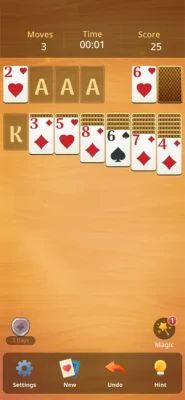
The goal is the classic one: arrange cards in descending alternating-color sequences, expose hidden cards in the tableau, and ultimately move every card into the four foundation piles in ascending suit order.
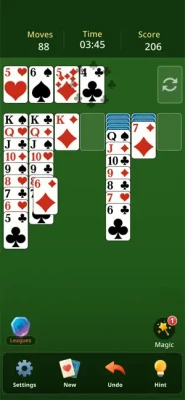
What makes this version especially approachable is its focus on relaxed play. Players have access to unlimited hints and undo, while each completed round records your time, number of moves, and score.
That combination makes the game suitable both for casual Solitaire sessions and for players who want to gradually improve their efficiency.
How to Play Solitaire Klondike Classic Fun
A Klondike game begins with seven tableau columns.
The cards are arranged so that some are face up while others remain hidden. Your objective is to uncover the hidden cards and move every card to the four foundation piles.
The basic progression is:
Reveal cards → build descending sequences → expose hidden cards → move cards to foundations → clear the tableau.
Cards placed in the tableau must normally alternate between red and black suits while descending in rank.
For example:
Black 8 → Red 7 → Black 6
The foundation piles work differently.
Each foundation starts with an Ace and progresses upward:
Ace → 2 → 3 → 4 → ... → King
The foundation is organized by suit.
Understanding the Four Main Areas
Tableau
The tableau is the main playing area.
This is where you build descending sequences and try to uncover face-down cards.
The tableau should generally be your first strategic priority because exposing hidden cards creates additional possibilities.
Foundation
The four foundation piles are where you ultimately send cards to complete the game.
Cards must be placed in ascending order and according to suit.
Moving cards to the foundation is useful, but doing it too early can sometimes remove a card you still need for tableau movement.
Stock
The stock contains cards that have not yet entered play.
When you need additional options, draw from the stock according to the game's current draw setup.
Waste
Cards drawn from the stock move through the waste area.
The visible waste card may provide an important move, so remember to check it before making unnecessary tableau changes.
Full Solitaire Klondike Strategy Guide
1. Expose Face-Down Cards First
One of your most important objectives is uncovering hidden tableau cards.
Whenever you have a choice between:
Making a move that only rearranges visible cards
Making a move that exposes a face-down card
the second option is often more valuable.
A newly exposed card can create an entirely new sequence of possibilities.
Think of hidden cards as your main source of new information.
2. Don't Automatically Move Every Ace to the Foundation
Moving an Ace to the foundation is usually safe, but the same principle doesn't always apply to higher cards.
Before moving a card upward, consider whether it could still be useful in the tableau.
For example, a low card may be needed to create an alternating-color sequence and expose another card.
The foundation should be used strategically rather than simply whenever a card is eligible.
3. Prioritize Empty Tableau Columns
An empty tableau column is extremely valuable because it can hold a King or a sequence beginning with a King.
If you have an opportunity to empty a column, consider whether doing so creates a useful new space.
An empty column can allow you to relocate a long sequence and reveal cards that were previously trapped.
However, don't empty a column merely because you can.
Ask:
What will I do with the empty space?
If there is no useful King or sequence available, the immediate benefit may be limited.
4. Move Large Sequences Carefully
Moving a long sequence can be powerful because it may expose a hidden card.
But don't move a sequence just because it is possible.
Before making the move, check:
What card will become exposed?
Where will the sequence go?
Will the destination column become more useful?
Are you blocking another important card?
Does the move create an empty column?
Good Solitaire play is often about creating future options rather than maximizing the number of moves immediately.
5. Look for Hidden Cards Before Using the Stock
When the board becomes difficult, players often immediately draw another card.
Instead, first inspect the tableau carefully.
There may already be a legal move that:
Exposes a hidden card
Creates a new sequence
Opens a column
Makes a stock card playable later
The stock should provide additional options, not replace careful board analysis.
How to Use Hints Effectively
Solitaire Klondike Classic Fun includes unlimited hints, which makes the game more forgiving for beginners.
But hints can also be used as a learning tool.
Instead of blindly following every suggestion, ask:
Why is this move useful?
If the hint moves a card to expose a hidden card, note the principle.
If it creates an empty tableau column, understand why that space matters.
If it moves a card toward the foundation, check whether doing so improves the board.
Over time, using hints this way can teach you to recognize good moves without assistance.
How to Use Undo Properly
The unlimited undo feature is particularly useful when experimenting with different strategies.
You can use it to test a move:
Make the move.
Examine what it reveals.
Decide whether the new position is better.
Undo if the move creates problems.
Try a different sequence.
This turns undo into more than a safety net.
It becomes a learning tool.
If you're trying to improve your Solitaire ability, experiment with alternative moves instead of simply undoing mistakes.
Improving Your Score
The game tracks your:
Time
Moves
Score
That gives you several ways to improve.
First Goal: Complete the Game
When learning, prioritize winning rather than speed.
Understanding the rules and board structure is more important than finishing quickly.
Second Goal: Reduce Unnecessary Moves
Once you can consistently finish games, start examining your move count.
Ask:
Did I move the same sequence multiple times?
Did I rearrange cards without revealing anything?
Did I move cards to the foundation too early?
Did I create an empty column without a plan?
Reducing these unnecessary moves will make your play more efficient.
Third Goal: Improve Your Time
Only after your decisions become reliable should you concentrate heavily on speed.
Fast play is valuable, but fast mistakes are still mistakes.
A Strong Opening Strategy
At the beginning of a Klondike round, scan all seven tableau columns.
Look for:
Moves that expose face-down cards
Opportunities to create longer sequences
Cards that can be moved between tableau columns
A possible empty column
Safe foundation moves
Stock cards that could immediately become useful
Try to maximize the amount of hidden information you reveal.
The opening is less about finishing quickly and more about creating a flexible board.
Mid-Game Strategy
The middle of the game is where many Solitaire rounds become complicated.
At this point:
Several cards may be available in the tableau
The stock may contain important cards
Some foundation piles may already be developing
One or more columns may contain long sequences
Avoid making moves simply because they are legal.
Instead, ask:
Which move gives me the most useful next move?
This single question can improve your decision-making considerably.
Endgame Strategy
When only a small number of cards remain, the objective changes.
You should have a clearer picture of where each remaining card needs to go.
At this stage:
Check the foundation piles
Look for cards that can be moved directly upward
Avoid unnecessary tableau rearrangements
Use the remaining stock carefully
Take advantage of undo if a sequence creates an unexpected blockage
The endgame is often about recognizing the shortest path to the foundations.
Common Solitaire Mistakes
Moving cards without exposing anything
A legal move isn't necessarily a useful move.
Sending cards to the foundation too quickly
Some cards can still be valuable in the tableau.
Ignoring empty columns
Empty spaces can dramatically increase your flexibility.
Drawing from the stock automatically
Always check the tableau for productive moves first.
Moving long sequences without checking the destination
The move may expose one card while creating several new problems.
Playing too quickly
Speed matters only after your decisions are reliable.
Beginner Tips
Tip 1: Reveal hidden cards
This should usually be one of your highest priorities.
Tip 2: Keep your tableau flexible
Avoid locking yourself into a position with very few legal moves.
Tip 3: Think before moving to the foundation
Ask whether the card has another useful role.
Tip 4: Create empty columns deliberately
An empty column is most valuable when you can use it effectively.
Tip 5: Use hints as lessons
Don't just copy the hint. Understand why the move works.
Tip 6: Use undo for experimentation
Try different approaches and compare the resulting boards.
Tip 7: Improve gradually
First learn to win, then improve moves, and finally improve speed.
Advanced Klondike Tips
Preserve Options
When two moves appear equally good, choose the one that leaves more possible moves afterward.
Flexibility is one of the most valuable resources in Solitaire.
Don't Reveal Everything at Once
Sometimes moving a card exposes another card but also removes an important sequence.
Think about the complete board rather than focusing only on what becomes visible.
Balance Foundation and Tableau Progress
Building foundations is necessary to win, but the tableau is where you unlock new information.
Keep both goals in balance.
Use Undo to Compare Lines
If you are unsure between two legal moves, use undo to test both.
Compare which position exposes more cards or creates more useful sequences.
Is Solitaire Klondike Classic Fun Relaxing?
Yes. The game is designed around the familiar Solitaire formula rather than a complicated progression system.
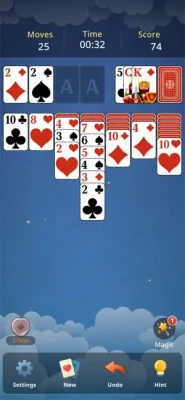
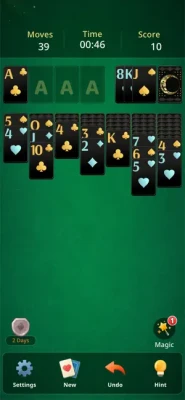
The clean interface, simple controls, unlimited hints and undo, and ability to play individual rounds make it suitable for short breaks as well as longer sessions.
The game's store description specifically positions it as both a mental exercise and a relaxing card experience.
It is therefore a good choice for players who want traditional Solitaire without needing to learn a large collection of additional mechanics.
Game Features
Classic Klondike Gameplay
The central experience remains traditional Solitaire: draw cards, build sequences, reveal the tableau, and clear the board.
Unlimited Hints
Players can request assistance whenever they become unsure about their next move.
Unlimited Undo
Mistakes don't have to end a promising round. You can reverse moves and experiment with different choices.
Time Tracking
Each round records how long you took to complete it.
Move Tracking
The game also counts your moves, giving experienced players another performance metric to improve.
Score Tracking
Your score provides another way to measure improvement across repeated games.
Clean Mobile Design
The interface is designed around straightforward card interaction rather than unnecessary complexity.
Pros and Cons
Pros
Classic Klondike Solitaire gameplay
Easy-to-understand rules
Unlimited hints
Unlimited undo
Time tracking
Move tracking
Score tracking
Clean interface
Suitable for short sessions
Relaxing gameplay
Useful for beginners and experienced Solitaire players
Available across Apple mobile platforms
Cons
Players looking for many different Solitaire variants may find the focus narrow
Advertising is part of the free experience
The GameHouse+ model may not appeal to players who prefer a one-time purchase
The game is deliberately simple, so there is less variety than in larger card-game collections
Platforms and Requirements
The current U.S. App Store listing supports iPhone and iPad.
The listed requirements are:
iPhone: iOS 15.0 or later
iPad: iPadOS 15.0 or later
Mac: macOS 12.0 or later with an Apple M1 chip or later
Apple Vision: visionOS 1.0 or later
The current App Store listing shows an app size of approximately 171.6 MB.
GameHouse+ and Pricing
Solitaire Klondike Classic Fun can be played through the GameHouse ecosystem with a free advertising-supported option.
The current listing also promotes GameHouse+ VIP, which provides ad-free access and other benefits across GameHouse+ titles.
The U.S. App Store listing currently shows:
Monthly GameHouse subscription: $9.99
Yearly GameHouse subscription: $89.99
Subscription prices can vary by country and may change over time.
Ratings and Player Feedback
The current U.S. App Store listing shows 4.6 out of 5 from 13 ratings. Because the number of ratings is still relatively small, this score should be treated as an early snapshot rather than a long-established player consensus.
Google Play currently shows the game at approximately 4.3 stars from 176 reviews, with 10K+ downloads listed.
The available external review coverage has highlighted the polished presentation and classic gameplay while also noting advertising and occasional technical issues as potential drawbacks.
Is Solitaire Klondike Classic Fun Worth Playing?
Solitaire Klondike Classic Fun is best suited to players who want a straightforward version of the card game they already know.
Its strength isn't an elaborate story or complicated progression system. Instead, it focuses on the fundamentals of Klondike Solitaire and adds useful quality-of-life features such as unlimited hints, unlimited undo, and performance tracking.
For beginners, hints and undo make learning much less frustrating.
For experienced players, the time, move, and score tracking creates a reason to replay games and gradually improve.
The best way to approach the game is to stop thinking only about the next legal move. Look for moves that expose hidden cards, create useful empty columns, and preserve future options.
Frequently Asked Questions
What type of Solitaire is Solitaire Klondike Classic Fun?
It is based on classic Klondike Solitaire, the familiar card game where players build descending alternating-color sequences and move cards to four foundation piles.
Does Solitaire Klondike Classic Fun have hints?
Yes. The game provides unlimited hints to help players identify possible moves.
Can you undo moves?
Yes. Unlimited undo is one of the game's advertised features.
Does the game track your performance?
Yes. It tracks time, moves, and score after each round.
Is Solitaire Klondike Classic Fun free?
The game is available as a free experience with advertising. GameHouse+ offers additional access and ad-free options.
Can beginners play it?
Yes. The classic rules are easy to understand, and unlimited hints and undo make the game particularly accessible to new players.
What is the best Solitaire strategy?
Prioritize moves that expose hidden cards, create useful tableau space, and preserve multiple future options instead of simply choosing the first legal move.
Should I always move cards to the foundation?
No. A card that can legally enter the foundation may still be useful in the tableau. Consider how the move affects your ability to uncover and rearrange hidden cards.
How can I improve my Solitaire score?
First focus on winning consistently. Then reduce unnecessary moves and finally work on completing games faster while maintaining good decisions.
Final Verdict
Solitaire Klondike Classic Fun keeps the focus where it belongs: classic Solitaire.
With familiar Klondike rules, unlimited hints and undo, clean controls, and tracking for time, moves, and score, it works well as both a casual relaxation game and a way to practice more efficient Solitaire play.
The most important strategy is simple:
Don't make a move just because you can. Make the move that gives you better options afterward.
If you enjoy classic card games, relaxing puzzle sessions, and the traditional Klondike experience, Solitaire Klondike Classic Fun is a solid choice for your mobile game library.
Rate the Game
User Reviews







Popular Games



















 Android
 iOS
iOS Windows
 Xbox
Xbox