
Latest Version
August 12, 2026
Wizards of the Coast
Card
iOS
0
Report a Problem
More About :game
What Is Magic: The Gathering Arena?
Magic: The Gathering Arena is the digital adaptation of the world's original trading card game.
Rather than physically shuffling cards and sitting across a table from another player, MTG Arena recreates the Magic experience digitally. You build a deck, choose your strategy, play lands, cast spells, summon creatures, activate abilities, and attempt to reduce your opponent's life total to zero.
The game retains the strategic depth that has made Magic famous while adding the convenience of digital matchmaking, automated rules enforcement, visual effects, daily rewards, and online events.
The current App Store listing categorizes the game as a strategy card game and lists Wizards of the Coast as its developer.
MTG Arena Gameplay Overview
A typical match revolves around several fundamental decisions.
You begin by drawing cards and playing lands to generate the mana required for your spells. From there, you decide when to develop your battlefield, attack, defend, remove opposing creatures, draw additional cards, or hold mana available for an opponent's move.
The game rewards careful planning rather than simply playing the strongest card available.
A successful turn may depend on what you expect your opponent to do next.
Core Gameplay Loop
- Build or select a deck.
- Enter a match.
- Draw an opening hand.
- Play lands to generate mana.
- Cast creatures and spells.
- Manage your battlefield and resources.
- React to your opponent's strategy.
- Complete objectives and earn rewards.
- Improve your collection and decks.
- Continue learning and refining your playstyle.
How Magic: The Gathering Works
Magic is built around five primary colors of mana:
- White – often associated with order, protection, teamwork, and powerful defensive strategies.
- Blue – commonly focused on knowledge, card advantage, control, and manipulating spells.
- Black – embraces sacrifice, graveyard mechanics, ambition, and removal.
- Red – emphasizes speed, direct damage, aggression, and explosive turns.
- Green – traditionally focuses on creatures, mana acceleration, strength, and natural growth.
You can build around a single color or combine multiple colors to create a more specialized strategy.
This color system is one of the foundations of Magic's enormous deck-building possibilities.
Deck Building
Deck building is arguably the heart of MTG Arena.
Your deck determines how you approach a match.
An aggressive deck may try to win quickly with efficient creatures and direct damage. A control deck may attempt to neutralize threats and win after establishing long-term card advantage. A combo deck can focus on assembling specific cards that create a powerful interaction.
There is no single correct way to build a deck.
The best choice depends on your preferred strategy, available cards, current format, and understanding of the game's mechanics.
Collecting Cards
MTG Arena includes a digital card collection that grows as you play.
Players can earn cards and rewards, unlock decks, participate in events, and expand their collection over time. The App Store description emphasizes collecting cards and building decks around individual strategies and personalities.
Building a strong collection is a long-term part of the experience.
New Player Experience
Magic can appear complicated when you first encounter it, but MTG Arena includes a tutorial system designed to introduce new players to the fundamentals.
The App Store specifically highlights tutorials that teach different playstyles and help newcomers understand how Magic works.
New players can also practice against AI opponents before moving into more competitive matches.
This makes Arena considerably more approachable than trying to learn the physical game without assistance.
Playing Against the AI
MTG Arena includes AI practice options that allow newcomers to learn the fundamentals without immediately competing against experienced players.
This is particularly useful for understanding:
- Mana management
- Combat
- Card types
- Timing
- Creature abilities
- Spell effects
- Blocking
- Attacking
- Deck strategies
Practicing against the AI can help you become comfortable with the interface before entering competitive matchmaking.
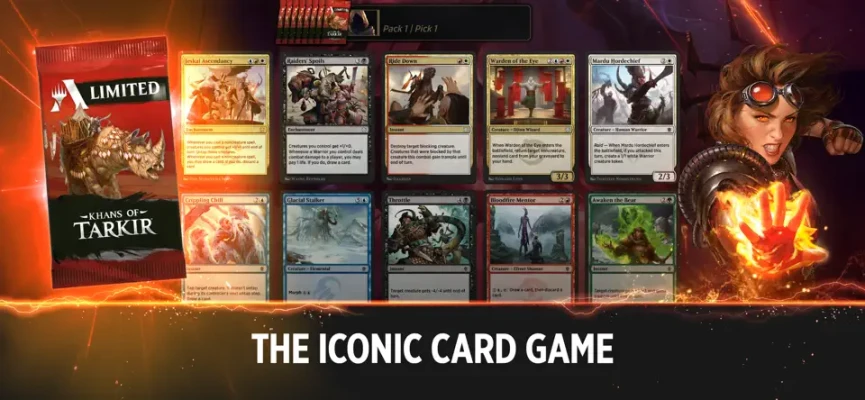
Draft Mode
Draft is one of Magic's most distinctive formats.
Instead of simply selecting a pre-built deck, players choose cards from shared packs and gradually construct a deck during the draft process.
This tests skills beyond normal deck construction.
You need to recognize strong cards, understand synergies, identify the colors that appear to be available, and construct a functional deck from a limited selection.
Draft is particularly appealing to players who enjoy adapting their strategy from one game session to another.
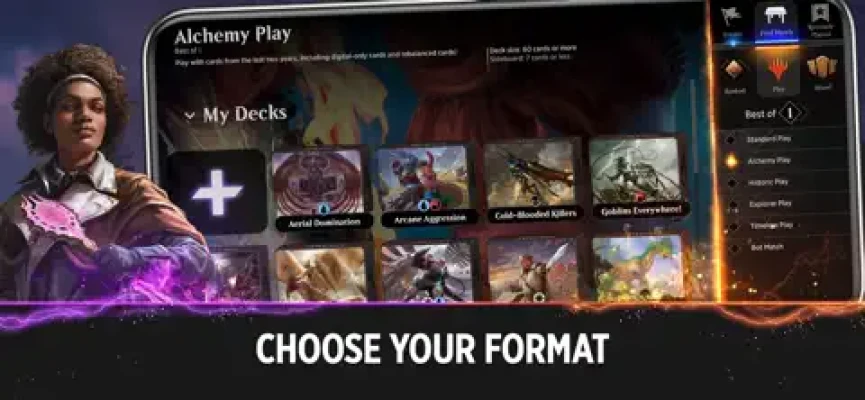
Brawl
Brawl provides another way to experience Magic through a different deck-building structure.
Instead of using the same approach as traditional constructed formats, Brawl encourages players to build around a legendary creature or planeswalker and create a deck with a distinctive identity.
For players who enjoy experimenting with unusual strategies, Brawl can provide a refreshing alternative to standard competitive play.
The current App Store listing specifically identifies Draft and Brawl among Arena's available formats.
Competitive Play
MTG Arena supports competitive progression for players who want to take their skills further.
You can start with casual matches, learn the fundamentals, and gradually move toward ranked and tournament-style play.
Competitive Magic rewards players who understand not only their own deck but also the strategies commonly used by opponents.
The App Store listing also highlights tournaments and esports qualification opportunities.
Casual Matches
Not every match has to be highly competitive.
Casual play gives you a place to experiment with new decks, practice unfamiliar strategies, or simply enjoy a few games without treating every result as a major test of skill.
This is particularly useful when trying a newly constructed deck.
Daily Rewards and Progression
MTG Arena includes daily rewards and progression systems that encourage regular play.
Daily objectives can help players expand their collections while practicing different aspects of the game.
The progression system works particularly well for players who prefer playing a little each day rather than completing long sessions.
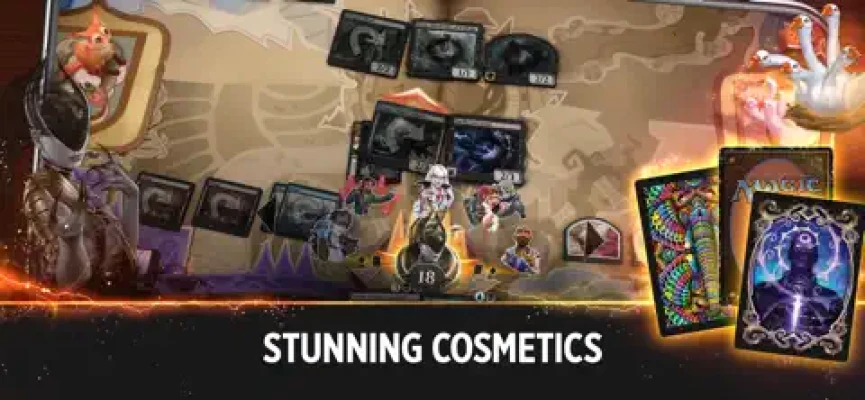
Cosmetics and Personalization
Your digital collection is not limited to playable cards.
MTG Arena also features cosmetic customization, including:
- Avatars
- Card sleeves
- Pets
- Card styles
- Other visual effects
These options allow players to give their Arena profile and battlefield a more personal identity.
Battlefields and Visual Effects
MTG Arena transforms the traditional tabletop experience into a digital battlefield.
Cards animate as spells are cast, creatures enter combat, and major effects receive visual and audio treatment.
These effects give matches more atmosphere than simply viewing static cards on a digital table.
Understanding Mana
One of the first skills every new Magic player needs to develop is mana management.
Lands generate mana, and mana determines which cards you can play.
A common beginner mistake is spending all available mana simply because it is available.
Strong players think ahead.
You may need to save mana for an instant, activation, or response to your opponent.
Understanding Card Advantage
Card advantage is another important Magic concept.
If you can consistently exchange one of your cards for multiple opposing resources, you may gain an advantage that becomes increasingly important as the game progresses.
Drawing additional cards, removing multiple threats, or forcing an opponent to discard can all influence card advantage.
Combat Strategy
Combat may look simple at first, but attacking and blocking involve substantial decision-making.
Before attacking, consider:
- What creatures can block?
- What happens if your opponent blocks?
- Can you afford to lose the attacking creature?
- Is your opponent holding a combat trick?
- Will attacking expose your defenses?
A good attack is not necessarily the one that deals the most damage immediately.
Sometimes the strongest move is to wait.
Spells and Timing
Magic includes several types of spells with different timing rules.
Learning when you can cast an instant, sorcery, creature, enchantment, artifact, or other spell is essential.
Timing can turn an ordinary card into a powerful tactical tool.
For beginners, understanding the difference between casting a spell and activating an ability is also important as you encounter more complicated decks.
Beginner's Guide to MTG Arena
Start With the Tutorial
Complete the game's introductory experience rather than skipping immediately into competitive play.
Try Several Colors
Do not decide that one color is your favorite after your first match.
Experiment with different colors and playstyles.
Learn One Deck Well
Once you find a deck you enjoy, play it repeatedly.
Understanding your deck's strengths and weaknesses is more valuable than constantly switching decks.
Watch Your Mana
Think about how much mana you will need during your opponent's turn.
Read Every Card
Magic contains thousands of cards with different abilities.
Never assume that a card works the way you expect.
Learn From Losses
When you lose, identify why.
Was your opening hand weak? Did you mismanage your mana? Did you attack too early? Did you fail to anticipate your opponent's strategy?
Every loss can teach you something.
Advanced MTG Arena Strategies
Think About Your Opponent's Hand
Try to determine which responses your opponent may have available based on their untapped mana and previous plays.
Plan Multiple Turns Ahead
Instead of asking only, “What should I play now?”, ask what your next two or three turns might look like.
Protect Key Creatures
Do not expose an important creature to unnecessary removal simply because you can attack with it.
Understand Your Deck's Win Condition
Every deck should have a reason it expects to win.
Some decks win through overwhelming creatures, others through card advantage, direct damage, combo interactions, or powerful late-game threats.
Mulligan Carefully
Your opening seven cards can determine the direction of an entire match.
Do not automatically keep a hand simply because it contains seven cards.
Learn the Meta
Competitive formats develop recognizable strategies and popular deck archetypes.
Understanding what you are likely to face can help you prepare your own deck.
Game Modes Overview
Color Challenge
An introductory mode designed to help players learn Magic's different colors and fundamental strategies.
Bot Matches
Practice against AI-controlled opponents.
Ranked Play
Compete against other players and work toward improving your ranking.
Draft
Construct a deck from cards selected during the drafting process.
Brawl
Build around a legendary centerpiece and experience a different deck-building format.
Direct Challenge
Challenge friends directly.
Special Events
Limited-time events introduce different rules, rewards, and gameplay opportunities.
MTG Arena supports a broad selection of formats and events, with availability depending on the current game schedule.
Multiplayer and Friends
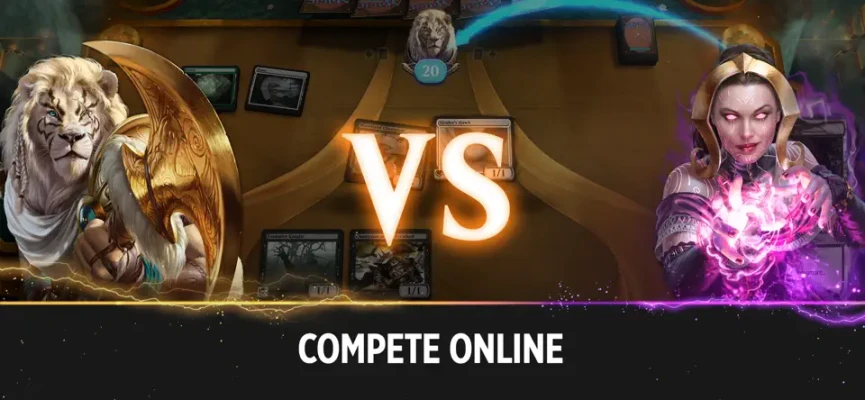
MTG Arena is designed around online play.
You can challenge friends, enter matchmaking, play against AI opponents, and participate in organized events.
Wizards confirms that the same account can be used across PC, Mac, and mobile, with the collection and progression available across supported platforms.
Cross-Platform Progression
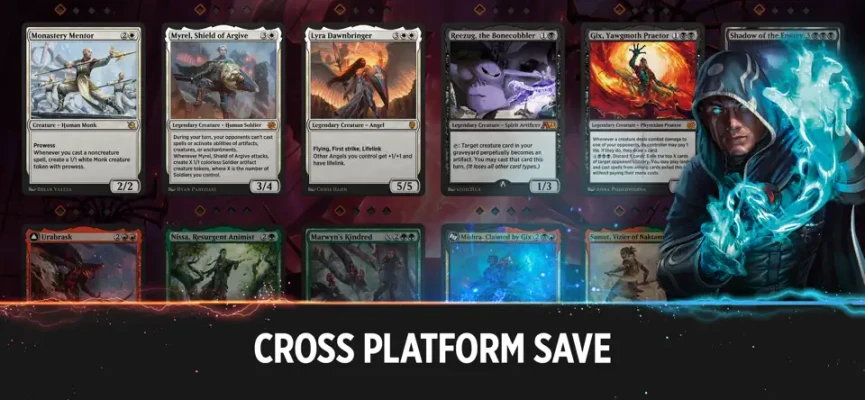
One of the most useful features of Arena is its cross-platform account system.
If you sign into your Wizards Account, your collection and progress can be accessed across supported versions of the game.
This means you can play on a computer at home and continue your Magic experience on a compatible mobile device.
MTG Arena on iPhone and iPad
The current U.S. App Store listing supports both iPhone and iPad.
It lists the app at approximately 1.3 GB, with a 13+ age rating and in-app purchases. The listing currently shows a 4.6/5 rating from around 152,000 ratings.
Wizards' current mobile requirements documentation recommends iOS 15 or later for supported mobile devices.
Mobile Performance
MTG Arena is a relatively demanding digital card game because it combines animated battlefields, card effects, online matchmaking, and a large collection of visual assets.
Wizards recommends devices with at least 4 GB of RAM for mobile and notes that supported devices can vary.
For competitive play, a stable connection and a capable device are particularly important.
Is MTG Arena Free?
Yes. The current App Store listing identifies Magic: The Gathering Arena as free to download with optional in-app purchases.
The game can be played without purchasing every card or cosmetic item, although players can use purchases to accelerate or expand their collection.
Is MTG Arena Pay to Win?
The answer is more complicated than a simple yes or no.
A larger card collection gives players more options when constructing decks, and acquiring cards can make it easier to experiment with competitive strategies.
However, owning cards does not automatically make someone a good Magic player.
Deck construction, sequencing, resource management, matchup knowledge, and decision-making remain fundamental to winning.
Does MTG Arena Require Internet?
Yes, MTG Arena is primarily an online game.
Its core experience revolves around matchmaking, account synchronization, events, collection management, and other online services.
Players should therefore expect to need a reliable internet connection for normal gameplay.
Is MTG Arena Good for Beginners?
Yes, although Magic has a significant learning curve.
The tutorial, AI practice, introductory decks, and structured progression help new players understand the basics before entering more advanced formats.
The deeper challenge begins when you start learning card interactions, deck archetypes, timing, probability, and competitive strategy.
Difficulty
Beginner: Moderate
Intermediate: High
Advanced: Very High
The basic rules can be learned relatively quickly.
Mastering Magic is another matter.
The huge card pool and enormous number of interactions mean there is almost always something new to learn.
Visual Style and Presentation
MTG Arena uses detailed fantasy artwork, animated card effects, character animations, atmospheric battlefields, and spell effects to bring Magic's Multiverse to life.
The presentation is particularly effective when powerful cards interact and the battlefield becomes filled with creatures, abilities, and visual effects.
Pros and Cons
Pros
- Authentic Magic: The Gathering experience
- Deep strategic gameplay
- Huge deck-building possibilities
- Multiple game formats
- Draft and Brawl
- AI practice
- Multiplayer matchmaking
- Cross-platform collection and progression
- Regular events
- Daily rewards
- Strong visual effects
- Extensive card collection
- iPhone and iPad support
Cons
- Steep learning curve
- Large card pool can overwhelm beginners
- Competitive deck building can require significant collection investment
- Mobile performance depends on device capability
- Matches can become lengthy
- Frequent new content means the competitive environment continually changes
Who Should Play MTG Arena?
MTG Arena is ideal for:
- Trading card game fans
- Strategy game players
- Magic veterans
- Competitive card gamers
- Deck-building enthusiasts
- Fantasy fans
- Players who enjoy tactical decision-making
- Players who want to learn Magic
- Friends who want online card battles
- Players interested in Draft and Brawl
Who Might Not Enjoy MTG Arena?
The game may not be the best fit if you prefer:
- Very simple card games
- Short matches with little strategy
- Offline-only games
- Games without collectible progression
- Minimal rules
- Completely casual gameplay
Technical Details
Game: Magic: The Gathering Arena
Developer: Wizards of the Coast
Genre: Strategy Card Game / Trading Card Game
Platforms: iPhone and iPad
Price: Free
In-App Purchases: Yes
Age Rating: 13+
Current Listed Size: Approximately 1.3 GB
Current App Store Rating: 4.6/5 from approximately 152K ratings
Languages: English plus eight additional languages
Controller: Not required
Internet: Required for the primary online experience
Recent Content and Updates
MTG Arena continues to receive new sets, events, mechanics, cosmetics, and balance or technical updates.
The current App Store version history shows releases throughout 2026, including content tied to Magic: The Gathering | Marvel Super Heroes, additional digital cards, and later themed events and cosmetics.
This ongoing content cycle is one of the reasons Arena remains a constantly changing competitive card game rather than a static digital adaptation.
MTG Arena vs Physical Magic
The physical Magic experience offers face-to-face play, physical cards, collecting, trading, and tabletop interaction.
MTG Arena offers convenience.
You can build decks digitally, find opponents quickly, practice against AI, participate in events, and maintain your collection across supported devices.
For players who already know Magic, Arena is an excellent way to play without needing a physical table and a collection of cards.
For beginners, the digital rules enforcement can also make learning easier because the game automatically handles many rules interactions.
MTG Arena vs Other Digital Card Games
MTG Arena's biggest advantage is the depth of the underlying Magic system.
Many digital card games are designed around simplified rules and shorter matches.
Magic provides substantially more freedom in deck construction, card interactions, resource management, and strategy.
That depth can be intimidating, but it is also what makes the game so rewarding for players who enjoy mastering complicated systems.
Player Experience
The first few hours can feel like an introduction to an enormous world.
You learn the five colors, experiment with decks, discover different card types, and begin understanding how combat and spells interact.
Eventually, the game changes.
You stop simply asking, “What can I play?”
You start asking:
“What will my opponent do if I play this?”
That shift is where MTG Arena becomes particularly compelling.
Frequently Asked Questions
What is MTG Arena?
MTG Arena is the digital version of Magic: The Gathering, allowing players to collect cards, build decks, and compete online.
Is Magic: The Gathering Arena free?
Yes. The iOS version is free to download with optional in-app purchases.
Is MTG Arena available on iPhone?
Yes. The current App Store listing supports iPhone and iPad.
Can I play MTG Arena on PC and mobile with the same account?
Yes. Wizards confirms cross-platform support, including access to your collection and progression when using the same Wizards Account.
Does MTG Arena have Draft?
Yes. Draft is one of the supported game formats.
Does MTG Arena have Brawl?
Yes. Brawl is available as one of Arena's game formats.
Can I play against friends?
Yes. MTG Arena supports direct challenges and multiplayer battles with friends.
Can I practice against AI?
Yes. AI matches are available and are particularly useful for learning the game.
Is MTG Arena difficult to learn?
The fundamentals are approachable because of the tutorial system, but mastering Magic can take considerable time because of the game's extensive card pool and interactions.
Does MTG Arena have daily rewards?
Yes. The game includes daily rewards and progression systems designed to help players develop their collections.
What devices support MTG Arena?
MTG Arena is available on supported iPhone and iPad devices, as well as other platforms. Wizards' mobile documentation currently recommends iOS 15 or later and at least 4 GB of RAM for mobile.
Can I play competitive Magic on mobile?
MTG Arena supports competitive modes, but Wizards specifically advises against competing in Magic esports events on a mobile device because of the possibility of gameplay or connection issues.
Final Verdict
Magic: The Gathering Arena is one of the deepest strategy card games available on mobile.
It successfully translates the enormous complexity of Magic into a digital format while providing tutorials, AI practice, deck building, Draft, Brawl, multiplayer matchmaking, events, cosmetics, and cross-platform progression.
The learning curve is real, but that is also part of the appeal. Every match can teach you something new about your deck, your opponent, or the underlying game.
For anyone interested in Magic: The Gathering on iPhone or iPad, MTG Arena is the most direct way to experience the modern digital version of the game.
Expert Rating: 9.4/10
Rate the Game
User Reviews
Popular Games
















 Android
 iOS
iOS Windows
 Xbox
Xbox