

Latest Version
October 01, 2026
Animoca Brands
Strategy
Android
0
Report a Problem
More About :game
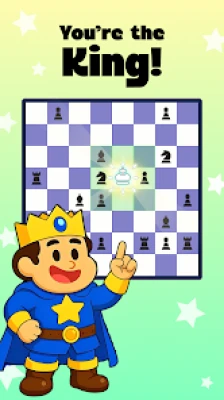
The game takes place on a familiar 8×8 chessboard, but the rules are redesigned for quick survival runs. You move the King one square at a time, capture approaching pieces, build consecutive capture chains and use special abilities to survive increasingly dangerous situations.
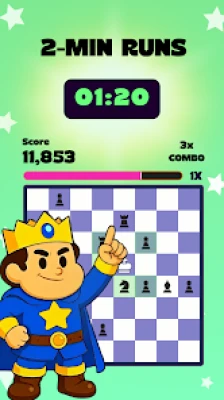
A typical run is designed to last around two minutes, making King's Gambit a good fit for short gaming sessions while still giving experienced players plenty of room to chase higher scores.
The Google Play listing currently shows the game from Animoca Brands, with in-app purchases and an Everyone content rating. It has also passed the 10K+ download milestone shown on Google Play.
What Makes King's Gambit Different?
Traditional chess is about checkmate, positional planning and long-term strategy. King's Gambit: Chess Survival turns those ideas into an arcade survival challenge.
You don't build an opening repertoire or worry about losing an ELO rating. Instead, you constantly evaluate:
Which enemy can you capture next?
Where can the King safely move?
Can you maintain the current capture chain?
Should you take a risky capture for more points?
When should you use a power-up?
Can you reach Royal Frenzy?
Can you survive long enough to reach the higher score multipliers?
The result is closer to a chess puzzle, survival game and arcade score attack combined.
How the Gameplay Works
The basic gameplay loop is easy to understand.
You control the King on an 8×8 board while enemy pieces appear around you. Your King can move one square in any of the eight directions.
Enemy pieces retain familiar chess movement patterns:
Pawns block movement and create dangerous areas.
Knights jump in an L-shaped pattern.
Bishops attack along diagonals.
Rooks move along rows and columns.
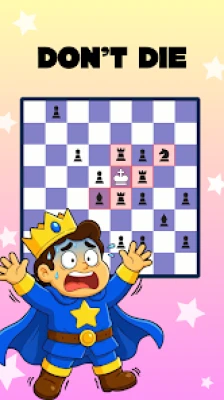
Your objective is to capture enemies before they capture your King.
The important difference from traditional chess is that the King can actually be captured. There is no conventional checkmate sequence to finish the game. If an enemy reaches your square, your run ends.
Capture Chains and Combo Strategy
Captures are the heart of King's Gambit.
When you capture one enemy and immediately continue into another capture, you build a chain. Moving onto an empty square breaks that chain.
This creates an interesting choice between survival and score.
A safe empty-square move may protect your King but destroy your multiplier. A risky capture sequence may keep your score growing while putting you closer to danger.
For high scores, learn to look several moves ahead rather than simply taking the closest available enemy.
How to Build Better Combos
Try to:
Identify several reachable enemy pieces before moving.
Look for a capture that leads naturally into another capture.
Avoid breaking a chain unnecessarily.
Keep an escape route available.
Watch Knight attacks carefully because Knights can threaten squares that other pieces cannot.
Don't sacrifice the entire run simply to preserve a multiplier.
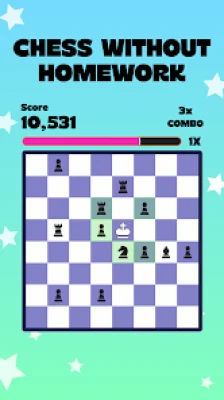
The game lists combo multipliers that can climb substantially as your chain grows, making uninterrupted captures particularly valuable.
Royal Frenzy
One of the most important mechanics is Royal Frenzy.
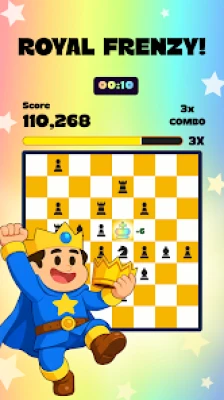
Reach a 7-chain and Royal Frenzy activates. During Frenzy, the King becomes invincible and enemy spawning stops temporarily. Each successful capture can extend the Frenzy timer.
If you maintain the sequence and clear the board during the right conditions, a Perfect Frenzy can provide an additional 2.25× multiplier to the run.
Royal Frenzy Strategy
Don't think of Royal Frenzy as merely an emergency button.
The best use is to prepare for it.
Before completing the chain that triggers Frenzy, look for:
Groups of nearby enemies
Multiple possible capture routes
Special-piece combinations
Dangerous enemies that can be removed during the invincibility period
A route that allows you to keep capturing without wasting turns
The goal is to turn the short safety window into a major scoring opportunity.
Special Piece Abilities
King's Gambit includes special effects when you capture three matching pieces in sequence.
Knight Stampede
Three Knights trigger Knight Stampede, sending Knights across the board and destroying pieces they land on.
This is particularly useful when the board contains several clustered targets.
Rook Rampage
Three Rooks activate Rook Rampage, clearing an entire row and column through the King.
This can remove dangerous lines and create breathing room.
Bishop Barrage
Three Bishops activate Bishop Barrage, clearing both diagonals through the King.
This is especially useful when diagonal threats are becoming difficult to avoid.
These special effects also provide a 2× score bonus for destroyed pieces, according to the current game description.
The Golden Crown and Queen Movement
A golden crown can appear on the board.
Collecting it temporarily gives the King Queen-like movement for 10 turns.
That dramatically changes your options because the King can move across rows, columns and diagonals rather than being restricted to one square.
The Queen movement also allows the King to jump over pieces and bypass certain pawn barriers.
Best Way to Use the Crown
Don't automatically grab the crown immediately.
First check the surrounding board.
If the normal King movement is still safe, the crown may be more valuable when the board becomes crowded. Using its mobility at the right moment can help you:
Escape a trap
Reach distant enemies
Continue a combo
Collect useful items
Cross dangerous sections
Set up a large capture sequence
Power-Ups
Several power-ups can dramatically change a run.
Teleport
Teleport lets you jump to an empty square.
Use it when normal movement would put the King in an increasingly dangerous position.
Magnet
Magnet pulls shields and loot boxes toward the King.
It is particularly useful when valuable items are positioned away from your current route.
Invincible
Invincible protects the King and freezes enemies for a limited number of turns.
This is valuable during crowded sections or when you need time to reorganize your position.
Second Chance
Second Chance can revive the King after death and keep the run going.
Treat it as a safety net rather than something to rely on from the beginning.
Shield
Shield destroys enemies in a 3×3 area around the King.
It is particularly useful when several threats are already surrounding you.
Ultra Shield
Ultra Shield provides a full-board wipe and also gives a 2× scoring bonus on destroyed pieces.
Because of its power, using it at the right scoring moment can be more valuable than activating it immediately.
Survival Mode
Survival is the main score-chasing mode.
Runs contribute to weekly, monthly and all-time global leaderboards, while replays can also be saved.
This makes Survival more than simply a way to pass time. It becomes a challenge to improve your previous score and optimize your decisions.
Survival Strategy
For your first runs, focus on staying alive.
Once you understand enemy movement, start working on:
Longer capture chains
Higher multipliers
Better Frenzy timing
Special-piece combinations
Power-up efficiency
Turn-based scoring bonuses
A high score comes from combining survival with efficient captures rather than blindly chasing every enemy.
Missions
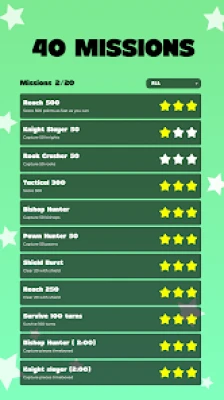
The Missions mode provides 40 challenges across seven campaigns.
Missions have free retries, personal-best tracking and star ratings, giving you a structured way to practice different parts of the game.
Use Missions to improve specific skills instead of repeatedly playing Survival without changing your approach.
For example, if you regularly lose because of poor positioning, use the challenges to practice reading the board before moving.
Practice Mode
Practice mode lets you learn the core gameplay without the same pressure associated with losing a run.
It is particularly useful for new players who understand traditional chess but are unfamiliar with the game's survival mechanics.
Practice:
Knight movement
Rook lines
Bishop diagonals
Capture chains
Safe King positioning
Power-up timing
Frenzy preparation
Once those become instinctive, Survival becomes much easier to read.
Beginner Strategy Guide
1. Learn Enemy Movement First
You don't need to memorize chess openings, but you do need to understand how each enemy attacks.
A Knight is often the most surprising threat because its L-shaped movement can reach squares that appear safe.
2. Keep an Escape Route
Before capturing an enemy, ask where your King can move if the board changes.
Don't trap yourself in a corner simply because a capture is available.
3. Don't Break Every Combo
A move onto an empty square resets the capture chain.
If you have a safe capture available, maintaining the chain can be more valuable than moving randomly.
4. Don't Chase Score Too Early
During your first few games, survival matters more than maximizing points.
Learn the board first. Optimize scoring after you understand the threats.
5. Watch the Edges
Corners and edges can become dangerous because they restrict the number of escape squares available to your King.
Move toward open territory when the board starts becoming crowded.
6. Respect Knights
Always check Knight attack positions before committing to a move.
A Knight can create a threat without occupying a nearby line like a Rook or Bishop.
7. Save Emergency Power-Ups
Teleport, Shield, Invincible and Second Chance can rescue a run.
Don't waste your strongest defensive option simply because the board looks slightly uncomfortable.
Advanced King's Gambit Strategy
Once you can consistently survive short runs, start thinking about board control.
Plan Two Captures Ahead
Don't ask only:
What can I capture now?
Ask:
What will I be able to capture after that?
The second question is what separates random movement from deliberate combo building.
Use the Board as a Resource
Open squares are valuable.
An empty area gives the King room to escape, while a crowded section can become dangerous very quickly.
Avoid voluntarily moving into positions where several enemy types attack the same area.
Prepare for Frenzy
If you're one capture away from Royal Frenzy, don't rush.
Look at the board and identify the best route for the Frenzy period.
The objective is not merely to activate Frenzy. It is to extract as many useful captures as possible while Frenzy is active.
Combine Special Effects With Scoring
Three matching pieces can trigger a powerful board-clearing effect.
When possible, plan your movement so the special ability activates when the board contains plenty of targets.
Think About Turn Multipliers
The scoring system becomes increasingly important later in a run, with a higher multiplier available after surviving beyond turn 80.
That means an advanced player should think about both:
Survival + scoring efficiency
rather than maximizing one at the expense of the other.
How to Get a Higher Score
For serious leaderboard attempts, use this basic scoring philosophy:
Safe route → capture chain → special ability → Royal Frenzy → continued captures → late-run multiplier
The official description indicates that a casual run can land around 4,000 points, while much higher scores are intended for leaderboard competition.
Don't judge a run only by its final number. Look at where your chain broke, where you wasted a power-up and where your King became trapped.
Those mistakes are usually more useful than simply replaying the same strategy.
Common Mistakes to Avoid
Moving Without Checking Threats
Every move should have a reason.
Breaking a Long Chain for a Small Escape
Sometimes survival requires it, but don't do it automatically.
Using Power-Ups Too Early
Strong power-ups can become much more valuable when the board is crowded.
Staying in a Corner
A corner can provide fewer escape options.
Ignoring Future Capture Routes
A capture that looks good now may leave you with no follow-up capture.
Chasing Every Loot Box
Resources are useful, but staying alive is the primary objective.
King's Gambit: Chess Survival Game Features
Chess-inspired survival gameplay
Familiar 8×8 board
Two-minute arcade runs
King-focused survival mechanics
Chain captures
Combo multipliers
Royal Frenzy
Perfect Frenzy
Knight Stampede
Rook Rampage
Bishop Barrage
Golden Crown
Teleport
Magnet
Invincible
Second Chance
Shield
Ultra Shield
Survival leaderboards
Missions
Practice mode
Weekly and monthly scoring
Replay support
In-app purchases
Android support
Recent Updates
The Google Play listing shows the game was updated in August 2026. The latest listed changes include a new head-to-head feature involving another King, with two-minute matches where the first player to win two rounds takes the match.
The daily claim system was also updated so players receive a loot box with improved rewards.
This indicates that King's Gambit: Chess Survival is being actively developed rather than remaining a static launch release.
Is King's Gambit Traditional Chess?
No.
Although King's Gambit uses a recognizable chessboard and familiar chess-piece movement, it is fundamentally an arcade survival game.
You don't play a normal opponent across a complete chess match. You control the King while enemy pieces continuously create survival problems.
The emphasis is on:
Fast decisions
Positioning
Capture chains
High scores
Power-ups
Survival
Arcade-style replayability
Is King's Gambit Good for Chess Beginners?
It can provide an accessible introduction to chess-piece movement because the game uses familiar Kings, Knights, Bishops, Rooks and Pawns.
However, it should not be treated as a complete replacement for learning traditional chess rules, tactics or strategy.
Its main purpose is fast survival gameplay with a chess theme rather than conventional chess competition.
Is King's Gambit Difficult?
The controls are simple, but surviving longer runs becomes increasingly demanding.
The basic rules can be understood quickly:
Move → capture → maintain the chain → avoid being captured.
The difficulty comes from combining those actions while enemy pieces fill the board and your available escape routes become more limited.
Is King's Gambit Free to Play?
The Google Play listing identifies the game as containing in-app purchases.
The developer's description also presents the game as skill-focused rather than pay-to-win, but that statement is a developer claim rather than an independent assessment.
Frequently Asked Questions
What is King's Gambit: Chess Survival?
King's Gambit: Chess Survival is a chess-inspired arcade survival game where you control the King and attempt to survive enemy chess pieces while building capture combos.
How long is a King's Gambit run?
The game is designed around approximately two-minute survival runs, although individual sessions can vary depending on gameplay and mode.
Do I play normal chess?
No. King's Gambit uses chess movement concepts but replaces traditional chess with survival and score-based arcade gameplay.
How does Royal Frenzy work?
A 7-chain activates Royal Frenzy, making the King temporarily invincible and stopping enemy spawning. Maintaining captures can extend the Frenzy timer.
What is the Golden Crown?
The Golden Crown temporarily gives the King Queen-like movement for 10 turns, greatly increasing mobility.
What are the special piece abilities?
Three consecutive Knights, Rooks or Bishops can activate Knight Stampede, Rook Rampage or Bishop Barrage respectively.
Does King's Gambit have leaderboards?
Yes. Survival scores contribute to weekly, monthly and all-time global leaderboards.
Does King's Gambit have missions?
Yes. The game currently lists 40 missions across seven campaigns, with retries, personal-best scores and star ratings.
Is there a Practice mode?
Yes. Practice mode lets players learn the core mechanics without losing lives.
Who developed King's Gambit: Chess Survival?
The Google Play listing identifies Animoca Brands as the developer.
Final Overview
King's Gambit: Chess Survival takes the familiar language of chess and turns it into a quick survival challenge. Instead of worrying about checkmate or studying opening theory, you are constantly deciding where the King should move next, which piece to capture and how long you can maintain a combo.
Its strongest gameplay ideas revolve around capture chains, Royal Frenzy, special-piece attacks, power-ups and leaderboard scoring. The short runs also make it easy to play when you only have a few minutes available.
For players who enjoy chess-inspired strategy but want something faster and more arcade-focused, King's Gambit offers a very different way to interact with the classic chessboard.
Rate the Game
User Reviews












Popular Games


















 Android
 iOS
iOS Windows
 Xbox
Xbox