

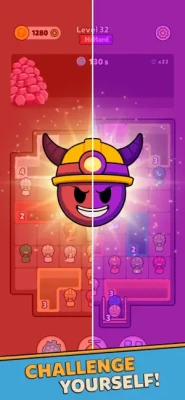

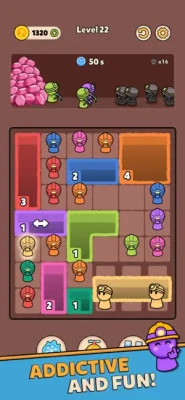
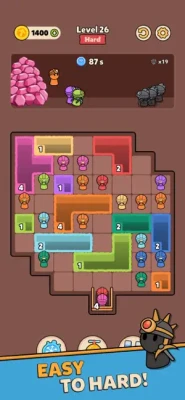
Latest Version
September 28, 2026
UNICO STUDIO
Strategy
iOS
0
Report a Problem
More About :game
When the rescue phase ends, the miners you successfully saved enter an auto-battle around the final gold pile and fight the remaining enemies. That means every decision during the puzzle phase can affect the battle that follows.
The game uses simple one-touch controls, but its puzzles become more complicated as elevators, locked holes, moving obstacles, portals, generators, bombs, ropes, scissors, and other mechanics are introduced.
How to Play Drop Miner: Color Block
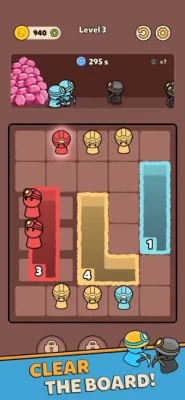
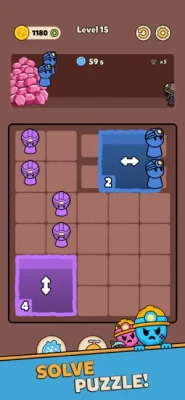
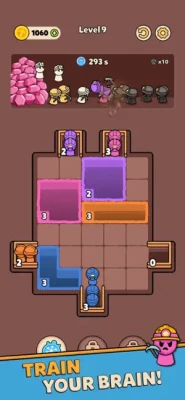
Each stage presents a group of miners, an environment filled with obstacles, approaching enemies, and a valuable gold pile that must ultimately be defended.
Your basic objectives are:
- Find safe routes for the miners.
- Rescue as many miners as possible.
- Use the environment to slow or redirect enemies.
- Work around locks, holes, elevators, ropes, and other obstacles.
- Manage the available time.
- Reach the end of the rescue phase with the strongest possible group.
- Let the rescued miners fight in the final auto-battle.
The important strategic connection is:
Better rescue decisions → more surviving miners → stronger final defense.
Main Gameplay Features
Miner Rescue
The core of every stage is getting miners to safety.
A miner that reaches the safe area becomes part of your final defensive force, so rescuing additional miners can directly improve the battle at the end.
Gold Defense
The final objective revolves around protecting the last pile of gold.
You are effectively preparing your rescued miners for a final stand against the enemy forces.
Timed Puzzle Gameplay
Time matters throughout the rescue phase.
You must balance careful planning with the need to keep the rescue moving. Waiting too long can allow enemies to advance before you've positioned your miners correctly.
Auto-Battle Finale
Once the timer runs out, the rescued miners automatically enter battle against enemies around the gold.
You don't manually control every attack in this final phase. Your main strategic decisions happen beforehand when deciding how many miners to save and how effectively to delay the enemy.
One-Touch Controls
The controls are designed to be simple, allowing the challenge to come from route planning and timing rather than complicated button combinations.
Drop Miner: Color Block Strategy
The most important concept is to stop thinking of the game as only a miner rescue puzzle.
It is actually two connected challenges:
Phase 1: Rescue and delay.
Phase 2: Defend and survive.
A move that saves one miner but allows several enemies to advance may be worse than a move that temporarily slows the enemy while creating a larger rescue opportunity.
Always consider what your current action will mean for the final battle.
Full Drop Miner: Color Block Strategy Guide
1. Study the Entire Level Before Acting
Before moving a miner, quickly identify:
- Miner locations
- Safe destinations
- Enemy routes
- Gold location
- Elevators
- Holes
- Locks
- Keys
- Moving obstacles
- Portals
- Ropes
- Bombs
- Generators
- Available boosters
The more complicated stages are designed around interactions between these elements, so rushing into the first available path can cause problems.
2. Rescue the Most Accessible Miners First
If a miner has a clear and safe route, consider rescuing that miner early.
This provides an immediate addition to your final defense and reduces the number of miners still exposed to danger.
However, don't blindly prioritize distance. A nearby miner may be more difficult to rescue safely than one slightly farther away.
3. Look for the Safest Route, Not Always the Shortest
The shortest path isn't automatically the best route.
A longer path may:
- Avoid an enemy
- Use an elevator
- Pass through a portal
- Give you time to rescue another miner
- Keep a key available
- Avoid blocking another route
Think in terms of survival efficiency, not just distance.
4. Watch Enemy Movement
Enemy waves are an important part of the puzzle.
Don't plan a route based only on where an enemy is right now.
Consider:
Where will the enemy be when my miner reaches this position?
This is particularly important when several miners are moving through the same area.
5. Use Obstacles as Defensive Tools
Obstacles are not always problems.
Some can actually help you delay enemy progress.
When you see a complicated section, ask:
Can this obstacle slow the enemy while my miners escape?
That can turn an apparently difficult level into a manageable one.
6. Protect Your Escape Routes
Don't send every miner through the same narrow route unless you know it will remain safe.
If an enemy can reach that route, several miners may become vulnerable simultaneously.
Whenever possible, maintain alternative routes.
7. Understand the Timer
You don't have unlimited time to solve the rescue section.
Avoid spending too long analyzing a simple decision.
A good approach is:
Think before the move → act confidently → reassess.
Don't repeatedly hesitate after you've already identified a safe route.
8. Rescue Quality Matters More Than Speed Alone
Finishing quickly is useful, but the final battle depends on who actually survives the rescue phase.
A fast but careless route can leave you with too few miners.
Try to maximize the number of useful survivors rather than simply reaching the end as quickly as possible.
Elevators
Elevators can change the vertical route available to miners.
Before using one, check:
- Where the miner will arrive
- Whether the destination is safe
- Whether an enemy is approaching
- Whether another miner needs the same route
An elevator can be a shortcut, but it can also place a miner directly into danger if used without checking the surrounding area.
Locked Holes and Keys
Locks and keys create simple but important dependencies.
A useful way to think about them is:
Key → unlock → new route → miner rescue
Don't use a key simply because the corresponding lock is nearby.
First determine whether opening that lock actually improves your overall route.
If one key can open access to several miners, it may have much greater strategic value.
Layered and Combined Holes
Some stages introduce more complicated hole arrangements.
These can alter how miners travel through the level and can create routes that aren't immediately obvious.
When several holes are connected or layered, trace the complete path before sending a miner into one.
Ask:
- Where does the miner emerge?
- Is the exit safe?
- Can another miner use the same route?
- Does this route help avoid enemies?
Moving Obstacles
Moving obstacles add timing to the puzzle.
Don't treat them as permanently fixed barriers.
Instead, observe their movement pattern and look for a safe opening.
Sometimes waiting for the right moment is better than forcing a miner through a dangerous position.
Portals
Portals can dramatically shorten routes.
But a portal should never be judged solely by the distance it saves.
Check the destination before using it.
A portal is useful when it places the miner somewhere that is both:
Closer to safety + less exposed to enemies.
Ropes and Scissors
Ropes can restrict movement or connect parts of the puzzle.
Scissors can change the situation by cutting ropes.
Before cutting a rope, determine what the resulting change will do.
Ask:
What becomes accessible when this rope is cut?
The best use of scissors is usually one that opens an important route or removes a major restriction.
Bombs
Bombs can alter the board and help manage obstacles or enemy positioning.
Don't activate one simply because it is available.
First consider whether its effect can:
- Open a route
- Remove a problem
- Delay enemies
- Create a safer path
- Protect several miners
A well-timed explosion can accomplish more than a rushed one.
Generators
Generators can continuously affect the level by producing additional elements.
When a generator is active, pay attention to how quickly it changes the environment.
Ignoring it can allow the board to become increasingly difficult to manage.
If possible, plan your route around the generator rather than repeatedly reacting to what it creates.
Powerful Boosters
Drop Miner includes several boosters designed to help when a level becomes difficult.
Freeze Time
The time-freezing booster temporarily stops the clock.
Use it when you need a short window to make several careful decisions without losing valuable rescue time.
It is particularly useful when:
- Multiple miners need different routes
- Moving obstacles are involved
- Several enemies are approaching
- You need to solve a complicated interaction
Propeller
The propeller can launch miners.
This can provide a fast way to move miners through a dangerous or inconvenient section.
Use it when the normal route is too slow or when the launch can place a miner safely ahead of an approaching threat.
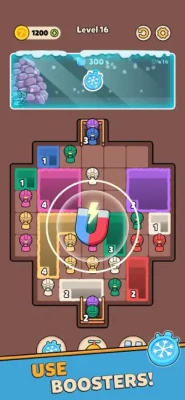
Magnet
The magnet pulls miners toward a useful position.
It can help when a miner is difficult to route manually or when you need to reposition one quickly.
Use it to correct a dangerous situation rather than wasting it on a miner that already has a perfectly safe route.
How to Prepare for the Final Auto-Battle
The rescue phase determines the strength of your final defense.
When the timer is nearly finished, don't simply focus on one last miner.
Look at the entire group.
Ask:
- How many miners have been rescued?
- Are they clustered together?
- Are any still exposed?
- How many enemies are approaching?
- Can another miner realistically be saved?
- Is using a booster worthwhile?
The final auto-battle is the payoff for the decisions made during the puzzle phase.
Final Battle Strategy
The final combat is automatic, so your main job is to prepare the strongest possible group before it begins.
Prioritize Survival
A surviving miner is more valuable than a risky rescue attempt that may fail.
Maximize the Rescue Count
When two routes are equally safe, choose the one that allows more miners to reach safety.
Delay Enemy Waves
If you can stall enemies while continuing to rescue miners, take advantage of that opportunity.
Don't Waste the Final Seconds
If there is enough time for one more realistic rescue, use it.
If the route is highly dangerous, protecting your current group may be more sensible.
How to Beat Difficult Drop Miner Levels
When a stage feels difficult, use this sequence.
Step 1: Identify Every Miner
Know where your potential rescue units are.
Step 2: Identify Enemy Routes
Determine where the enemy waves are likely to travel.
Step 3: Find the Safest Escape
Don't immediately choose the shortest route.
Step 4: Locate the Level's Key Mechanic
Look for the elevator, lock, portal, rope, bomb, generator, or other object that controls the puzzle.
Step 5: Plan the Order
Decide which miner should move first.
Step 6: Use Obstacles Against the Enemy
Whenever possible, make the environment slow or complicate enemy movement.
Step 7: Protect the Main Route
Don't accidentally close the only safe path for your remaining miners.
Step 8: Use Boosters Strategically
Freeze time, Propeller, and Magnet are most useful when they solve a genuine timing or positioning problem.
Step 9: Finish With the Strongest Group Possible
Remember that every successful rescue can matter in the final auto-battle.
Common Mistakes to Avoid
Moving Without Checking Enemy Positions
A route that looks safe can become dangerous quickly.
Always Choosing the Shortest Path
Distance isn't the only consideration.
Ignoring Secondary Miners
The final battle benefits from a larger rescued group.
Using Boosters Too Early
Save powerful tools for moments where they meaningfully improve the rescue.
Forgetting the Timer
A perfect plan is useless if it takes too long to execute.
Opening Every Mechanism Immediately
Not every lock, rope, or portal needs to be activated at once.
Ignoring the Final Battle
The rescue phase isn't the end goal. Your rescued miners must still defend the gold.
Advanced Drop Miner Tips
Think in Two Phases
Always keep the final battle in mind while solving the rescue puzzle.
Use Enemy Timing to Your Advantage
If an enemy is about to enter a narrow route, that can sometimes give you an opportunity to send a miner through another route first.
Create Delays
The game rewards clever use of obstacles and mechanisms to stall enemy progress.
Prioritize High-Value Routes
A route that rescues several miners or opens access to a major section can be more valuable than one that saves only a single miner.
Keep an Emergency Booster
Don't spend every booster immediately.
A difficult final sequence can become much easier if you still have Freeze Time, Propeller, or Magnet available.
Reassess After Every Major Action
Opening a lock or cutting a rope can completely change the level.
Stop and look at the new situation before continuing.
Difficulty and Progression
Drop Miner starts with relatively simple rescue puzzles and gradually introduces more complicated obstacles, portals, gadgets, and timing challenges.
The developer describes the game as easy to learn but hard to master, with additional mechanics appearing as progression continues.
The difficulty comes from combining:
- Path planning
- Timing
- Enemy management
- Obstacle interaction
- Miner positioning
- Resource management
- Final-battle preparation
This makes later stages substantially more strategic than the basic rescue concept suggests.
Atmosphere and Presentation
Drop Miner uses a colorful, accessible presentation built around miners, underground-style environments, obstacles, enemies, and a valuable gold pile.
The game mixes a casual puzzle feel with the tension of a defense scenario. The ticking timer adds urgency, while the automatic battle at the end gives successful puzzle solving a clear payoff.
Rather than requiring complex controls, the game places most of its depth in route planning and timing.
Is Drop Miner: Color Block a Tower Defense Game?
It has elements associated with tower defense, but its core gameplay is more accurately described as a defense puzzle combined with miner rescue and auto-battle.
You don't spend the main phase placing traditional defensive towers.
Instead, you rescue miners, manipulate the environment, delay enemy waves, and prepare your surviving miners for the final automatic fight around the gold.
Pros and Cons
Pros
- Unusual combination of puzzle and defense mechanics
- Miner rescue creates a clear objective
- Timer adds urgency
- Multiple environmental mechanisms
- Elevators and portals create route-planning challenges
- Locks and keys add puzzle dependencies
- Ropes and scissors provide interactive solutions
- Bombs and generators change the board
- Freeze Time, Propeller, and Magnet boosters
- Automatic battle provides a satisfying finale
- Simple one-touch controls
Cons
- Advertising is included
- Optional in-app purchases are available
- Some levels can become difficult when several mechanics interact
- The final battle depends heavily on decisions made during the rescue phase
- The game is still relatively new, so the App Store review sample is small
The current US App Store listing shows 5.0/5 from 7 ratings, while Google Play shows 4.8 stars from 132 reviews and 5K+ downloads.
Ratings and Player Feedback
At the time of checking, the US App Store lists 5.0 out of 5 from 7 ratings. This is a small sample, so the rating should be interpreted accordingly.
Google Play currently shows 4.8 stars from 132 reviews and 5K+ downloads.
The available store information describes the game as a strategy puzzle that combines timing, path planning, rescue, and auto-battle rather than a conventional block puzzle.
Recent Updates
The App Store version history currently lists version 0.0.23, with bug fixes and performance improvements. Earlier releases, including 0.0.22, 0.0.19, and 0.0.17, also included bug fixes and performance improvements.
The Google Play listing also describes the game as an actively maintained release and currently lists bug fixes and performance improvements in its update information.
Platform and Requirements
Developer: UNICO STUDIO
Genre: Strategy
Platforms: iPhone, iPad
Minimum iOS: iOS 15.0
Minimum iPadOS: iPadOS 15.0
Mac: macOS 12.0+ with Apple M1 chip or later
Apple Vision: visionOS 1.0+
Age Rating: 4+
App Size: Approximately 247.9 MB
Business Model: Free with advertising and in-app purchases
Languages: English plus 18 additional languages, including Arabic
The Android version is also available through Google Play.
Frequently Asked Questions
What is Drop Miner: Color Block?
Drop Miner: Color Block is a strategy puzzle game where you rescue miners, manipulate obstacles, delay enemies, protect gold, and finish each stage with an automatic battle.
How do you play Drop Miner?
Guide miners through safe routes while using environmental mechanisms to avoid or delay enemies. Your rescued miners then participate in the final auto-battle.
What happens when the timer runs out?
The rescued miners enter an auto-battle and fight enemies around the final pile of gold.
What obstacles are in Drop Miner?
The game includes elevators, locked holes, moving obstacles, layered and combined holes, locks and keys, portals, generators, bombs, ropes, and scissors.
What boosters are available?
The game includes Freeze Time, Propeller, and Magnet boosters.
What does Freeze Time do?
It gives you additional breathing room by temporarily stopping the timer, which is useful when a stage requires several carefully timed actions.
What does the Propeller do?
The Propeller launches miners, helping move them rapidly through certain situations.
What does the Magnet do?
The Magnet pulls miners toward a useful position and can help solve difficult positioning problems.
Is Drop Miner: Color Block a puzzle game?
Yes. The main rescue phase is built around path planning, timing, obstacles, and environmental puzzles, followed by an auto-battle defense phase.
Is Drop Miner a tower defense game?
It contains defense elements, but the primary gameplay is a rescue puzzle rather than traditional tower placement.
Is Drop Miner difficult?
The basic controls are simple, but later levels introduce more obstacles, gadgets, portals, and interactions that require careful planning.
Is Drop Miner: Color Block free?
Yes. The game is free to download and includes advertising and optional in-app purchases.
Is Drop Miner available on Android?
Yes. The game is available on Google Play and currently lists 5K+ downloads.
Is Drop Miner available on iPhone?
Yes. The App Store version supports iPhone and iPad and requires iOS 15 or later.
What is the best strategy for Drop Miner?
Plan around both stages of the game. Rescue as many miners as possible, use obstacles to delay enemies, preserve important routes, and save boosters for situations where timing or positioning becomes difficult.
Final Drop Miner: Color Block Strategy Tip
The key to Drop Miner is to think about the battle before it begins.
Every miner you rescue can become part of your final defense, while every second you waste gives enemies more opportunity to advance.
The strongest approach is:
Plan the route → rescue miners → delay enemies → protect your escape paths → use boosters wisely → enter the final battle with the strongest group possible.
Once you stop treating the stage as a simple path puzzle and start viewing it as preparation for the final gold defense, the game's deeper strategy becomes much easier to understand.
Rate the Game
User Reviews










Popular Games


















 Android
 iOS
iOS Windows
 Xbox
Xbox