


Latest Version
September 27, 2026
Yso Corp
Strategy
iOS
0
Report a Problem
More About :game
The game's central challenge is deciding which cards to use, when to play them, and how their effects interact.
A match consists of a series of five battles, giving each decision greater importance. A strong deck needs to do more than deal damage—it needs to defend, create useful combinations, and respond to what the opponent is doing.
What Is Throne Tactics?
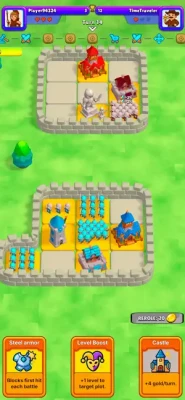
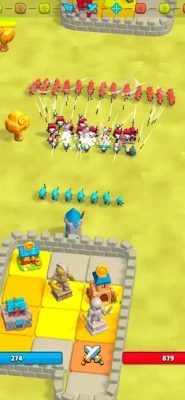
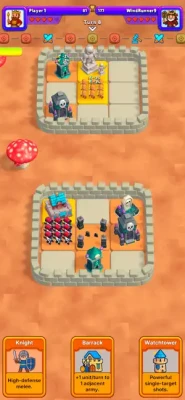
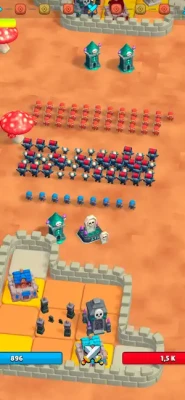
Throne Tactics combines elements of PvP card games, tactical battles, deck building, and base defense.
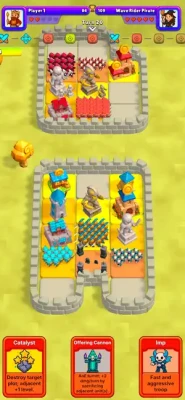
The App Store describes a card pool containing hundreds of unique cards with different effects and abilities. Players can combine troops, defensive structures, enhancements, and tactical abilities to create different approaches to combat.
The main gameplay loop is:
Build your deck → Enter battle → Adapt to the opponent → Use card combinations → Defend and attack → Complete the five-battle series
Throne Tactics Gameplay
The most important skill in Throne Tactics isn't simply collecting powerful cards. It is understanding how different cards work together.
Your deck can include several types of tools:
- Troops
- Towers
- Fortifications
- Enhancements
- Tactical abilities
- Buffs
- Trigger-based effects
This creates opportunities for different strategies. A deck focused entirely on attacking may struggle against a defensive opponent, while a deck with too much defense may have difficulty creating enough pressure.
The key is finding a combination where your cards support one another.
How to Build a Throne Tactics Deck
A good beginner deck should have a clear purpose.
Rather than selecting cards simply because they look powerful, ask what each card contributes to the overall plan.
1. Have a Reliable Offensive Option
Your deck needs a way to pressure the opponent.
Troops or offensive abilities should work together rather than functioning as completely independent cards.
2. Include Defensive Tools
Defensive structures are an important part of Throne Tactics.
Don't build a deck that assumes you will always attack first and remain in control. A defensive option gives you a way to recover when the opponent creates pressure.
3. Look for Card Interactions
The game's description specifically highlights card combos, buffs, and triggers.
This means a card can become much more valuable when paired with another card that activates or enhances its effect.
4. Avoid an Overly Complicated Deck
Having many different ideas in one deck can make it difficult to play consistently.
For beginners, concentrate on a smaller number of interactions that you understand well.
Throne Tactics Strategy Guide
1. Think Several Moves Ahead
Don't use a card simply because it is available.
Before playing it, consider:
- What will the opponent do next?
- Am I leaving myself vulnerable?
- Can this card activate another effect?
- Do I need this card later?
- Can I create a stronger combination by waiting?
A good tactical decision can be more valuable than an individually powerful card.
2. Save Important Cards for the Right Moment
Some cards are more useful as reactions than as opening plays.
If you immediately use every strong ability, you may have fewer options when the opponent changes strategy.
Keep at least some flexibility in your hand whenever possible.
3. Use Defensive Structures Intelligently
Towers and fortifications shouldn't simply be treated as extra damage sources.
Their defensive value can give you time to prepare another move, protect your position, or create an opportunity for a counterattack.
4. Look for Buff Combinations
Buffs can become especially valuable when they affect multiple parts of your strategy.
Instead of using an enhancement immediately, consider whether waiting for the right troop or combination could produce greater value.
5. Pay Attention to Triggers
Triggers can change the value of a card dramatically.
When learning a new card, don't only ask:
"What does this card do?"
Also ask:
"What causes its effect to activate?"
That second question can reveal useful combinations.
Five-Battle Strategy
Throne Tactics uses a series of five battles, so you should think beyond a single confrontation.
A strong start is useful, but preserving your ability to adapt across the series is equally important.
Early Battles
Use the opening battles to understand your opponent's approach.
Look for clues about:
- Offensive preferences
- Defensive tendencies
- Favorite card combinations
- Timing of abilities
- Reliance on particular structures
Middle Battles
Once you understand the opponent's pattern, adjust your card choices accordingly.
If they consistently attack aggressively, strengthen your defensive response.
If they rely heavily on defensive structures, look for ways to create pressure without wasting your strongest cards.
Final Battles
By the later stages of the series, avoid making unnecessary risks.
If you have established an effective strategy, there is no need to change everything simply for the sake of variety.
Card Combo Strategy
Card combinations are one of the most important strategic ideas in Throne Tactics.
A simple way to analyze your deck is to divide cards into three roles:
Setup Cards
These prepare the battlefield or establish a position.
Payoff Cards
These benefit from the setup.
Reaction Cards
These respond to the opponent's actions.
A deck that contains all three categories can be more flexible than one that depends entirely on a single type of card.
PvP Tips for Beginners
Don't Play Every Card Immediately
Having an available card does not mean you need to use it.
Watch Your Opponent
PvP strategy is partly about reading the other player.
Their previous actions can give you information about what they may try next.
Protect Your Win Condition
If your strategy depends on a particular combination, don't expose it unnecessarily.
Use Defense to Create Opportunities
Defense isn't only about surviving. A successful defensive sequence can create the opening for your next attack.
Learn From Failed Combos
If a combination repeatedly fails, don't automatically blame the individual cards.
The problem may be the timing or the card supporting them.
Factions and Arena Progression
The game's recent updates added two new factions, while later updates added faction introductions when players unlock arenas.
This indicates that faction and arena progression is an important part of the game's broader structure.
When a new faction becomes available, take time to understand its cards instead of immediately replacing your existing strategy.
A new faction may introduce different interactions that work better with a particular style of deck.
How to Improve Your Deck
When a deck isn't performing well, change one part at a time.
For example:
Problem: You cannot survive aggressive opponents.
Adjustment: Add or improve defensive options.
Problem: You survive but cannot pressure the opponent.
Adjustment: Improve your offensive card interactions.
Problem: Your strongest cards rarely work together.
Adjustment: Review the cards that trigger or enhance them.
Problem: Your deck feels inconsistent.
Adjustment: Remove cards that don't contribute to your main strategy.
This method makes it easier to identify what actually improved the deck.
Common Throne Tactics Mistakes
Using Cards Without a Plan
A powerful card used at the wrong time can have little impact.
Ignoring Defense
Even aggressive decks need a way to respond when the opponent takes control.
Chasing Every Combo
Not every possible card interaction needs to be included in your deck.
A smaller number of reliable combinations can be easier to execute.
Changing Too Many Cards at Once
If you replace half your deck after one loss, you won't know which change helped.
Make controlled adjustments.
Forgetting the Five-Battle Format
A single successful move isn't necessarily enough. Think about the entire battle series.
Advanced Throne Tactics Tips
Build for Consistency
A strategy that works occasionally isn't as useful as one that you can execute repeatedly.
Prioritize card interactions that you understand and can realistically set up.
Force Difficult Decisions
Good tactical play can put your opponent in situations where every response has a cost.
Use attacks, defensive structures, and abilities together to create these situations.
Don't Reveal Everything Early
If your opponent sees your main strategy immediately, they have more time to prepare for it.
Keep some options available until you understand their deck.
Adapt Rather Than Copy
If another player uses an effective strategy, learn the principle behind it rather than simply copying every card.
Understanding why the combination works is more valuable.
Game Features
- PvP strategy battles
- Deck building
- Hundreds of cards
- Troop cards
- Defensive structures
- Towers and fortifications
- Enhancements
- Tactical abilities
- Card combos
- Buff effects
- Trigger mechanics
- Five-battle match series
- Multiple factions
- Arena progression
- Voiced tutorial
- Card voice-overs
- Faction introductions
- In-game purchases
- Strategy-focused gameplay
The App Store currently lists version 1.6, with recent updates adding card voice-overs, a voiced tutorial, faction introductions when arenas are unlocked, and stability improvements. Earlier updates added two factions and improved visual quality.
Throne Tactics Game Information
Developer: Yso Corp
Genre: Strategy
Gameplay: PvP card strategy
Platforms: iPhone, iPad
Age Rating: 13+
Size: 380.6 MB
Languages: English plus 19 additional languages
Requires: iOS 15.0 or later
In-App Purchases: Yes
The App Store currently shows a 4.8/5 rating from 62 ratings. Available purchases include VIP Status, Remove Ads, Legendary Spell packs, Diamonds, and a Big Trophy Pack.
Throne Tactics Honest Review
Throne Tactics has a more strategic foundation than its relatively simple presentation might initially suggest. The interesting part is the interaction between troops, structures, enhancements, buffs, and triggers.
Its biggest strength as a gameplay concept is that deck construction actually matters. You aren't simply choosing the strongest individual card; you are trying to assemble cards that function well together.
The five-battle structure also gives the PvP format more room for adaptation than a single isolated fight.
There are some early technical concerns in the App Store reviews. One player reported that the game froze during the tutorial, while another recent reviewer described the game as having a decent amount of strategy for a relatively simple game. These are individual user experiences rather than independently verified technical findings.
The game's update history also shows that stability fixes have been released, including in the latest listed version.
Pros and Cons
Pros
- Card-focused tactical gameplay
- Hundreds of cards
- Multiple card categories
- Defensive structures
- Buff and trigger interactions
- Five-battle PvP format
- Multiple factions
- Arena progression
- Voiced tutorial and card voice-overs
- Regular stability and content updates
Cons
- The large card pool can be overwhelming for beginners
- Effective deck building requires experimentation
- Some players have reported tutorial/freezing issues
- In-app purchases are available
- Results can involve both tactical decisions and luck
Frequently Asked Questions
What type of game is Throne Tactics?
Throne Tactics is a PvP strategy game centered on deck management, card combinations, defensive structures, buffs, and tactical abilities.
How many battles are in a Throne Tactics match?
The App Store describes the game as a series of five battles.
Does Throne Tactics have PvP?
Yes. PvP strategy is the core format described by the game's App Store listing.
How many cards are available?
The listing describes hundreds of unique cards, with different effects and capabilities.
What types of cards can you use?
The game includes troops, defensive structures, enhancements, and tactical abilities.
Are there factions in Throne Tactics?
Yes. The game's update history specifically mentions multiple factions, including the addition of two new factions in an earlier update.
Does Throne Tactics have a tutorial?
Yes. The latest update includes a voiced tutorial.
Can you play Throne Tactics on iPhone?
Yes. The App Store lists iPhone compatibility with iOS 15.0 or later.
Is Throne Tactics free?
Yes. The game is listed as free with optional in-app purchases.
Final Thoughts
Throne Tactics is built around a simple but flexible idea: create a deck, understand how its cards interact, and adapt your strategy during a five-battle PvP series.
The most important lesson for new players is not to chase individual powerful cards. Build around reliable combinations, maintain a balance between offense and defense, and learn when to save important abilities.
As you unlock additional factions and arenas, experiment gradually and pay attention to which combinations consistently produce useful results. That approach will make the game's increasingly large card pool much easier to understand.
Rate the Game
User Reviews












Popular Games


















 Android
 iOS
iOS Windows
 Xbox
Xbox