







Latest Version
September 28, 2026
UNICO STUDIO
Strategy
iOS
0
Report a Problem
More About :game
What gives the game more depth than a simple idle clicker is the combination of hero roles and between-wave decisions. Your team can include frontline fighters, durable tanks, ranged archers and powerful wizards, while upgrade cards can change the way a run develops.
The App Store describes Miner Fighters as an idle strategy game where players build a squad, fight through endless waves, choose upgrades after each wave and progress through different maps and boss encounters.
Miner Fighters Game Information
- Game: Miner Fighters!
- Subtitle: Mine, Fight & Upgrade Heroes
- Developer: UNICO STUDIO
- Category: Strategy
- Secondary Genre: Role Playing
- Platforms: iPhone and iPad
- Price: Free with in-app purchases
- Age Rating: 4+
- Current Listed Version: 3.9.3
- Requires: iOS 15.0 or later
- Size: About 323.1 MB
- Language: English
- Game Style: Idle strategy, RPG, hero collection, wave survival
- App Store Rating: 4.7/5 from about 1.1K ratings
- In-App Purchases: Yes
What Is Miner Fighters?
Miner Fighters is an idle RPG and strategy game centered around a repeating mine, fight and upgrade progression system.
Your miners generate resources while your fighters battle incoming enemies. As you earn resources, you can recruit and improve heroes, strengthen important stats and prepare your squad for increasingly difficult waves.
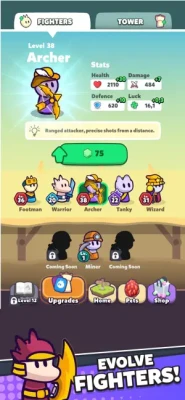
The game features several hero types, including Fighter, Warrior, Tanky, Archer and Wizard, giving players different approaches to team building. Each character can be developed through stats such as Health, Damage, Defence and Luck.
The result is a game that mixes the convenience of idle progression with the decision-making of a wave survival strategy game.
How to Play Miner Fighters
The core gameplay loop works like this:
- Mine gold and collect resources.
- Recruit additional heroes.
- Upgrade your fighters.
- Enter enemy waves.
- Survive increasingly difficult attacks.
- Choose an upgrade card after a wave.
- Use boosters when necessary.
- Defeat the boss.
- Unlock or progress through new environments.
- Repeat the process with a stronger team.
The important part is understanding that every upgrade should support the way your team actually fights.
Simply increasing everything equally isn't always the most useful approach.
Main Features of Miner Fighters
Idle Mining
Mining is the economic foundation of the game.
Gold allows you to develop your squad and continue improving your overall progression.
The mining side gives the game a resource-management layer alongside its combat mechanics.
Hero Recruitment
Miner Fighters includes several distinct hero roles:
- Fighter – aggressive frontline damage
- Warrior – balanced combat role
- Tanky – defensive character designed to absorb damage
- Archer – ranged damage dealer
- Wizard – area and burst damage specialist
These different roles make squad composition an important part of progression.
Hero Upgrades
Heroes can improve their:
- Health
- Damage
- Defence
- Luck
Upgrading these statistics helps your squad survive longer and deal with increasingly difficult waves.
Hero Evolution
The game also allows heroes to evolve, creating additional progression beyond simple stat upgrades.
Wave-Based Battles
Enemies arrive in waves, with later encounters becoming more demanding.
This gives the game a clear progression structure: survive, upgrade, prepare and push further.
Boss Battles
Bosses introduce a larger challenge with special attack patterns and mechanics.
The App Store specifically highlights massive bosses, unique attack patterns and rewards for defeating them.
Upgrade Cards
After each wave, players can choose an upgrade card.
Cards can increase damage, accelerate spawning, summon additional miners or provide special abilities.
These choices are important because they allow each run to develop differently.
Boosters
Miner Fighters includes combat boosters such as turrets and shields, along with other tools designed to help when waves become difficult.
Maps and Environments
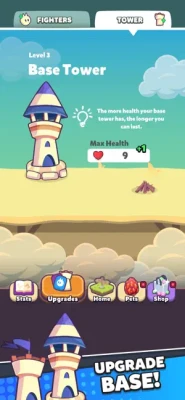
Progression takes players through different environments featuring new enemies and boss encounters.
Daily Rewards
Daily rewards, offers and treasure chests provide additional progression resources.
Miner Fighters Strategy Guide
The biggest mistake in an idle strategy game is assuming that simply upgrading everything will always produce the best result.
Miner Fighters gives you several different systems to manage, so your goal should be to build a balanced progression path.
1. Build a Balanced Squad
A strong team should not rely entirely on one type of hero.
A basic balanced structure can include:
Frontline + Damage + Ranged Support + Area Damage
For example:
- Tanky absorbs incoming damage.
- Fighter or Warrior contributes frontline damage.
- Archer attacks from range.
- Wizard handles groups and burst damage.
The exact combination will depend on your current roster and the enemies you are facing.
2. Understand Hero Roles
Don't upgrade heroes only because they have the highest visible damage number.
Think about what each hero contributes.
Fighter
Useful when you need aggressive frontline damage.
Warrior
A more balanced option that can provide reliable general-purpose combat performance.
Tanky
Important when your squad is dying before your damage dealers can finish the wave.
Archer
Provides ranged damage and can contribute without standing directly in the frontline.
Wizard
Particularly valuable against groups of enemies because of its area-focused attacks.
These roles are described directly in the current App Store listing.
3. Upgrade the Right Stat
Miner Fighters provides several upgrade categories, including Health, Damage, Defence and Luck.
Don't automatically invest everything into Damage.
If your team is already dealing enough damage but dying quickly, additional offensive power may not solve the actual problem.
Instead:
Dying too quickly → Health/Defence
Enemies survive too long → Damage
Looking for stronger overall progression → Consider Luck and broader upgrades
The best choice depends on the weakness of your current team.
4. Don't Ignore Your Frontline
Damage dealers cannot do much if they are constantly overwhelmed.
A durable frontline gives ranged heroes and wizards more time to contribute.
This is especially important during difficult waves and boss encounters.
If you repeatedly lose because your backline is being exposed too quickly, consider strengthening your defensive characters before adding more offensive upgrades.
5. Choose Upgrade Cards Strategically
The card selection after each wave is one of the game's most important decision points.
Available card effects can include:
- More damage
- Faster spawning
- Additional miners
- Special abilities
The best card isn't necessarily the one with the largest immediate numerical benefit.
Think about what your team needs right now.
Example:
If your fighters already deal strong damage but the economy is slowing your progression, an additional mining-related benefit may be more useful than another small offensive increase.
6. Build Around Synergy
Try to choose upgrades that complement your existing team.
For example:
Tank + ranged damage + area damage
can work naturally because the tank buys time while the other heroes deal damage.
Similarly, an aggressive damage-heavy build may be useful when enemies are relatively weak but less comfortable when survivability becomes the limiting factor.
7. Save Boosters for Important Waves
Turrets, shields and other boosters can provide an important advantage when a wave becomes overwhelming.
Don't necessarily activate every booster at the first sign of difficulty.
Save stronger tools for:
- Difficult waves
- Boss encounters
- Attempts where you're close to victory
- Situations where one defensive tool can prevent a complete collapse
Boss Battle Strategy
Boss fights require a different mindset from ordinary waves.
The boss may have stronger attacks or special mechanics, so simply relying on the normal wave setup may not be enough.
Before the Boss
Check:
- Team health
- Main damage output
- Frontline durability
- Available boosters
- Recent card upgrades
If you've been barely surviving normal waves, the boss is a good indication that your team needs another round of upgrades.
During the Boss
Pay attention to the boss's attack pattern.
If the boss is destroying your frontline too quickly, defensive improvements may be more valuable than another offensive upgrade.
If your team survives comfortably but the boss takes too long to defeat, focus on damage.
Miner Fighters Advanced Tips
1. Identify Your Actual Bottleneck
When you lose, ask:
What caused the defeat?
Was it:
- Not enough damage?
- Weak defense?
- Poor hero balance?
- Insufficient mining income?
- Bad card choices?
- An underdeveloped hero?
Fix the actual problem rather than upgrading randomly.
2. Don't Overinvest in One Hero
A single powerful character can be useful, but an unbalanced squad may struggle when enemies become stronger.
Try to maintain a functional team rather than putting all your resources into one unit.
3. Think About the Next Wave
Don't spend everything immediately if you know a difficult encounter is approaching.
Sometimes preserving resources for a major upgrade before a boss is more useful than making several small improvements.
4. Use Cards to Correct Weaknesses
Cards give you a chance to temporarily emphasize a particular strength.
If your squad needs more damage, choose accordingly.
If you need faster progression or additional miners, economic cards can become more useful.
How to Beat Difficult Miner Fighters Levels
When a level seems impossible, don't simply repeat the same run.
Use the failed attempt as information.
Step 1: Identify Why You Lost
Was your team overwhelmed early?
Did the boss survive too long?
Did your frontline collapse?
Step 2: Change One Major Variable
Try changing:
- Hero upgrades
- Team composition
- Card priorities
- Booster timing
Step 3: Improve Your Economy
More resources mean more opportunities to strengthen your squad.
Step 4: Try Again
Once the team is better prepared, repeat the encounter.
This approach is more efficient than making the exact same upgrades and expecting a different result.
Best Upgrade Priorities in Miner Fighters
There isn't one universal upgrade order for every stage.
Instead, use this simple rule:
If you die quickly
Prioritize Health and Defence.
If enemies survive too long
Prioritize Damage.
If your economy feels slow
Look for upgrades and cards that improve mining or resource generation.
If waves overwhelm your formation
Strengthen the frontline and consider area damage.
If bosses are the main problem
Balance survivability with concentrated damage and save useful boosters for the encounter.
Miner Fighters Beginner Guide
New players should concentrate on understanding the progression system rather than trying to optimize every number immediately.
Start by building a functional team.
Don't worry about creating a perfect endgame composition.
Upgrade consistently.
Small improvements add up over multiple waves.
Learn each hero's role.
Knowing what Tanky, Archer and Wizard contribute will make team decisions easier.
Pay attention to cards.
The post-wave card system can significantly change your run.
Save useful boosters.
Especially when you're approaching difficult waves or bosses.
Collect daily rewards.
The game includes daily rewards and treasure-based progression systems.
Miner Fighters Progression System
The game's progression can be viewed as several connected layers:
Mining → Resources → Heroes → Upgrades → Waves → Cards → Bosses → New Maps → Stronger Team
This is what makes the game feel more substantial than a basic idle miner.
Every part of the system feeds another:
- Mining supports upgrades.
- Heroes provide combat power.
- Upgrades improve survival.
- Cards modify the current run.
- Bosses test the squad.
- New maps introduce additional challenges.
Miner Fighters Atmosphere
Miner Fighters uses a colorful fantasy battle presentation built around small heroic characters, mining activity and increasingly dangerous enemies.
The visual identity shifts between the resource-gathering side of the game and its combat-focused wave battles.
The result is a lighthearted take on the idle RPG formula rather than a serious military strategy game.
The cute fighter designs have also been mentioned positively in individual App Store reviews, although those comments represent personal player impressions rather than a universal assessment.
Miner Fighters Difficulty
Miner Fighters starts with an accessible idle progression system, but the difficulty increases as enemies and bosses become stronger.
The App Store feedback includes players describing boss encounters as challenging, while another review discusses difficulty and progression balance at later stages. The developer has acknowledged feedback concerning boss difficulty and balance.
This means that getting stuck is not necessarily a sign that you need to repeat the same battle indefinitely. It can be a signal to reconsider your team, upgrades or card choices.
Miner Fighters Pros and Cons
Pros
- Combines mining and wave combat
- Idle progression
- Multiple hero roles
- Hero upgrades and evolution
- Upgrade-card system
- Boss battles
- Multiple maps
- Combat boosters
- Daily rewards
- Easy-to-understand core loop
- Free-to-play entry
Cons
- Advertising is part of the experience
- Optional purchases are available
- Some players have reported difficult boss encounters
- Some player reviews have raised concerns about progression and ad frequency
- Repeated wave combat may feel repetitive to players who prefer more active gameplay
Recent App Store reviews include reports of ad-related freezing and concerns about difficulty or progression. The developer has responded to those reports and indicated that the feedback would be considered for balancing and technical improvements. These are individual reports, not a statement that every player encounters the same issues.
Miner Fighters Reviews
The current U.S. App Store listing shows a 4.7/5 rating from approximately 1.1K ratings.
Player feedback highlights several different aspects of the experience.
Some players enjoy upgrading fighters, progressing through difficult stages and the game's character design. One reviewer specifically described the challenge of difficult bosses as part of the appeal.
Other reviews criticize repetition, progression balance and the frequency or behavior of rewarded advertisements. One player also reported an advertisement-related freeze, and the developer responded by asking the player to contact support with additional information.
These comments provide useful insight into individual experiences but should not be treated as universal results.
Miner Fighters Updates
The current App Store listing shows version 3.9.3, released August 18, with bug fixes and performance improvements. Previous versions, including 3.9.1, 3.9.0, 3.8.0 and numerous earlier releases, also included bug fixes and performance improvements.
The game's version history shows frequent maintenance and balancing-related attention since its initial release.
Is Miner Fighters an Idle Game?
Yes. Miner Fighters is explicitly described as an idle strategy game.
Its idle elements are combined with active strategic decisions involving hero upgrades, card selection, boosters and boss encounters.
Is Miner Fighters an RPG?
Miner Fighters includes RPG-style systems such as:
- Hero collection
- Character roles
- Stat upgrades
- Hero evolution
- Progressive power growth
- Multiple environments
- Boss encounters
The App Store categorizes it under Strategy, while third-party App Store analytics also classify it across Strategy and Role Playing.
Who Should Play Miner Fighters?
Miner Fighters is particularly suited to players who enjoy:
- Idle RPGs
- Idle strategy games
- Hero collection
- Wave survival
- Boss battles
- Character upgrades
- Resource management
- Auto-battle experiences
- Card-based upgrades
- Casual strategy games
It may be less suitable for players who want highly interactive real-time combat or competitive multiplayer as the central feature.
Miner Fighters FAQ
What is Miner Fighters?
Miner Fighters is an idle strategy RPG combining mining, hero recruitment, upgrades and wave-based combat.
How do you play Miner Fighters?
Mine gold, recruit and upgrade heroes, survive enemy waves, choose upgrade cards and defeat bosses to continue progressing.
What heroes are available in Miner Fighters?
The current App Store listing names Fighter, Warrior, Tanky, Archer and Wizard.
What stats can you upgrade?
The game includes Health, Damage, Defence and Luck upgrades.
Does Miner Fighters have boss battles?
Yes. Bosses have stronger attacks and special mechanics, with rewards for successful victories.
Does Miner Fighters have upgrade cards?
Yes. After each wave, players can choose upgrade cards that can affect damage, spawning, miners and special abilities.
Does Miner Fighters have different maps?
Yes. The game includes different environments with new enemies and boss encounters.
Is Miner Fighters free?
Yes. It is free to download with optional in-app purchases.
What devices support Miner Fighters?
The current App Store listing supports iPhone and iPad and requires iOS 15.0 or later.
Is Miner Fighters difficult?
The basic mechanics are accessible, but later waves and bosses can become significantly more challenging. Player reviews also mention difficulty around certain bosses and stages.
What is the best strategy in Miner Fighters?
Build a balanced team, upgrade the stats that address your current weakness, choose cards that complement your squad and save useful boosters for difficult waves and bosses.
Final Thoughts
Miner Fighters combines several familiar mobile-game systems into one progression loop: mine resources, recruit heroes, upgrade your squad, survive waves and defeat bosses.
Its strongest strategic element is the way different systems interact. Hero roles determine how your team fights, stat upgrades determine where your resources go, and post-wave cards can change the direction of a run.
The best approach is not to chase the largest number on every upgrade. Instead, identify why your team is struggling and spend resources on the weakness that is actually stopping your progression.
If your frontline collapses, improve survivability. If enemies survive too long, increase damage. If your progression is limited by resources, strengthen the economic side of the loop.
For fans of idle RPGs, hero collectors, wave survival and upgrade-focused strategy games, Miner Fighters offers a straightforward mine → fight → upgrade → progress structure with heroes, cards, boosters and boss battles layered on top.
Rate the Game
User Reviews










Popular Games

















 Android
 iOS
iOS Windows
 Xbox
Xbox