

Latest Version
September 24, 2026
Alyssa Jean Kabigting
Strategy
iOS
0
Report a Problem
More About :game
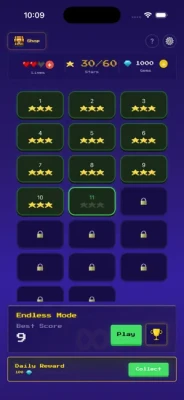
The central mechanic is easy to understand but becomes increasingly strategic: merge identical ships to double their power, position your fleet carefully, and survive increasingly difficult alien waves. The game includes 20 handcrafted campaign levels, an Endless Mode, Game Center leaderboards, five evolving alien enemy types, and three ship tiers.
What Is Pixel Grid Guardians?
Pixel Grid Guardians is a number-based tower defense game built around a simple merge mechanic.
Instead of buying conventional towers from a large defensive menu, you deploy spaceships onto a grid and combine matching ships to increase their strength.
The basic progression works like this:
Level 1 + Level 1 = Level 2
Level 2 + Level 2 = Level 4
As your ships become stronger, they deal more damage to the invading aliens.
However, stronger enemies appear as the waves progress, so simply creating one powerful ship is not always enough. Good placement, smart merging, and efficient use of the grid become increasingly important.
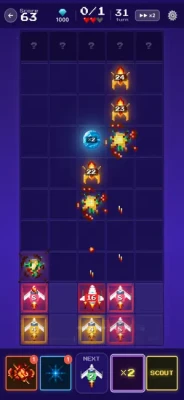
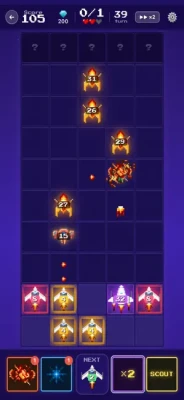
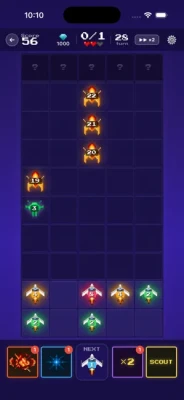
Pixel Grid Guardians Gameplay
The core gameplay loop is straightforward:
- Deploy your next spaceship.
- Place it on the defensive grid.
- Match identical ships.
- Merge them into stronger ships.
- Reposition ships when necessary.
- Let your fleet attack enemies.
- Survive the incoming waves.
- Earn stars and progress through the campaign.
Ships automatically attack aliens in their respective rows each turn, so placement is an important part of the strategy.
The challenge comes from deciding when to merge and where to position your ships.
How Number Merging Works
Number merging is the heart of Pixel Grid Guardians.
Two identical ships can be combined to produce a stronger ship.
For example:
1 + 1 → 2
2 + 2 → 4
4 + 4 → 8
The exact visual appearance also evolves as ships are merged into higher tiers, giving the battlefield a clear sense of progression. The current App Store listing describes three ship tiers.
The important point is that merging does more than increase a number.
It also changes how much defensive power you can concentrate into a limited number of grid spaces.
Best Merging Strategy
The temptation is to merge whenever two matching ships appear.
That is not always the best move.
Before merging, consider:
- Which row is currently under attack?
- Will removing one ship leave that row exposed?
- Can the merged ship cover a more useful position?
- Are additional matching ships likely to appear?
- Is the enemy wave about to become more difficult?
A good merge should solve a problem or create a meaningful advantage.
When to Merge Immediately
Merge quickly when:
- A dangerous enemy is approaching.
- Your current damage is not sufficient.
- Two weak ships are occupying valuable spaces.
- The stronger ship can immediately attack an important target.
- You need to free a grid position.
The goal is to convert two weak defenses into one stronger defense at the moment it matters.
When to Keep Ships Separate
There are also situations where two individual ships are more useful than one stronger ship.
For example, imagine two separate rows are both under pressure.
Merging the ships could give you greater damage in one row while completely removing your defense from another.
In that situation, keeping both ships may be the safer choice.
Always consider coverage before raw power.
Ship Placement Strategy
Pixel Grid Guardians is a grid-based defense game, so placement matters.
The App Store description states that ships automatically fire at aliens in their row each turn.
That means every ship should be placed with its firing lane in mind.
Before deploying a ship, ask:
Which row will it defend?
Which enemies will enter that row?
Will another ship already cover that lane?
Can this position create a future merge?
This simple checklist can dramatically improve your defensive efficiency.
Avoid Overloading One Row
A common beginner mistake is putting several strong ships into the same row.
This may produce impressive damage numbers, but it can leave another row vulnerable.
Instead, try to maintain useful coverage across the battlefield.
Concentrate power when a dangerous enemy requires it, but avoid creating unnecessary defensive gaps.
Repositioning Ships
The game allows players to drag ships to reposition or swap them for better grid strategy.
Repositioning is especially useful when:
- A powerful ship is in the wrong row.
- A dangerous alien is approaching another lane.
- Two matching ships need to be brought together.
- One row has become over-defended.
- You want to prepare a future merge.
Don't think of repositioning as a last resort.
It is part of your normal tactical toolkit.
How to Handle Alien Waves
Pixel Grid Guardians features five evolving alien enemy types, with enemies becoming more threatening as their power increases.
When a new enemy type appears, don't simply react by increasing your strongest ship.
First determine:
- How quickly does it advance?
- How much damage can it absorb?
- Which row does it threaten?
- Does it require concentrated fire?
- Can weaker enemies be left to your existing defenses?
This helps you decide whether you need a new merge or simply better positioning.
Priority Target Strategy
Not every enemy deserves the same attention.
When multiple aliens are approaching, prioritize the enemy that creates the greatest immediate danger.
A useful order is:
- Enemy closest to breaching the defense.
- High-power enemy that your current ship cannot easily stop.
- Fast-moving threat.
- Normal enemies that can be handled by existing defenses.
This prevents you from wasting your strongest firepower on enemies that were already under control.
Campaign Mode
Pixel Grid Guardians contains 20 handcrafted campaign levels with increasing difficulty.
Campaign Mode is the ideal place to learn the game's core mechanics.
Use early levels to experiment with:
- Ship placement
- Number merging
- Repositioning
- Defensive coverage
- Wave management
- Star requirements
Do not rush through the campaign simply to unlock later stages.
Each level can teach you something that becomes useful when enemy strength increases.
How to Earn More Stars
The game allows players to earn up to three stars per level.
If you're trying to improve your campaign results, focus on consistency rather than simply surviving.
A strong approach is:
- Avoid unnecessary merges.
- Keep all important rows protected.
- Build power before the most dangerous waves.
- Reposition ships when coverage changes.
- Don't allow one defensive lane to collapse.
- Use the smallest number of moves necessary to maintain control.
Replay earlier levels to test different formations rather than assuming the first successful strategy is optimal.
Endless Mode Strategy
Endless Mode changes the objective from simply completing a handcrafted level to surviving for as long as possible and achieving a high score.
This requires a different approach.
In Campaign Mode, you can optimize for a particular level.
In Endless Mode, you need a defense that remains effective as the enemy pressure continues increasing.
Endless Mode Tips
1. Don't Sacrifice Your Entire Grid for One Wave
A temporary solution can create a larger problem later.
2. Maintain Multiple Strong Rows
Avoid relying completely on one super-powerful ship.
3. Merge With the Future in Mind
Think about the next few deployments, not just the current one.
4. Keep Space Available
A completely crowded grid can make future merges difficult.
5. Reposition Before It Becomes an Emergency
Small adjustments are easier than trying to rebuild your entire formation.
6. Watch the Score
Endless Mode is also a high-score challenge, with Game Center leaderboards available for competition.
High-Score Strategy
If your goal is to climb the Game Center leaderboard, surviving longer is only part of the challenge.
Efficiency becomes important.
Try to:
- Merge efficiently.
- Avoid wasted spaces.
- Maintain consistent damage.
- Prevent defensive collapses.
- Build stronger ships before the most difficult waves.
- Avoid unnecessary repositioning.
- Keep your formation balanced.
A high score is usually the result of many efficient decisions rather than one spectacular merge.
Three Ship Tiers
The game features three visually evolving ship tiers.
The tier system provides an easy visual indication of progression.
As you merge ships into stronger forms, your fleet becomes more powerful while the alien threat also increases.
Don't focus exclusively on reaching the highest visual tier.
A lower-tier ship in the correct row can still be more useful than a high-tier ship placed where it cannot contribute effectively.
Five Alien Enemy Types
The current App Store description identifies five evolving alien enemy types.
The enemies become increasingly dangerous as their power rises.
This means the strategy that works during the first few waves may not remain effective later.
When enemy strength increases, reassess:
- Ship power
- Row coverage
- Merge frequency
- Formation balance
- Target priority
The goal is to adapt before the aliens overwhelm your grid.
Beginner Tips
Tip 1: Don't merge automatically
A merge should have a strategic reason.
Tip 2: Watch every row
A powerful ship cannot protect a lane it isn't attacking.
Tip 3: Keep some space open
You need room for future ships and repositioning.
Tip 4: Think about the next deployment
The ship you receive next can affect your current decision.
Tip 5: Build before the difficult wave
Don't wait until enemies are already at the defensive line.
Tip 6: Reposition intelligently
Move ships toward the rows that actually need them.
Tip 7: Don't overbuild one lane
Balanced coverage can be more valuable than concentrated power.
Tip 8: Use campaign levels as practice
Experiment before focusing heavily on Endless Mode.
Tip 9: Replay difficult levels
A different formation can produce a much better result.
Tip 10: Protect your strongest ships
A high-level ship is a major investment in your defensive grid.
Advanced Strategy: Plan Your Merges
Experienced players should stop thinking about merging as a reaction.
Instead, plan a sequence.
For example:
Step 1: Place a Level 1 ship.
Step 2: Position the next matching ship nearby.
Step 3: Keep both contributing to defense.
Step 4: Merge when enemy pressure increases.
Step 5: Reposition the upgraded ship.
Step 6: Prepare the next merge.
This creates a continuous upgrade cycle rather than a series of random combinations.
Advanced Strategy: Protect Future Space
One of the most overlooked resources in a merge game is empty space.
An empty grid position gives you options.
It allows you to:
- Deploy a new ship.
- Move an existing ship.
- Create a merge.
- Respond to a new enemy.
- Rearrange your formation.
Therefore, don't consider empty cells wasted.
Sometimes an empty cell is exactly what allows you to survive a difficult wave later.
Advanced Strategy: Strong Does Not Mean Useful
A common mistake is assuming that the ship with the largest number should always receive priority.
Instead, evaluate:
Power × Position × Coverage
A very powerful ship in a useless row can contribute less than a medium-strength ship positioned directly against an incoming threat.
Always evaluate the complete battlefield.
Advanced Strategy: Prepare for Enemy Scaling
The App Store listing states that alien enemies grow more menacing as their power increases.
Therefore, don't wait for the enemy to become overwhelming before upgrading.
If your current defense barely survives a wave, the next wave may expose the weakness.
Use successful waves to prepare for future difficulty.
Pixel Grid Guardians Offline Play
One useful feature is that Pixel Grid Guardians can be played offline.
The App Store description explicitly states that no internet connection is required.
This makes the game suitable for short sessions when you don't have a reliable connection.
The Game Center leaderboard functionality naturally depends on Apple's online services for synchronization and competition, but the core game itself is advertised as playable offline.
Pixel Grid Guardians Visual Style
The current version was completely rebranded from Hold the Line into Pixel Grid Guardians and received a full retro pixel-space makeover.
The redesign includes:
- Pixel-art spaceships
- Pixel-art alien enemies
- Projectile animations
- Explosion effects
- Ice particle effects
- Pixel-art boosters
- Pixel-art stars, gems, and hearts
- Dark space-themed backgrounds
- CRT scanline effects
- Retro pixel typography
The result is a deliberately arcade-inspired presentation rather than a realistic science-fiction visual style.
Pixel Grid Guardians Version History
The App Store currently lists Version 2.0.0 as a major rebrand and visual overhaul. It changed the game's presentation from the former Hold the Line identity to Pixel Grid Guardians and introduced the pixel-space theme, ships, aliens, new shop categories, boosters, and other interface changes.
Version 1.1.0 also revamped Endless Mode, making one breach result in game over, adding score-based leaderboards, improving difficulty scaling and enemy variety, and increasing the daily reward to 100 gems.
This is important when creating gameplay content because older videos or screenshots may still show the previous visual identity.
Boosters and Rewards
The current game includes boosters, gems, lives, stars, and hearts as part of its progression and shop systems. The Version 2.0.0 update introduced a tabbed shop covering Gems, Boosters, and Lives, as well as booster-pack purchases.
Use boosters strategically rather than treating them as automatic solutions.
Save powerful resources for situations where they can prevent a defensive collapse or help you achieve an important campaign result.
Game Center Leaderboards
Pixel Grid Guardians supports Game Center leaderboards, allowing players to compete for high scores.
For leaderboard play, focus on:
- Longer survival
- Efficient merges
- Strong row coverage
- Minimal wasted movement
- Consistent damage
- Early preparation for stronger enemies
The difference between a good run and an excellent run can come from many small efficiency improvements.
Honest Gameplay Assessment
Pixel Grid Guardians has a straightforward premise but combines several mechanics that work naturally together.
The number-merging system gives you a reason to reorganize the grid, while tower-defense mechanics make positioning important. The retro pixel presentation adds a clear arcade identity.
The current version is also substantially different from the game's original identity because of the complete rebrand from Hold the Line.
The game is particularly suited to players who enjoy:
- Merge games
- Number puzzles
- Tower defense
- Pixel-art games
- Casual strategy
- Offline games
- High-score challenges
The current U.S. App Store listing shows 5.0/5 from 4 ratings, but that is a very small sample, so it should not be treated as representative of a large player population.
Pros and Cons
Pros
- Simple number-merging mechanic
- Tower-defense strategy
- Retro pixel-art presentation
- 20 handcrafted campaign levels
- Endless Mode
- Five alien enemy types
- Three evolving ship tiers
- Game Center leaderboards
- Offline gameplay
- Repositioning and merging create tactical decisions
- Regular updates and visual improvements
Cons
- The current public rating is based on a very small number of reviews
- The game has a relatively simple core gameplay loop
- Players looking for complex traditional tower-defense systems may want deeper mechanics
- Advertising is included
- Optional in-app purchases are available
- Older gameplay videos may show the previous Hold the Line presentation
Pixel Grid Guardians Game Information
Game: Pixel Grid Guardians
Subtitle: A Number Defense Strategy
Former Name: Hold the Line
Developer: Alyssa Jean Kabigting
Seller: Alyssa Jean Kabigting
Genre: Strategy
Platform: iPhone and iPad
Also listed for: Apple Vision and compatible Apple Silicon Mac configurations
Age Rating: 4+
Price: Free
In-App Purchases: Yes
Size: 22.9 MB
Required iOS: iOS 15.0 or later
Language: English
Game Center: Yes
Offline Play: Yes
Campaign: 20 handcrafted levels
Endless Mode: Yes
Alien Types: 5
Ship Tiers: 3
Current listed version: 2.0.0
Frequently Asked Questions
What is Pixel Grid Guardians?
Pixel Grid Guardians is a retro pixel-art number defense game combining tower defense with a merge mechanic. Players deploy spaceships, merge matching ships, and defend against alien waves.
How does merging work?
Two identical ships can be merged to create a stronger ship. For example, two Level 1 ships become a Level 2 ship, while two Level 2 ships become a Level 4 ship.
Is Pixel Grid Guardians a tower defense game?
Yes. It combines number merging with grid-based tower defense mechanics.
How many campaign levels are there?
The current App Store listing describes 20 handcrafted campaign levels with increasing difficulty.
Does Pixel Grid Guardians have Endless Mode?
Yes. Endless Mode challenges players to survive increasingly difficult waves and compete for high scores.
Can Pixel Grid Guardians be played offline?
Yes. The App Store description states that the game does not require an internet connection for gameplay.
Does Pixel Grid Guardians have leaderboards?
Yes. Game Center leaderboards allow players to compete for high scores.
How many alien types are in the game?
The current listing identifies five evolving alien enemy types.
How many ship tiers are there?
The current game includes three visually evolving ship tiers.
What happened to Hold the Line?
The game was completely rebranded from Hold the Line to Pixel Grid Guardians in Version 2.0.0, including a new retro pixel-space visual identity and redesigned gameplay presentation.
Is Pixel Grid Guardians free?
Yes. The App Store lists the game as free with optional in-app purchases.
Final Pixel Grid Guardians Strategy Checklist
Before each wave, ask:
Where should my next ship go?
Can I create a useful merge?
Which row needs more firepower?
Should I keep two ships separate?
Do I have enough empty space for the next deployment?
Which alien is the biggest threat?
Can repositioning improve my coverage?
Am I preparing for the next wave or only reacting to the current one?
The most important rule is simple:
Merge for power, but position for survival.
A high-level ship is valuable, but a balanced formation can be even more important. Use number merging to concentrate power when necessary, maintain coverage across vulnerable rows, preserve useful grid space, and plan your next move before the aliens become a problem.
For Endless Mode, focus on efficiency and consistency. For Campaign Mode, experiment with different formations and merge timings until you can consistently complete levels while working toward three-star results.
Pixel Grid Guardians rewards players who treat every ship placement as part of a larger plan rather than simply merging whenever matching numbers appear.
Rate the Game
User Reviews










Popular Games


















 Android
 iOS
iOS Windows
 Xbox
Xbox