
Latest Version
September 24, 2026
Alyssa Jean Kabigting
Strategy
iOS
0
Report a Problem
More About :game
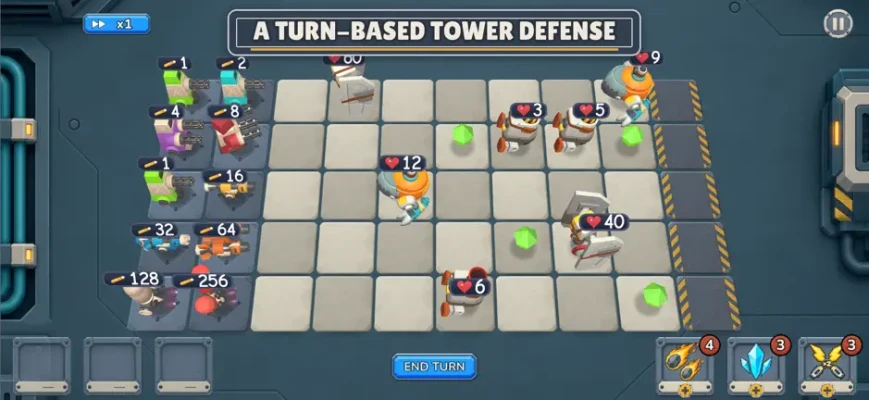
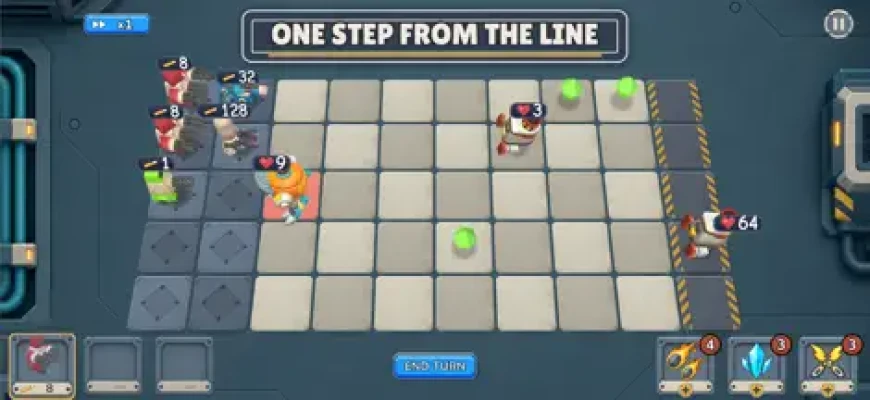
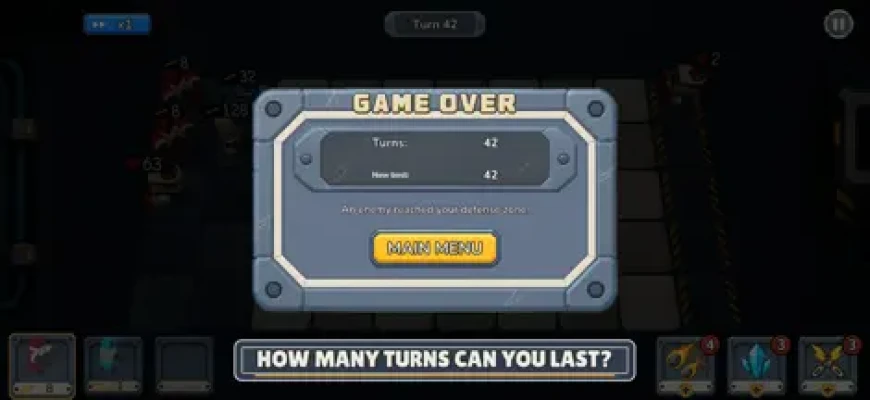
Enemies advance across the board one cell at a time while your turrets fire down their rows. You can tap a turret to see its available movement and placement options, then move, merge, or trade positions depending on the situation.
The result is a slower, more deliberate style of tower defense where positioning, merging, power management, and timing are more important than quick reactions.
What Is Grid Guardians?
Grid Guardians is a casual strategy game built around a grid-based tower defense system.
The game's central mechanics are:
- Turn-based tower defense
- Grid positioning
- Tower merging
- Turret power levels
- Enemy movement
- Strategic placement
- Power cores
- Tactical repositioning
- Campaign progression
- Endless survival
- Boosters and abilities
The current version is designed around a simple philosophy:
Think first. Move second. End the turn when you're ready.
Unlike fast-paced tower defense games where enemies are constantly advancing in real time, Grid Guardians gives you time to examine the board and decide what action makes the most sense.
How Grid Guardians Works
Each turn gives you an opportunity to manipulate your defensive grid.
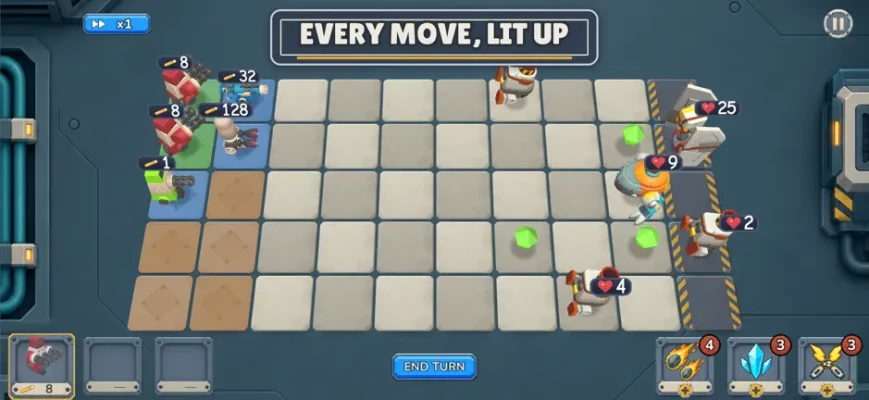
You can select a turret and see the cells available to it. The game uses different visual indicators to show what actions are possible.
According to the current App Store description:
- Amber indicates cells where a turret can be placed or moved.
- Green indicates a possible merge.
- Blue indicates a possible trade of positions.
After arranging your defenses, you can use the END TURN button.
When the turn ends:
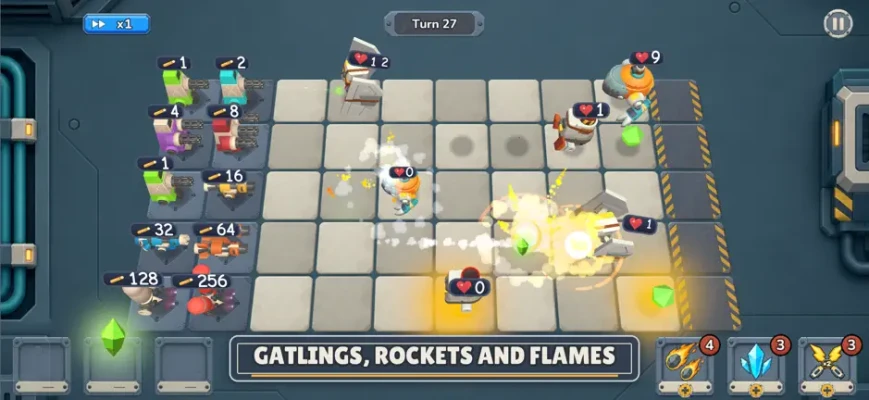
- Your turrets fire.
- Enemies advance.
- The next tactical situation begins.
This creates a chess-like rhythm where every move should have a purpose.
Grid Guardians Tower Placement Strategy
Tower placement is arguably the most important part of Grid Guardians.
A strong turret in the wrong position can be less useful than a weaker turret placed where it has better coverage.
Because turrets fire down their rows, you should always consider the relationship between:
Turret → Row → Enemy path
Before moving a turret, ask:
- Which enemies will enter its firing row?
- How soon will they reach that row?
- Can another turret cover the same area?
- Can this position create a useful merge later?
- Will moving this turret expose another part of the board?
This turns every placement into a small tactical puzzle.
How to Use the Grid Efficiently
Do not treat every empty cell as equally valuable.
Some positions give your turrets better opportunities to attack incoming enemies.
Other cells may be more valuable because they allow future merges or create flexible movement options.
A useful principle is:
Don't fill the board just because you can.
Leave yourself room to maneuver.
A crowded board can make it harder to reposition towers or create the merges you need.
Tower Merging Explained
Merging is one of the defining mechanics of Grid Guardians.
The basic idea is to combine towers to create stronger defenses.
The current game description specifically highlights “Merge to Power Up”, with two towers combining into something stronger. Power cores also drift across the board and can be broken to earn new turrets.
This creates an important decision:
Should you merge now or keep two separate turrets?
The answer depends on the battlefield.
When You Should Merge Towers
Merging is usually valuable when:
- A stronger turret is needed to stop a dangerous enemy.
- Two weaker turrets have overlapping coverage.
- One position is much more useful than two weaker positions.
- You need to increase turret power.
- The board is becoming crowded.
However, merging should not become automatic.
Two separate towers can sometimes cover different rows or provide more total coverage than one upgraded tower.
Before merging, examine the entire board.
When You Should NOT Merge
Avoid merging immediately when the two towers currently serve different defensive purposes.
For example, imagine:
- Tower A protects the left side.
- Tower B protects the right side.
Merging them could produce a stronger turret but leave one side exposed.
In that situation, keeping both towers may be more useful.
The strongest merge is not necessarily the biggest numerical upgrade.
It is the merge that improves your overall defensive position.
Power Management
The latest version displays each turret's power directly above it, making it easier to compare defensive strength at a glance.
Use these power values to determine which towers deserve attention.
When several towers are available, consider:
- Which turret has the highest power?
- Which turret is currently underperforming?
- Which enemy requires more damage?
- Can two weaker towers combine into a meaningful upgrade?
- Would moving a stronger tower provide better coverage?
Don't focus exclusively on creating the highest possible turret.
Your goal is to create a stable defensive network.
Power Cores
Power cores are another important part of the current gameplay loop.
The game allows players to break power cores drifting across the board to obtain new turrets. Two turrets can then be combined to create something stronger.
This gives you a second reason to pay attention to the entire board.
Don't concentrate only on enemies.
Watch for opportunities to acquire additional defensive resources.
The Importance of the End Turn Button
The END TURN button is a particularly important part of the current version.
You don't have to move a turret simply because you have selected it.
If everything is already positioned correctly, ending the turn allows the battle to proceed:
Turrets fire → enemies move → new board state
This is important because unnecessary movement can make your position worse.
Sometimes the best move is:
No move at all.
Enemy Movement Strategy
Enemies move one cell per turn, making their future positions easier to anticipate than in a traditional real-time tower defense game.
Use this predictability to plan ahead.
Instead of asking:
Where is the enemy now?
Ask:
Where will the enemy be after the next turn?
And then:
Where will it be after two turns?
This allows you to prepare your firing rows before the enemy reaches them.
Predict the Next Turn
One of the best habits to develop is planning one turn ahead.
Before pressing END TURN, check:
Enemy position
Where will each dangerous enemy move?
Turret position
Will your turrets still be aligned correctly?
Merge opportunities
Will two towers be in a useful position to merge?
Power cores
Can you collect or destroy a core?
Weak points
Will any section of your defense become exposed?
If the answer to any of these questions is unfavorable, reconsider your move.
Campaign Mode
Grid Guardians includes a Campaign Mode featuring handcrafted levels with increasing difficulty.
Campaign mode is the best place to develop your fundamentals.
Instead of trying to survive as long as possible immediately, use the campaign to learn:
- Tower movement
- Merge timing
- Enemy patterns
- Board positioning
- Power management
- Defensive coverage
- Ability timing
Each level can be approached as a puzzle rather than simply a battle.
Campaign Strategy
When entering a campaign level, don't immediately move every turret.
First, inspect the complete board.
Identify:
- Enemy starting positions.
- Available power cores.
- Your strongest turrets.
- Potential merge combinations.
- Vulnerable rows.
- Possible future movement routes.
Then make the minimum number of moves necessary.
This keeps your board flexible.
Endless Mode
Endless Mode changes the objective.
Instead of simply progressing through handcrafted levels, your goal is to survive increasingly demanding waves.
The App Store listing describes Endless Mode as featuring endless waves with customizable difficulty settings.
This makes long-term efficiency much more important.
A strategy that works for the first few waves may not remain effective later.
Endless Mode Strategy
Build for Sustainability
Do not spend every opportunity creating the biggest possible turret.
You need a defense that remains flexible.
Preserve Board Space
Crowding can make future decisions harder.
Merge Carefully
A powerful turret is useful, but losing multiple firing positions can create weaknesses.
Think Several Turns Ahead
Endless Mode rewards consistency.
Don't sacrifice your entire defensive structure just to solve one immediate threat.
Adapt
As enemy pressure increases, your ideal layout may change.
Boosters and Abilities
Grid Guardians also includes boosters and abilities that can change the battlefield.
These should be treated as strategic resources rather than buttons to press immediately.
Before activating an ability, ask:
- Does it solve an immediate threat?
- Can I get greater value by waiting?
- Is the current board already stable?
- Will a stronger enemy arrive soon?
- Can normal tower fire handle the current situation?
Saving an ability for the right moment can be more valuable than using it simply because it is available.
Advanced Merge Strategy
Experienced players should start thinking about future merges, not just current merges.
Suppose two towers cannot currently merge efficiently.
Instead of forcing them together, reposition them so that a future turn creates a better opportunity.
This introduces a deeper layer of strategy:
Position → Prepare → Merge
rather than:
See merge → Merge immediately
The second approach may produce short-term power, but the first can produce a much stronger board.
Defensive Overlap
Overlapping turret coverage can be extremely useful.
If two rows are both threatened, you may want your defenses arranged so that enemies moving through one area are still exposed to multiple attacks.
However, don't overdo it.
Too much overlap can leave another section completely undefended.
The goal is useful overlap, not maximum overlap.
How to Handle Difficult Waves
When a difficult wave appears, avoid making several rushed changes.
Instead:
Step 1
Identify the biggest threat.
Step 2
Determine where that enemy will move next.
Step 3
Check which turret can attack it.
Step 4
Move only if necessary.
Step 5
Merge if the upgrade meaningfully improves the defense.
Step 6
Use a booster or ability if normal attacks are insufficient.
Step 7
End the turn.
This structured approach prevents panic decisions.
Beginner Mistakes to Avoid
Moving Towers Too Often
Movement should have a purpose.
Merging Automatically
A stronger tower isn't always better than two strategically positioned towers.
Ignoring Future Enemy Positions
The game is turn-based, so use that predictability.
Filling Every Available Space
Flexibility is valuable.
Using Abilities Too Early
Save powerful tools for moments when they can change the outcome.
Forgetting Power Cores
New turrets can provide valuable opportunities for future merges.
Focusing on One Enemy
Always consider the entire board.
Best Grid Guardians Tips
Tip 1: Think before every turn
You have time. Use it.
Tip 2: Watch enemy movement
Enemies advance one cell per turn.
Tip 3: Keep the grid flexible
Don't block yourself with unnecessary placements.
Tip 4: Merge with a purpose
Upgrade when it improves your overall defense.
Tip 5: Plan future merges
Position towers before the merge becomes available.
Tip 6: Protect vulnerable rows
Don't let one strong tower make you forget another weak section.
Tip 7: Use END TURN confidently
If your board is already optimal, don't move a tower just to make a move.
Tip 8: Save abilities
Use boosters when they provide meaningful value.
Tip 9: Collect power cores strategically
They can provide additional towers for your defensive network.
Tip 10: Learn from failed runs
A failed attempt can reveal which position, merge, or timing decision caused the defense to collapse.
Grid Guardians Game Modes
Campaign Mode
Handcrafted levels with increasing difficulty.
Campaign mode is ideal for learning the mechanics and progressing through structured challenges.
Endless Mode
Endless Mode challenges you to survive repeated waves with customizable difficulty.
It is more focused on endurance, efficiency, and long-term board management.
Latest Gameplay Improvements
The current App Store version has introduced several meaningful changes to the way Grid Guardians plays.
The latest listed version, 1.4.3, includes gameplay changes such as:
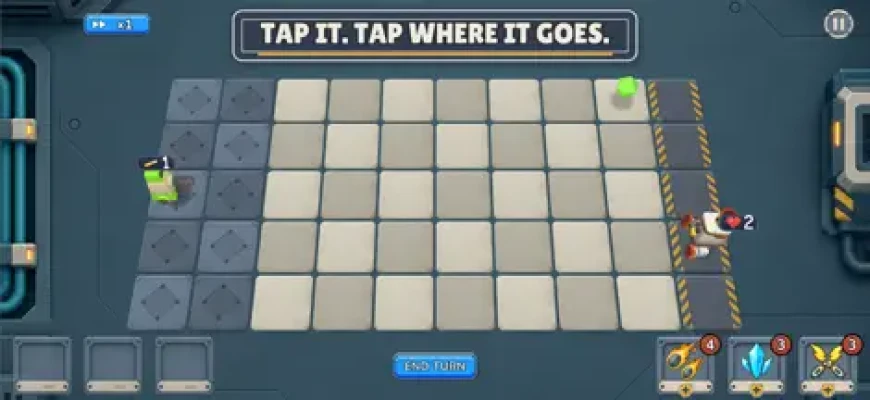
- Tap-based turret interaction
- Visible movement options
- END TURN functionality
- Turret power indicators
- An interactive guide
- Clearer board instructions
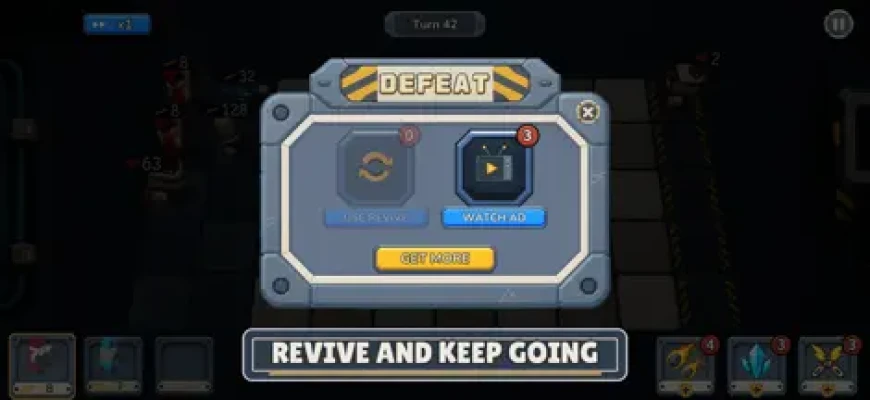
- Revive changes
- Game speed beginning at 1×
- Improved presentation for the arena, shop, and daily rewards
- Optional Sign in with Apple progress synchronization
These changes make the current version substantially more focused on deliberate, turn-by-turn decision-making than older descriptions of the game might suggest.
Grid Guardians Controls
The current control system is designed primarily around taps.
Tap a turret and the game highlights the cells available for different actions.
The visual system uses:
- Amber: move/place
- Green: merge
- Blue: trade positions
Dragging is also supported.
The system is intentionally simple, allowing most of the challenge to come from decision-making rather than complicated controls.
Grid Guardians Atmosphere
Grid Guardians has a compact, puzzle-like presentation built around its board.
Rather than emphasizing a large story or cinematic campaign, the focus is on the battlefield itself.
The grid becomes the main strategic puzzle.
Every empty cell, turret, enemy, power core, and potential merge contributes to the tactical situation.
That makes the game particularly suitable for players who enjoy casual strategy, puzzle mechanics, tower defense, and turn-based decision-making.
Honest Gameplay Assessment
Grid Guardians is most interesting when approached as a turn-based tactical puzzle disguised as tower defense.
The absence of a constant timer changes the experience significantly. You can stop, inspect the grid, consider the enemy's next position, and then decide what to do.
The merge system adds another layer because the strongest immediate upgrade isn't always the best strategic move.
The game is also still evolving. The App Store shows repeated bug-fix releases and gameplay improvements, including the substantial changes in version 1.4.3.
Current App Store information lists 3.5/5 from 14 ratings on the U.S. listing, so that rating represents a relatively small review sample and can change over time.
Pros and Cons
Pros
- Turn-based tower defense
- No need for twitch reactions
- Merge mechanics add depth
- Grid positioning matters
- Enemy movement is predictable
- Campaign and Endless modes
- Customizable Endless difficulty
- Boosters and abilities
- Power-core system
- Simple tap-based controls
- Regular gameplay improvements
Cons
- Small current review sample
- Some earlier players reported lag, freezing, or visual glitches
- The deliberate pace may not appeal to players who prefer fast tower defense
- Merging can become strategically complicated as the board fills
- Advertising and optional in-app purchases are present
The App Store review section includes reports of freezing, glitches, and sluggish merging from some users, while the developer has also released multiple bug-fix updates. These are user reports rather than an independent technical assessment.
Grid Guardians Game Information
Game: Grid Guardians
Developer: Alyssa Jean Kabigting
Seller: Alyssa Jean Kabigting
Genre: Casual / Strategy
Gameplay: Turn-based merge tower defense
Platforms: iPhone, iPad
Age Rating: 4+
Price: Free
In-App Purchases: Yes
Language: English
App Size: Approximately 203.9 MB on the U.S. App Store listing
Required iOS: iOS 16.0 or later
Modes: Campaign and Endless
Core Mechanics: Tower placement, merging, power management, enemy movement, boosters, and abilities
Controller: Touch-focused gameplay
Current listed version: 1.4.3
Frequently Asked Questions
What is Grid Guardians?
Grid Guardians is a turn-based merge tower-defense game in which players position, move, and combine turrets while enemies advance across a grid.
Is Grid Guardians a tower-defense game?
Yes. Its current App Store description specifically presents it as a turn-based merge tower defense game.
Is Grid Guardians real-time?
No. The current gameplay is turn-based. Enemies move one cell per turn, while your turrets fire after you end the turn.
Does Grid Guardians have a timer?
The current App Store description specifically emphasizes that there are no timers, allowing players to think before making their move.
How do you merge towers in Grid Guardians?
Move two compatible towers into a merge position, indicated by the game's green movement highlight, to combine them into a stronger defense.
What is the END TURN button?
END TURN completes the player's planning phase, allowing the turrets to fire and enemies to advance.
What are power cores?
Power cores move across the board and can be destroyed to provide new turrets, which can then be used to expand or strengthen your defense.
Does Grid Guardians have an Endless Mode?
Yes. Endless Mode features continuing waves and customizable difficulty settings.
Does Grid Guardians have a Campaign?
Yes. Campaign Mode contains handcrafted levels with increasing difficulty.
Is Grid Guardians free?
Yes. The App Store lists Grid Guardians as free with optional in-app purchases.
What devices support Grid Guardians?
The App Store lists support for iPhone and iPad and requires iOS 16.0 or later.
Final Grid Guardians Strategy Checklist
Before every turn, ask:
Where are the enemies?
Where will they move next?
Which turret has the best firing position?
Can I create a useful merge?
Should I move or stay?
Is there a power core I should target?
Do I need a booster?
Is my board stronger after this move?
If the answer to the final question is yes, make the move.
If not, consider simply pressing END TURN.
The key to Grid Guardians is not making the most moves. It is making the right moves.
With enemies advancing one cell at a time and turrets firing at the end of each turn, the game rewards players who think ahead, preserve useful board space, create smart merges, and build a defense that can survive more than just the next wave.
Rate the Game
User Reviews




Popular Games













 Android
 iOS
iOS Windows
 Xbox
Xbox