







Latest Version
October 01, 2026
Small Giant Games
Strategy
iOS
0
Report a Problem
More About :game
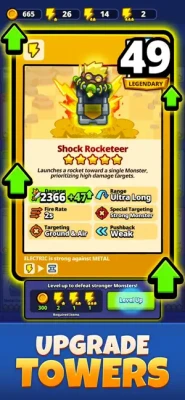
Instead of relying on a fixed group of towers, you build a deck from collectible cards and develop your defenses as you progress. Elemental cards, tower upgrades and card fusion give you different ways to strengthen your castle and respond to increasingly difficult enemies.
The game also expands beyond its main tower-defense campaign with PvP battles, Horde Battles, alliances, timed quests, themed challenges, elite enemies and bosses.
What Is Defend the Castle: Card TD?
Defend the Castle: Card TD is a deck-building tower defense game where strategic card selection is just as important as placing and upgrading defenses.
The main gameplay systems include:
Tower defense
Card collection
Deck building
Elemental towers
Tower card fusion
Card leveling
Elite enemies
Boss battles
PvP
Horde Battles
Alliances
Timed quests
Themed challenges
Seasonal and limited-time content
The game is free to download with optional in-app purchases and requires a network connection.
Defend the Castle: Card TD Gameplay
The basic gameplay loop is:
Build Your Deck → Enter a Battle → Place Towers → Stop Enemy Waves → Earn Rewards → Upgrade Cards → Improve Your Deck
Your goal is to prevent enemies from reaching your castle.
As enemies become stronger, simply using the same towers repeatedly becomes less effective. You need to improve your cards, experiment with elemental combinations and build a deck that can handle different enemy types.
Tower Defense Strategy
Positioning is one of the most important parts of any tower-defense battle.
When placing towers, consider:
How much of the enemy path they can cover
How long enemies remain inside their attack range
Whether several towers can attack the same target
Which enemies require specific tower properties
Whether your defensive setup can handle fast and slow enemies
Don't automatically place every tower as soon as you can.
Sometimes saving a position for a more useful defensive card produces a better result.
Defend the Castle Card Deck Building
Your deck determines which defensive options are available during a battle.
A good deck should provide different forms of coverage rather than relying entirely on one type of tower.
Consider including cards that can handle:
Groups of enemies
Fast enemies
Durable enemies
Flying or special enemies
Elemental threats
Enemies with unusual properties
The game has continued expanding its tower roster, including elemental variants and specialized towers such as Megaphones, which block taunts, and Balloons, which provide anti-air capabilities.
Elemental Cards Guide
Elemental cards are an important part of deck construction.
The game's current tower progression includes elemental themes such as:
Nature
Desert
Snow
Water
Lava
Poison
Electric
Metal
Wind
Recent updates expanded the elemental tower system and introduced additional towers across these themes.
When building a deck, don't focus only on the rarity of a card. Consider how its elemental properties and special abilities fit into the rest of your defense.
Tower Card Fusion
Card fusion is one of the defining progression systems in Defend the Castle.
The fusion system allows compatible tower cards to be combined to create stronger and more powerful cards.
The game later simplified fusion rules so that only cards of the same rarity can be fused.
Card Fusion Tips
Before fusing cards:
Check whether the card is part of your active deck.
Keep useful duplicates when they contribute to upgrades.
Don't fuse valuable cards without checking your future deck needs.
Prioritize cards that can strengthen your main defensive strategy.
Keep track of elemental and special properties.
Fusion should be part of a long-term progression plan rather than something you do automatically whenever duplicates appear.
Defend the Castle Beginner Strategy
1. Learn Your Cards
Don't judge a tower only by its damage number.
Range, attack speed, special properties and elemental effects can all influence how useful a tower is.
2. Build a Balanced Deck
A deck consisting entirely of similar towers may struggle against certain enemy types.
Try to maintain different forms of coverage.
3. Upgrade Your Core Towers
Concentrate resources on cards that you use frequently.
Constantly upgrading every card can spread your resources too thin.
4. Study Enemy Movement
Watch how enemies move through the map.
A tower that looks weak on paper may become extremely useful when placed where enemies remain within its range for a long period.
5. Use Choke Points
If the map creates a location where enemies must travel through a narrow route, use that area to concentrate defensive fire.
6. Think About Coverage
Place towers so their attack ranges complement one another.
Avoid creating several towers that all cover exactly the same small section of the path unless there is a specific reason.
7. Save Strong Options
Don't necessarily use every powerful defensive card immediately.
Keeping a strong option available can help when a particularly dangerous wave arrives.
Advanced Tower Placement Tips
Cover Long Paths
Towers with strong range can be particularly useful where enemies travel for a long time.
Concentrate Damage Carefully
Several towers attacking one dangerous target can prevent it from reaching the castle.
Protect Weak Sections
If one part of your defensive line is consistently struggling, strengthen that area instead of upgrading towers that are already handling their section easily.
Adapt to the Enemy
Your tower layout should respond to the enemies appearing on the map.
A successful setup against one wave may need to change when a new enemy type arrives.
Defend the Castle Enemy Strategy
The game contains increasingly powerful monsters, elite enemies and bosses.
The most important principle is to identify what makes the enemy dangerous.
An enemy may be dangerous because it:
Moves quickly
Has high health
Appears in large numbers
Has a special property
Disrupts your towers
Requires a specific counter
Appears alongside other difficult enemies
Instead of simply increasing damage everywhere, build your defense around the threats actually appearing in the level.
Boss Battle Guide
Bosses require more preparation than ordinary waves.
Before entering a difficult boss encounter:
Upgrade your main towers.
Check your deck.
Review elemental options.
Make sure you have adequate enemy coverage.
Consider where the boss will spend the most time.
Avoid wasting your strongest defensive options early.
Boss rewards can provide valuable progression, so difficult encounters are worth preparing for rather than repeatedly entering with an underdeveloped deck.
Defend the Castle PvP Guide
PvP adds an entirely different layer to the game.
Instead of simply defending against AI-controlled waves, players can attack opponents by sending minions toward their castle while using towers to defend against incoming enemies.
This creates two simultaneous objectives:
Attack your opponent while maintaining your own defense.
PvP Tips
Don't sacrifice defense for offense.
Sending a large attack against an opponent does little good if your own castle is left vulnerable.
Watch your opponent's strategy.
If your opponent is sending specific types of minions, adapt your defensive choices accordingly.
Build for the current PvP rules.
The game has received a major PvP overhaul, including new battle layouts, a PvP energy system, updated matchmaking logic, revised deck-power calculations and adjustments to towers and monsters.
Because PvP mechanics can change through balance updates, avoid treating one particular deck as permanently dominant.
Horde Battles Guide
Horde Battles are cooperative activities where players work with their alliance against waves of zombie enemies.
The latest major overhaul introduced:
New special Zombies
Three five-path Horde layouts
12 tower slots
A Danger Level mechanic
Improved Horde scoring
Updated visuals
Horde Battle Strategy
The larger number of paths means that coverage becomes particularly important.
Before committing to a placement:
Look at all available paths.
Identify where enemies overlap.
Prioritize towers that can cover multiple routes.
Protect vulnerable sections.
Coordinate with your alliance when appropriate.
Pay attention to Danger Level progression.
The goal isn't simply to maximize damage in one location. Your defenses need to survive pressure across the battlefield.
Alliance Strategy
Alliances give players an opportunity to work together against zombie hordes and participate in cooperative activities.
If you join an alliance:
Participate in Horde Battles.
Complete available alliance activities.
Communicate about difficult encounters.
Share useful strategic information.
Keep developing your strongest towers.
An active alliance can also make the game's cooperative content more engaging.
Defend the Castle Quests
Quests provide additional objectives beyond ordinary campaign progression.
The game includes timed quests and themed challenges that offer limited-time rewards.
When completing quests, look at their requirements before starting a battle.
If a quest requires a specific type of tower or gameplay objective, build your deck around completing that objective rather than using your normal setup automatically.
Card Rarity and Progression
Card progression is central to becoming stronger.
As you collect more cards, you'll gradually have more opportunities to:
Upgrade towers
Fuse cards
Experiment with elemental decks
Create specialized defenses
Improve your PvP lineup
Prepare for Horde Battles
Recent versions have also introduced Common, Uncommon, Rare and Epic monsters, while earlier updates added Epic Towers and Monsters and elemental variants.
How to Build a Strong Deck
A practical deck should have a purpose.
Instead of selecting cards simply because they have high rarity, ask:
What problem does this card solve?
For example:
Do you need stronger single-target damage?
Do you need better crowd control?
Do you need anti-air coverage?
Do you need protection against special enemy properties?
Do you need stronger elemental coverage?
Do you need more reliable damage across multiple paths?
A deck becomes more effective when every card contributes to a clear defensive plan.
Defend the Castle Advanced Tips
Focus on Synergy
Two individually average towers can work well together if their abilities complement each other.
Don't Chase Rarity Alone
A rare card isn't automatically the correct choice for every deck.
Consider the card's actual role and how it interacts with your lineup.
Keep Your Deck Flexible
A highly specialized deck may perform extremely well in one situation but struggle when the enemy composition changes.
Upgrade With a Plan
Before spending resources, decide which cards are part of your primary strategy.
Watch Balance Changes
The developers regularly adjust towers, monsters, PvP and Horde Battles. Recent updates have made substantial changes to these systems.
This means older guides can become outdated quickly.
Latest Defend the Castle Updates
The current version has undergone a substantial PvP and Horde overhaul.
The latest listed update includes changes to existing towers and monsters, a new PvP energy system, new PvP layouts, improved deck-power calculations, revised matchmaking, a redesigned interface and new monster rarities.
Horde Battles were also substantially redesigned with new zombie types, five-path layouts, 12 tower slots, Danger Level mechanics and improved scoring.
Earlier updates introduced new elemental towers and signature tower sets covering themes including Cold, Earth, Electric, Fire, Metal, Nature, Poison, Water and Wind.
Defend the Castle: Card TD Features
Deck-building tower defense
Collectible tower cards
Elemental cards
Tower upgrades
Card fusion
Common to Epic cards
Elite enemies
Boss battles
PvP
Minion attacks
Horde Battles
Alliance gameplay
Timed quests
Themed challenges
Special Zombies
Multiple battle layouts
Danger Level system
PvP energy
Limited-time rewards
Random rewards
Defend the Castle: Card TD on iPhone and iPad
Defend the Castle: Card TD is available on iPhone and iPad and requires iOS/iPadOS 13.0 or later. The App Store lists it in the Strategy category and identifies Small Giant Games as the developer.
The current App Store listing shows a 242.7 MB download size, a 13+ age rating and support for English plus 19 additional languages.
A network connection is required to play.
Free-to-Play and In-App Purchases
Defend the Castle: Card TD is free to download and play, with optional purchases available.
The App Store listing includes purchases such as Gems, King's Pass, VIP Pass, Starter Pack and other offers. It also identifies random rewards and loot boxes.
Defend the Castle: Card TD Pros and Cons
Pros
Combines tower defense with deck building.
Card fusion adds another progression layer.
Elemental towers provide deck-building variety.
PvP provides competitive battles.
Horde Battles add cooperative gameplay.
Alliances create a social element.
Quests provide additional objectives.
Regular updates have significantly expanded the game.
Cons
The number of cards and systems can take time to learn.
Progression becomes more demanding at higher levels.
Card acquisition and upgrade systems involve random elements.
PvP and Horde mechanics can change as balance updates are released.
A network connection is required.
Recent App Store reviews include differing experiences regarding progression, card availability, difficulty and balance, while the developer has responded to some concerns by pointing to subsequent balance, rewards and progression changes. These are individual player reports and should not be treated as universal descriptions of the current experience.
Who Should Play Defend the Castle: Card TD?
Defend the Castle: Card TD is designed for players who enjoy combining:
Tower defense
Strategy games
Card collection
Deck building
Resource management
PvP
Cooperative battles
Fantasy enemies
Progression systems
Players who enjoy experimenting with different tower combinations can build several different decks for campaign, PvP and Horde Battles.
Defend the Castle: Card TD FAQ
What is Defend the Castle: Card TD?
Defend the Castle: Card TD is a deck-building tower defense game where players collect, upgrade and fuse tower cards to protect their castle from waves of monsters.
Is Defend the Castle: Card TD free?
Yes. The game is free to download and play with optional in-app purchases.
Does Defend the Castle have card fusion?
Yes. Tower card fusion allows players to combine cards to create more powerful towers. The current rules require same-rarity cards for fusion.
Does Defend the Castle have PvP?
Yes. PvP lets players attack opponents by sending minions while defending their own castle with towers.
Does Defend the Castle have cooperative multiplayer?
Yes. Players can join or create alliances and participate in Horde Battles against zombie enemies.
What are Horde Battles?
Horde Battles are cooperative battles against zombie enemies. The current system features multiple paths, tower slots, special Zombies, Danger Level mechanics and scoring.
Does the game have elemental towers?
Yes. The game includes elemental cards and has expanded its elemental tower system across several themes, including Nature, Water, Fire, Poison, Electric, Metal, Wind and others.
Does Defend the Castle have boss battles?
Yes. The game includes powerful elite and boss enemies that provide rewards as players progress.
Does Defend the Castle require an internet connection?
Yes. The App Store listing states that a network connection is required.
What devices can run Defend the Castle: Card TD?
The App Store currently lists iPhone and iPad support and requires iOS/iPadOS 13.0 or later.
Final Overview
Defend the Castle: Card TD combines tower defense, collectible cards and deck building into a progression-focused strategy game.
The core challenge is not simply placing the strongest tower. Players need to collect useful cards, build complementary decks, fuse and upgrade towers, respond to different enemy types and adapt their defenses to different modes.
The addition of PvP, Horde Battles, alliances, elemental towers, bosses and timed quests gives the game several different ways to use and develop a card collection. Recent updates have also significantly changed PvP and Horde Battles, making it important to keep strategy information current as the game continues to evolve.
Rate the Game
User Reviews















Popular Games



















 Android
 iOS
iOS Windows
 Xbox
Xbox