






Latest Version
June 07, 2025
Tripledot Studios Limited
Card
0
com.tripledot.ginrummy
Report a Problem
More About :game
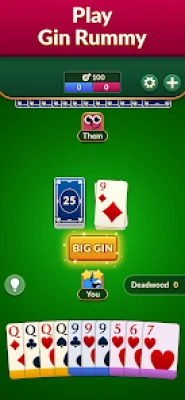
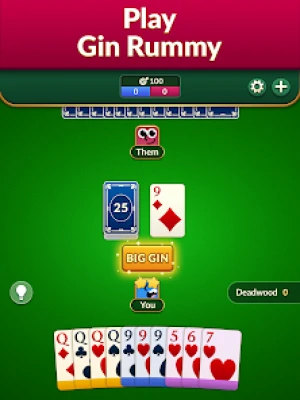
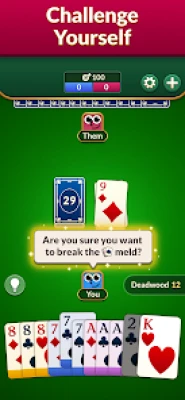
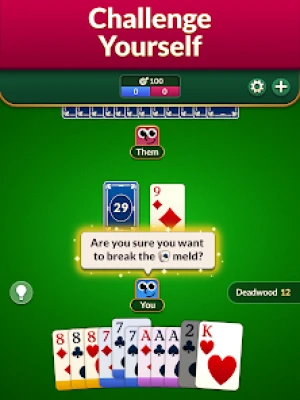
Gin Rummy is a classic two-player card game based around creating melds while keeping the value of unmatched cards, known as deadwood, as low as possible.
There are two basic types of melds:
- Sets: three or four cards of the same rank.
- Runs: three or more consecutive cards of the same suit.
For example:
7♥ 7♣ 7♠ is a set.
4♦ 5♦ 6♦ is a run.
The remaining cards that don't belong to a meld are your deadwood. Keeping those cards low is one of the central skills of Gin Rummy.
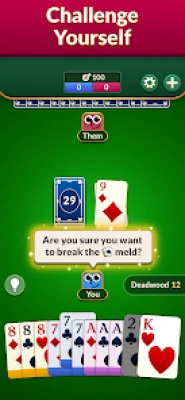
The Tripledot version follows standard Gin Rummy rules according to the current listing and offers tutorials and smart hints for newer players.
How to Play Gin Rummy
Each turn follows a simple pattern:
- Draw one card from either the face-up discard pile or the face-down stock.
- Look for ways to improve your hand.
- Discard one card.
- Continue building melds and reducing deadwood.
- When your hand reaches the appropriate condition, you can knock or go for Gin, depending on the situation.
The difficult part isn't understanding these rules.
The difficult part is deciding which card to keep and which card to throw away.
That decision is where most hands are won or lost.
The Most Important Gin Rummy Strategy
1. Build Potential, Not Just Immediate Melds
Suppose you start with:
4♥ 5♥ 9♣ 10♣ J♣
You already have a strong run opportunity with:
9♣ 10♣ J♣
You also have a possible connection between 4♥ and 5♥.
Don't automatically discard the 4♥ just because it isn't currently part of a three-card meld.
It has useful potential.
A good hand contains both:
- completed melds;
- cards that are close to becoming melds.
Your job is to determine which potential combinations are actually worth keeping.
2. The Rule of Two Connections
A particularly useful advanced technique is to value cards that have multiple ways to become useful.
Consider:
6♠
It can potentially connect with:
4♠ 5♠
or:
5♠ 7♠
or:
7♠ 8♠
So a middle card can have considerably more flexibility than an isolated high card.
By comparison, an A♠ has fewer possibilities because it only participates in low-end sequences.
This doesn't mean middle cards are always better, but they often give you more opportunities to complete a run.
3. Don't Keep Every Pair
Pairs are tempting because they are already halfway toward a set.
But keeping too many pairs can make your hand inflexible.
Imagine you have:
8♣ 8♦
and later draw:
8♥
Now you have a set.
Excellent.
But if you are holding three different pairs while waiting for a third card for each, you're depending on several future draws.
A pair should be kept when:
- the rank is reasonably likely to connect with your existing hand;
- it can also contribute to another structure;
- the alternative card you're considering discarding is worse.
Don't keep a pair automatically.
4. Watch the Discard Pile
The discard pile isn't just a source of cards.
It is information.
If your opponent repeatedly ignores cards from one suit, that can tell you something.
For example, imagine you discard:
8♥
Your opponent doesn't take it.
Later you discard:
7♥
They still don't take it.
That doesn't prove they don't need hearts, but it gives you information.
Conversely, if your opponent immediately takes a 9♣, you should become suspicious that they are building a club run around it.
Don't just ask:
“What card do I need?”
Also ask:
“What cards does my opponent appear to need?”
5. Never Give Away an Easy Run
This is one of the most important defensive principles.
Suppose your opponent takes:
7♦
from the discard pile.
A few turns later, you're considering discarding:
6♦
Think carefully.
You may be giving them an obvious:
6♦ 7♦
connection.
The same applies to cards that sit immediately next to cards your opponent has already collected.
Once your opponent reveals interest in a particular suit or rank, be more cautious about feeding that structure.
The Deadwood Strategy
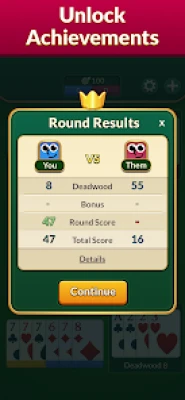
Deadwood is the total value of cards that aren't currently part of melds.
High deadwood is dangerous.
A hand containing:
K♠ Q♦ 9♥
as unmatched cards carries much more risk than:
3♠ 4♦ 2♥
even though neither group is useful as a meld.
Therefore, when two cards have similar strategic potential, the lower-value card is often safer to retain.
A useful priority:
Completed meld > strong two-way combination > low deadwood > speculative high card
This isn't an absolute rule, but it is a useful decision framework.
When Should You Knock?
Knocking too early and knocking too late are both mistakes.
If your deadwood is low enough to knock, ask three questions:
1. Can I improve substantially?
If you have only a small amount of deadwood and the remaining cards aren't particularly promising, waiting may expose you to unnecessary risk.
2. What is my opponent likely holding?
If your opponent has been collecting cards aggressively from the discard pile, they may be close to a strong hand.
3. Could I realistically reach Gin?
If one draw could complete several possibilities, waiting may make sense.
But don't chase Gin just because it feels satisfying.
A safe knock is often better than a risky attempt at perfection.
Gin vs. Knocking
Going for Gin means completing your hand with no deadwood.
It is attractive because it can produce a stronger scoring result, but chasing Gin too aggressively can backfire.
Imagine your hand is already very strong:
3♣ 4♣ 5♣
8♥ 8♦ 8♠
10♠ J♠ Q♠
6♦
You're holding only one unmatched card.
If you have a realistic opportunity to remove that final card, pursuing Gin may be sensible.
But if you repeatedly reject a good knocking opportunity while waiting for a very specific card, your opponent gets additional chances to finish first.
The 10-Card Mental Checklist
Before every discard, quickly check:
- What are my completed melds?
- What cards are close to forming melds?
- Which card has the fewest future uses?
- What has my opponent picked up?
- What have they rejected?
- Am I holding too many high cards?
- Am I keeping too many speculative combinations?
- Does my discard help my opponent?
- How close am I to knocking?
- Is chasing Gin actually worth the risk?
You don't need to calculate all ten points slowly.
With practice, this becomes a quick mental scan.
How to Read Your Opponent
Gin Rummy contains a hidden-information battle.
You can't see your opponent's hand, but their decisions reveal clues.
Watch What They Pick Up
A card taken from the discard pile is especially informative.
If your opponent repeatedly takes cards from one suit, consider that suit dangerous to discard.
Watch What They Reject
A discarded card they ignore is evidence that it may not fit their current hand.
Don't assume it is worthless, though. They may simply have a better alternative.
Watch Their Timing
If they suddenly start taking cards that fit together, they may be approaching a knock or Gin.
That's when you should become more aggressive about reducing your own deadwood.
The Best Discarding Strategy
A strong discard should accomplish two things:
Improve your hand while revealing as little useful information as possible.
When deciding between two unwanted cards, compare:
Card A
High value, isolated, no obvious connections.
Card B
Lower value but sits next to cards that your opponent appears to want.
Card A may be the safer discard despite its higher point value.
This is why deadwood value alone should not determine every discard.
How to Handle Face-Up Discards
The discard pile can offer powerful opportunities.
Take a face-up card when it:
- immediately completes a meld;
- creates a strong two-card connection;
- gives you multiple future combinations;
- removes a dangerous high card from your hand.
Don't take it merely because it's the same suit as another card you own.
For example:
5♣ + 10♣
doesn't make a 9♣ automatically valuable enough to take.
But:
6♣ + 8♣
makes 7♣ highly attractive because it immediately completes a run.
A Practical Example
Suppose your hand is:
4♠ 5♠ 7♠ 8♠ 10♥ 10♣ 3♦ 6♦ Q♣ K♥
You have:
4♠ 5♠ 7♠ 8♠
This is interesting because you have two possible run structures:
4♠ 5♠ 6♠
or
5♠ 6♠ 7♠ 8♠
depending on what arrives.
You also have a pair:
10♥ 10♣
Instead of automatically throwing away one of the spades, evaluate the entire structure.
If 6♠ appears, the hand can improve dramatically.
If the discard pile also suggests your opponent is collecting spades, however, you need to reassess.
The correct decision depends on both your potential and your opponent's information.
Advanced Strategy: Count the Outs
An “out” is a card that could significantly improve your hand.
Suppose you have:
5♣ 6♣
Cards such as:
4♣ or 7♣
can improve the run.
If you also have:
8♣
then 7♣ becomes even more valuable because it creates:
5♣ 6♣ 7♣ 8♣
When comparing two possible hands, favor the structure with more useful future cards.
This is much stronger than simply counting how many cards are already in a meld.
Advanced Strategy: Don't Overvalue Long Runs
A four-card run looks impressive.
But sometimes a shorter run gives you more flexibility.
For example:
4♥ 5♥ 6♥ 7♥
is already a complete meld, but you may still have decisions to make about how to organize your remaining cards.
A hand should be evaluated as a whole.
Don't keep unnecessary cards simply because they extend an already-completed structure.
Once a meld is secure, look at whether another card can be released to reduce deadwood or improve another combination.
How to Improve Your Opening Hand
Your first several turns are about sorting possibilities.
Immediately identify:
- obvious sets;
- connected same-suit cards;
- isolated face cards;
- high-value deadwood;
- cards with multiple possible connections.
Don't rush to build the perfect hand.
Your first objective is to determine what your hand is naturally trying to become.
If the hand contains several connected clubs, build around clubs.
If it contains a promising pair plus several disconnected cards, you may want to develop the pair while removing high deadwood.
How to Recover From a Bad Hand
You will sometimes receive a poor opening hand.
Don't try to rescue every card.
Use this recovery sequence:
Step 1
Identify your strongest existing combination.
Step 2
Keep the cards that directly support it.
Step 3
Find your highest deadwood.
Step 4
Look for a discard that doesn't help the opponent.
Step 5
Build around the strongest remaining structure.
The goal is to turn a bad hand into a low-risk hand, not necessarily a spectacular one.
Tournament Strategy
The game includes competitive tournaments and global leaderboards.
In competitive play, consistency becomes more important.
Don't make high-risk decisions simply to create impressive Gins.
A player who repeatedly produces:
- low deadwood;
- sensible knocks;
- safe discards;
- good opponent reads;
can outperform someone who constantly waits for perfect hands.
Think in terms of expected results over many games, not one spectacular round.
Beginner Tips
Keep Your Hand Flexible
Don't commit too early to one combination.
Throw High Deadwood Carefully
Kings, queens and jacks become expensive when they remain unmatched.
Watch the Discard Pile
It provides information about your opponent.
Don't Chase Gin Every Time
A strong knock can be better than waiting for a perfect hand.
Avoid Helping Your Opponent
Think about what your discarded card could create for them.
Use Hints to Learn Patterns
The game's smart hints can be useful when learning the basics, but try to understand why a suggested move is strong rather than following it automatically.
Advanced Gin Rummy Tips
Middle Cards Are Flexible
Cards around the middle of a suit often have more possible sequence connections.
High Cards Need a Reason to Stay
Keep a queen or king because it contributes to a realistic combination—not simply because it might become useful later.
Track Revealed Information
Every draw and discard changes what you know.
Reduce Information You Give Away
Don't repeatedly discard cards that reveal exactly which suit or rank you are building.
Attack When Your Opponent Is Close
If your opponent appears to be approaching a knock, prioritize reducing your own deadwood rather than waiting for an unlikely perfect draw.
Don't Become Predictable
If you always discard the highest card, an observant opponent may learn to ignore other possibilities. Mix your decisions according to the actual hand.
Common Mistakes That Lose Gin Rummy Games
Holding High Cards Too Long
A king that never becomes part of a meld can destroy your score.
Keeping Too Many Pairs
Pairs are promising, but they still require another card.
Ignoring the Opponent
Gin Rummy is not solitaire. Their discard choices matter.
Taking Every Interesting Discard
A card can look useful while actually making your hand less flexible.
Chasing Gin Recklessly
Waiting for one specific card gives your opponent time to finish.
Discarding Without Looking at the Board
Every discard should have a reason.
Features
- Classic Gin Rummy rules
- Modern mobile presentation
- Smooth card animations
- Interactive tutorials
- Smart hints
- Competitive tournaments
- Global leaderboards
- Custom card decks
- Custom table designs
- Custom avatars
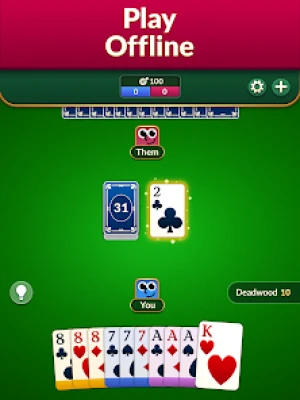
- Offline play
- Online competitive play
- Android and Windows availability
Google Play currently lists the game as Gin Rummy: Classic Card Games from Tripledot Studios Limited, with 1M+ downloads and advertising.
Current Player Feedback
The current Google Play listing shows a 4.4-star rating and more than 7,000 reviews on the main page.
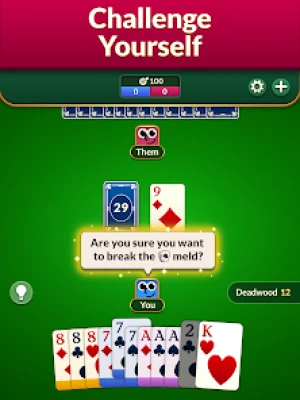
Recent reviews are generally positive about the actual card-game implementation. One March 2026 player specifically praised the standard Gin rules, scoring and cumulative statistics, while pointing out an issue involving meld arrangements and a Big Gin recognition glitch. The developer acknowledged the feedback.
Advertising is another recurring criticism. A recent August 2026 reviewer described the game positively overall but said there were enough ads to prevent a five-star rating. The developer confirmed that advertising helps keep the game free.
The listing also states that recent updates have focused on gameplay tuning, bug fixes and performance improvements.
Is Gin Rummy: Classic Card Games Difficult?
Learning the rules: Easy
Basic strategy: Moderate
Reading opponents: Moderate
Advanced play: Challenging
The rules are simple enough for beginners, but strong Gin Rummy play requires several skills at once: probability, memory, risk management, discard tracking and opponent reading.
That combination gives the game much more depth than simply matching cards into sets.
Pros and Cons
Pros
- Traditional Gin Rummy gameplay
- Straightforward interface
- Tutorials and smart hints
- Offline mode
- Competitive tournaments
- Global leaderboards
- Customizable cards and tables
- Good replay value
- Android and Windows support
- Strong overall player reception
Cons
- Contains advertising
- Some players have reported occasional gameplay glitches
- Competitive play can become demanding
- Some interface/meld decisions may feel restrictive
Frequently Asked Questions
What is Gin Rummy: Classic Card Games?
It is a mobile version of traditional two-player Gin Rummy developed by Tripledot Studios. It includes standard-style gameplay, tutorials, smart hints, tournaments, leaderboards, customization and offline play.
What is the best strategy for Gin Rummy?
Build strong melds while keeping deadwood low, watch your opponent's discards, avoid giving them useful cards, and knock when the risk of waiting for Gin becomes greater than the potential reward.
Should I always try to get Gin?
No. Going for Gin can produce a strong result, but waiting too long can allow your opponent to finish first. A well-timed knock is often the better decision.
What cards should I discard first?
Look for isolated high-value cards that have little realistic potential. However, always consider whether the discard could help your opponent.
Are middle cards useful in Gin Rummy?
Yes. Middle cards often have several possible sequence connections, making them flexible building blocks for runs.
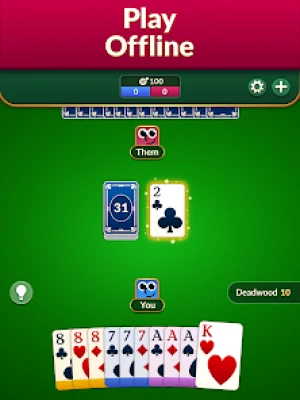
Can I play Gin Rummy offline?
Yes. The current Google Play description explicitly advertises offline play.
Does the game have tournaments?
Yes. The listing advertises competitive tournaments and global leaderboards.
Does Gin Rummy: Classic Card Games have ads?
Yes. Google Play currently marks the game as containing ads.
Is Gin Rummy available on Windows?
Yes. Google Play currently lists Android and Windows availability.
Final Verdict
Gin Rummy: Classic Card Games is a solid mobile interpretation of the traditional card game, particularly for players who want standard Gin Rummy rules combined with modern features such as tutorials, smart hints, tournaments, leaderboards and offline play.
The biggest improvement you can make isn't learning a secret trick. It's learning to make every discard with a purpose.
Build useful combinations → reduce deadwood → track the discard pile → read your opponent → protect yourself from giving them easy cards → knock when the risk is right.
And remember one of the most important Gin Rummy lessons:
You don't need the perfect hand to win. You need a better hand than your opponent when the round ends.
Rate the Game
User Reviews



Popular Games



















 Android
 iOS
iOS Windows
 Xbox
Xbox