






Latest Version
August 15, 2025
Aurecas Games
Strategy
0
com.aurecas.eviltower
Report a Problem
More About :game
Key Features
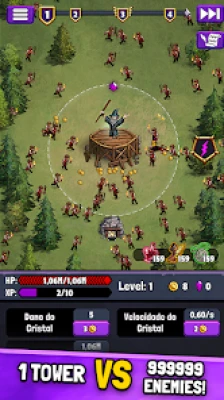
Idle Tower Defense Gameplay
Progress continues even when you are not actively playing. Resources accumulate over time, allowing constant tower growth and long-term progression.
Roguelike Upgrade System
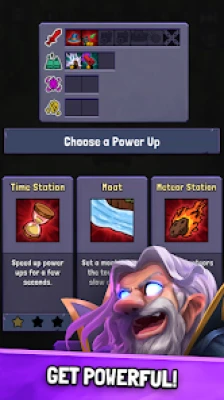
Every battle introduces different upgrade choices that can dramatically change your strategy and tower effectiveness.
Strategic Tower Building
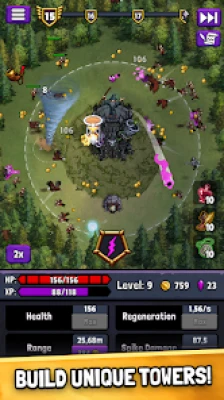
Customize your tower with defensive stations, offensive structures, and special enhancements to create unique builds.
Incremental Progression
Unlock increasingly powerful upgrades through an expanding resource economy that rewards consistent play.
Active Combat Abilities
Special powers can be activated during battles to eliminate enemies, save critical defenses, and change the outcome of difficult encounters.
Offline Play
The game supports offline progression, allowing players to continue developing their tower without requiring a constant internet connection.
Evil Tower - Idle Defense TD Strategy Guide
Practical Strategy Guide for Evil Tower
Evil Tower is not a game where simply upgrading everything as soon as possible is always the best approach. Your results depend on how you combine tower upgrades, perks, station customization, resource growth, and special powers during each run.
Because the game uses roguelike decisions, the strongest approach can change from one run to another. Instead of following one rigid build, use the following priorities to make better decisions during difficult waves.
1. Build Around One Main Strength
When you receive upgrade choices, avoid creating a completely random collection of bonuses.
If you are already improving a particular type of offensive or defensive strength, look for upgrades that reinforce it. A concentrated build is easier to understand and usually gives you a clearer path through difficult waves than spreading every upgrade across unrelated effects.
Practical rule:
If an upgrade improves something your current build already relies on, give it serious consideration before choosing a completely unrelated bonus.
2. Do Not Spend Every Upgrade on Damage
Damage is important, but an enemy reaching your tower can quickly expose a defensive weakness.
If your damage is already sufficient to eliminate ordinary enemies, consider using your next upgrade to improve another part of the build. A stronger overall setup can be more valuable than repeatedly increasing the same offensive stat.
Think of each run as a balance:
Damage → Survival → Economy → Utility
The exact balance should change according to the enemies and the difficulty of the current battle.
3. Use Early Waves to Build Your Economy
Evil Tower includes an incremental resource system, so early progress can affect how powerful your tower becomes later in a run.
When the first waves are comfortably under control, look for opportunities to improve your resource generation rather than spending everything immediately on short-term combat power.
However, do not sacrifice your defense simply to earn more resources.
The better approach is: build enough power to survive comfortably, then invest additional gains into progression and economy.
4. Read Every Perk Before Choosing It
The roguelike upgrade system means that the decision presented to you matters.
Do not automatically choose the upgrade with the largest-looking number. Ask three questions:
- Does this upgrade help my current build?
- Will it remain useful during later waves?
- Does it solve the problem that is currently causing me to lose?
For example, if enemies are already dying comfortably but your tower is struggling to survive, another damage-focused choice may not solve the actual problem.
5. Upgrade the Weakest Part of Your Build
When a run starts going badly, identify why you are losing.
If enemies are reaching the tower with high health, your offensive power may be the problem.
If enemies are reaching the tower too frequently, defensive or control improvements may be more useful.
If your tower can survive but your progression is too slow, an economy-focused upgrade may provide greater long-term value.
Do not upgrade blindly. First identify the bottleneck.
6. Save Special Powers for Dangerous Waves
Evil Tower gives you action buttons that allow you to use special powers against enemies.
A common mistake is using an ability simply because it is available.
Instead, keep your strongest emergency tools available when the battlefield becomes dangerous.
Use a special power when it can:
- Stop a wave that is about to overwhelm your defense
- Remove a dangerous group of enemies
- Buy time for your normal defenses
- Help you survive a particularly difficult section
- Prevent a run from ending when your tower is close to being overwhelmed
If the current wave is already under control, there is often less reason to waste an important ability immediately.
7. Change Your Build When You Get Stuck
If you repeatedly fail at approximately the same point, do not simply repeat the exact same build and hope for a different result.
Look at what happens immediately before the failure.
Enemies overwhelm you → improve the part of the build responsible for survival or crowd control.
Enemies survive too long → strengthen your offensive capability.
Progress feels too slow → improve your resource generation where possible.
Your build works early but collapses later → choose upgrades with stronger long-term value instead of focusing entirely on early-wave performance.
This is especially important because Evil Tower combines idle progression with roguelike decisions.
8. Don't Treat Every Perk as Equally Valuable
A perk can look powerful but still be a poor choice for your current run.
For example, an upgrade that would be excellent in an offensive build may be much less useful if your current problem is surviving enemy waves.
Before choosing, compare the perk against what your tower actually needs.
Ask yourself:
“What is stopping me from surviving the next few waves?”
Choose the upgrade that addresses that problem whenever possible.
9. Use Station Customization to Support Your Build
The game allows you to upgrade your tower, choose perks, and customize your stations.
Treat these systems as parts of the same build rather than separate upgrade menus.
If your run is built around a particular strength, try to make your station and perk choices support that direction instead of creating a collection of unrelated bonuses.
The goal is to make your upgrades work together.
10. Farm When You Need to Farm
Because Evil Tower includes idle and incremental progression, you do not have to treat every failed run as wasted time.
If your current tower is not strong enough for the next challenge, use easier content and accumulated resources to improve your overall progression before attempting the difficult section again.
A stronger permanent progression system can eventually turn a frustrating wall into a manageable one.
11. Offline Progress Can Help
Evil Tower supports offline battles and incremental progression.
That means you can make use of the game's idle mechanics instead of relying entirely on active play.
If you have reached a point where your current progression is too slow, allow the idle systems to contribute before making another serious push.
The important thing is to return with more resources and then spend them where they will actually improve the next attempt.
12. Don't Follow a “Perfect Build” Blindly
There is no reason to copy one build for every situation.
Evil Tower's roguelike decision system means that the upgrades available during a run can influence what becomes strongest.
A better strategy is to recognize the direction your run is taking and then make subsequent choices that reinforce it.
Think of it as building a strategy during the run, rather than entering every battle with one fixed recipe.
Beginner Build Strategy
For a new player, keep your first few runs simple.
Early Waves
Focus on establishing enough offensive power to deal with normal enemies comfortably.
Do not overspend on specialized upgrades before you know what the upcoming waves require.
Mid Run
Once your basic defense is stable, start looking for upgrades that improve the overall efficiency of your tower.
At this point, compare offensive, defensive, and economy choices instead of automatically selecting damage.
Difficult Waves
When enemies begin threatening the tower, stop thinking only about maximum damage.
Look for upgrades that address your immediate weakness and save your strongest special powers for moments when they can prevent a collapse.
After a Failed Run
Do not simply repeat the same choices.
Ask:
- What enemy or wave caused the failure?
- Was the problem damage, survival, or progression?
- Which upgrade could have prevented that problem?
- Did I use my special power too early?
- Did I spend resources on upgrades that were not helping my actual build?
Then change the next run accordingly.
Best Way to Improve at Evil Tower
The biggest improvement comes from learning to distinguish between what looks powerful and what your current tower actually needs.
A successful run should gradually develop a clear identity. Your upgrades should complement one another, your economy should support your progression, and your special abilities should be available when the battle becomes dangerous.
Instead of asking:
“Which upgrade is strongest?”
ask:
“Which upgrade solves my current problem while helping my build later?”
That is a much more useful strategy for Evil Tower.
Common Mistakes to Avoid
Upgrading Randomly
Choosing whatever looks strongest without considering your existing upgrades can produce a weak combination.
Spending Abilities Too Early
An ability that saves you during a dangerous wave is much more valuable than one used when everything is already under control.
Ignoring Your Weakness
If enemies are surviving too long, more defensive investment may not solve the problem. If your tower is constantly under attack, simply adding more damage may not be enough.
Chasing Short-Term Power
Some upgrades may help immediately but contribute little to the later part of a run. Consider how an upgrade fits into your progression before choosing it.
Repeating a Failed Build
If the same strategy repeatedly fails at the same point, change the build instead of repeatedly making the same decisions.
Ignoring the Idle System
Evil Tower is designed around incremental progression and offline battles. Use those systems to strengthen your account rather than relying entirely on active combat.
Evil Tower Strategy in One Sentence
Build around your strongest upgrades, identify your current weakness, spend resources accordingly, and save special powers for the waves that can actually end your run.
Gameplay Walkthrough
Step 1: Build Your First Tower
At the beginning, focus on establishing a balanced defense capable of handling early enemy waves.
Prioritize:
- Basic tower upgrades
- Resource generation
- Damage improvements
- Survival-focused perks
Step 2: Defeat Early Waves
Early battles teach the fundamentals of tower defense and resource management.
Focus on:
- Understanding enemy behavior
- Testing different upgrades
- Learning ability timing
- Improving efficiency
Step 3: Invest Resources Wisely
Resources are limited during the early stages.
Spend them on:
- Damage output
- Defensive strength
- Resource production
- Core tower improvements
Avoid spreading upgrades across too many systems at once.
Step 4: Unlock Powerful Perks
As progression continues, increasingly powerful perks become available.
Look for upgrades that:
- Multiply damage
- Increase attack speed
- Improve resource generation
- Enhance special abilities
Step 5: Create Synergistic Builds
Winning strategies often depend on combining upgrades that complement one another.
Strong synergies frequently outperform individual powerful upgrades.
Best Beginner Tips
Focus on Economy First
A strong resource economy allows faster progression and easier access to advanced upgrades.
Upgrade Consistently
Regular improvements are usually more effective than saving resources for a single expensive upgrade.
Learn Enemy Waves
Understanding wave patterns helps prepare defenses before major threats arrive.
Experiment with Builds
Different upgrade combinations can dramatically change performance.
Testing new strategies often reveals powerful synergies.
Use Active Skills Carefully
Saving powerful abilities for difficult waves can prevent defeat and extend runs.
Advanced Strategy Guide
Prioritize Multipliers
Percentage-based upgrades often provide greater long-term value than flat bonuses.
Build Around a Core Strategy
Choose a primary focus such as:
High Damage Build
Designed to eliminate enemies before they can overwhelm defenses.
Resource Farming Build
Focused on maximizing long-term progression.
Balanced Survival Build
Provides stability and reliability during extended battles.
Adapt to Upgrade Choices
Because roguelike elements influence available upgrades, flexibility is essential for success.
Maximize Idle Rewards
Collect offline earnings regularly and reinvest them immediately to accelerate progression.
Common Mistakes to Avoid
Ignoring Resource Production
Without a strong economy, progression becomes significantly slower.
Choosing Random Upgrades
Successful runs require synergy rather than selecting upgrades based solely on rarity.
Overusing Special Powers
Using abilities too early may leave the tower vulnerable during difficult waves.
Neglecting Defense
Focusing exclusively on offense can create weaknesses against stronger enemies.
Why Players Enjoy Evil Tower
Several factors make the game appealing:
- Idle progression systems
- Strategic decision-making
- Roguelike upgrade variety
- Offline gameplay support
- Tower customization
- Medieval fantasy setting
- Long-term progression goals
- Incremental growth mechanics
The combination of tower defense strategy and idle progression creates a satisfying gameplay loop that rewards both active and passive play.
Progression Guide
Early Game
Focus on:
- Resource generation
- Core upgrades
- Learning mechanics
Mid Game
Prioritize:
- Build specialization
- Upgrade synergies
- Efficient farming
Late Game
Concentrate on:
- Maximizing multipliers
- Optimizing tower layouts
- Perfecting upgrade combinations
Final Verdict
Evil Tower – Idle Defense TD successfully blends idle progression, tower defense mechanics, roguelike decision-making, and strategic resource management into a highly engaging experience. Players who enjoy building powerful defenses, experimenting with upgrade combinations, and watching their empire grow over time will find plenty of depth and replayability.
Whether you're a casual idle gamer or a dedicated strategy enthusiast, Evil Tower offers a rewarding progression system and countless opportunities to refine your defensive tactics.
Frequently Asked Questions
Is Evil Tower an offline game?
Yes. The game includes offline progression systems that allow continued growth while away from the game.
What type of game is Evil Tower?
It combines idle gameplay, tower defense mechanics, roguelike upgrades, and strategic resource management.
Does Evil Tower have roguelike elements?
Yes. Players receive different upgrade choices during runs, creating unique strategies and replayability.
Who is the main character?
Players control Murdolf, an exiled wizard seeking to build a powerful tower and conquer the kingdom using the Primordial Crystal.
Is Evil Tower suitable for strategy fans?
Yes. Strategic planning, upgrade selection, resource management, and tower customization are central parts of the gameplay experience.
Rate the Game
User Reviews
"Webster defines "strategy" as..."
SquishyFu
3 weeks ago
That isn't a strategy guide, you're just saying what strategy is. That's like asking how to be successful in the stock market and saying, "Buy low, sell high." Umm...okay. Thanks for the help, I guess.















Popular Games


















 Android
 iOS
iOS Windows
 Xbox
Xbox