







Latest Version
October 05, 2026
Gamehouse LLC
Simulation
iOS
0
Report a Problem
More About :game
Delicious: Recipe for Renewal continues the long-running Delicious series with another chapter in Emily's story.
After a harsh review spreads online and a disaster puts her restaurant business at risk, Emily has to start rebuilding. Her journey takes her through six restaurants, each introducing different menus, customer demands and kitchen challenges.
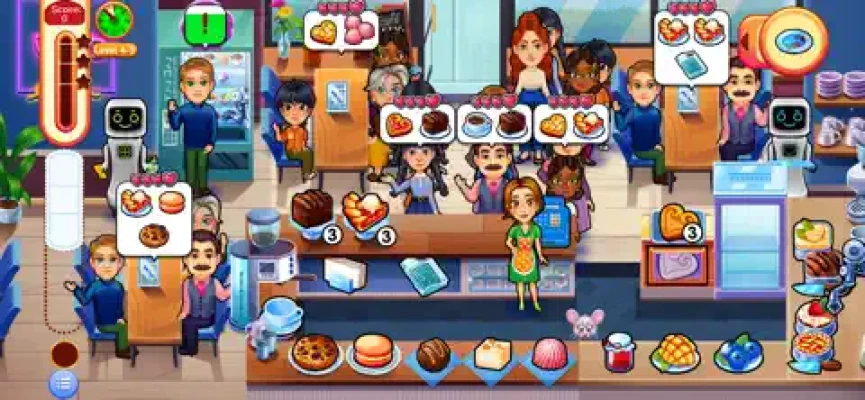
Rather than simply cooking recipes, the game is about managing an entire restaurant during increasingly hectic shifts. You need to prepare food, deliver orders, keep customers happy and make smart decisions when several orders arrive at once.
The game is available on iPhone and iPad through the App Store, with a free-to-play option supported by ads and additional GameHouse+ subscription options.
Delicious: Recipe for Renewal Gameplay
At its core, the game is a time-management cooking experience.
Each level gives you a restaurant to operate and a stream of customers to serve. Orders must be completed quickly enough to keep customers from losing patience.
A typical shift can involve several tasks at once:
Preparing ingredients
Cooking dishes
Making drinks
Combining ingredients
Delivering completed orders
Managing multiple customers
Completing interactive mini-games
Maintaining a fast service rhythm
Completing additional objectives
The challenge increases as new dishes, equipment and customer types are introduced.
The key is not simply clicking as fast as possible. Good players learn to organize the kitchen so several tasks can progress at the same time.
Story and Emily's Journey
Emily's restaurant empire is threatened after a damaging review goes viral. Things become even worse when disaster strikes, forcing her to rethink her approach to running restaurants.
The story gives the game more personality than a traditional cooking simulator. Instead of moving from one disconnected kitchen to another, the restaurants form part of Emily's larger journey.
Her progress is also reflected through unlockable profile customization and Emily's journal, giving players additional insight into her experiences.
Six Restaurants to Manage
One of the game's biggest attractions is its variety.
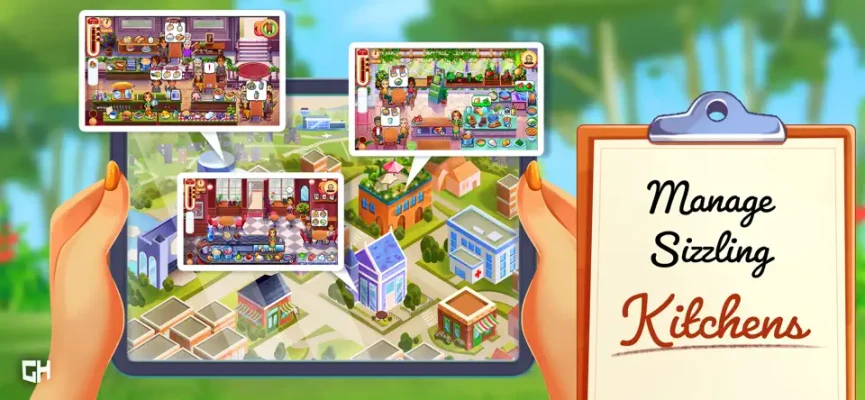
Delicious: Recipe for Renewal features six unique restaurants, each designed to introduce different challenges and demands.
Moving between restaurants prevents the gameplay from becoming completely repetitive. New menus and kitchen layouts require you to adjust your strategy rather than relying on exactly the same routine throughout the game.
When entering a new restaurant, spend a little time learning:
Where every ingredient is located.
Which foods take the longest to prepare.
Which stations can operate simultaneously.
Which customer types are most demanding.
Which upgrades provide the biggest improvement.
Learning the layout is often just as important as improving your reaction speed.
Complete Strategy Guide
1. Learn the Kitchen Before Chasing Perfect Scores
Your first objective in a new level should be understanding the kitchen.
Don't immediately try to achieve the highest possible score. Instead, learn where everything is and identify the slowest parts of the workflow.
Pay particular attention to:
Long cooking times
Ingredients requiring multiple steps
Drinks or side items
Stations that frequently become bottlenecks
Customers with rapidly declining patience
Once you know the workflow, replaying the level becomes much easier.
2. Prioritize Customers With Low Patience
Customer patience is one of the most important mechanics in Delicious: Recipe for Renewal.
A customer with a nearly full patience meter can usually wait a little longer. A customer who is already close to leaving should receive immediate attention.
A useful priority system is:
Nearly leaving → complicated order → quick order → recently arrived customer
However, don't follow this blindly. If a nearly finished order is sitting beside you, completing it may be faster than abandoning your current task.
The best strategy is to constantly evaluate what can be completed fastest while protecting your most impatient customers.
3. Prepare Multiple Orders Efficiently
One of the biggest mistakes new players make is treating every customer as an isolated task.
Instead, look for opportunities to prepare several orders together.
For example:
Start a long cooking process.
While it is cooking, prepare another ingredient.
Serve a completed item.
Return to the first station.
Finish another order before beginning a completely new task.
This creates a continuous production cycle instead of waiting around for individual dishes.
4. Use Idle Time
There should rarely be a moment when Emily is doing nothing.
If you are waiting for food to finish, use that time to:
Start another dish
Prepare another ingredient
Deliver an available item
Begin a drink
Check customer patience
Set up the next order
Efficient players turn waiting time into preparation time.
5. Learn Which Orders Are Fast and Which Are Dangerous
Not every order deserves the same amount of attention.
A simple drink or prepared item may take only a moment, while a multi-step meal can occupy several stations.
When several customers are waiting, identify the orders that require the most preparation.
Starting those orders early gives you more flexibility later.
6. Upgrade the Right Equipment First
The game allows you to upgrade kitchen items and menu elements.
Don't automatically spend every available resource on the first upgrade you see.
Instead, ask:
Which upgrade will save me the most time?
Good upgrades generally improve one of three things:
Preparation speed
Cooking efficiency
Service speed
If a particular kitchen station repeatedly causes delays, upgrading that station can have a greater effect than purchasing a minor improvement elsewhere.
7. Choose Helpers Strategically
Helpers can make difficult restaurant shifts considerably easier.
The best helper is not necessarily the one that looks most powerful. Consider the specific problem you're having in a level.
If cooking is slowing you down, prioritize assistance that improves kitchen efficiency.
If customers are becoming impatient, look for support that helps maintain the service flow.
Think of helpers as solutions to specific problems rather than permanent choices.
8. Don't Ignore Mini-Games
The interactive mini-games are more than a small distraction between cooking sequences.
They test your ability to recognize ingredients and react quickly.
Approach them calmly rather than rushing through every input. Accuracy is usually more useful than frantic clicking.
As you become familiar with the patterns, the mini-games become much easier to complete efficiently.
9. Complete the Main Objective First
When a level becomes chaotic, concentrate on keeping the restaurant operating.
It is tempting to chase every possible bonus immediately, but losing several customers can create a much bigger problem.
A good approach is:
Maintain service → stabilize the kitchen → complete side objectives → improve the score.
Once you know the level, you can replay it specifically for a higher score or additional objectives.
10. Replay Difficult Levels
Don't assume that failing to reach your desired score means you played badly.
Some levels are designed around learning the correct sequence.
On the first attempt, identify:
Which orders cause trouble
Where customers lose patience
Which station creates the bottleneck
Which upgrade would help
Which tasks should be prepared in advance
Then replay the level with that information.
A level that initially feels impossible can become much more manageable once its rhythm is understood.
How to Get Better Scores
If you're trying to maximize your performance, focus on consistency rather than random speed.
Keep Customers Moving
Try to avoid having customers wait unnecessarily after their food is ready.
Chain Actions
Perform several actions in succession instead of repeatedly moving between unrelated tasks.
Start Long Tasks Early
If something takes a long time to prepare, begin it before the situation becomes hectic.
Avoid Empty Stations
Whenever possible, keep the kitchen productive.
Learn the Level's Rhythm
After one or two attempts, you should start recognizing when difficult waves of customers arrive.
Replay for Improvement
Use early runs to learn and later runs to optimize.
Tips for Difficult Levels
When a level suddenly becomes much harder, don't simply play faster.
First determine why it is difficult.
Is the problem:
Too many customers?
Slow preparation?
A complicated menu?
A difficult mini-game?
Poor upgrade choices?
A particular customer type?
Too much movement around the kitchen?
Once you've identified the bottleneck, your next upgrade or strategy becomes much clearer.
One particularly important late-game lesson is to serve special demanding customers quickly. The game's App Store update notes specifically warn that in level 6-3, when the special customer Karen appears, failing to serve her quickly can cause other customers to lose patience rapidly.
Bonus Challenges
After completing the main story content, the 30 bonus levels provide an additional challenge.
These stages are a good place to test whether you've actually mastered the game's mechanics.
For bonus challenges:
Learn the customer sequence.
Watch patience meters carefully.
Prepare ingredients ahead of time.
Avoid unnecessary movement.
Use the most useful upgrades.
Focus on maintaining a smooth service chain.
The bonus levels are particularly useful for players who enjoy chasing better scores rather than simply completing the story.
Level 56 and Other Late-Game Challenges
Some players have reported that the later stages can become significantly more demanding.
A notable example is Level 56, where customer patience and preparation speed can make the stage feel considerably harder than earlier levels. The App Store reviews include player feedback specifically describing difficulty from Level 56 onward.
For these levels, preparation becomes critical.
Before starting:
Check your available upgrades.
Select useful helpers.
Identify the slowest recipes.
Learn which customers need immediate attention.
Avoid wasting movements.
Replay the level after identifying its pattern.
The later stages reward planning more than simple reaction speed.
Restaurant Management Tips
The game becomes easier when you start thinking like a restaurant manager.
Instead of asking:
"What should I click next?"
ask:
"What will I need 10 seconds from now?"
That small change makes a major difference.
If you see several customers approaching, prepare the items that are likely to be needed.
If a long recipe has just started cooking, use that waiting period to complete another task.
If a customer has several items in an order, try to coordinate their preparation instead of finishing each item independently.
How to Handle Busy Customer Waves
Busy periods are where most mistakes happen.
When several customers arrive together:
Step 1
Check every order quickly.
Step 2
Identify the most complicated order.
Step 3
Start the longest preparation immediately.
Step 4
Complete quick orders while the longer item cooks.
Step 5
Watch patience meters continuously.
Step 6
Deliver finished orders before starting unnecessary new tasks.
This approach keeps the restaurant moving even when several orders arrive simultaneously.
Kitchen Upgrade Strategy
Upgrades should solve problems rather than simply increase numbers.
A useful upgrade priority is:
1. Slowest bottleneck
2. Frequently used kitchen equipment
3. Items needed by multiple customers
4. Expensive or complicated recipes
5. Convenience upgrades
This approach helps your resources have a noticeable effect on gameplay.
Profile Customization and Progression
Recipe for Renewal also includes profile customization, ranks and unlockable looks.
These features provide additional progression outside the basic restaurant loop.
Players can gradually build a profile that reflects their progress through the game while continuing to unlock rewards.
The game also includes Emily's journal, which adds another layer to the story and gives players more insight into her journey.
Diorama Feature
One of the game's more unusual extras is the ability to create a diorama of your dream restaurant.
Instead of focusing entirely on scores and restaurant management, the diorama gives players a more creative activity.
It is a nice change of pace after completing hectic cooking levels.
Difficulty and Accessibility
The gameplay is designed around fast restaurant management, but the experience can be approached at different difficulty levels.
The PC version lists Relaxed, Normal and Expert difficulty options, making it possible to choose a pace that fits your experience.
Players who are new to time-management cooking games should start comfortably and learn the mechanics before pushing for the highest performance.
Experienced Delicious players can increase the challenge and aim for stronger results.
Delicious: Recipe for Renewal Features
60 Story-Driven Levels
Follow Emily's journey through a substantial collection of story-focused restaurant levels.
30 Bonus Challenges
Take on additional stages designed for players who want more demanding gameplay.
Six Restaurants
Manage six different restaurant environments with changing menus and challenges.
Fast-Paced Cooking
Prepare food and serve customers while managing multiple tasks.
Interactive Mini-Games
Complete smaller cooking and preparation challenges.
Kitchen Upgrades
Improve equipment and menu performance to make difficult shifts easier.
Helpers
Use assistants to improve your restaurant's efficiency.
Profile Customization
Unlock different looks, ranks and rewards.
Emily's Journal
Discover additional elements of Emily's personal story.
Restaurant Diorama
Create and customize a miniature dream restaurant.
These features are confirmed in the game's current App Store and Google Play descriptions.
Pros and Cons
Pros
60 story-driven levels
30 additional challenges
Six restaurant settings
Fast and satisfying time-management gameplay
Story-focused progression
Kitchen and menu upgrades
Helpful assistants
Interactive mini-games
Profile customization
Restaurant diorama
Strong appeal for longtime Delicious fans
Cons
Later levels can become demanding
Fast-paced stages may feel stressful for casual players
Free play includes advertising
Some advanced levels require careful optimization
Players looking for a traditional cooking simulator may find the time-management focus different from expected
The App Store currently lists the game at 4.9/5 from about 1.3K ratings, while Google Play lists it at 4.6/5 with more than 3,000 reviews, showing strong player reception across mobile platforms.
Is Delicious: Recipe for Renewal Worth Playing?
Yes, especially if you enjoy cooking games where speed, organization and customer management matter as much as the recipes themselves.
The strongest part of Recipe for Renewal is its combination of restaurant time management and character-driven storytelling. The six restaurants give the campaign variety, while upgrades, helpers and bonus challenges provide reasons to replay levels.
Longtime Delicious fans will also appreciate the familiar Emily-centered structure and nostalgic feel, while new players can enjoy it as a colorful and accessible cooking challenge.
If you enjoy games such as cooking time-management games, restaurant simulators, casual strategy games or story-driven management games, Delicious: Recipe for Renewal is worth trying.
Frequently Asked Questions
How many levels are in Delicious: Recipe for Renewal?
There are 60 main story-driven levels plus 30 bonus challenge levels.
How many restaurants are in the game?
The game features six unique restaurants, each with different challenges and menus.
Is Delicious: Recipe for Renewal a cooking game?
Yes. It combines cooking with fast-paced time management, customer service and restaurant management.
Can you upgrade the kitchen?
Yes. Kitchen equipment and menu items can be upgraded to improve efficiency and make restaurant shifts easier.
Are there bonus levels?
Yes. There are 30 bonus challenge levels in addition to the main story campaign.
Does the game have mini-games?
Yes. Interactive mini-games are included as part of the cooking and restaurant experience.
Can you customize your character profile?
Yes. Players can unlock profile looks, ranks and other customization rewards.
Can you play Delicious: Recipe for Renewal for free?
The iPhone and iPad version is listed as free with in-app purchases and advertising. GameHouse also offers GameHouse+ options, including an ad-free VIP subscription.
What is the best strategy for difficult levels?
Learn the restaurant layout, identify slow tasks, upgrade the biggest bottleneck, use an appropriate helper and prioritize customers who are close to losing patience.
Is Delicious: Recipe for Renewal good for longtime fans?
Yes. The game retains the recognizable Delicious formula while adding new restaurants, customization, upgrades, challenges and story content.
Final Verdict
Delicious: Recipe for Renewal succeeds because it understands what makes restaurant time-management games enjoyable: quick decisions, increasingly complicated kitchens, satisfying progression and the constant pressure of keeping customers happy.
The addition of six restaurants, 60 story levels and 30 bonus challenges gives the game plenty of content, while upgrades, helpers, mini-games and customization add variety outside the basic cooking loop.
The best way to play is to treat every level as a small optimization puzzle. Learn the kitchen, prepare ahead, protect customer patience and spend upgrades where they remove the biggest bottleneck.
For fans of Emily and the Delicious series, Recipe for Renewal feels like a natural continuation. For newcomers, it offers a colorful introduction to fast-paced restaurant management with a strong story component.
Rate the Game
User Reviews















Popular Games



















 Android
 iOS
iOS Windows
 Xbox
Xbox