

Latest Version
September 26, 2026
Yso Corp
Simulation
iOS
0
Report a Problem
More About :game
The game is published by Yso Corp and is listed in the Simulation category on the App Store. It is free to play with optional in-app purchases.
What Is BitСoiner - Merge Chips?
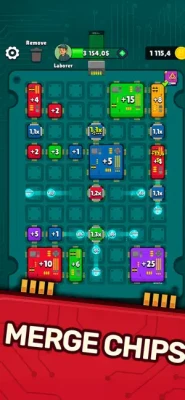
BitСoiner - Merge Chips turns a small collection of chips into an increasingly powerful electronic system.
The basic gameplay loop is:
Add Chips → Place Them → Merge Matching Chips → Improve the Reactor → Increase Income → Upgrade Again
The important part is that simply adding more chips is not always the best solution. Your available space and the arrangement of your chips matter, so planning the microcircuit can make your progression more efficient.
The App Store describes the game as combining clicker, simulation, and casual gameplay, making it suitable for players who enjoy incremental progression without complicated controls.
Main Features
Build a Microcircuit
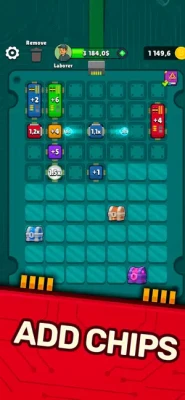
Your microcircuit is the foundation of your operation. New chips can be placed into the available system as you develop it.
Merge Matching Chips
Identical chips can be combined to create more powerful chips. This is the central progression mechanic and the main reason to think carefully about where each chip goes.
Upgrade the Reactor
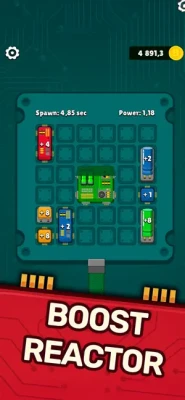
The reactor boosts the power of your overall microcircuit setup. Improving it is an important part of increasing your earning potential.
Strategic Chip Placement
Different chip types can be placed in different positions, so your board isn't simply a collection of random upgrades. Positioning can influence how efficiently your setup develops.
Generate Increasing Income
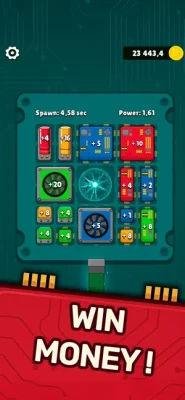
As your chip system becomes stronger, your income can grow substantially. This creates the classic incremental loop of earning money and using it to improve the system further.
Progress Through Worlds
The App Store listing includes player feedback referring to progression through different worlds. One reviewer reported reaching World 2 and completing the available progression relatively quickly.
How to Play BitСoiner - Merge Chips
The easiest way to understand BitСoiner is to think of your microcircuit as a puzzle that is also an income-generating machine.
You begin by adding chips to the board. Matching chips can then be merged into stronger versions. The stronger your setup becomes, the more resources you can generate for additional improvements.
Don't automatically fill every available space.
Instead, consider whether a new chip will help you create a useful merge or improve the structure of your existing circuit.
Complete BitСoiner - Merge Chips Strategy Guide
1. Learn the Board Before Spending Heavily
When you first begin, resist the temptation to place everything immediately.
Look at the available spaces and identify where your existing chips are positioned.
Your objective is to create useful groups that can eventually be merged.
A good early question is:
"Where should this chip go so that my next merge is easier?"
That mindset is more useful than simply asking where there is an empty space.
2. Prioritize Matching Chips
Merging identical chips is the core way to create stronger components.
Whenever you have matching pieces, consider combining them rather than spreading them across the board.
A useful progression pattern is:
Two matching chips → One stronger chip → Free space → New placement opportunity
This means merging can provide two benefits at once: a stronger chip and additional room on your microcircuit.
3. Don't Fill the Board Without a Plan
One of the biggest mistakes in merge games is treating empty spaces as something that must immediately be filled.
Empty space is valuable.
If your board becomes crowded with unrelated chips, you may make future merges harder to organize.
Try to maintain enough flexibility to accommodate the next useful chip.
4. Create Organized Chip Groups
Keep similar chips reasonably close together whenever possible.
An organized board makes it easier to recognize potential combinations.
Instead of having identical chips scattered across the entire microcircuit, try to build compact groups that can be merged efficiently.
This becomes particularly important as the number of chip types increases.
5. Build Around Your Income-Producing Layout
Player feedback on the App Store describes a strategy involving corner chips and money-making chips arranged into a loop to accelerate income. This is a player-reported tactic rather than an officially documented optimal layout, but it is worth experimenting with if your board supports it.
The important lesson is broader:
Look for layouts where your chips work together instead of treating every position independently.
Experiment with arrangements and compare the income they produce.
6. Upgrade the Reactor at the Right Time
The reactor increases the power of your overall microcircuit.
Don't completely ignore it while focusing only on individual chips.
A stronger collection of chips becomes more useful when your overall system can take advantage of it.
A sensible progression is:
Improve chips → Strengthen the system → Upgrade reactor → Generate more income → Repeat
The exact balance can change as you progress, so avoid following a rigid spending formula.
7. Use Income to Accelerate Future Income
BitСoiner is an incremental game, so the most useful upgrades are often the ones that improve your future earning ability.
Instead of spending everything on small temporary improvements, think about which purchase will make the next several upgrades easier.
Ask yourself:
- Will this increase my income?
- Will it improve my chip quality?
- Will it free board space?
- Will it make future merges easier?
- Will it strengthen the entire microcircuit?
This approach helps prevent inefficient spending.
8. Don't Merge Automatically
Although merging is important, not every merge should necessarily happen immediately.
Before combining two chips, consider whether their current positions are helping your overall arrangement.
If moving them or waiting for another matching chip would create a better board structure, keeping them temporarily may be useful.
The goal isn't simply to merge as fast as possible.
The goal is to build a stronger system with each merge.
9. Keep Your Board Flexible
A flexible board gives you more options.
When your microcircuit becomes crowded, future chips may be forced into inconvenient locations.
Regularly look for opportunities to:
- Merge duplicates
- Remove unnecessary clutter
- Create useful open spaces
- Consolidate similar chips
- Improve the overall shape of your circuit
Board organization becomes increasingly valuable as progression continues.
10. Don't Ignore World Progression
Some player feedback indicates that the game can move through worlds relatively quickly. One App Store reviewer reported completing the available progression after reaching World 2 and then losing interest because there was little further progression at the time of their review.
That means players should treat each new world as an opportunity to learn the next layer of the system rather than simply grinding the same board indefinitely.
If you reach a progression limit, focus on improving your existing setup while watching for future content updates.
Best Beginner Tips
Keep Similar Chips Together
Organization makes merges easier to identify.
Protect Empty Space
An empty position can be more useful than a weak chip occupying it.
Merge With a Purpose
Don't merge simply because two identical chips are available. Consider the resulting board.
Improve Income
Your income determines how quickly you can make future improvements.
Experiment With Layouts
Different arrangements can produce different results. Test your own microcircuit instead of assuming there is only one correct setup.
Upgrade the Reactor
The reactor affects the power of the overall system and should remain part of your progression plan.
Avoid Unnecessary Spending
Keep enough resources available for important upgrades and new chip placements.
Advanced Microcircuit Strategy
Once you understand the basics, start thinking about your board as a connected system rather than individual chips.
Build Around Strong Positions
If certain positions appear particularly useful for connecting or organizing your chip system, reserve them for important components.
Don't waste valuable positions on low-level pieces if you expect to replace them shortly.
Consolidate Before Expanding
When you have several lower-level matching chips, merging them can create stronger components while freeing space.
This creates a useful cycle:
Consolidate → Free Space → Add New Chips → Merge Again
Create a Long-Term Layout
Instead of rebuilding your board every few minutes, gradually move toward a layout that can support future upgrades.
This reduces unnecessary rearranging and makes your system easier to manage.
Common Mistakes in BitСoiner - Merge Chips
Filling Every Available Space
More chips do not automatically mean a better board.
Crowding can make future merges difficult.
Ignoring the Reactor
Focusing exclusively on individual chips can cause you to overlook improvements to the overall system.
Spending Income Too Quickly
If you spend everything immediately, you may have less flexibility for a larger upgrade.
Separating Matching Chips
Scattered matching chips are harder to manage than organized groups.
Merging Without Thinking
The strongest move isn't always the fastest merge. Consider what the resulting board will look like.
Expecting Endless Content
Current player feedback suggests that some players reached the available progression relatively quickly. The amount of content can change with future updates, so the current experience should not automatically be treated as the game's permanent endgame.
BitСoiner - Merge Chips Progression Guide
The progression can be divided into several practical stages.
Early Game
Concentrate on learning:
- Chip placement
- Basic merging
- Income generation
- Reactor upgrades
- Board organization
Don't worry about creating a perfect layout immediately.
Mid Game
Start optimizing.
Look for:
- Better chip combinations
- More efficient placement
- Higher income
- Stronger reactor upgrades
- More organized board layouts
Later Progression
At this stage, small improvements can have a larger effect because your system has become more developed.
Focus on optimizing the relationship between:
Chip strength + board position + reactor power + income
BitСoiner - Merge Chips Atmosphere
BitСoiner has a relaxed technology-and-business atmosphere built around microchips, circuitry, upgrades, and growing income.
It doesn't require complicated controls or an elaborate story. Its appeal comes from watching a small chip setup develop into a more powerful system.
The combination of merging and incremental income also gives the game a satisfying "one more upgrade" feeling that is common in casual simulation and clicker games.
Ratings and Player Feedback
At the time of checking the US App Store listing, BitСoiner - Merge Chips has a 4.5/5 rating from 169 ratings.
Player opinions are mixed on progression length and game depth. One reviewer praised the addictive gameplay but wanted more worlds, while another said the available progression felt short after only a few hours. Another player shared a specific income strategy involving corner chips and money-making chips.
These are individual reviews rather than a complete measure of every player's experience, but they provide useful context for understanding the game's current progression.
Ads and In-App Purchases
BitСoiner - Merge Chips is free to download and contains advertising and optional in-app purchases. The current US App Store listing includes purchases such as Remove Ads, money packs, a VIP Chips Pack, and bundles combining money, income boosts, and ad removal.
The listed prices range from $2.99 to $14.99 for the displayed purchases.
Players who prefer free progression can concentrate on improving their chip placement and income generation rather than relying on paid boosts.
Latest Updates
The current App Store version history lists version 1.2, dated January 5, with an update focused on bug fixes. Version 1.1 was listed on December 18, 2025, while version 1.0 was released on December 9, 2025.
The version history also mentions an updated UI design and bug fixes.
Because the game is relatively new, future updates may add additional worlds, rebalance progression, or expand the chip system.
BitСoiner - Merge Chips FAQs
What is BitСoiner - Merge Chips?
BitСoiner - Merge Chips is a casual simulation and clicker-style game centered around placing, merging, and upgrading chips on a microcircuit.
How do you merge chips?
Place identical chips on the microcircuit and combine them to create more powerful versions.
What does the reactor do?
The reactor increases the power of your overall microcircuit setup and is part of the game's upgrade system.
What is the best way to make money?
Focus on efficient chip placement, useful merges, reactor improvements, and layouts that increase your income. One player specifically reported success using a loop involving corner chips and money-making chips.
Is BitСoiner - Merge Chips free?
Yes. The game is free on the App Store with advertising and optional in-app purchases.
Does BitСoiner - Merge Chips have different worlds?
The current App Store player feedback references multiple worlds, including World 2. The amount of available progression can change as the game receives updates.
Is the game suitable for children?
The App Store currently gives BitСoiner - Merge Chips an age rating of 4+.
What devices support BitСoiner - Merge Chips?
The listing supports iPhone, iPad, iPod touch, Mac with an Apple M1 chip or later, and Apple Vision. iPhone and iPod touch require iOS 14 or later, while iPad requires iPadOS 14 or later. Mac requires macOS 11 or later with Apple M1 or later.
BitСoiner - Merge Chips Game Information
| Information | Details |
|---|---|
| Game Title | BitСoiner - Merge Chips |
| Subtitle | Reactor Syncs with Microchips |
| Genre | Simulation |
| Developer | Yso Corp |
| Seller | Yso Corp |
| Price | Free with In-App Purchases |
| Age Rating | 4+ |
| App Store Rating | 4.5/5 from 169 ratings |
| App Size | 197.4 MB |
| Current Version | 1.2 |
| Languages | English + 13 more |
| Platforms | iPhone, iPad, iPod touch, Mac, Apple Vision |
| Advertising | Yes |
| In-App Purchases | Yes |
| Core Mechanics | Chip placement, merging, reactor upgrades, income generation |
| Developer | Yso Corp |
The information above is based on the current US App Store listing.
Final Strategy
The key to BitСoiner - Merge Chips is understanding that space, merges, and income are connected.
Don't fill your microcircuit just because space is available. Keep matching chips organized, merge with a purpose, maintain room for future pieces, and invest your earnings into improvements that strengthen the whole system.
The reactor should remain part of your upgrade plan, while your chip arrangement should continuously evolve as stronger pieces become available.
The basic strategy is simple:
Organize → Merge → Free Space → Upgrade → Increase Income → Optimize → Repeat
Once you stop treating the board as a collection of individual chips and start treating it as one connected income-generating system, the game's strategic side becomes much clearer.
Rate the Game
User Reviews















Popular Games



















 Android
 iOS
iOS Windows
 Xbox
Xbox