



Latest Version
October 05, 2026
Gamehouse LLC
Simulation
iOS
0
Report a Problem
More About :game
The game combines quick cooking challenges with restaurant management, character-driven storytelling, upgrades, competitions, events, and a long progression system featuring 950 levels.
What Is Cooking Fame: Restaurant Star?
Cooking Fame: Restaurant Star puts you behind the counter of busy kitchens where speed, organization, and customer management are just as important as preparing the food.
The story begins with an apprentice chef whose kitchen blunder unexpectedly goes viral. Instead of ending the culinary dream, the incident opens the door to a new career. Together with Piper and influencer Tristan, you embark on a journey through restaurants around the world while trying to turn cooking skills into genuine fame.
The game isn't simply about tapping food as quickly as possible. You need to learn each kitchen, understand its serving rhythm, improve equipment, manage multiple orders, and make smart use of the resources you earn.
The App Store lists 950 levels, restaurant upgrades using coins and gems, kitchen decoration, leaderboards, special events, clubs, and competitions.
Cooking Fame Gameplay
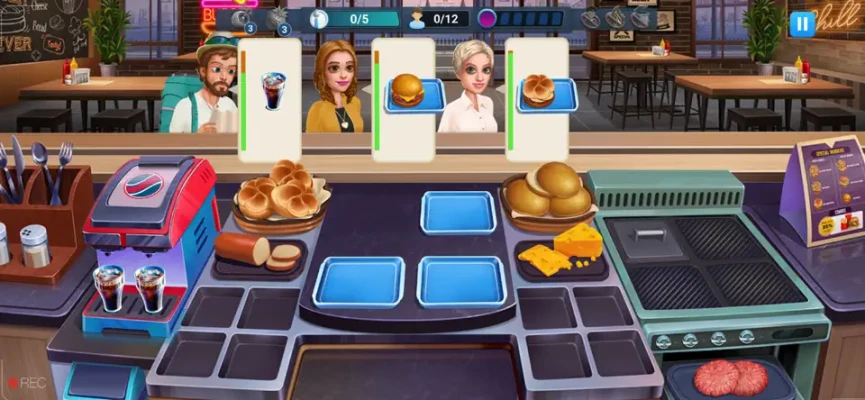
The central gameplay loop is built around serving customers under pressure.
A typical session involves:
Checking which dishes customers want.
Preparing ingredients.
Cooking food at the correct station.
Collecting finished dishes before they become a problem.
Serving customers quickly.
Keeping several orders moving at the same time.
Collecting coins and rewards.
Improving the restaurant.
Repeating the process with more demanding challenges.
The difficulty comes from having several things happening simultaneously. A player who concentrates on only one customer can easily create a backlog at another station.
The key is to think of the restaurant as a production line rather than a collection of individual orders.
Story and Characters
The story gives Cooking Fame more personality than a purely score-based cooking game.
Your character starts as an apprentice chef, but a kitchen mistake unexpectedly becomes a viral moment. Piper becomes an important companion during the journey, while influencer Tristan helps push the characters further into the world of online food fame.
As you progress, the game introduces drama, rivalries, friendships, quirky customers, and new culinary environments.
This creates a useful balance between short cooking sessions and longer-term progression.
Restaurants and Culinary Journey
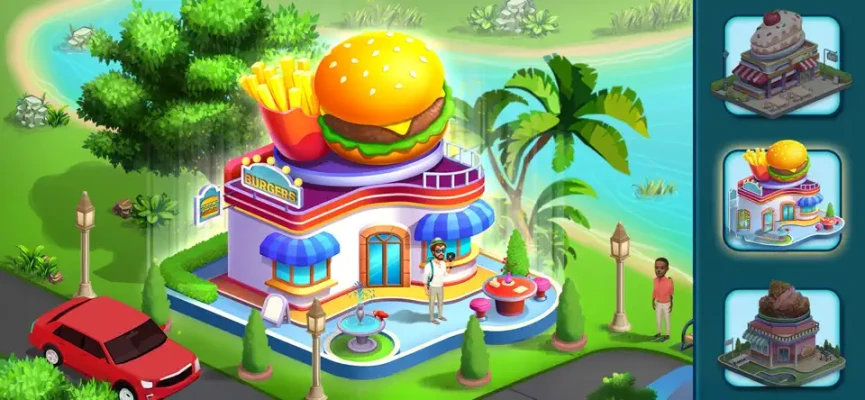
Cooking Fame takes you through different types of kitchens, ranging from food trucks to more sophisticated fine-dining locations.
Each new restaurant can change the pace of the game because the available dishes, preparation stations, customer demands, and kitchen layout can force you to change your strategy.
Don't assume that a strategy that worked perfectly in an earlier restaurant will remain optimal later.
Instead, spend the first few levels of a new location learning:
Where every cooking station is positioned.
Which foods take the longest to prepare.
Which products can be prepared in advance.
Which customer orders are most urgent.
Where finished dishes can accumulate.
Which upgrades provide the biggest improvement.
The Most Important Cooking Fame Strategy
Learn the Kitchen Before Trying to Play Perfectly
When you enter a new restaurant, don't immediately try to maximize every possible score.
Your first goal should be understanding the kitchen.
Identify the entire route from:
ingredient → cooking station → finished dish → customer
Once you know that route, your movements become much more efficient.
A few seconds saved on every order can make a significant difference during difficult stages.
Keep Your Cooking Stations Active
One of the biggest mistakes in time-management cooking games is allowing a valuable cooking station to sit unused.
For example, if one item is cooking and you are waiting beside it, you may be wasting the opportunity to prepare another product.
Instead:
Start a long cooking task.
Immediately move to another station.
Prepare another order.
Serve a completed dish.
Return when the first item is ready.
This creates a continuous production cycle.
Don't Cook Randomly
Cooking everything as soon as possible can actually make a difficult level harder.
Prepared food can become a distraction when your attention is needed elsewhere.
Before starting a dish, consider:
Who ordered it?
How long will it take?
Where will the finished food go?
Can I serve it immediately?
This simple mental checklist prevents unnecessary cooking and reduces mistakes.
Prioritize Customers Intelligently
Not every customer should receive identical attention.
When several customers are waiting, look for the order that can be completed immediately.
If one customer needs a finished item already sitting on the counter, serve that customer first rather than starting a completely new recipe.
A quick completed order can free space, generate income, and reduce customer frustration.
Use Waiting Time Productively
A strong Cooking Fame player rarely stands still.
If you are waiting for food to cook, use those seconds to:
Prepare another recipe.
Collect a finished dish.
Serve another customer.
Check another cooking station.
Set up the next order.
The objective isn't simply to move quickly. It's to make sure almost every second contributes to the next completed order.
Master Order Chains
As levels become more complicated, you will often have several customers requesting different combinations.
Instead of treating each customer as an isolated task, look for shared preparation.
For example, if two customers need products involving the same ingredient, prepare the shared component first when the game allows it.
This reduces unnecessary movement and helps prevent a rush near the end of the level.
Upgrade Restaurants Wisely
Cooking Fame allows you to upgrade restaurants using coins and gems.
Don't automatically spend every resource on whichever upgrade becomes available first.
Think about what is slowing you down.
Prioritize upgrades that:
Reduce cooking time.
Increase customer patience.
Improve serving efficiency.
Increase the value of completed orders.
Reduce bottlenecks at important stations.
Make frequently used equipment more effective.
An upgrade that improves a station used constantly can be considerably more valuable than an upgrade affecting something you rarely use.
How to Spend Coins
Coins are part of your regular progression, so avoid spending them without considering your next restaurant requirements.
A good approach is:
Complete available levels.
Collect the rewards.
Identify the weakest part of your current kitchen.
Upgrade the bottleneck.
Replay difficult stages if additional resources are needed.
Continue progressing.
The strongest upgrade isn't necessarily the most expensive one. It is the upgrade that solves the problem preventing you from completing levels efficiently.
How to Use Gems
Gems are more valuable because premium resources can be harder to replace.
Avoid spending them impulsively just because an upgrade or opportunity appears.
Before using gems, ask:
Will this improve my performance across many future levels?
If the answer is yes, the investment may be worthwhile.
If it only solves a temporary problem on one easy stage, saving the gems can be the smarter choice.
Restaurant Decoration
Cooking Fame also lets players decorate their kitchen with event rewards.
Decoration adds another progression layer beyond simply completing cooking levels.
Treat cosmetic rewards as part of the larger journey rather than something that should interfere with your core resource management.
How to Handle Difficult Levels
When a level suddenly feels much harder, don't immediately assume you need better reflexes.
First identify the actual bottleneck.
If food isn't ready quickly enough
Look for equipment or recipe upgrades that reduce preparation time.
If customers become impatient
Improve your order sequence and serve quick orders immediately.
If you constantly run out of counter space
Stop preparing unnecessary dishes and focus on the active queue.
If you make many mistakes
Slow down slightly and establish a repeatable routine before trying to improve speed.
If the final part of the level collapses
Your opening sequence may be inefficient.
A strong first minute usually makes the final rush much easier.
The Three-Stage Level Mindset
A useful way to approach a difficult Cooking Fame stage is to divide it into three phases.
Opening
Establish your rhythm.
Start the longest preparation tasks first and identify the first group of customers.
Middle
Maintain the production cycle.
Move continuously between cooking, collecting, and serving instead of concentrating on one station.
Final Rush
Stop experimenting.
Use the routine you already know and prioritize orders that can be completed immediately.
Many failures happen because players panic near the end and begin starting unnecessary recipes.
Replay Levels With a Purpose
Replay isn't only useful when you fail.
A completed level can be replayed to improve your understanding of the restaurant.
During a replay, test one change at a time:
Serve a different customer first.
Start a different recipe first.
Prepare shared ingredients earlier.
Upgrade a different station.
Change your movement route.
This makes replaying useful rather than repetitive.
Road to Fame and Leaderboards
Cooking Fame includes a Road to Fame leaderboard, giving progression a competitive element.
If you care about leaderboard performance, don't simply chase speed.
Consistency matters.
A slightly slower run with fewer mistakes can often outperform a chaotic attempt that includes wasted ingredients, missed orders, or inefficient movement.
Special Events and Competitions
The game also features special activities such as the Food Truck Race, clan competitions, cook-offs, and a Season Pass.
These activities provide reasons to keep playing beyond the standard restaurant progression.
When an event is available, check its objectives before spending resources. If rewards are tied to particular actions, you can adjust your normal playing routine to make progress more efficiently.
Food Truck Race Tips
For racing-style cooking events, focus on consistency.
Use this priority:
Complete orders → maintain cooking stations → avoid mistakes → improve speed.
Trying to perform every action as quickly as possible can actually create delays.
The fastest player is usually the one who creates the fewest interruptions.
Clan and Club Competition Tips
If you're participating in club or clan activities, don't wait until the end of the event to start contributing.
Complete the objectives you can reliably handle and collect the available rewards.
Competition systems work best when you treat them as an extension of your normal progression rather than something requiring reckless resource spending.
Cooking Fame Beginner Tips
1. Learn before rushing
Your first few attempts should teach you the kitchen layout.
2. Keep multiple tasks moving
Never spend unnecessary time waiting for one dish.
3. Watch the customer queue
The next order is often more important than the customer you're currently serving.
4. Upgrade bottlenecks
Improve whatever repeatedly causes delays.
5. Avoid unnecessary preparation
Food sitting unused can create more problems than it solves.
6. Save premium resources
Gems should have a clear purpose.
7. Learn the rhythm of every restaurant
Each kitchen eventually develops a predictable workflow.
8. Don't panic during the final rush
Follow your established sequence.
9. Replay difficult stages
Use failed attempts to identify exactly where time is being lost.
10. Balance speed and accuracy
Fast mistakes are still mistakes.
Advanced Cooking Fame Techniques
Queue Forecasting
Instead of looking only at the current customer, anticipate the next two or three orders.
If you know what is coming, you can prepare the kitchen before the customer reaches the front of the queue.
Station Cycling
Create a personal rotation through the kitchen:
Station A → Station B → customer → Station C → Station A
A consistent route reduces unnecessary movement.
Bottleneck Detection
During a failed level, ask:
What caused the biggest delay?
Was it cooking time?
Customer patience?
Movement?
Ingredient preparation?
Counter space?
Once you identify the bottleneck, your next upgrade or strategy becomes much clearer.
Preparation Windows
Use quiet periods to prepare for the busy period.
If the kitchen temporarily has fewer active orders, don't treat that as downtime. Use it to position yourself for the next wave.
How to Progress Faster
The fastest progression isn't necessarily achieved by rushing through every stage.
A better approach is:
Complete → upgrade → learn → replay if necessary → progress.
Don't waste large amounts of resources trying to brute-force a stage when a relatively small kitchen upgrade or route change can solve the problem.
Graphics, Atmosphere and Presentation
Cooking Fame has a colorful restaurant-focused presentation built around busy kitchens, food preparation, characters, and a global culinary journey.
The atmosphere changes as you move between different restaurant environments, helping prevent the game from feeling like a single kitchen repeated indefinitely.
The combination of cooking pressure, character interactions, restaurant upgrades, and fame progression gives the game a more story-driven identity than a basic food-serving simulator.
Game Features
Fast-paced time-management cooking gameplay
950 levels
Multiple restaurant environments
Food trucks and fine-dining locations
Recipe and cooking challenges
Coins and gems
Restaurant upgrades
Kitchen decoration
Story-driven progression
Piper and Tristan
Rivalries and friendships
Road to Fame leaderboard
Food Truck Race
Clan competitions
Cook-offs and special events
Season Pass
Free play with advertisements
Optional GameHouse+ subscription options
Technical Information
Title: Cooking Fame: Restaurant Star
Genre: Simulation / Time-Management Cooking
Developer: Gamehouse LLC
Platforms: iPhone and iPad, with listed compatibility for Mac with Apple silicon and Apple Vision
iOS Requirement: iOS 15.0 or later
iPad Requirement: iPadOS 15.0 or later
Size: Approximately 318.6 MB on the U.S. App Store listing
Languages: English, French, German, Italian, Japanese, Korean, Portuguese, Russian, and Spanish
Monetization: Free with advertising and in-app purchases
Age Rating: 18+ on the U.S. App Store listing
Is Cooking Fame: Restaurant Star Worth Playing?
If you enjoy time-management cooking games, restaurant simulators, and story-driven casual games, Cooking Fame has a lot of content to work through.
The biggest attraction is its scale. With 950 listed levels, multiple restaurant settings, upgrades, characters, competitions, and special events, there is considerably more here than a short cooking challenge.
However, the long progression can also be a weakness for players who dislike repetition. Some App Store reviewers have specifically complained that reaching new restaurants can require playing many similar stages.
That means the game is best suited to players who enjoy gradually improving their kitchen, learning efficient routines, and working through a long progression system.
Pros and Cons
Pros
Large number of cooking levels
Fast and satisfying time-management gameplay
Multiple restaurant environments
Story and recurring characters
Restaurant upgrades
Kitchen customization
Competitive leaderboard elements
Special events and competitions
Plenty of long-term progression
Cons
Some stages can feel repetitive
Later progression may require patience
Fast-paced kitchens can become hectic
Advertising is part of the free-play model
Premium subscription options may not appeal to every player
Frequently Asked Questions
How many levels are in Cooking Fame: Restaurant Star?
The App Store listing currently advertises 950 levels.
Is Cooking Fame: Restaurant Star free?
Yes. The game is listed as free with advertising and in-app purchases. GameHouse also offers a subscription model with additional benefits.
What type of game is Cooking Fame?
It is a simulation/time-management cooking game focused on preparing food, serving customers, upgrading restaurants, and progressing through a culinary story.
Can you upgrade restaurants?
Yes. Coins and gems can be used to upgrade restaurants and improve your progression.
Does Cooking Fame have a story?
Yes. The story follows an apprentice chef whose kitchen mistake becomes viral, leading to a culinary journey alongside Piper and influencer Tristan.
Does Cooking Fame have events?
Yes. The game advertises activities including the Food Truck Race, clan competitions, cook-offs, and a Season Pass.
Can I decorate my kitchen?
Yes. Kitchen decoration is part of the game's progression and can involve event rewards.
What is the best strategy for difficult levels?
Identify the restaurant's main bottleneck first. Then improve your cooking sequence, prioritize active customers, keep stations working, and invest in upgrades that directly reduce the delay.
Final Verdict
Cooking Fame: Restaurant Star combines the familiar satisfaction of restaurant time-management games with a larger progression system built around fame, characters, restaurant upgrades, competitions, and a long culinary journey.
Its biggest strength is the amount of content. With 950 advertised levels, multiple kitchens, story progression, customization, and events, players who enjoy the genre have plenty to work through.
The best way to play isn't simply to tap faster. Learn each kitchen, develop an efficient serving route, keep cooking stations active, anticipate customer orders, and spend upgrades where they actually solve your biggest problems.
For fans of cooking simulators and fast-paced restaurant management games, Cooking Fame offers a substantial journey from inexperienced apprentice to culinary star.
Rate the Game
User Reviews














Popular Games



















 Android
 iOS
iOS Windows
 Xbox
Xbox