
Latest Version
September 27, 2026
Yso Corp
Simulation
iOS
0
Report a Problem
More About :game
The game combines idle progression with hands-on management. Instead of simply watching a timer count down, your progress depends on building a stronger workforce and making smart decisions about when to improve your abilities and resources.
The Egyptian-themed setting gives the game its distinctive personality, while the straightforward controls make it easy to pick up and play.
What Is Tomb Pusher?
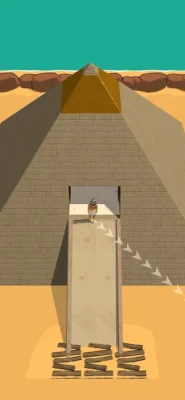
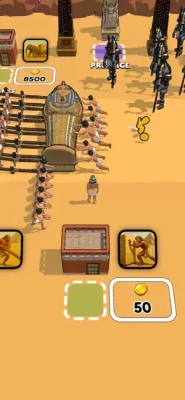
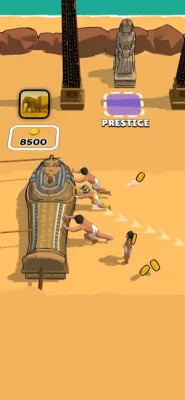
In Tomb Pusher, your main goal is to move a large tomb through the environment and eventually deliver it to its destination. Workers provide the muscle needed to keep the tomb moving, while upgrades and resources help you increase your overall efficiency.
The basic idea is easy to understand, but progressing efficiently requires some planning. Spending resources at the right time can make a noticeable difference, particularly when the tomb becomes harder to move or obstacles and enemies slow your progress.
The game is published by Yso Corp and is categorized as a Simulation title on the App Store. It is available for iPhone and iPad and requires iOS 15.0 or later.
Tomb Pusher Gameplay
The core gameplay revolves around several connected activities:
- Hiring and improving workers
- Pushing the tomb toward its destination
- Collecting and managing resources
- Increasing your overall pushing strength
- Dealing with obstacles and enemies
- Progressing through new areas
- Using upgrades to improve efficiency
- Making better use of rewards and available resources
The strongest strategy is to treat every resource as part of a larger progression system rather than spending everything immediately.
How to Play Tomb Pusher
At the beginning, concentrate on understanding how quickly your workers can move the tomb and how much each improvement changes your progress.
Your basic gameplay loop is:
Push → Earn resources → Upgrade → Push farther → Unlock more progress → Repeat
The further you progress, the more important it becomes to invest resources intelligently.
Don't rush to spend everything as soon as you receive it. If an upgrade can significantly improve your pushing speed or worker effectiveness, saving for that upgrade can produce better long-term results.
Tomb Pusher Strategy Guide
1. Improve Your Workforce First
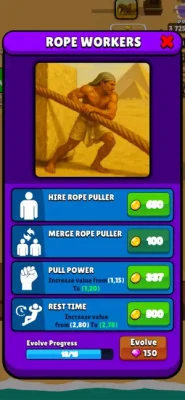
Your workers are the foundation of your progress. A stronger workforce means the tomb can move more efficiently, allowing you to reach new sections faster.
Whenever the game gives you an opportunity to increase worker effectiveness, consider whether that improvement will directly increase your ability to push the tomb.
Early upgrades should generally focus on improving your basic production and pushing capability rather than wasting resources on small improvements that have little immediate effect.
2. Don't Spend Resources Without a Plan
Resources can disappear quickly if you upgrade everything immediately.
Before purchasing an upgrade, ask:
- Does this increase my pushing power?
- Does it improve resource generation?
- Will it help me overcome the next obstacle?
- Is there a larger upgrade worth saving for?
A good rule is to prioritize upgrades that improve your overall progression rather than temporary benefits that have little impact.
3. Keep the Tomb Moving
The entire progression system revolves around getting the tomb farther along its route.
If your progress slows down, investigate what is holding you back. It may be insufficient worker strength, a missing upgrade, limited resources, or an encounter that requires additional power.
Rather than randomly upgrading different elements, identify the bottleneck and improve that area first.
4. Upgrade Before Major Progress Walls
If the tomb suddenly becomes much harder to move, don't repeatedly push against the same obstacle without improving your team.
Use the slowdown as a signal that your current setup needs an upgrade.
A well-timed upgrade can turn a frustrating section into a much faster progression phase.
5. Make Use of Available Rewards
Tomb Pusher includes advertising and optional in-app purchases. The App Store listing also shows options such as a Starter Pack, VIP Pack, resource packs, gems, and a Remove Ads purchase.
If you choose to watch optional ads for rewards, use those bonuses when they can meaningfully accelerate your current progression rather than spending them immediately.
For free-to-play players, patience and careful resource management can reduce the need to spend money.
6. Watch Your Progress During Difficult Sections
Some encounters can slow the game's pace considerably. Player reviews have specifically mentioned situations involving stronger enemies or "boss beast" encounters where players wanted clearer information about enemy health.
When facing a difficult section, concentrate on improving your damage, worker strength, or other relevant progression upgrades rather than repeatedly attempting the same encounter with an underpowered setup.
7. Balance Short-Term and Long-Term Upgrades
A useful progression strategy is to divide upgrades into two categories.
Short-term upgrades
- Help you overcome your current obstacle
- Increase immediate pushing power
- Get you moving again quickly
Long-term upgrades
- Improve your overall efficiency
- Increase resource generation
- Strengthen your workforce
- Make future sections easier
Use short-term upgrades when you're stuck, but don't neglect improvements that make the entire progression system stronger.
Best Tips for Tomb Pusher
Tip 1: Focus on the Current Bottleneck
Don't upgrade randomly. Find the exact reason your progress has slowed and address that problem first.
Tip 2: Save Valuable Resources
If you're close to an important upgrade, saving resources can be more effective than making several minor purchases.
Tip 3: Strengthen Workers Consistently
Your workforce determines how effectively you can keep the tomb moving, so worker improvements should remain an important part of your progression.
Tip 4: Don't Ignore Resource Generation
More pushing power is useful, but a strong resource economy helps you afford future upgrades faster.
Tip 5: Use Bonuses Strategically
If you receive bonus currency or resources from an optional reward, consider using them during a difficult progression section.
Tip 6: Expect Progress to Slow Down
Idle and simulation games are designed around gradual progression. A slower section does not necessarily mean you are doing something wrong.
Tip 7: Return After Making Improvements
When progress stalls, upgrade your operation and then return to the difficult section. The goal is to gradually increase your power rather than force progress with an underpowered team.
Tomb Pusher Workers and Upgrades
Workers are one of the most important parts of Tomb Pusher because the game's central objective depends on getting enough power behind the tomb.
When deciding where to invest:
Prioritize:
- Improvements that increase pushing capability
- Worker-related upgrades
- Resource generation improvements
- Upgrades that help overcome difficult sections
- Less important convenience improvements
A useful approach is to compare the cost of an upgrade with the amount of additional progress it can generate.
If one upgrade is expensive but dramatically improves your workforce, it may provide more value than several small upgrades.
Tomb Pusher Resource Management
Resource management becomes increasingly important as your progress increases.
Try to maintain three goals:
Build: Increase your workforce and basic strength.
Save: Keep enough resources available for important upgrades.
Spend: Invest when an upgrade provides a meaningful improvement.
Avoid spending all your resources simply because an upgrade button is available.
How to Progress Faster in Tomb Pusher
There is no single upgrade that solves every situation. Faster progression comes from combining several improvements.
A strong progression cycle looks like this:
1. Push the tomb
Start by making as much progress as possible with your current setup.
2. Identify the slowdown
Determine whether workers, resources, enemies, or another progression requirement is causing the problem.
3. Upgrade the weak point
Spend resources on the improvement that directly addresses the slowdown.
4. Push again
Return to the route and see how much additional progress the upgrade provides.
5. Repeat
Continue improving the weakest part of your operation.
This approach is more efficient than spending resources randomly.
Tomb Pusher Enemies and Difficult Encounters
Although the primary objective is pushing the tomb, some sections introduce enemies and tougher encounters that can interrupt your progress.
When facing a difficult enemy:
- Upgrade before repeatedly attempting the encounter.
- Strengthen your overall progression rather than relying on one improvement.
- Take advantage of available rewards.
- Avoid wasting resources on upgrades that do not help with the immediate problem.
- Be patient if the encounter takes longer than normal.
Player feedback has also mentioned a desire for clearer enemy health information during boss encounters, which suggests that judging progress during these sections can sometimes be difficult.
Is Tomb Pusher an Idle Game?
Tomb Pusher has strong idle and incremental gameplay elements because progression revolves around building up workers, resources, and improvements over time.
However, the central objective gives the game more direction than simply collecting idle rewards. You're working toward a specific goal: moving the tomb to its final destination.
Google Play currently describes the game as a Simulation title and says that players hire workers to push the tomb to its final destination.
Tomb Pusher Features
Egyptian-Themed Setting
The tomb-pushing concept gives the game an unusual Egyptian-inspired setting and visual identity.
Worker Management
Hiring and improving workers is central to increasing your pushing capability.
Incremental Progression
Your operation becomes stronger as you collect resources and invest in improvements.
Resource Management
Deciding when and where to spend resources is an important part of progression.
Casual Gameplay
The simple objective makes Tomb Pusher easy to understand without requiring complicated controls.
Free-to-Play Model
The game is free to download and includes advertising and optional in-app purchases.
Tomb Pusher Controls
Tomb Pusher is designed around straightforward mobile gameplay rather than complicated control schemes.
The emphasis is on managing your progress, improving your workers, collecting resources, and keeping the tomb moving.
This makes the game suitable for short sessions as well as longer progression-focused play.
Tomb Pusher Difficulty
The early stages are easy to understand because the game's objective is immediately clear. The challenge comes from gradually increasing progression requirements.
As your tomb moves farther, resource management and upgrades become more important.
The most difficult moments generally occur when your current workforce is no longer strong enough to maintain the same pace.
When that happens, stop trying to force progress and improve your setup.
Tomb Pusher Pros and Cons
Pros
- Simple and easy-to-understand objective
- Egyptian-themed setting
- Worker-based progression
- Resource and upgrade management
- Casual gameplay
- Incremental progression
- Free to play
Cons
- Progress can slow during difficult sections
- Advertising is part of the free-to-play experience
- Some players have reported pacing concerns
- Player feedback has mentioned limited information during certain enemy encounters
Tomb Pusher Game Information
Game: Tomb Pusher
Developer: Yso Corp
Genre: Simulation
Platforms: iPhone, iPad
Age Rating: 9+
Price: Free with optional in-app purchases
Requires: iOS 15.0 or later
Game Size: Approximately 283.9 MB on the current U.S. App Store listing
Languages: English plus 13 additional languages
Developer: Yso Corp
Google Play also lists Tomb Pusher for Android and Windows, with the Android version showing more than 1 million downloads.
Tomb Pusher Ratings and Player Feedback
The U.S. App Store currently lists Tomb Pusher at 4.6 out of 5 from 270 ratings. Player comments include praise for its entertaining idle gameplay, while other reviews mention pacing and requests for clearer information during difficult encounters.
On Google Play, the game currently has more than 8,000 reviews and more than 1 million downloads, showing that the game has attracted a substantial mobile audience.
Tomb Pusher Beginner's Strategy
If you're starting Tomb Pusher for the first time, follow this simple progression plan:
Early game
- Learn the basic pushing loop.
- Build your worker strength.
- Collect resources regularly.
- Avoid wasting valuable currency.
Mid game
- Focus on the upgrades that directly improve progression.
- Save for meaningful improvements.
- Prepare for stronger obstacles and enemies.
- Use optional bonuses strategically.
Later game
- Identify your biggest progression bottleneck.
- Invest heavily in the systems that solve that bottleneck.
- Maintain a healthy resource reserve.
- Don't spend everything on minor upgrades.
Tomb Pusher Advanced Strategy
Once you've learned the basic mechanics, efficiency becomes more important than simply spending resources.
Think of each upgrade as an investment.
For example, an upgrade that gives a small immediate benefit may be less useful than an upgrade that improves resource generation and helps you afford multiple future improvements.
Before spending, consider the upgrade's long-term return.
This simple habit can make your progression considerably smoother.
Common Tomb Pusher Mistakes
Spending Everything Immediately
Having resources available does not mean they need to be spent immediately.
Ignoring Your Workers
The workforce is central to the game's primary objective.
Repeating a Difficult Section Without Upgrading
If progress repeatedly stops at the same point, your current setup probably needs improvement.
Chasing Every Small Bonus
Not every reward has the same value. Focus on bonuses that contribute directly to your current goal.
Forgetting Resource Generation
Pushing power is important, but your ability to fund future upgrades matters just as much.
Frequently Asked Questions
What is Tomb Pusher?
Tomb Pusher is a simulation game where you hire workers and help push a tomb toward its final destination.
Is Tomb Pusher free?
Yes. Tomb Pusher is free to download, with advertising and optional in-app purchases.
Is Tomb Pusher available on iPhone?
Yes. The App Store lists Tomb Pusher for iPhone and iPad and requires iOS 15.0 or later.
Is Tomb Pusher available on Android?
Yes. Google Play currently lists Tomb Pusher for Android and reports more than 1 million downloads.
Who developed Tomb Pusher?
Tomb Pusher was developed by Yso Corp.
What type of game is Tomb Pusher?
Tomb Pusher is categorized as a Simulation game and features idle-style progression and worker management.
Does Tomb Pusher have upgrades?
The game revolves around hiring workers, gathering resources, and improving your operation so that you can continue pushing the tomb toward its destination.
Can you play Tomb Pusher offline?
The current Google Play player information indicates that an internet connection may be required, so players should not assume that the game supports full offline play.
Final Thoughts
Tomb Pusher takes a very simple idea and turns it into an incremental management challenge. The objective is straightforward, but getting the tomb farther requires thoughtful worker development, resource management, and well-timed upgrades.
The best approach is not to spend everything immediately. Instead, identify what is slowing your progress, strengthen that part of your operation, and then push forward again.
If you enjoy casual simulation games, idle progression, worker management, and games with simple objectives that gradually become more demanding, Tomb Pusher offers a distinctive Egyptian-themed experience built around one unusual question: how far can you push the tomb?
Rate the Game
User Reviews














Popular Games



















 Android
 iOS
iOS Windows
 Xbox
Xbox