
Latest Version
October 04, 2026
Gryphon Games UG
Simulation
iOS
0
Report a Problem
More About :game
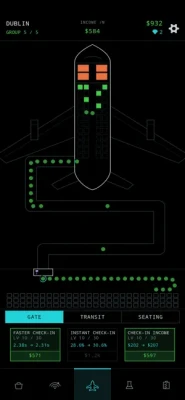
Instead of driving the vehicles yourself, you manage the systems that keep passengers moving. Travelers pass through gates, walk toward their vehicle, board, and take their seats. Your job is to identify bottlenecks and upgrade the right part of the operation.
The game begins with a small aircraft route and gradually expands into larger planes, buses, trains, and ships. As your income grows, you can unlock new destinations, research improvements, collect managers, participate in events, and eventually use prestige mechanics to push your earnings even further.
What Is Traffic Flow: Idle Tycoon Game?
Traffic Flow combines idle management, transportation simulation, tycoon progression, and incremental upgrades.
The central gameplay loop is simple:
Passengers arrive → check in → travel to the vehicle → board → take seats → vehicle departs → you earn money → upgrade your operation.
The interesting part is that upgrading one area can expose another bottleneck. Improving the gate may cause passengers to pile up during transit, while faster transit can create congestion at the seating stage.
That makes Traffic Flow more than a simple "buy upgrades and wait" idle game. Successful progression comes from understanding where your passenger flow is slowing down and investing accordingly.
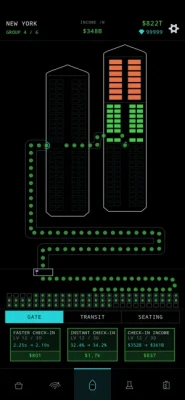
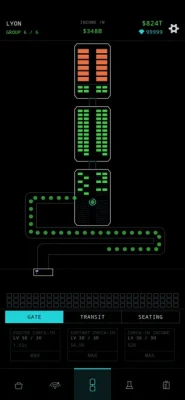
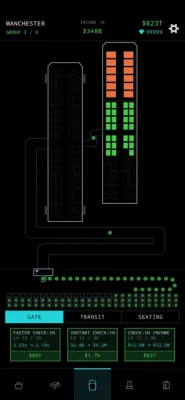
The App Store describes three main upgrade systems—Gate, Transit, and Seating—with 30 levels for each track.
Traffic Flow Gameplay Overview
The Three Main Upgrade Areas
1. Gate Upgrades
Gate upgrades improve how quickly passengers enter the system.
They can affect:
Check-in speed
Instant check-in capabilities
Income generated during check-in
Passenger throughput
A stronger gate is particularly useful when your queue is growing before passengers even begin moving toward the vehicle.
Strategy: Don't automatically maximize the Gate simply because it is the first stage. Watch the passenger flow and determine whether the gate is actually the limiting factor.
2. Transit Upgrades
Transit controls how quickly passengers move through the route toward boarding.
Important improvements include:
Faster passenger movement
Faster boarding
Increased income at the door
Better overall passenger throughput
Transit becomes increasingly important when passengers are entering the system quickly but spending too much time reaching the vehicle.
Strategy: If your entrance looks efficient but passengers are accumulating between the gate and the vehicle, Transit should become your priority.
3. Seating Upgrades
Seating determines how efficiently passengers take their final seats.
Important improvements include:
Faster seating
Instant seating effects
Increased income per seat
Improved final-stage throughput
A vehicle cannot depart until its available seats are filled, so poor seating performance can slow down the entire operation.
Strategy: When passengers reach the vehicle quickly but remain waiting for seats, invest in Seating rather than continuing to upgrade Gate.
The Most Important Traffic Flow Strategy: Find the Bottleneck
The biggest mistake beginners can make is upgrading everything equally.
Traffic Flow is built around a bottleneck system.
Imagine this:
Gate → Transit → Seating
If the Gate becomes extremely fast but Transit remains slow, passengers simply move from one queue into another.
Likewise, making Transit extremely fast does not help much if passengers then become stuck at Seating.
The best approach is to continuously watch the flow.
Simple Bottleneck Rule
Look at where passengers are waiting. Upgrade that area first.
This gives you a much better return than blindly spending every available dollar on the same upgrade.
Best Upgrade Strategy for Beginners
During the early game, your income is limited, so every upgrade matters.
A useful approach is:
Upgrade the weakest stage.
Watch the passenger queue.
Identify the next bottleneck.
Upgrade that area.
Increase income-producing upgrades when throughput is already balanced.
Repeat the process.
Don't try to create one incredibly fast stage while ignoring the other two.
A balanced transportation system usually produces a smoother flow and more consistent income.
How to Make Money Faster
Your main source of income comes from successfully processing passengers and filling seats.
The faster you can complete a vehicle cycle, the more frequently you can generate income.
Focus on three things:
Increase Passenger Throughput
Faster check-in means more passengers enter the system.
Reduce Waiting
Passengers sitting in a queue represent potential income that has not yet been converted.
Increase Revenue Per Passenger
Income-focused upgrades become increasingly valuable as your passenger numbers grow.
The game progresses from relatively small earnings early on to extremely large numbers later, with the developer describing late-game ship income reaching billions per minute.
Plane Strategy
Planes are the starting point for your transportation empire.
Your early aircraft provide a straightforward way to learn the core mechanics.
Focus on:
Filling seats consistently
Keeping passenger flow balanced
Improving the slowest stage
Unlocking stronger aircraft
Comparing route profitability
Building enough income for your next transportation milestone
As you progress, larger aircraft provide more seating opportunities and can introduce more valuable premium seating.
Plane Tip
Don't judge a route only by its total potential income.
A route with a larger vehicle may take longer to process. A smaller route that turns over quickly can sometimes provide a smoother income cycle.
Economy vs Premium Seating
Later aircraft can contain premium rows that generate substantially more income than standard economy seats.
This changes how you should think about upgrades.
A passenger entering a premium seat can be considerably more valuable than a passenger occupying a normal seat.
Therefore, once premium seating becomes available, pay attention to:
Premium seat income
Boarding speed
Seat completion
Vehicle turnaround time
A good strategy is to make sure premium seats are being filled efficiently instead of allowing the high-value part of the vehicle to become a bottleneck.
Unlocking Buses, Trains and Ships
Traffic Flow eventually expands beyond aircraft.
The game includes:
Planes
Buses
Trains
Ships
Each transportation category introduces a different passenger-flow challenge. Buses can provide faster turnaround, trains can fill multiple cars, while ships can handle much larger passenger queues.
New vehicle types are unlocked through research certificates, making transportation unlocks meaningful progression milestones rather than ordinary percentage upgrades.
Bus Strategy
Buses are useful for players who want faster transportation cycles.
Because routes can turn over more quickly, buses can provide an interesting alternative to simply pursuing the largest possible vehicle.
When managing buses:
Improve boarding speed
Keep queues moving
Avoid overspending on low-impact upgrades
Compare route income
Use managers strategically
Check whether the route's turnaround time justifies its income
Train Strategy
Trains introduce a larger passenger-processing challenge because multiple cars can be filled.
The important question becomes:
Can your passenger system feed every car efficiently?
If one part of the system is significantly slower than the others, your train's capacity does not automatically translate into better earnings.
Prioritize throughput before chasing maximum capacity.
Ship Strategy
Ships represent some of the largest passenger operations in the game.
They also create much longer queues, making bottleneck management even more important.
For ships:
Improve passenger throughput.
Increase boarding efficiency.
Strengthen seating speed.
Improve income per seat.
Watch where queues develop.
Upgrade the bottleneck rather than upgrading randomly.
Because ships can eventually generate enormous income, they become an important part of long-term progression.
Route and City Strategy
Traffic Flow includes a route map where you can select destinations and examine their passenger capacity and income potential.
Destinations include locations such as:
Dublin
Singapore
Cambridge
Brussels
Bilbao
Different routes can have different combinations of economy and premium seating, so changing destinations can significantly alter your earning potential.
Best Route Tip
Don't assume the newest destination is automatically the best destination for every situation.
Compare:
Seat count
Income potential
Premium seating
Passenger throughput
Upgrade requirements
How quickly the vehicle completes its cycle
The best route is the one that produces the strongest progression for your current upgrade level.
Research Guide
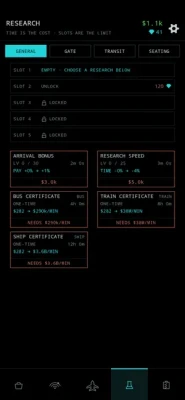
Research is an important part of long-term progression.
Research allows you to unlock new transportation opportunities and later provides additional improvements through prestige progression.
Recent updates added seven new research options that can be unlocked using Prestige Coins.
Research Strategy
Avoid spending research resources without understanding the benefit.
A useful priority is:
Unlock important transportation progression → improve income → improve throughput → strengthen long-term bonuses.
If you are unsure which research to choose, prioritize an upgrade that improves the system you are actively using rather than one that only becomes useful much later.
Manager Guide
Managers are another major progression system.
The game has expanded to 48 managers, giving players a collection and optimization system in addition to the basic upgrade mechanics. Managers can also be upgraded to higher levels, with recent updates raising the maximum manager level to 15.
How to Use Managers Effectively
Don't simply equip a manager because they are available.
Consider:
Which route you are currently using
Which vehicle produces most of your income
Where your biggest bottleneck is
Whether the manager improves income or throughput
Whether upgrading the manager provides a meaningful improvement
Your strongest managers should generally support the part of your transportation network that is generating the most value.
Idle Income Strategy
Traffic Flow is designed to continue progressing as an idle game, allowing players to step away and return later.
This means you should prepare your network before leaving the game.
Before going offline:
Choose your strongest profitable route.
Make sure your key upgrades are purchased.
Assign useful managers.
Check that the passenger system is operating efficiently.
Spend excess resources where they provide useful long-term value.
The goal is to make your transportation network productive even when you are not actively watching it.
Prestige Guide
Prestige becomes important during advanced progression.
Recent updates allow players to max out destinations and prestige them for increased income, while Prestige Coins can be used to unlock additional research.
Prestige should be viewed as a long-term investment rather than simply resetting progress.
When Should You Prestige?
A good time is when:
Your destination is fully developed.
The prestige reward meaningfully improves future progression.
Your current route has reached a plateau.
The reset will accelerate your next stage of development.
Don't prestige simply because the button becomes available. Consider how much faster your next progression cycle will be.
Traffic Rush Event Strategy
Traffic Flow also includes a weekly Traffic Rush event.
The event provides another way to earn rewards while competing through the game's progression systems. A global leaderboard tracks Miles earned through upgrades, routes, research, and managers.
Traffic Rush Tips
Start the event with a clear upgrade plan.
Avoid wasting resources on low-impact upgrades.
Prioritize actions that advance your overall progression.
Use managers effectively.
Check your leaderboard position regularly.
Save useful resources when doing so gives you a stronger event push.
The event is particularly useful for players who enjoy competition alongside the normally relaxed idle gameplay.
Best Beginner Build Order
If you're just starting Traffic Flow, try this general progression:
Stage 1 – Establish the Route
Get your first passenger route operating smoothly.
Stage 2 – Fix the Biggest Bottleneck
Watch the queue and identify whether Gate, Transit, or Seating is slowing the operation.
Stage 3 – Improve Income
Once passenger movement is balanced, start investing in income-producing upgrades.
Stage 4 – Expand
Work toward larger vehicles and new transportation categories.
Stage 5 – Research
Use research to unlock major progression improvements.
Stage 6 – Managers
Collect and upgrade managers that complement your most profitable routes.
Stage 7 – Prestige
Once destinations reach their maximum development, consider prestige for stronger long-term income.
Advanced Traffic Flow Strategy
Don't Max Every Upgrade Immediately
Maximum-level upgrades are tempting, but your resources are limited.
Instead, ask:
Which upgrade will increase my income or throughput the most right now?
This question should guide almost every purchase.
Watch the Queue, Not Just the Money
Your income number tells you what happened.
The passenger queue tells you why it happened.
If a queue suddenly grows at the gate, your Gate system needs attention.
If passengers are leaving the gate but moving slowly, focus on Transit.
If passengers reach the vehicle but remain unseated, improve Seating.
This simple habit can dramatically improve your decision-making.
Balance Speed and Income
There are two broad upgrade types:
Speed upgrades increase throughput.
Income upgrades increase the value of completed passenger actions.
The strongest strategy is usually to balance the two.
There is little benefit in making passengers extremely fast if your income per passenger remains weak. Likewise, high income per seat is less useful when passengers take too long to reach those seats.
Common Mistakes to Avoid
Mistake 1: Upgrading One Track Exclusively
A huge Gate upgrade cannot compensate for extremely slow Seating.
Mistake 2: Ignoring Queues
A growing queue is a warning sign that your system has a bottleneck.
Mistake 3: Chasing Capacity Without Throughput
A larger vehicle does not automatically mean better progression if you cannot fill it efficiently.
Mistake 4: Spending Resources Randomly
Always ask what the next upgrade actually improves.
Mistake 5: Ignoring Managers
Managers can become increasingly important as your network expands.
Mistake 6: Prestiging Too Early
Prestige is most useful when the long-term benefit justifies the reset.
Mistake 7: Forgetting Events
Traffic Rush provides another progression opportunity and a global leaderboard.
Is Traffic Flow: Idle Tycoon Game Relaxing?
Yes. One of the game's defining characteristics is its deliberately calm presentation.
There are no lives or traditional fail states, and the game can be played one-handed or with the sound turned off. The visual design centers around a neon-on-dark presentation and an easy-to-follow passenger flow.
That makes it a good fit for players who enjoy:
Idle games
Tycoon games
Management simulations
Transportation games
Incremental progression
Relaxing mobile games
Airport and travel management
Strategy through optimization
Traffic Flow: Idle Tycoon Game Features
Idle transportation management
Passenger-flow optimization
Gate, Transit and Seating upgrades
Planes and larger aircraft
Bus routes
Train routes
Ship routes
Global destinations
Economy and premium seating
Research system
Manager collection
Manager upgrades
Idle income
Destination progression
Prestige system
Prestige Coins
Traffic Rush weekly event
Global leaderboard
Relaxing gameplay
One-handed play
No traditional fail state
The game's recent updates have also added 48 managers, more research, prestige progression, additional languages, a mailbox, and performance improvements.
Traffic Flow: Idle Tycoon Game Tips and Tricks
Tip 1: Always identify the current bottleneck before buying an upgrade.
Tip 2: Keep Gate, Transit, and Seating reasonably balanced.
Tip 3: Watch passenger behavior instead of looking only at income.
Tip 4: Prioritize upgrades that improve your current route.
Tip 5: Compare destinations rather than assuming the newest route is best.
Tip 6: Use premium seating as a major income opportunity when available.
Tip 7: Assign managers according to your most valuable transportation operation.
Tip 8: Use idle periods to generate additional income.
Tip 9: Research upgrades that support your current progression.
Tip 10: Consider prestige when the long-term income boost is worthwhile.
Tip 11: Participate in Traffic Rush if you want additional rewards and leaderboard progression.
Tip 12: Don't spend every resource immediately. Saving for an important unlock can be more valuable than several small upgrades.
Pros and Cons
Pros
Simple but surprisingly strategic passenger-flow system
Relaxing idle gameplay
Multiple transportation types
Large progression curve
Route and destination choices
Manager collection system
Research and prestige mechanics
Weekly competitive event
Easy-to-understand visual presentation
Suitable for short or longer play sessions
Cons
Players who prefer active gameplay may find the idle structure slow
Progress depends heavily on incremental upgrades
The most effective strategy requires paying attention to bottlenecks
Some players may prefer more direct control over vehicles
Monetization and reward systems may not appeal to everyone
The App Store currently lists Traffic Flow as free with in-app purchases and advertising, while its recent reviews show both positive reactions to its relaxing simplicity and criticism around certain progression and reward experiences.
Ratings and Game Information
Game: Traffic Flow: Idle Tycoon Game
Developer: Gryphon Games UG
Genre: Simulation
Platform: iPhone
Age Rating: 9+
Business Model: Free with in-app purchases
iOS Requirement: iOS 17.0 or later
Game Size: Approximately 106 MB on the current U.S. App Store listing
Core Theme: Transportation management and idle tycoon simulation
The current U.S. App Store listing shows a 4.2/5 rating from 71 ratings, although ratings can change as more players review the game.
Who Should Play Traffic Flow?
Traffic Flow: Idle Tycoon Game is best suited to players who enjoy watching a system become more efficient over time.
If you like idle tycoon games, airport management, transportation simulations, incremental games, business simulators, and optimization-focused strategy, the game's passenger bottleneck system gives it a distinctive twist.
It is especially appealing if you prefer relaxed progression rather than games built around constant combat, timers, or difficult failure conditions.
Final Verdict
Traffic Flow: Idle Tycoon Game takes a simple idea—moving passengers from a queue into seats—and turns it into an incremental transportation management system.
Its strongest feature is the bottleneck mechanic. Instead of simply buying the biggest available upgrade, players have to understand where passengers are getting stuck and improve that part of the network.
Starting with a small aircraft operation and eventually expanding into planes, buses, trains, and ships gives the game a clear sense of progression. Research, managers, destinations, prestige, and Traffic Rush add additional layers once the basic passenger-flow system becomes familiar.
For players looking for a relaxing idle tycoon game with transportation strategy, Traffic Flow is worth trying.
Frequently Asked Questions
Is Traffic Flow: Idle Tycoon Game free?
Yes. The game is free to download and includes advertising and optional in-app purchases.
What is the goal of Traffic Flow?
The goal is to efficiently move passengers through gates, transit areas, and seating, earn income, upgrade your transportation network, and expand into larger and more profitable routes.
What vehicles are available?
The game includes planes, buses, trains, and ships.
What is the best upgrade in Traffic Flow?
There is no single best upgrade for every situation. The strongest upgrade is normally the one that fixes your current bottleneck.
How do I earn more money?
Improve passenger throughput, increase income per passenger or seat, unlock stronger routes, use managers effectively, and expand into more profitable transportation operations.
What are Managers?
Managers are collectible characters that can be used to improve your transportation operations. Recent updates expanded the collection to 48 managers and increased manager upgrade levels.
What is Prestige?
Prestige allows developed destinations to be reset in exchange for stronger long-term income progression and Prestige Coins for additional research.
Does Traffic Flow have events?
Yes. Traffic Rush is a weekly event featuring rewards and a global leaderboard.
Can I play Traffic Flow casually?
Yes. The game is designed around relaxed idle progression, with no traditional fail state and support for short, one-handed play sessions.
Rate the Game
User Reviews











Popular Games















 Android
 iOS
iOS Windows
 Xbox
Xbox