
Latest Version
October 09, 2026
Nebula Studio
Puzzle
iOS
0
Report a Problem
More About :game
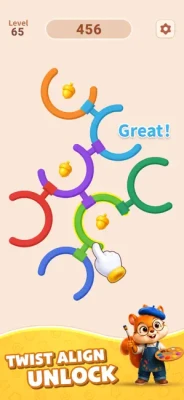
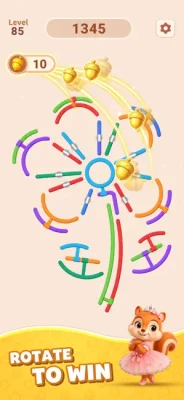
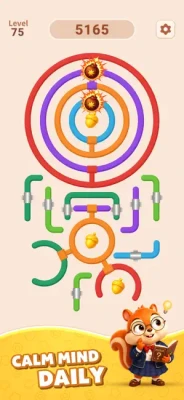
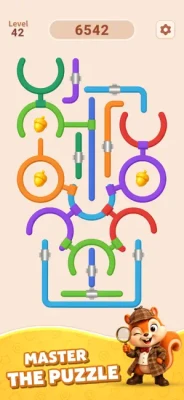
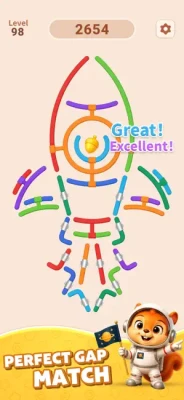
Rotate Rings is a logic-based puzzle game developed by Nebula Studio. The objective is to manipulate interconnected rings until their openings line up and the individual pieces can be released.
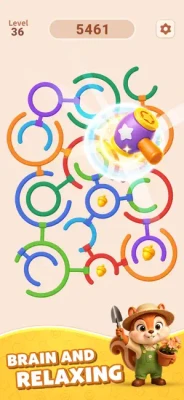
At first, the task seems straightforward: rotate a ring, find the correct angle, and create enough space to free the structure. However, the challenge becomes more interesting when several rings overlap or depend on one another. Moving one piece can affect your ability to release another, making the order of your actions just as important as the direction of rotation.
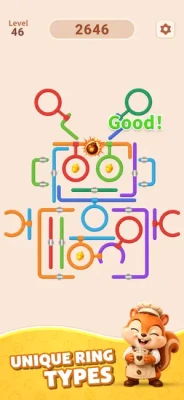
The game features different mechanical shapes, including C-locks, D-rings, S-flex links, and triangular frames. These designs encourage players to study each puzzle rather than rely on a single solution method.
Rotate Rings Gameplay Features
Ring Rotation and Gap Alignment
The central mechanic involves rotating rings until their openings align correctly. A small change in angle can determine whether a connected piece remains trapped or becomes free to move.
Interlocking Mechanical Puzzles
Many stages contain several connected elements. Players must understand how the pieces fit together and determine which ring needs to move first.
Different Ring Shapes
The game introduces varied mechanical designs, including C-shaped locks, D-shaped rings, flexible S-shaped links, and triangular frames. Each shape can require a different approach to positioning and release.
Hundreds of Puzzle Levels
Rotate Rings advertises hundreds of handcrafted levels. The puzzles provide opportunities to develop spatial awareness and learn more effective ways to manipulate complex arrangements.
Helpful Boosters
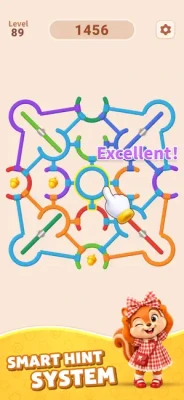
Hints are available to help players who become stuck on difficult puzzles. Use assistance when necessary, but try to understand the suggested move so you can apply the same reasoning to later stages.
Smooth Touch Controls
The game uses tap-and-drag controls to rotate rings. This makes it easy to experiment with different positions and observe how each adjustment changes the puzzle.
Relaxing but Challenging Gameplay
Rotate Rings offers a measured puzzle-solving experience rather than a traditional action challenge. The difficulty comes from analyzing connections, planning moves, and finding a workable sequence.
How to Play Rotate Rings
The main objective is to untangle the connected structures by rotating the rings and aligning their openings.
Study the puzzle. Examine the shapes, connections, and openings before moving anything.
Identify the trapped pieces. Determine which rings are preventing other components from moving freely.
Select a ring. Use the touch controls to manipulate the piece you want to move.
Rotate carefully. Drag the ring toward a position that brings its opening closer to the required alignment.
Check the connections. Observe whether the adjustment creates a path for another piece to move or unlock.
Repeat in the correct order. Continue repositioning the connected elements until the structure can be untangled.
Complete the stage. Release the interlocking pieces and move on to the next puzzle.
The key is to understand how the pieces interact. Rotating a ring repeatedly without considering the surrounding structure can make the puzzle more confusing.
Complete Rotate Rings Strategy Guide
1. Inspect Every Ring Before Moving
Begin by looking at the entire arrangement. Identify the openings, overlapping sections, and points where two or more pieces appear to be connected.
Try to determine which pieces are genuinely blocking movement and which can already be adjusted freely.
This initial inspection helps you avoid unnecessary rotations and gives you a clearer idea of how the puzzle might be solved.
2. Understand How Openings Work
The position of each opening is one of the most important details in Rotate Rings.
A ring may need to rotate until its gap lines up with a connected piece's path. If the opening is facing the wrong direction, the piece may remain trapped even when the ring looks almost correctly positioned.
Pay attention to the orientation of the gap, not just the overall shape of the ring. A small adjustment may be enough to create the alignment you need.
3. Find the Most Restrictive Connection
Some pieces have very little freedom to move because they are trapped by several surrounding rings.
Identify these restrictive connections early. They often determine the order in which the rest of the puzzle must be solved.
Instead of starting with the easiest-looking ring, ask which connection is preventing the greatest amount of movement. Finding a way to release that restriction can simplify the entire structure.
4. Solve the Puzzle From the Outside In When Appropriate
In some layouts, the outer rings are easier to manipulate and can provide access to inner pieces. In others, an inner connection is the main obstacle.
Examine the actual arrangement before choosing a direction. If an outer ring blocks several components, try resolving that connection first. If the outer pieces can already move freely, focus on the internal connection that keeps the structure locked.
Treat this as a flexible strategy rather than a rule that applies to every level.
5. Rotate One Ring at a Time
When learning a new puzzle, change one ring's position and observe the result before making another adjustment.
This makes it easier to understand which movement affects which connection. If you rotate several pieces rapidly, you may lose track of the position that created a useful opening.
Controlled experimentation gives you more information with every move.
6. Look for a Sequence of Unlocking Moves
A difficult puzzle may require several actions before any piece can be released.
Think of each move as part of a sequence. One ring may need to rotate to free a second piece, which then creates room for a third ring to move.
Ask yourself what must happen immediately before the final piece can escape. Then work backward to identify the adjustments needed to reach that position.
This approach is often more effective than trying random rotations until something works.
7. Pay Attention to Different Shapes
Not every mechanical shape behaves in the same way.
C-shaped locks have an opening that may provide a path for another piece. D-shaped rings have a different profile and may require a different orientation. S-shaped links can create more complicated connections, while triangular frames may restrict movement in ways that circular rings do not.
Study how each shape sits inside the overall structure. Understanding its orientation can help you identify which rotation is likely to be useful.
8. Avoid Repeating the Same Unsuccessful Move
If a rotation does not create a useful opening, do not keep repeating it without reconsidering the arrangement.
Return to the original position if needed and examine the other available options. The blocked connection may depend on a different ring, or you may need to change the order of your moves.
Every unsuccessful attempt should help you eliminate an ineffective approach or understand the puzzle more clearly.
9. Use Hints as a Learning Tool
If the game provides a hint and you cannot identify a productive move, consider using it.
Before accepting the hint, review the pieces that appear to be blocking one another. After seeing the suggested move, examine why that rotation helps and what it allows you to do next.
This turns assistance into an opportunity to learn the puzzle's underlying logic rather than simply bypassing the challenge.
10. Work Backward From the Final Release
Sometimes it is easier to imagine the completed puzzle first.
Consider which piece needs to move out of the structure and what opening would allow that movement. Then identify which ring must rotate to create the opening and whether another piece blocks that rotation.
Working backward can reveal a useful sequence when the initial arrangement looks confusing.
11. Recheck the Puzzle After Every Successful Move
When a ring becomes free or a connection changes, the entire puzzle may become easier to solve.
Pause after each important movement and inspect the new arrangement. Previously blocked openings may now be accessible, and a different ring may have become the main obstacle.
Avoid continuing with a plan that no longer fits the updated structure.
12. Develop a Consistent Solving Routine
Use this simple process when approaching a difficult stage:
Identify all rings and their openings.
Locate the connections that prevent movement.
Decide which piece is most important to free.
Find the rotation that could remove the restriction.
Make one controlled adjustment.
Observe how the arrangement changes.
Repeat until the connected pieces can be released.
With practice, you will become more comfortable recognizing useful alignments and predicting how one movement affects the remaining rings.
Advanced Rotate Rings Tips and Tricks
Focus on the openings first. The position of each gap often provides more useful information than the overall appearance of a ring.
Look for dependencies. If one piece cannot move until another is released, solve the blocking connection first.
Avoid unnecessary rotations. Every movement should help you understand the structure, test an idea, or create a useful alignment.
Use small adjustments. Fine movements can help you identify the angle at which two openings line up.
Study the shape of every connection. Different ring designs can interact in different ways, so do not assume one method works for every puzzle.
Think backward when stuck. Imagine the final piece being released and work out which openings and rotations would make that possible.
Learn from completed levels. Remember which patterns required an outer ring to move first and which depended on an internal connection.
Use hints selectively. Try to identify the obstacle yourself before asking the game for assistance.
Common Rotate Rings Mistakes to Avoid
Rotating Without a Plan
Moving rings randomly can make it difficult to understand the original arrangement. Identify a specific objective before each rotation.
Ignoring the Openings
A ring may look correctly positioned while its opening remains misaligned with the required path. Always check the gap's orientation.
Moving the Wrong Piece First
Some rings cannot be released until another connection is resolved. Look for the most restrictive part of the structure before deciding where to begin.
Changing Too Many Positions at Once
Rapidly rotating several rings makes it harder to understand cause and effect. Adjust one piece at a time when learning a new layout.
Overlooking Different Ring Shapes
C-locks, D-rings, S-flex links, and triangular frames may create different restrictions. Study the shape and position of each piece rather than treating every connection identically.
Using Hints Too Early
Hints can save time, but examining the puzzle first helps you develop your own problem-solving skills. Use assistance when you have genuinely run out of ideas.
Is Rotate Rings Good for Beginners?
Yes. Rotate Rings is relatively easy to understand because its main controls involve tapping and dragging to rotate pieces. The early learning process focuses on recognizing openings and understanding how connected rings interact.
As the puzzles become more complicated, players need to think about move order, spatial relationships, and the consequences of changing a ring's position.
Beginners can improve by moving slowly, observing each result, and identifying one obstacle at a time. Players who already enjoy mechanical puzzles and spatial reasoning challenges may appreciate the more complicated interlocking designs.
Rotate Rings Pros and Cons
Pros
Simple tap-and-drag controls.
Satisfying ring rotation and unlocking mechanics.
Different mechanical shapes and connections.
Hundreds of advertised puzzle levels.
Encourages careful observation and logical thinking.
Helpful hints for difficult stages.
Suitable for short sessions or longer puzzle-solving breaks.
Cons
Some puzzles can require considerable patience.
Repeated experimentation may become frustrating when the correct sequence is unclear.
Players who prefer fast-paced action may find the deliberate gameplay too slow.
Advertising is present, according to the App Store listing, and its frequency may affect the experience.
Optional assistance and purchase details should be checked in the current version.
Rotate Rings Game Information
Game title: Rotate Rings
Subtitle: Logic Puzzle: Twist to Unlink
Developer: Nebula Studio
Seller: HURELAX PTE. LTD.
Genre: Puzzle, logic, spatial reasoning
Game type: Single-player mechanical puzzle
Main objective: Rotate interlocking rings and align openings to release connected pieces
Controls: Tap and drag
Puzzle elements: C-locks, D-rings, S-flex links, and triangular frames
Level design: Hundreds of advertised handcrafted puzzles
Hints: Available
Platforms: iPhone and iPad
Minimum operating system: iOS 15.0 or later; iPadOS 15.0 or later for iPad
Pricing: Free to download, with in-app purchases where offered
Advertising: The App Store listing indicates that the game contains advertising
Best suited for: Casual puzzle fans, logic-game enthusiasts, and players who enjoy spatial challenges
Game features, compatibility, pricing, and advertising may change with updates. Check the current store listing for the latest details.
Rotate Rings Frequently Asked Questions
What is Rotate Rings?
Rotate Rings is a spatial logic puzzle game in which you rotate interlocking rings, align their openings, and release connected pieces to complete each level.
How do you play Rotate Rings?
Tap and drag to rotate the rings. Study their openings and connections, find the pieces that are blocking movement, and adjust the rings until the structure can be untangled.
What is the best strategy for Rotate Rings?
Identify the most restrictive connection first. Then work out which ring needs to rotate to create a useful opening. Make controlled adjustments and reassess the arrangement after each important move.
How do you solve difficult Rotate Rings levels?
Look carefully at the orientation of each opening and the way the rings overlap. Identify which piece must be released first and work backward to determine the required sequence of rotations.
What are the different ring shapes in Rotate Rings?
The game advertises C-locks, D-rings, S-flex links, and triangular frames. These shapes create different types of mechanical connections that players must understand to solve the puzzles.
Does Rotate Rings have hints?
Yes. The game advertises hints designed to help players discover a next move when a puzzle becomes difficult.
Is Rotate Rings free to play?
The game is listed as free to download. Check the current App Store listing for available in-app purchases and other optional features.
Can you play Rotate Rings on an iPhone?
Yes. Rotate Rings is available for iPhone and iPad. The current listing specifies iOS 15.0 or later for iPhone and iPadOS 15.0 or later for iPad.
Is Rotate Rings a relaxing game?
Its measured pace and focus on logical problem-solving can make it relaxing for players who enjoy puzzles. More complex stages may require patience and repeated experimentation.
Does Rotate Rings contain advertisements?
Yes. The App Store listing indicates that the game contains advertising. The frequency and presentation of advertisements may vary with the version and gameplay experience.
How can you improve at Rotate Rings?
Learn to recognize the openings, understand how the different shapes connect, and consider the consequences of each rotation. Controlled experimentation helps you discover useful movement patterns.
Does Rotate Rings have many levels?
The developer advertises hundreds of handcrafted levels, offering a range of puzzles with different arrangements and mechanical challenges.
Final Verdict: Is Rotate Rings Worth Playing?
Rotate Rings is a good option for players who enjoy mechanical puzzles, spatial reasoning, and the satisfaction of releasing tightly connected pieces. Its controls are easy to learn, but the more complicated arrangements require careful observation and a sensible sequence of moves.
The most effective approach is to study the openings, locate the restrictive connections, and rotate one ring at a time. By learning how different shapes interact, you can solve puzzles more confidently and rely less on hints.
If you enjoy casual logic games that reward patience and thoughtful experimentation, Rotate Rings is worth trying.
Rate the Game
User Reviews







Popular Games


















 Android
 iOS
iOS Windows
 Xbox
Xbox