

Latest Version
October 09, 2026
Nebula Studio
Puzzle
iOS
0
Report a Problem
More About :game
What Is GOGO! Blast?
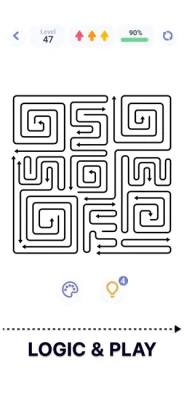
GOGO! Blast is a casual logic puzzle game developed by Nebula Studio. Its central challenge is to remove arrows from a crowded arrangement without attempting moves that are blocked by other pieces.
Every arrow has a fixed direction. Your job is to identify which arrows can leave the board and determine the order in which to tap them. Removing one arrow may open a path for another, gradually revealing a sequence that clears the entire puzzle.
The game combines straightforward controls with increasingly complicated layouts. As more arrows fill the board, it becomes important to examine their directions, recognize blocked paths, and avoid making moves that interfere with the remaining sequence.
Some arrows feature animal heads instead of conventional arrow tips, adding a playful visual element to the puzzle design. The game is suitable for short breaks as well as longer sessions spent working through challenging boards.
GOGO! Blast Gameplay Features
Directional Arrow Puzzles
Every arrow moves in the direction it points. Players must check the arrow's path before tapping it and determine whether it can leave the board without colliding with another piece.
Sequence-Based Gameplay
The order of your moves matters. Removing an accessible arrow can uncover a path for another, while choosing a blocked arrow too early can interrupt your progress.
Colorful Arrow Designs
The game uses clear, colorful arrows that make the board easier to read. Some pieces feature animal heads, giving the visual design a distinctive touch.
Thousands of Puzzle Levels
GOGO! Blast advertises thousands of levels with varied layouts and gradually increasing difficulty. New arrangements encourage players to adapt their approach instead of relying on the same sequence every time.
Relaxing, Untimed Play
The game's description emphasizes playing at your own pace without time pressure. This allows you to study each board, consider possible moves, and work through difficult puzzles without racing against a countdown.
Simple Touch Controls
The controls are easy to learn: tap an arrow when you determine that it can move out in its indicated direction. The real challenge lies in deciding which arrow to select first.
Offline Gameplay
The developer advertises offline play, making GOGO! Blast convenient for travel and situations where an internet connection is unavailable. Online-dependent features, if present, may still require connectivity.
A Casual Brain Teaser
The game encourages players to recognize patterns, anticipate consequences, and plan a sequence of actions. It combines the accessibility of a casual mobile game with the reasoning required by a logic puzzle.
How to Play GOGO! Blast
The objective is to clear the board by removing every arrow in a valid sequence.
Study the board. Examine the direction of every arrow and identify the pieces near the edges.
Check each arrow's path. Determine whether the arrow has a clear route in the direction it points.
Find an available move. Look for an arrow that can leave without being blocked by another piece.
Tap the arrow. Remove it from the board and observe how the layout changes.
Recheck the remaining arrows. The space created by a successful move may make another arrow available.
Plan the next move. Choose an arrow that opens additional paths or preserves access to other pieces.
Clear the board. Continue until every arrow has been removed and the level is complete.
The most important rule is simple: do not choose an arrow just because it looks easy to remove. Check its path and consider how the move affects the rest of the puzzle.
Complete GOGO! Blast Strategy Guide
1. Inspect the Entire Board Before Tapping
Your first move can influence the rest of the level. Before tapping anything, scan the board and look at the direction each arrow points.
Pay particular attention to arrows positioned near the edges, arrows surrounded by several other pieces, and arrows whose paths appear to cross crowded sections.
This quick inspection helps you identify likely opening moves and avoid wasting attempts on arrows that cannot leave yet.
2. Understand the Direction of Every Arrow
An arrow's direction determines the route it follows when you tap it. An arrow pointing upward needs a clear path upward; a downward-pointing arrow needs a clear route downward. The same principle applies to left- and right-facing arrows.
Do not focus only on where an arrow begins. Follow its direction toward the edge and check whether another piece blocks the way.
Understanding the route is the foundation of every successful move.
3. Start With Arrows That Have Clear Paths
Arrows with unobstructed routes are often the best candidates for your first moves.
Removing these pieces can create additional space and make previously blocked arrows accessible. However, do not automatically remove every available arrow without considering its consequences.
When several arrows can move, prefer one that opens an important section of the board or helps free multiple pieces.
4. Work Backward From the Most Blocked Arrows
Sometimes the easiest way to solve a puzzle is to focus on the arrow that seems hardest to remove.
Follow its direction and identify which pieces obstruct its route. Then ask what must happen before those obstructions disappear.
If one blocking arrow needs to leave first, check its own path. Continue tracing the dependencies until you find an arrow that can move immediately.
This backward approach helps you discover the sequence required to release the most restricted pieces.
5. Recognize Dependencies Between Arrows
Some arrows cannot leave until other arrows have been removed. These relationships form a sequence of dependencies.
For example, an arrow may block the route of a second arrow, while the second arrow is itself prevented from leaving by a third. The puzzle becomes easier when you identify which piece must move first and which pieces depend on it.
Think of every successful removal as a step that unlocks new possibilities.
6. Prioritize Moves That Open More Space
When two arrows are both available, consider which removal creates the greatest improvement.
One arrow may leave without affecting the rest of the layout. Another may open a crowded area and allow several additional arrows to move.
The second option may be more valuable because it creates flexibility. Whenever possible, choose moves that reduce congestion and make the remaining board easier to read.
7. Avoid Tapping Blocked Arrows
A common mistake is selecting an arrow because its direction appears to point toward an open edge without checking the entire route.
Look along the arrow's path, not just at the space immediately in front of its tip. Another arrow may obstruct the route farther along.
If a move is unavailable or penalized in your current version, avoid repeatedly testing blocked pieces. Study the path and find the obstruction first.
8. Reassess the Board After Every Move
A successful removal can change the entire puzzle.
An arrow that was previously blocked may now have a clear route, while another arrow may become easier to identify because the board is less crowded.
After every tap, pause briefly and scan the remaining pieces again. Do not continue following an old plan if the new arrangement reveals a better sequence.
9. Use Animal-Head Arrows Carefully
Some GOGO! Blast arrows feature animal heads instead of conventional arrow tips. These pieces add a playful twist to the visual design, and player feedback describes them as having a special behavior: they can move automatically when their path becomes available.
Observe how these arrows behave in your current level. If an animal-head arrow cannot leave immediately, check whether another move will clear its route and allow it to move later.
Avoid assuming every arrow behaves identically when the game indicates otherwise.
10. Break Complicated Boards Into Smaller Sections
A crowded board can be difficult to understand all at once.
Divide it mentally into smaller areas and examine the arrows in each section. Identify the available exits, note which arrows block others, and then consider how the sections interact.
Once you have solved one part of the board, return to the full layout to see which new moves have become available.
This method keeps complicated puzzles manageable without ignoring connections between different areas.
11. Avoid Unnecessary Moves
An arrow may be available to remove, but that does not always make it the most useful choice.
Before tapping, ask yourself:
Is its path definitely clear?
Will removing it open a useful route?
Does another arrow depend on this space becoming available?
Could a different move simplify the board more effectively?
These questions encourage deliberate play and help you avoid decisions that complicate the remaining sequence.
12. Learn From Difficult Levels
When you become stuck, return to the arrows that remain blocked and work backward from their routes.
Identify the first obstruction, determine which arrow must leave, and repeat the process until you find a clear starting move.
Over time, you will become faster at recognizing common patterns and understanding how one removal changes the rest of the board.
Advanced GOGO! Blast Tips and Tricks
Follow each arrow to its exit. Never judge a path only by the space near the arrowhead. Check the entire route toward the edge.
Look for the most restricted arrow. The piece with the most complicated path can reveal which other arrows need to move first.
Think in sequences. Plan several moves ahead when possible, but reassess after each successful removal.
Choose moves that reduce congestion. Removing an arrow that opens a crowded area can be more useful than clearing an isolated piece.
Use backward reasoning. If an arrow cannot leave, identify its obstruction and work backward until you find a piece that can move.
Keep the board readable. Examine the remaining layout after every tap instead of trying to memorize the entire sequence from the beginning.
Observe special arrow behavior. If an animal-head arrow behaves differently from a standard arrow, account for that behavior when planning your moves.
Stay patient. Since the game is designed for untimed play, use the opportunity to study the puzzle rather than tapping rapidly.
Common GOGO! Blast Mistakes to Avoid
Tapping the First Arrow You Notice
The first visible arrow may be blocked or may be less useful than another available piece. Inspect the whole board before committing to a move.
Ignoring the Full Arrow Path
A route may look clear near the starting point but remain obstructed farther along. Follow the direction all the way toward the exit.
Forgetting Which Arrows Depend on Others
Removing an arrow can create a path for another piece. If you fail to notice these relationships, you may overlook the most efficient sequence.
Repeating the Same Failed Attempt
If an arrow remains blocked, identify the obstruction instead of repeatedly selecting it. Remove the blocking piece first when possible.
Making Moves Without Rechecking the Board
Every successful removal changes the layout. Continuing with an outdated plan can cause you to miss newly available arrows.
Rushing Through a Difficult Puzzle
Fast tapping is not a substitute for planning. Use the untimed format to evaluate the available paths and determine a valid sequence.
Is GOGO! Blast Good for Beginners?
Yes. GOGO! Blast is easy to learn because its main interaction involves tapping arrows and understanding the direction in which they move.
Beginners can start by identifying arrows with clear paths, then gradually learn how to recognize blocked routes and plan a sequence of removals.
More experienced puzzle players can challenge themselves by solving crowded boards efficiently, identifying dependencies, and predicting how a single move will change the remaining layout.
The combination of simple controls and increasingly complicated arrangements makes GOGO! Blast a suitable option for players who enjoy casual logic games without time pressure.
GOGO! Blast Pros and Cons
Pros
Simple and accessible touch controls.
Clear directional arrow mechanics.
Puzzles that reward planning and logical reasoning.
Colorful arrows and playful animal-head designs.
Thousands of advertised levels.
No time pressure during ordinary puzzle solving, according to the game's description.
Offline play is advertised.
Suitable for short sessions and longer puzzle-solving breaks.
Cons
Some levels can be difficult when several arrows block one another.
Players who prefer action-focused gameplay may find the experience too slow.
Repeated arrow puzzles may feel familiar over time.
Advertising may interrupt the experience; check the current version and available settings for details.
Some special arrow behaviors may take time to understand.
GOGO! Blast Game Information
Game title: GOGO! Blast
Subtitle: Fun & Relaxing Puzzle
Developer: Nebula Studio
Seller: HURELAX PTE. LTD.
Genre: Puzzle, casual logic
Game type: Single-player arrow escape puzzle
Main objective: Clear the board by removing arrows in a valid sequence.
Core mechanics: Directional movement, blocked-path detection, sequence planning, and logical deduction.
Controls: Tap-based touch controls.
Special visual elements: Colorful arrows and animal-head arrows.
Level content: Thousands of advertised puzzle levels.
Platforms: iPhone and iPad.
Minimum operating system: iOS 15.0 or later; iPadOS 15.0 or later.
Pricing: Free to download.
Offline support: Advertised by the developer.
Best suited for: Casual gamers, arrow puzzle fans, and players who enjoy logic challenges.
Device compatibility, available features, pricing, and advertising may change with updates. Check the current App Store listing for the latest information.
GOGO! Blast Frequently Asked Questions
What is GOGO! Blast?
GOGO! Blast is a casual arrow puzzle game where players tap arrows in the correct order to clear the board. Each arrow moves in its indicated direction, so finding a valid sequence is essential.
How do you play GOGO! Blast?
Inspect the arrows, check the direction of each path, and tap an arrow only when it can leave the board. Continue removing available arrows until the puzzle is cleared.
What is the best strategy for GOGO! Blast?
Start with arrows that have clear paths, then prioritize moves that unblock other pieces. If an arrow is trapped, identify the obstruction and work backward to find the move that must happen first.
Is GOGO! Blast difficult?
The controls are simple, but the difficulty increases as layouts become more complicated. Players must learn to recognize blocked routes, understand dependencies, and plan their moves in the correct order.
Does GOGO! Blast have thousands of levels?
Yes. The developer advertises thousands of levels with varied layouts and progressively challenging puzzles.
Can you play GOGO! Blast offline?
Yes. Offline gameplay is advertised by the developer, making it suitable for playing without a constant internet connection. Certain connected features, if available, may still require internet access.
Does GOGO! Blast have a timer?
The game's description emphasizes playing at your own pace without time pressure. Individual features or future updates may differ, so check the rules in your current version.
What are the animal-head arrows in GOGO! Blast?
Some arrows feature animal heads instead of traditional arrow tips. Player feedback describes these pieces as having a special behavior that allows them to move when their path becomes available. Observe their behavior during gameplay.
How do you solve a level when every arrow seems blocked?
Choose one of the most restricted arrows and trace its route toward the edge. Identify the piece blocking its path, then determine which arrow must leave before that obstruction can be removed.
Is GOGO! Blast free to play?
GOGO! Blast is listed as free to download. Check the current App Store listing for the latest information about optional purchases and other features.
Is GOGO! Blast suitable for casual players?
Yes. Its simple controls, untimed puzzle format, and gradual difficulty progression make it suitable for casual players who enjoy thinking through a challenge at their own pace.
Does GOGO! Blast help improve logical thinking?
The game encourages players to practise sequencing, visual analysis, and logical deduction. However, playing a puzzle game does not guarantee lasting improvements in general cognitive abilities.
Final Verdict: Is GOGO! Blast Worth Playing?
GOGO! Blast offers a straightforward but engaging puzzle concept: remove directional arrows in the correct order to clear a crowded board. Its accessible controls make it easy to begin, while blocked routes and increasingly complicated layouts provide a reason to think carefully before every move.
The most effective approach is to study each arrow's entire path, identify the pieces that are preventing progress, and prioritize moves that open additional routes. Reassessing the board after every removal will help you recognize new opportunities and avoid unnecessary mistakes.
If you enjoy relaxing logic games, arrow escape puzzles, and challenges that reward careful planning rather than quick reactions, GOGO! Blast is worth considering.
Rate the Game
User Reviews







Popular Games



















 Android
 iOS
iOS Windows
 Xbox
Xbox