






Latest Version
August 24, 2025
Ivan Ivanov
Action
iOS
0
Report a Problem
More About :game
The game has expanded considerably since its original release. Recent updates added an open-world map, tricks, ragdoll physics, ziplines, trampolines, new skins, trails, sprinting, an Endless Runner Mode, dynamic weather and additional maps. The latest September 2026 updates also introduced a realistic active ragdoll combat system with NPCs, a procedural-physical slide mechanic and a new Playground level.
The result is a freerunning game that combines traditional rooftop traversal with physics-based movement, exploration and newer combat-oriented mechanics.
What Is Rooftops Parkour Freerun?
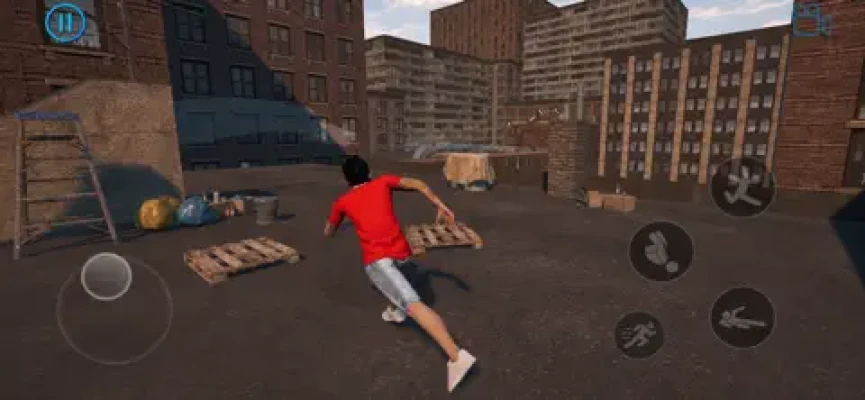
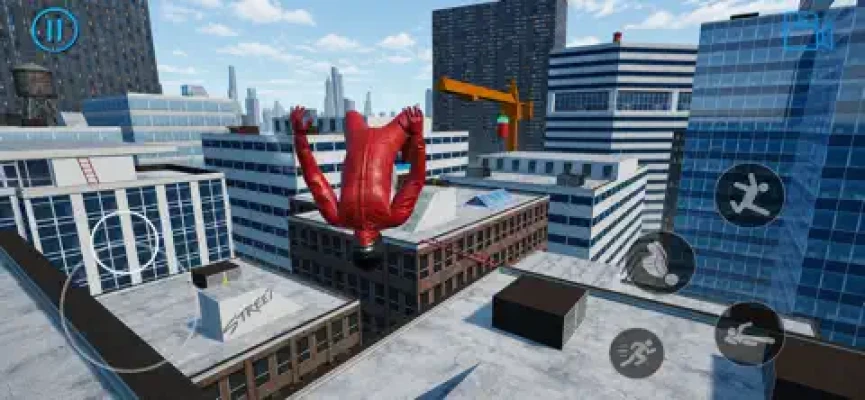
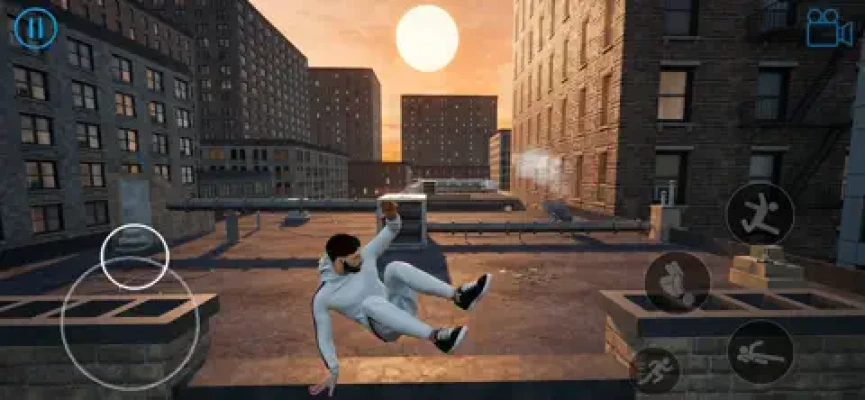
Rooftops Parkour Freerun puts you in control of a freerunner moving through detailed urban environments. The main challenge is maintaining momentum while overcoming gaps, walls, obstacles and elevated structures.
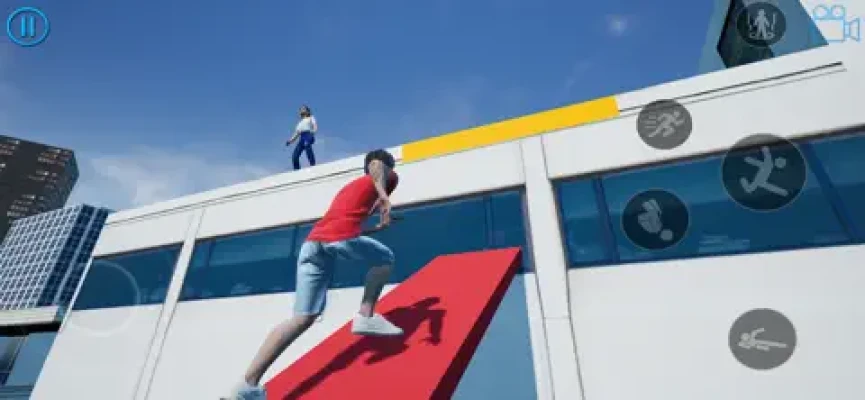
The App Store describes the game around realistic parkour physics, rooftop jumping, climbing, wall running, tricks and stunts. It also features a first-person mode with a body-camera effect that makes jumps and movement feel more immediate.
The game has evolved from a relatively straightforward parkour experience into a larger movement playground with open-world exploration, multiple maps and several movement systems.
Rooftops Parkour Freerun Key Features
First-Person Parkour
The first-person perspective puts the player directly into the movement, making jumps, wall runs and rooftop gaps feel more immediate.
The body-camera effect adds to the feeling of moving through an urban environment rather than controlling a character from a distant camera.
Open-World Map
A major update introduced an open-world environment, giving players more freedom to explore rather than following only a strict sequence of levels.
Parkour Tricks
Trick mechanics were introduced alongside the open-world map and ragdoll physics.
These give you more ways to move through the environment and make traversal less predictable than simply running and jumping.
Wall Running
Wall running is one of the game's core traversal mechanics and has been substantially remade in the recent update series.
Sprinting
Sprinting was added as a dedicated movement feature, allowing players to build speed before jumps and traversal sequences.
Sliding
Sliding is useful for maintaining momentum while passing underneath obstacles or transitioning between movement sections.
The latest version also introduced a procedural-physical slide mechanic designed to make the movement more physics-driven.
Trampolines
Trampolines provide additional ways to launch yourself through the environment and create more vertical movement opportunities.
Ragdoll Physics
Ragdoll physics add physical consequences to failed jumps, collisions and certain interactions.
Endless Runner Mode
The game includes an Endless Runner Mode, giving players an alternative to the standard level and exploration experience.
Dynamic Weather
Dynamic weather was added in a previous update, adding environmental variation to the freerunning experience.
NPC Combat
The latest update introduced a realistic active ragdoll combat system with NPCs, adding a combat element alongside the existing parkour mechanics.
Rooftops Parkour Freerun Gameplay Guide
1. Learn Movement Before Chasing Speed
When you first start playing, don't immediately try to move as quickly as possible.
Learn the fundamental movement chain:
Run → Jump → Land → Continue
Then add:
Sprint → Jump → Wall Run → Land
Finally introduce:
Sprint → Jump → Wall Run → Slide → Trick
The more comfortable you become with each movement independently, the easier it becomes to combine them.
2. Use Sprint Before Long Jumps
Sprinting is particularly useful when approaching large gaps.
Instead of jumping immediately:
- Find the safest running line.
- Build speed.
- Approach the edge directly.
- Jump at the appropriate point.
- Prepare for the landing before you leave the rooftop.
Avoid zigzagging immediately before a large jump because unnecessary movement can make your trajectory less predictable.
3. Master Wall Running
Wall running is one of the most important skills for advanced rooftop routes.
When approaching a wall:
- Build enough speed.
- Approach at a useful angle.
- Initiate the wall run.
- Maintain your movement direction.
- Look for the next platform.
- Prepare your landing before the wall-run sequence ends.
The recent update specifically notes that Wall Run, Slide and Sprint were remade from scratch, so the current movement behavior should be treated differently from older versions of the game.
4. Don't Treat Every Wall as a Wall Run
A common mistake is trying to wall-run whenever a wall is nearby.
Instead, ask:
Will the wall run actually improve my route?
Sometimes a direct jump is safer.
Other times, a wall run can give you the extra distance or positioning required to reach the next rooftop.
Use wall running as a traversal tool rather than a trick you need to perform constantly.
5. Learn Sliding
Sliding becomes especially useful when an obstacle is too low to run through normally.
A practical sequence is:
Sprint → Slide → Recover → Sprint
This preserves momentum better than stopping completely.
The newest version's procedural-physical slide system makes sliding an important part of the updated movement model.
6. Combine Slide and Jump
Sliding doesn't have to end a movement sequence.
You can use it as a transition:
Sprint → Slide → Jump → Land
This can be particularly useful when obstacles appear close together.
The key is to avoid sliding unnecessarily. If there is no obstacle requiring a slide, maintaining normal running speed may be more efficient.
7. Use Trampolines for Vertical Routes
Trampolines can dramatically change your movement options.
Before jumping onto one, identify where you want to go afterward.
Think:
Trampoline → Launch → Target → Landing
rather than:
Trampoline → Jump randomly
This is particularly important when several rooftops are visible from above.
Open-World Exploration Guide
The open-world map changes the way you should approach Rooftops Parkour Freerun.
Instead of following only the obvious route, look around for:
- Rooftops
- Elevated platforms
- Side paths
- Gaps
- Walls
- Ziplines
- Trampolines
- Obstacles
- Hidden traversal routes
- Collectible or bonus areas
The open-world map was introduced with new environments and checkpoint improvements, giving exploration a larger role in the game.
Rooftops Parkour Route Planning
Before making a large jump, identify the next two or three movement points.
For example:
Rooftop → Wall → Platform → Slide → Gap → Landing
This is much safer than looking only at the immediate obstacle.
Good route planning reduces sudden direction changes and makes it easier to maintain momentum.
Rooftops Parkour Freerun Trick Strategy
Tricks are useful for style and experimentation, but they should not interfere with basic traversal.
When approaching a trick opportunity, first ask:
Do I have enough space to recover?
If yes, perform the trick.
If the landing area is narrow, prioritize control.
A simple clean landing is preferable to an elaborate trick followed by a fall.
How to Improve Parkour Movement
Use this practice sequence:
Beginner
Practice running and jumping.
Intermediate
Add sprinting and sliding.
Advanced
Combine wall runs with jumps.
Expert
Introduce tricks, ziplines and trampoline launches.
Freestyle
Build your own movement chains through the open-world map.
This gradual approach makes the game's physics easier to understand.
Endless Runner Mode Strategy
Endless Runner Mode requires a slightly different mindset.
In normal levels, you can learn a route.
In endless running, you need to react continuously.
Focus on:
- Maintaining forward momentum
- Looking ahead
- Identifying obstacles early
- Avoiding unnecessary tricks
- Choosing reliable jumps
- Recovering quickly after mistakes
Don't spend too much time looking at the scenery. In an endless mode, the next obstacle matters more than the previous one.
Endless Runner Movement Pattern
A useful rhythm is:
Observe → Sprint → Jump → Land → Observe → Repeat
When the route allows it:
Sprint → Slide → Jump → Wall Run → Land
The goal is consistency rather than performing the most impressive sequence every time.
Combat Guide
The newest version adds a realistic active ragdoll combat system with NPCs.
Because combat is now integrated into a game primarily built around movement, avoid treating every encounter as a completely separate activity.
Movement can remain part of your strategy.
Use the environment to:
- Maintain distance
- Reposition
- Reach elevated areas
- Avoid being trapped
- Create space before re-engaging
When an NPC encounter becomes dangerous, movement and positioning can be as important as the actual attack.
Ragdoll Physics Tips
Ragdoll physics can produce unexpected outcomes when you collide with obstacles or NPCs.
If your character begins to lose control:
- Stop trying to perform complex movement.
- Look for a safe recovery area.
- Avoid adding unnecessary momentum.
- Reposition yourself.
- Resume the route once control is restored.
Don't assume every fall is recoverable. Sometimes restarting the sequence is faster than trying to recover from a bad position.
Checkpoint Strategy
The game added a checkpoint system during its open-world development.
When you reach a checkpoint:
- Learn where it is.
- Use it as a route reference.
- Treat the next section as a separate challenge.
- Practice the movement immediately after it.
If a difficult section repeatedly causes failures, focus on mastering the section between two checkpoints rather than replaying the entire route mentally.
Dynamic Weather
Dynamic weather adds another environmental variable to the game and was introduced alongside other open-world improvements.
Weather can also make the environment feel less repetitive.
When visibility or presentation changes, focus on the geometry of the route:
Where is the next platform?
Where is the wall?
Where is the landing zone?
This keeps your movement based on the level rather than visual familiarity.
Rooftops Parkour Freerun Tips and Tricks
Tip 1: Look Ahead
Don't focus only on the obstacle directly in front of you.
Tip 2: Sprint Before Long Gaps
Build momentum before committing to a large jump.
Tip 3: Wall Run With a Purpose
Use walls when they improve your route.
Tip 4: Slide Under Obstacles
Sliding can preserve momentum while avoiding low barriers.
Tip 5: Practice Trampolines Separately
Learn their launch behavior before using them in complicated routes.
Tip 6: Don't Overuse Tricks
A trick is only useful if you can recover afterward.
Tip 7: Learn the Open World
Explore alternative paths instead of always following the most obvious route.
Tip 8: Use Checkpoints as Practice Markers
Break difficult routes into smaller sections.
Tip 9: Keep Combat Mobile
When NPCs are involved, use movement and positioning instead of standing still.
Tip 10: Expect Physics to Surprise You
Ragdoll-based movement can behave differently after collisions. Adapt instead of forcing the same input repeatedly.
Best Practice Routine
If you want to become better at Rooftops Parkour Freerun, use this routine:
Five minutes: basic running and jumping.
Five minutes: sprinting and long jumps.
Five minutes: wall running.
Five minutes: sliding and obstacle transitions.
Five minutes: tricks.
Five minutes: open-world freestyle.
Then finish with an Endless Runner session.
This gives you practice across the game's major movement systems without spending the entire session repeating one mechanic.
How to Master Rooftop Gaps
Large gaps are among the most important parkour challenges.
Before jumping, evaluate:
Distance
Is the destination realistically reachable?
Speed
Do you need a sprint?
Angle
Are you approaching the edge directly?
Landing
Where exactly will your character land?
Recovery
If the landing isn't perfect, is there somewhere safe to recover?
If the answer to several of these questions is unclear, explore the area before committing.
How to Combine Parkour Moves
The strongest movement sequences usually flow naturally.
Basic
Sprint → Jump → Land
Intermediate
Sprint → Jump → Wall Run → Land
Advanced
Sprint → Jump → Wall Run → Slide → Jump
Freestyle
Sprint → Wall Run → Trick → Trampoline → Jump → Slide → Land
Don't assume that longer combinations are automatically better. The best combination is the one that keeps your movement controlled.
New Playground Level
The latest version adds a new Playground level along with graphics improvements and the newer movement and combat systems.
The Playground is a useful environment for experimenting with the updated mechanics because you can focus on movement rather than simply trying to finish a traditional route.
Use it to practice:
- Wall runs
- Slides
- Sprinting
- Trampolines
- Tricks
- Ragdoll interactions
- Combat movement
Honest Feedback
Rooftops Parkour Freerun has developed substantially since its September 2024 release. The update history shows a clear expansion from basic parkour into a broader movement playground with open-world exploration, tricks, ragdoll physics, ziplines, trampolines, sprinting, endless running, dynamic weather and now NPC combat.
The App Store currently shows a 4.6/5 rating from 429 ratings in the U.S. listing.
Player feedback is mixed on specific aspects. Some reviewers praise the parkour concept and ask for additional levels, tricks and freerunning options. Other recent reviews report bugs involving ragdoll states, mantling, collectibles and advertisements. These are individual player reports rather than evidence that every player encounters the same problems.
The recent updates are important when evaluating those comments because the game has continued to change rapidly. Version 2.216 adds the active ragdoll combat system, NPCs, a procedural-physical slide mechanic, a new Playground level, rebuilt wall running/sliding/sprinting, trampolines, sounds, optimization and stability fixes.
For players who enjoy first-person parkour, rooftop exploration and physics-based movement, the large number of movement systems gives the game plenty to experiment with. The trade-off is that the physics-heavy design can occasionally produce unpredictable behavior, especially around ragdolls and environmental interactions.
Rooftops Parkour Freerun Pros and Cons
Pros
- First-person parkour
- Rooftop environments
- Open-world map
- Wall running
- Sprinting
- Sliding
- Parkour tricks
- Ragdoll physics
- Trampolines
- Ziplines
- Endless Runner Mode
- Dynamic weather
- Multiple maps
- New skins and trails
- NPC combat
- Active ragdoll combat
- New Playground level
- Ongoing gameplay updates
Cons
- Physics can occasionally behave unpredictably
- Some players report bugs involving ragdolls and movement
- Advertising is a recurring complaint in some reviews
- Some players want additional levels and map variety
- First-person movement has received requests for further improvements from players
The pros and cons above distinguish documented game features from player-reported criticisms rather than treating individual reviews as universal experiences.
Rooftops Parkour Freerun Game Information
Game: Rooftops Parkour Freerun
Developer: Ivan Ivanov
Category: Action
Style: Parkour / Freerunning / Sports
Price: Free
Latest Version: 2.216
Latest Update: September 21, 2026
App Size: 447.6 MB
Age Rating: 13+
Language: English
Requires: iOS 15.0 or later
iPad: Supported
Mac: Supported on macOS 12.0 or later with Apple M1 or later
Apple Vision: Supported
In-App Purchases: No listed in the current App Store information
Contains Advertising: Yes
The App Store lists the game as free and designed for iPad, with iPhone and iPad support.
Rooftops Parkour Freerun Update History
Version 2.216
The latest listed update adds:
- Realistic active ragdoll combat system
- NPCs
- Procedural-physical slide mechanics
- New Playground level
- Graphics improvements
- Rebuilt wall run
- Rebuilt slide
- Rebuilt sprint
- Trampolines
- New sounds
- Optimization
- Stability improvements
- Level fixes
Version 2.115–2.117
Earlier 2026 updates introduced or expanded:
- Endless Runner Mode
- Sprint action
- Background music
- New skins
- Dynamic weather
- UI improvements
- Difficulty changes
- Bug fixes
Version 2.95
Added:
- 12 new levels
- Graphics improvements
- Optimization
- Offline Mode
- Skip Level feature
Version 2.81
Added:
- New location
- New maps
- New UI
- Lighting improvements
- Graphics improvements
Version 2.75
Added:
- New maps
- New tricks
- New skins
- Trails
- More bonuses
- Optimization and graphics improvements
Version 2.67
Introduced the open-world map, improved the environment and checkpoint system, and included optimization improvements.
Version 2.51
Added:
- Sprint
- More environmental detail
- New traversal animations
- Redesigned UI
- Enhanced controls
- Performance improvements
Version 2.1
Added:
- Tricks
- Open-world map
- Ragdoll physics
- Zipline
- New skins
- Trails
- New levels
- Trampoline mechanics
Frequently Asked Questions
What is Rooftops Parkour Freerun?
Rooftops Parkour Freerun is a first-person mobile parkour game where players navigate rooftops and urban environments using jumps, wall runs, slides, sprinting and tricks.
Is Rooftops Parkour Freerun free?
Yes. The App Store lists it as a free game.
Does Rooftops Parkour Freerun have an open world?
Yes. An open-world map was added during the game's development.
Can you wall run?
Yes. Wall running is one of the game's core traversal mechanics and has recently been rebuilt.
Does the game have sliding?
Yes. Sliding was introduced earlier and the latest version includes a new procedural-physical slide mechanic.
Does Rooftops Parkour Freerun have tricks?
Yes. Trick mechanics were added alongside the open-world and ragdoll systems.
Are there trampolines?
Yes. Trampolines were added as part of the game's movement systems and remain in the latest version.
Does it have an Endless Runner Mode?
Yes. Endless Runner Mode was introduced in the 2026 update series.
Does Rooftops Parkour Freerun have combat?
Yes. Version 2.216 introduced a realistic active ragdoll combat system with NPCs.
Can you play offline?
The version 2.95 update specifically lists Offline Mode as an addition.
Is Rooftops Parkour Freerun difficult?
Difficulty depends on the mode and route. Standard traversal requires timing and precision, while open-world exploration and Endless Runner Mode allow different approaches to the movement system.
What is the best way to learn the game?
Start with running and jumping, then learn sprinting, sliding and wall running. Once those mechanics are comfortable, introduce tricks, trampolines and more complicated movement combinations.
Final Thoughts
Rooftops Parkour Freerun has grown into a much broader experience than its original rooftop-running concept. Its current feature set combines first-person parkour, open-world exploration, tricks, wall running, sliding, sprinting, trampolines, ziplines, ragdoll physics, Endless Runner Mode and NPC combat.
For beginners, the best approach is to master movement in stages: run → sprint → jump → slide → wall run → trick → combine.
Once those fundamentals become natural, the open-world map and Playground provide room for experimentation, while Endless Runner Mode offers a more continuous test of reaction and route selection. The newest combat system adds another layer, but movement remains the central skill that ties the game together.
Rate the Game
User Reviews














Popular Games


















 Android
 iOS
iOS Windows
 Xbox
Xbox