



Latest Version
September 24, 2026
Staple Games
Action
iOS
0
Report a Problem
More About :game
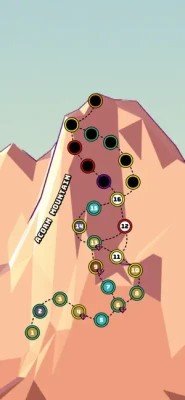
The game features mountains containing multiple routes, with stages introducing different mechanics and environments such as water, outer space, and vines. Players can also chase difficult Diamond times, collect Gems, and unlock cosmetic items as they progress.
What Is Dyno - Rock Climbing?
Dyno is designed around the basic idea of real-world bouldering but adapts it into a compact mobile action game. Each route becomes a combination of movement, timing, positioning, and experimentation.
The early levels introduce the game's core concepts, while later routes make those mechanics more demanding. This means success is not simply about reaching the top. Players who want Diamond times need to learn efficient movement and eliminate unnecessary hesitation.
The App Store lists the game as an Action title developed by Staple Games. It is free to download with optional in-app purchases and supports iPhone and iPad.
Dyno - Rock Climbing Key Features
Action-Packed Bouldering
Dyno transforms climbing into a fast mobile action experience. The objective is straightforward, but individual routes can require considerable practice.
Mountain-Based Levels
The game is organized around mountains containing multiple routes. Each route provides a different climbing challenge and gradually introduces more demanding situations.
Unique Environmental Mechanics
Some mountains introduce unusual mechanics and settings, including:
- Water-based climbing challenges
- Outer-space environments
- Vine-based sections
- Specialized route layouts
- Increasingly difficult movement sequences
These mechanics force you to adapt instead of relying on one movement pattern.
Diamond Times
Speed is an important part of Dyno. Reaching the finish is only the first objective; improving your completion time provides another layer of challenge.
Diamond times encourage players to replay routes, optimize movement and take more calculated risks.
Gems and Cosmetics
Gems can be collected during progression and used to unlock cosmetic items. This gives players an additional reason to explore routes and continue improving their performance.
Checkpoints
Checkpoints make longer routes more manageable by giving you a useful recovery point after reaching a particular section.
However, checkpoint positioning matters. Player reports have noted occasional situations where reaching a checkpoint at an awkward position can interfere with movement after respawning, so it is worth approaching checkpoint areas carefully.
Dyno - Rock Climbing Gameplay Guide
1. Learn the Route Before Chasing Speed
Your first objective should be understanding the route.
Don't immediately try to beat the Diamond time. Instead:
- Identify the major climbing sections.
- Learn where the difficult jumps or transitions occur.
- Find the safest path through the route.
- Notice where checkpoints appear.
- Complete the level consistently.
- Start optimizing your time afterward.
A route that feels difficult becomes much easier once its movement pattern is familiar.
2. Prioritize Control Over Speed
Fast movement is useful, but uncontrolled movement can cost more time than it saves.
When learning a new route, focus on making deliberate movements. Once you understand the spacing between holds and obstacles, gradually increase your pace.
A good rhythm is:
Learn → stabilize → accelerate → optimize.
This approach is especially useful when working toward Diamond times.
3. Study Every Route
Don't assume that two routes with similar layouts should be played the same way.
Dyno's levels are designed around different mechanics, and later challenges can combine familiar ideas in more demanding ways.
Pay attention to:
- The position of climbing surfaces
- Changes in terrain
- Environmental mechanics
- Long movement sequences
- Checkpoint locations
- Areas where a mistake causes a major fall
Learning the route is often more valuable than simply repeating it without analyzing your mistakes.
4. Use Checkpoints Intelligently
A checkpoint is more than a place to respawn.
Before reaching one, try to position yourself safely. Avoid treating the checkpoint as something you can activate at any cost.
Community feedback has reported occasional checkpoint positioning issues, including situations where a player can become awkwardly positioned after respawning. If a checkpoint behaves strangely, restarting the route can be more effective than repeatedly attempting the same recovery.
5. Don't Chase Diamond Times Too Early
Diamond times are one of Dyno's biggest replay incentives, but they should generally be treated as an optimization challenge rather than the first goal.
Use three stages:
Stage 1 — Completion
Finish the route reliably.
Stage 2 — Consistency
Repeat the route without major mistakes.
Stage 3 — Optimization
Remove unnecessary movements and improve your timing.
This makes difficult Diamond targets much less frustrating.
6. Memorize Difficult Sections
If a route contains a particularly difficult sequence, practice that section mentally before attempting another full run.
Ask yourself:
- Where does the difficult section begin?
- Which movement usually causes the mistake?
- Is the problem speed or positioning?
- Can the movement be made earlier?
- Is there a safer route that costs only a small amount of time?
This turns failed attempts into useful practice rather than wasted attempts.
How to Improve Your Diamond Times
Diamond times require a different mindset from normal completion.
Remove hesitation
Small pauses can add up quickly. Once you know a route, try to maintain a continuous rhythm.
Reduce unnecessary movement
Every unnecessary adjustment can cost time. Look for sections where you are moving more than required.
Practice the hardest transition
Don't spend all your practice time on sections you already understand. The biggest improvement usually comes from fixing the one or two sections where your runs consistently slow down.
Restart intelligently
If a run becomes badly compromised near the beginning, restarting may be more productive than continuing a slow attempt.
Build consistency first
A fast run that succeeds once is less useful than a slightly slower route that you can complete repeatedly. Once consistency is established, shaving seconds becomes much easier.
Dyno - Rock Climbing Tips and Tricks
Tip 1: Play for Completion First
Your first clear should teach you the route. Don't worry about perfection.
Tip 2: Watch Your Position
Being slightly out of position before a difficult movement can make the next move much harder.
Tip 3: Treat Water and Vines as Mechanics
Environmental features aren't simply decoration. When a new mechanic appears, slow down and understand how it changes your normal climbing rhythm.
Tip 4: Expect Later Routes to Demand More Precision
The game starts with straightforward concepts but can use them in increasingly complicated ways. Player reviews specifically describe the progression from simple mechanics toward more complex levels.
Tip 5: Improve One Problem at a Time
If you repeatedly fail a route, identify the exact point causing the failure instead of trying to improve the entire level simultaneously.
Tip 6: Use Safe Runs to Learn
A slower successful run teaches you more about a route than a fast attempt that ends immediately.
Tip 7: Save Aggressive Runs for Familiar Routes
Once you know where the safe movements are, you can begin taking calculated risks to improve your time.
Dyno Mountain Strategy
Each mountain should be approached as its own climbing environment.
Normal Climbing Sections
Focus on rhythm and positioning. These areas are ideal for learning basic movement.
Water Sections
Expect the environment to change the way you approach movement. Avoid rushing until you understand the mechanic.
Outer-Space Sections
Space-themed areas can make familiar climbing ideas feel different. Focus on the route structure rather than relying entirely on habits learned elsewhere.
Vine Sections
Vine mechanics require careful observation. Learn how they interact with your movement before attempting a speed-focused run.
The important lesson is to adapt your strategy to the mountain rather than forcing one strategy onto every level.
Dyno - Rock Climbing Progression Guide
A practical progression strategy is:
1. Explore the mountain
Learn the available routes.
2. Clear the route
Prioritize reaching the finish.
3. Collect Gems when practical
Use exploration to build your cosmetic collection.
4. Learn the difficult sections
Identify the movements that repeatedly cause failures.
5. Improve completion consistency
Aim for reliable clears.
6. Chase faster times
Start optimizing your route.
7. Work toward Diamond times
Turn familiar routes into precision speed runs.
This progression prevents the game from becoming frustrating too early.
Gems and Cosmetics
Gems provide a secondary progression system in Dyno. Collecting them contributes to unlocking cosmetic content, giving players another reason to revisit routes instead of treating each level as a one-time challenge.
If you are focused on improving times, don't allow cosmetic collection to interfere with a serious speed attempt. Consider separate runs for:
- Route completion
- Gem collection
- Diamond time attempts
This keeps each run focused on one objective.
Lives and Replay Strategy
The game's life system is an important part of the experience. Player reviews have specifically discussed the tension between frequent retries and the limited-life structure, with some players preferring unrestricted practice for speed-running.
Because of this, make each attempt productive.
Instead of repeatedly making the same mistake:
Fail → identify the mistake → change your approach → retry.
If you're practicing a difficult route, avoid burning attempts on careless early mistakes. Build a reliable opening sequence so you reach the difficult section consistently.
Dyno - Rock Climbing Difficulty
Dyno is easy to understand but can become demanding when you start chasing better times.
The basic concept is accessible, while the challenge comes from:
- Precision
- Timing
- Route memorization
- Environmental mechanics
- Repeated attempts
- Speed optimization
- Risk management
This creates two different experiences. Casual players can concentrate on completing routes, while competitive players can spend much longer refining individual runs.
Honest Feedback
Dyno's strongest idea is its simplicity. The game takes a recognizable activity—rock climbing—and turns it into short, repeatable mobile challenges.
The route-based structure also gives the game a natural replay loop. Completing a level once is only part of the experience; improving the route, collecting Gems and chasing better times can provide additional reasons to return. The App Store currently shows a 4.9/5 rating from around 1K ratings in the U.S. listing, while individual reviews praise its smooth mechanics and replay value.
The main point to keep in mind is that the lives system can make repeated speed-running attempts feel restrictive for some players. Several player reviews specifically mention wanting more freedom to replay levels while practicing.
There have also been player-reported bugs involving certain checkpoints and falling/out-of-bounds situations. These are user reports rather than confirmed statements from the developer, so they should be treated as occasional community feedback rather than universal problems.
Dyno - Rock Climbing Pros and Cons
Pros
- Simple climbing concept
- Precise action gameplay
- Multiple routes to master
- Different environmental mechanics
- Diamond time challenges
- Gem collection
- Cosmetic unlocks
- Strong replay potential
- Easy to understand but difficult to master
Cons
- The life system can limit repeated practice
- Some Diamond times require substantial optimization
- Certain player-reported checkpoint and falling issues can occasionally affect runs
- Players looking for constant new content may want additional mountains
The App Store version history currently lists version 1.06, released May 8, 2025, with the listed updates described as minor bug fixes.
Dyno - Rock Climbing Information
Game: Dyno - Rock Climbing
Developer: Staple Games
Genre: Action / Bouldering
Price: Free with optional in-app purchases
Platforms: iPhone, iPad; Apple lists Mac compatibility for Macs with Apple M1 or later
Language: English
Age Rating: 4+
App Size: 158.1 MB
Initial Release: April 9, 2025
Latest listed version: 1.06
Latest listed update: May 8, 2025
In-App Purchases: Yes
The App Store listing states that iPhone and iPad require iOS/iPadOS 13 or later, while Mac compatibility requires macOS 11 or later with an Apple M1 chip or newer.
Frequently Asked Questions
Is Dyno - Rock Climbing free?
Yes. Dyno is listed as a free game with optional in-app purchases.
What type of game is Dyno?
Dyno is an action-oriented bouldering and climbing game built around route completion, movement, timing and speed challenges.
Can you play Dyno on iPhone?
Yes. The App Store lists Dyno for iPhone and iPad.
What are Diamond times in Dyno?
Diamond times are difficult completion-time targets that encourage players to replay routes and optimize their movement.
What are Gems used for?
Gems contribute toward unlocking cosmetic items.
Does Dyno have different environments?
Yes. The game's description specifically mentions mechanics and environments involving water, outer space and vines.
How do you get better at Dyno?
Learn the route first, practice difficult sections, reduce unnecessary movement, then gradually increase your speed as your runs become consistent.
Is Dyno difficult?
The basic controls and concept are accessible, but the Diamond-time challenges can become considerably more demanding because they require precise and efficient movement.
Does Dyno have checkpoints?
Yes. Routes can contain checkpoints that help with progression through longer or more challenging sections.
Final Thoughts
Dyno - Rock Climbing works best when you approach it as both a climbing game and a time-attack challenge. The first goal is reaching the top, but the deeper challenge comes from learning routes, improving movement, collecting Gems and gradually pushing toward Diamond times.
For new players, the most effective approach is simple: learn first, finish consistently, then optimize. Once you stop treating every failed attempt as a setback and start using each attempt to identify one specific mistake, difficult routes become much more manageable.
Rate the Game
User Reviews















Popular Games



















 Android
 iOS
iOS Windows
 Xbox
Xbox