



Latest Version
September 23, 2026
Thomas Young
Action
iOS
0
Report a Problem
More About :game
The game contains 50 levels, collectible stars, unlockable secrets, five bosses, controller support and several unusual level types that expand on the traditional Dadish platforming formula.
What Is Dadish 2?
Dadish 2 is a retro 2D platformer developed by Thomas Young, creator of the Dadish series and Super Fowlst.
The basic objective is straightforward:
Move → jump → avoid hazards → defeat or bypass enemies → rescue the radish kids → reach the end of the level.
What makes the sequel more interesting is how it gradually introduces new environments and mechanics.
You will encounter:
- Traditional platforming
- Vine climbing
- Autoscrolling sections
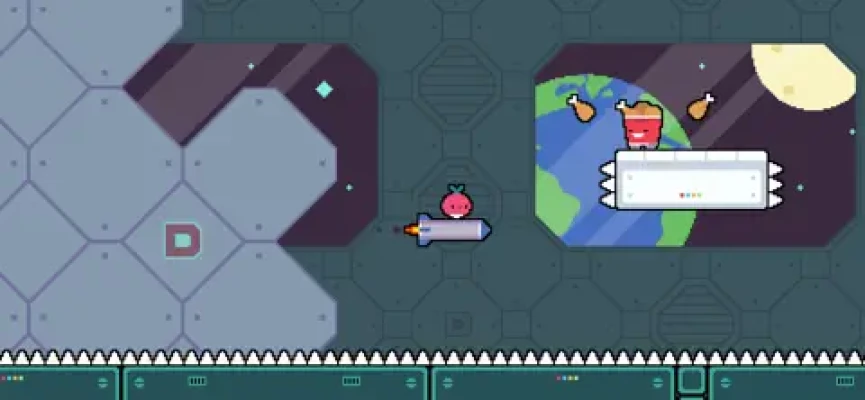
- Rocket sequences
- Low-gravity movement
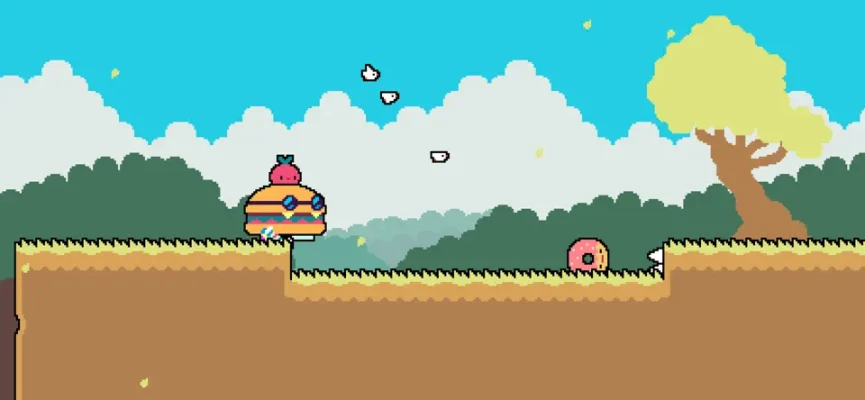
- Hamburger-riding sections
- Fast-food enemies
- Collectible stars
- Hidden secrets
- Boss battles
- A separate Fowlst Mode
The App Store describes it as Dadish's biggest adventure, with 50 levels spread across a much larger variety of environments.
Dadish 2 Story
Dadish's children are once again at the center of the adventure.
The trouble begins when Dadish brings his kids to work. Things quickly go wrong, leaving Dadish searching through increasingly strange locations to find them.
His journey includes:
- Swamps
- Meadows
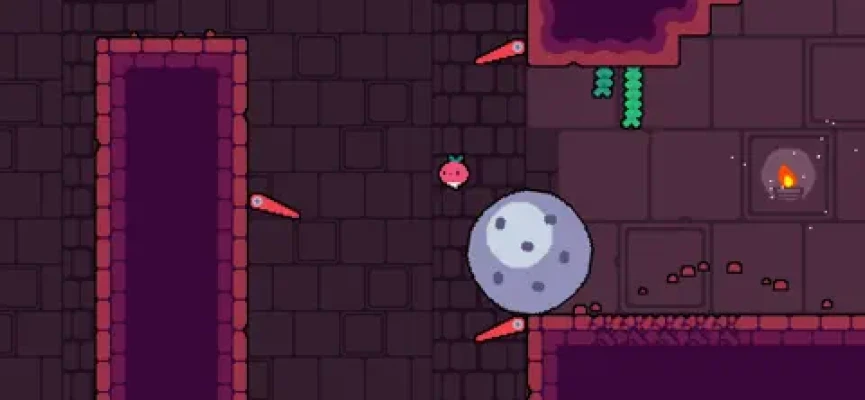
- Temples
- Large vertical environments
- Space-themed stages
- Rockets
- Fast-food enemies
- A giant talking hamburger
Along the way, Dadish encounters Burgurgular, an old character from the series who becomes involved in his own search for a missing hat.
The story isn't trying to be dramatic. Dadish 2 uses comedy, ridiculous characters and short conversations to keep the adventure light.
Dadish 2 Worlds and Level Structure
Dadish 2 contains 50 levels across five worlds, with each world containing nine standard levels followed by a boss encounter.
The five worlds are:
- Enuiga Corp
- Herbejo Meadow
- Koto Swamp
- Fantomo Temple
- Soleca Station
Each environment introduces its own visual style and platforming challenges.
The progression is important because the game doesn't simply make every level harder by adding more enemies. It also changes how you move through the environment.
Core Dadish 2 Gameplay
The controls are intentionally simple, but mastering them is another matter.
The most important skills are:
Movement
Learn exactly how quickly Dadish accelerates and changes direction.
Jumping
Don't think of jumping as simply getting from one platform to another. Your landing position often determines whether the next movement is safe.
Timing
Many hazards require you to move at the correct moment rather than simply moving quickly.
Positioning
Being on the wrong side of a platform can make the next jump considerably harder.
Patience
Some sections are designed to punish rushing.
A good Dadish 2 player learns when to move quickly and when to wait.
Best General Strategy for Dadish 2
1. Learn Before Speedrunning
Your first objective should be completing the level.
Don't immediately chase the fastest possible time.
Learn:
- Where enemies appear
- Where hazards activate
- Where platforms move
- Where stars are hidden
- Where checkpoints are located
- Which sections require precise timing
Once you know the level, speed becomes much easier.
2. Look Ahead Before Jumping
A common platforming mistake is concentrating only on the platform directly ahead.
Instead, look at the next two actions.
For example:
Jump → land → enemy → jump
is very different from:
Jump → land → stop → reposition → jump
If you know what comes after the landing, you can position Dadish correctly before you even touch the platform.
3. Don't Overcorrect in Midair
Small movement corrections can save a jump, but excessive corrections can turn a successful jump into a fall.
When you commit to a jump, make controlled adjustments rather than constantly changing direction.
This becomes especially important when attempting collectible stars or difficult platforming sequences.
Collectible Star Strategy
Stars are one of the main reasons to replay levels.
They are often placed in locations that require more than simply following the obvious route.
A star may force you to:
- Take a less direct path
- Perform a difficult jump
- Explore a side route
- Risk a hazard
- Use a particular movement mechanic
- Return through part of a level
Don't assume the fastest route is also the best route for collecting everything.
Two-run approach
A useful method is:
Run 1: Finish the level.
Run 2: Search specifically for the star.
This lets you learn the level before adding the additional risk of collecting everything.
How to Collect Difficult Stars
When a star appears to be in a dangerous position, don't immediately jump for it.
First determine:
Where do I land after collecting it?
This is extremely important.
A collectible isn't useful if reaching it immediately puts Dadish into an unavoidable hazard.
Look for the complete sequence:
Approach → collect → landing → next movement
rather than treating the star itself as the entire objective.
Hamburger Sections
One of Dadish 2's unusual additions is the ability to ride a giant talking hamburger.
These sections require a different approach from normal Dadish movement.
The hamburger has a different feel and jump behavior, so you shouldn't assume that normal Dadish timing will work perfectly.
Hamburger tips
- Approach gaps carefully
- Learn the jump arc before attempting speed
- Don't jump too early
- Watch the landing zone rather than the gap itself
- Avoid making last-second corrections
- Memorize difficult sequences
One player specifically criticized the hamburger sections for requiring very precise jump timing, particularly around gaps. That's individual player feedback rather than a universal assessment, but it highlights an important practical point: these sections reward learning the vehicle's movement rather than treating it like ordinary Dadish platforming.
Rocket and Autoscroll Sections
Dadish 2 introduces sections where the normal pace of platforming changes.
When a level scrolls automatically, you lose some control over how quickly the environment approaches.
That means you should prioritize:
- Positioning
- Anticipation
- Safe landing areas
- Enemy timing
- Keeping Dadish in a useful part of the screen
Don't wait until an obstacle is directly beside you.
In an autoscrolling section, the best strategy is usually to prepare before the obstacle reaches Dadish.
Vine Climbing Strategy
Vines add another type of movement to the platforming.
When climbing:
- Don't rush upward blindly
- Look for the next safe platform
- Watch enemies around the exit point
- Position yourself before leaving the vine
- Be aware that jumping from a vine can change your trajectory
A common mistake is reaching the top of a vine successfully but immediately moving into an enemy or hazard.
The climb isn't the end of the sequence. The landing afterward matters just as much.
Low-Gravity Sections
The later parts of Dadish 2 introduce space-themed environments and different movement behavior.
Low gravity changes the rhythm of platforming.
Your jumps become less about immediate vertical movement and more about controlling horizontal travel.
Low-gravity tips
Start controlling your movement early.
Because Dadish stays airborne longer, waiting until the end of the jump to correct your position may be too late.
Use smaller adjustments.
Long airborne periods give you more opportunity to drift too far.
Study the landing zone.
The important question isn't:
“Can I reach that platform?”
It is:
“Where will I be when I reach it?”
This distinction becomes extremely useful in space levels.
Enemy Strategy
Dadish 2 introduces a new group of fast-food-themed enemies.
The safest approach is to learn each enemy's movement pattern.
Before trying to pass an enemy quickly, determine:
- Does it move horizontally?
- Does it remain stationary?
- Does it patrol?
- Does it occupy the landing area?
- Can Dadish jump over it safely?
- Does avoiding it create a harder jump afterward?
You don't always need to attack an enemy.
Sometimes the fastest solution is simply to avoid it.
Checkpoint Strategy
Checkpoints are particularly valuable on difficult levels.
Once you reach one, mentally divide the stage:
Before checkpoint = completed route
After checkpoint = current challenge
This prevents you from mentally replaying the entire level every time you die.
When practicing a difficult section, concentrate on what happens after the checkpoint rather than worrying about the earlier portion you've already mastered.
Boss Strategy
Dadish 2 contains five bosses, each with its own personality and challenge.
The most important rule for boss fights is:
Observe before attacking.
Don't immediately focus on damaging the boss.
First identify:
- Attack pattern
- Safe positions
- Movement rhythm
- Vulnerable moments
- Environmental hazards
- Where you can safely land
Once the pattern becomes familiar, the fight becomes much more manageable.
Space Durnak Strategy
The game's final boss is Space Durnak, returning from the previous Dadish adventure.
This fight benefits from patience.
Rather than trying to force damage opportunities, concentrate on surviving the boss's attack pattern and taking advantage of safe openings.
The App Store version history also notes that the difficulty of Space Durnak was adjusted in an earlier update, showing that the encounter has received balance attention over the game's history.
How to Approach Difficult Levels
When a level repeatedly kills you, stop treating it as one giant problem.
Break it into pieces.
Phase 1: Opening
Learn the first sequence.
Phase 2: Main obstacle
Determine exactly what is killing you.
Phase 3: Recovery
Learn where you can safely regain control.
Phase 4: Final section
Don't relax simply because you've reached the end.
Many failed runs happen because players become less careful after surviving the hardest part.
Dadish 2 Speedrun Tips
Dadish 2 has attracted players interested in speedrunning, and App Store reviews specifically mention speedrunning as a way to experience the game differently.
If you want to improve your times, don't start by trying to move faster.
Start by removing mistakes.
Step 1: Complete the level
Establish a safe route.
Step 2: Memorize the route
Know what's coming before it happens.
Step 3: Remove hesitation
Stop pausing before familiar jumps.
Step 4: Optimize movement
Look for unnecessary jumps, stops and direction changes.
Step 5: Practice difficult transitions
A single awkward transition can cost more time than several ordinary movements.
Step 6: Attempt a full run
Only after the individual sections are consistent should you chase your best overall time.
Fowlst Mode
One of Dadish 2's most interesting secrets is Fowlst Mode.
Collecting all the stars unlocks the ability to play as Fowlst, a character from the Super Fowlst series.
This gives completionists an additional reason to return to previously completed levels.
The game therefore has two different completion goals:
Normal completion
Finish the 50 levels.
Full completion
Collect all the stars and unlock the additional mode.
This makes the stars much more meaningful than simple optional collectibles.
Full Completion Strategy
If you want to complete Dadish 2 rather than simply finish the story, use this order:
1. Finish every level.
Don't worry about every star yet.
2. Return for missing stars.
Now you know the level layout.
3. Revisit difficult sections.
Use your knowledge of the route.
4. Complete all collectible objectives.
Work through the remaining stars systematically.
5. Unlock Fowlst Mode.
All stars are required for the unlock.
This approach is much less frustrating than trying to collect everything during your first playthrough.
Controller vs Touch Controls
Dadish 2 supports controllers as well as mobile controls.
For casual play, touch controls are perfectly suited to the game's straightforward movement.
For difficult jumps and speedrunning, controller support can be useful if you prefer physical buttons and analog-style control.
The most important thing is consistency.
If you're trying to improve your performance, use the same control setup while practicing so your movement timing remains familiar.
How to Adjust the Controls
The game's update history notes that players can adjust the positions of the left and right controls from the pause menu. It also changed the interface so that players must intentionally choose Adjust Controls before repositioning the buttons.
If the default layout feels uncomfortable, customize it rather than forcing yourself to use an awkward button position.
For platforming games, comfortable controls can make precise jumps considerably easier.
Best Way to Practice Dadish 2
A good practice routine is:
First attempt
Explore the level.
Second attempt
Complete it without worrying about stars.
Third attempt
Learn the difficult movement sequences.
Fourth attempt
Collect the star.
Later attempts
Optimize the route and time.
This progression keeps the game challenging without turning every death into frustration.
Dadish 2 Difficulty
Dadish 2 is accessible at first but becomes significantly more demanding as the levels introduce more complicated movement and hazards.
The difficulty comes less from complicated controls and more from precision.
A player can understand the controls within minutes but still spend considerable time mastering a particular sequence.
Player feedback reflects this split: some players describe the game as reasonably difficult and enjoyable for speedrunning, while another review found certain levels and hamburger sections excessively demanding. These are individual experiences, but together they show that the game sits firmly on the challenging side of retro platforming.
Atmosphere and Presentation
Dadish 2 combines colorful pixel-art presentation with absurd comedy.
The environments change substantially throughout the adventure, moving from corporate and natural environments toward stranger locations and eventually space.
The game's tone stays playful even when the platforming becomes demanding.
The soundtrack is another important part of the experience, and several players have specifically praised the music in their App Store reviews.
The result is a game that doesn't take itself seriously even when its platforming asks you to concentrate.
Game Information
| Feature | Details |
|---|---|
| Game | Dadish 2 |
| Developer | Thomas Young |
| Genre | Action / Platformer |
| Levels | 50 |
| Worlds | 5 |
| Bosses | 5 |
| Playable Characters | Dadish + unlockable Fowlst Mode |
| Main Objective | Rescue Dadish's children |
| Collectibles | Stars |
| Secrets | Yes |
| Controller Support | Yes |
| Game Mode | Single-player |
| Platform | iPhone, iPad |
| Language | English |
| Age Rating | 9+ |
| App Size | 64.8 MB |
| Price | Free with in-app purchases |
| Current iOS Version | 1.20 |
| Latest Listed Update | September 11, 2025 |
The current US App Store listing shows 4.7/5 from approximately 1.5K ratings and lists the game as free with in-app purchases.
Dadish 2 Updates
The game has received multiple updates since its original release.
The current App Store listing shows version 1.20, dated September 11, 2025, with bug fixes. Earlier updates addressed compatibility, controls, level issues, Fowlst Mode problems and other bugs.
The Android listing was also updated in September 2025, showing that the game continues to be maintained across platforms.
Honest Feedback on Dadish 2
Dadish 2 succeeds because it keeps the basic platforming formula simple while introducing enough new mechanics to prevent the adventure from feeling repetitive.
The 50-level structure gives the game a clear finish line, while stars and Fowlst Mode provide reasons to return after completing the main adventure.
The strongest part of the game is arguably its variety. Swamps, vines, rockets, hamburger-riding sections and low-gravity environments give different sections their own identity.
The main consideration is difficulty. Some sections require precise timing, and the game's cheerful presentation can make its harder sequences seem deceptively simple. Player reviews show that this is a dividing point: some enjoy the challenge and speedrunning potential, while others find particular mechanics too punishing.
For players who enjoy retro platformers and don't mind repeating a difficult section until the timing is right, the challenge is an important part of the experience.
Pros and Cons
Pros
- 50 handcrafted platforming levels
- Five distinct worlds
- Five bosses
- Collectible stars
- Unlockable Fowlst Mode
- Fun retro presentation
- Funny dialogue
- Fast-food-themed enemies
- Hamburger-riding sections
- Rocket and space sections
- Low-gravity gameplay
- Controller support
- Good soundtrack
- Offline single-player gameplay on supported platforms
Cons
- Some sections require very precise timing
- Hamburger sections can take practice
- Collecting every star increases the difficulty considerably
- Players looking for very relaxed platforming may find later stages demanding
- The game's simplicity can hide how technical some later challenges become
Frequently Asked Questions
How many levels are in Dadish 2?
Dadish 2 contains 50 levels across five worlds. Each world includes nine regular stages and a boss encounter.
How many bosses are in Dadish 2?
There are five bosses, one associated with each world.
What are the collectibles in Dadish 2?
The main collectible is the star found in each level. Collecting all the stars unlocks Fowlst Mode.
What is Fowlst Mode?
Fowlst Mode is an unlockable mode that becomes available after collecting all the stars. It lets you play as Fowlst rather than Dadish.
Does Dadish 2 support controllers?
Yes. Controller support is listed as one of the game's features.
Is Dadish 2 difficult?
It starts relatively simply but becomes challenging as new mechanics, hazards and precise platforming sequences are introduced. Player experiences vary, particularly with some of the more demanding sections.
Can you speedrun Dadish 2?
Yes. The game's movement and level structure make it suitable for speedrunning, and App Store reviews specifically mention players using speedrunning as a way to deepen their experience with the game.
Who made Dadish 2?
Dadish 2 was developed by Thomas Young, creator of the Dadish series and Super Fowlst.
What is the final world in Dadish 2?
The fifth world is Soleca Station, the space-themed final area.
Final Thoughts
Dadish 2 takes the original game's simple platforming formula and expands it into a much larger adventure.
With 50 levels, five worlds, five bosses, collectible stars, secrets, unusual movement sections and Fowlst Mode, there is a substantial amount to do beyond simply reaching the end of the story.
The best way to approach the game is to separate completion from mastery.
First learn the level.
Then finish it.
After that, return for the star.
Finally, optimize your movement if you want a faster run.
That approach works particularly well because Dadish 2 rewards familiarity. Once you know where the hazards, enemies and difficult jumps are located, levels that initially seem chaotic become much more predictable.
Dadish 2 is a colorful, funny and surprisingly demanding retro platformer where mastering the movement is just as important as reaching the finish line.
Rate the Game
User Reviews














Popular Games



















 Android
 iOS
iOS Windows
 Xbox
Xbox