



Latest Version
September 23, 2026
Thomas Young
Action
iOS
0
Report a Problem
More About :game
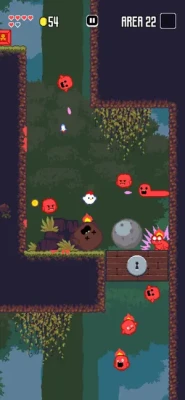
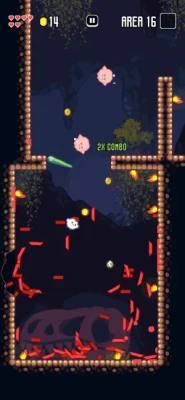
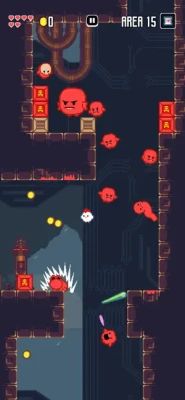
Instead of traditional jump buttons or virtual joysticks, Super Fowlst uses a distinctive hopping movement system. Touch the left side of the screen to hop left, touch the right side to hop right, and swipe upward to activate the item you're carrying.
That simple control system becomes surprisingly deep once the game starts combining projectiles, environmental hazards, enemies, bosses and awkwardly shaped rooms.
The App Store currently lists Super Fowlst as a Casual game developed by Thomas Young, with support for iPhone and iPad. The US listing shows a 4.5/5 rating from around 2,000 ratings.
What Is Super Fowlst?
Super Fowlst is an arcade-style action game built around:
- Momentum-based movement
- Enemy smashing
- Projectile avoidance
- Procedurally generated stages
- Boss fights
- Loot collection
- Power-ups
- Character unlocking
- Secret areas
- Repeated runs
The game doesn't rely on a traditional campaign where every level is permanently fixed.
Instead, its stages are procedurally generated, meaning the layouts can change between runs. This gives Super Fowlst a strong replay-oriented structure.
The result is a game where learning the controls and recognizing danger patterns is often more important than memorizing a single level.
Super Fowlst Story and Atmosphere
The story is deliberately simple.
Demons have taken over, and Super Fowlst is the chicken standing between them and total chaos.
There isn't a complicated narrative campaign. The personality comes from the strange characters, absurd enemies, explosions and intentionally silly situations.
That works well because the game is fundamentally about movement and action.
You're not supposed to spend minutes reading dialogue.
You're supposed to launch a chicken into a demon.
And then probably launch it into another demon.
Core Gameplay Features
Procedurally Generated Stages
One of Super Fowlst's most important features is its procedural stage generation.
The game advertises unlimited stages that are different each time you play.
This changes the strategy compared with a traditional platformer.
You can't depend entirely on memorizing a fixed route.
Instead, you need to learn:
- How your chicken moves
- How enemies behave
- How to recognize dangerous rooms
- How to react to projectiles
- How to use environmental objects
- When to attack
- When to retreat
Your mechanical skill carries from one run into the next.
Super Fowlst Controls Guide
The controls are extremely simple.
Hop Left
Touch the left side of the screen to move left.
Hop Right
Touch the right side to move right.
Use Your Item
Swipe upward to activate the item you're currently holding.
There is no conventional jump button.
This is important because your movement is based on repeated directional hops rather than precise joystick positioning.
Why the Controls Take Practice
The controls look simple on paper, but Super Fowlst's movement has momentum.
That means your biggest challenge isn't remembering which side of the screen to touch.
It's controlling where your next hop will put you.
For example, if an enemy is moving toward you, you don't necessarily want to keep tapping in its direction.
Sometimes the better option is to hop away, wait for the enemy to expose itself, then reverse direction and attack.
Think of movement as both offense and defense.
Combat Strategy
Smash Enemies Head-On
Your main weapon is your chicken.
You can attack enemies by smashing into them.
This creates a very different combat rhythm from a conventional shooter.
Instead of:
Aim → shoot → reload
the basic loop becomes:
Position → hop → collide → reposition
The challenge comes from making the collision happen without taking unnecessary damage.
Don't Chase Every Enemy
One of the easiest ways to lose health is becoming too aggressive.
If an enemy moves into a dangerous area, don't automatically follow it.
Check the surroundings first.
A chase can take you directly into:
- Fire
- Buzz saws
- Projectiles
- Turbines
- Traps
- Another enemy
Sometimes the safest attack is the one you delay for a second.
Projectiles and Ranged Threats
Some enemies can attack from a distance.
These enemies change the rhythm because simply moving toward them isn't always safe.
When projectiles are present:
- Watch the firing pattern.
- Identify open space.
- Move laterally rather than directly toward the enemy.
- Avoid getting trapped against a wall.
- Attack when the projectile pattern creates an opening.
A particularly important lesson is that enemies can sometimes attack from outside your immediate view, something players have specifically complained about in App Store reviews.
This makes positioning important even when the enemy isn't directly in front of you.
Environmental Hazards
Super Fowlst isn't dangerous only because of demons.
The game's environments contain hazards such as:
- Buzz saws
- Turbines
- Tubes
- Stalactites
- Pinball flippers
- Fire
- Springs
- Other mechanical obstacles
The App Store specifically highlights these environmental gadgets and hazards as part of the game's core challenge.
The important rule is:
Never look only at the enemy.
Look at the entire room.
An enemy might be easy to defeat, but reaching it could put you directly in the path of a saw or projectile.
Super Fowlst Power-Ups
Power-ups give your chicken additional ways to deal with enemies and dangerous situations.
The game includes options such as:
- Egg bombs
- Rockets
- Bird shields
- Beehive
- Friendship
- Rocketbot
- XL Bird Shield
Several of these were introduced through later updates, including the Beehive, Friendship, Rocketbot and XL Bird Shield.
How to Use Power-Ups Effectively
Don't immediately activate every item you find.
Instead, ask:
What problem am I about to face?
Egg Bomb
Useful when multiple enemies are clustered together.
Rockets
Useful when you need additional ranged damage or want to attack without relying entirely on direct collisions.
Shield
Save defensive protection for sections where avoiding damage is difficult.
Beehive
Useful when you need additional pressure against enemies.
Rocketbot
Particularly valuable when you want automated firepower while concentrating on movement.
The exact value of an item depends on the room you're in.
A power-up used at the wrong moment can be much less useful than the same power-up saved for a difficult encounter.
Loot and Upgrades
Super Fowlst rewards you with treasure that can be exchanged for upgrades.
The game's official description specifically describes trading loot for powerful upgrades and items such as egg bombs and rockets.
This creates an important progression loop:
Explore → defeat enemies → collect loot → upgrade → survive longer → reach harder areas
Don't think of coins or treasure as something you should simply collect without purpose.
Use your earnings to make future runs more reliable.
Character Unlocks
Super Fowlst includes a substantial character collection.
The App Store lists 30 unlockable characters, while the game's update history shows that additional characters were added over time.
Some characters are purchased directly, while others are connected to secrets or unlockable content.
The game therefore has a secondary collection objective beyond simply reaching farther into the stages.
For completionists, unlocking characters can become almost as important as surviving the main progression.
Secret Areas
Don't assume the obvious route is the only route.
Super Fowlst contains secrets and hidden characters, and some updates specifically introduced secret characters hidden in secret areas.
Whenever a room looks unusual, investigate.
Pay attention to:
- Strange gaps
- Unusual walls
- Areas that seem deliberately empty
- Alternate routes
- Platforms that appear unnecessary
- Suspicious dead ends
Procedural generation means you should remain curious rather than relying on one memorized secret route.
Complete Super Fowlst Survival Strategy
1. Control the Chicken Before Attacking
Your first priority should be movement.
If you can't reliably control where the chicken is going, attacking enemies becomes much harder.
Spend the early part of a run learning the rhythm of your hops.
2. Attack From an Angle
Directly flying into an enemy isn't always the safest approach.
Whenever possible, approach from a direction that gives you room to recover after the collision.
This is particularly useful near walls and environmental hazards.
3. Keep an Escape Route
Before attacking an enemy, identify where you can go afterward.
For example:
Enemy ahead + fire behind you = bad position.
If you attack without leaving yourself an exit, the collision can become a trade where you take damage immediately afterward.
4. Avoid Getting Pinned Against Walls
Walls can be dangerous because they restrict your movement options.
If projectiles are coming toward you, being trapped against one side of the room can make the situation much harder.
Keep moving whenever the room allows it.
5. Learn Hazard Timing
Mechanical hazards often operate according to recognizable patterns.
Don't blindly rush through.
Watch one cycle.
Then move.
This is especially important around:
- Buzz saws
- Turbines
- Springs
- Pinball mechanisms
How to Deal With Springs
Springs can create some of the game's most awkward movement situations.
If a spring launches you automatically, don't panic and mash both directions.
Instead:
- Watch the launch direction.
- Identify where you're likely to land.
- Prepare the next directional input.
- Avoid steering directly into another hazard.
- Use the environment rather than fighting the momentum.
The goal is to anticipate your trajectory instead of reacting after you've already been launched.
Boss Strategy Guide
Bosses are one of the major difficulty spikes in Super Fowlst.
The game has introduced multiple bosses over its update history, including The Sneak's Dad, Mecha Fowlst and The Tickler.
Boss Rule #1: Observe First
Don't immediately attack.
Watch:
- Movement
- Projectile patterns
- Direction changes
- Attack timing
- Safe zones
Understanding the boss's behavior is often more valuable than dealing damage quickly.
Boss Rule #2: Keep Moving
Large bosses can cover significant portions of the arena.
Standing still is usually dangerous.
Use short controlled hops rather than continuously flying around without a plan.
Boss Rule #3: Don't Chase the Boss
If the boss leaves your immediate area, don't automatically follow.
This can lead you directly into an attack.
Wait for it to return or identify its next attack pattern.
Boss Rule #4: Use Power-Ups During Vulnerable Moments
Save your strongest offensive items for moments when the boss is exposed.
A rocket or explosive attack is more valuable when you know it will connect.
Checkpoints
Checkpoints were added to Super Fowlst as the game expanded.
The update history notes checkpoints every five levels, including progression beyond level 60, while earlier updates also introduced boss-related checkpoint functionality.
This makes progression less punishing than starting completely from the beginning after every failed run.
Use checkpoints strategically, especially once the game starts introducing more dangerous combinations of enemies and hazards.
Daily Challenges
Super Fowlst also added Daily Challenges, giving players another reason to return after progressing through the main game.
Daily challenges are particularly useful for players who have already learned the basic mechanics and want a shorter objective.
They also give the game a different rhythm from ordinary progression.
How to Survive Longer Runs
If you're trying to push farther than before, follow this routine:
Early game
Play conservatively.
Collect loot and learn the current run's hazards.
Middle game
Start prioritizing efficient movement.
Don't take unnecessary damage for small rewards.
Difficult sections
Use your strongest items.
There is little value in saving everything if using an item could prevent a death.
Boss encounter
Stop rushing.
Observe the pattern and attack during safe windows.
After reaching a checkpoint
Take the opportunity to experiment.
The checkpoint system means you don't always need to treat every attempt as a perfect run.
Three Common Mistakes
Mistake 1: Constantly attacking
The chicken's attack is also its movement.
That makes reckless aggression particularly dangerous.
Better approach:
Attack only when you know where the collision will take you.
Mistake 2: Ignoring the environment
A successful attack can still end badly if the landing position sends you into a saw or projectile.
Better approach:
Plan the entire movement, not just the hit.
Mistake 3: Saving every power-up
Some players refuse to use items because they want to save them for later.
Better approach:
Use an item when it solves a genuine problem.
A power-up that prevents you from losing health can be worth much more than one sitting unused.
Difficulty and Learning Curve
Super Fowlst is easy to understand but can become demanding.
That distinction matters.
The controls are minimal, but the combination of procedural rooms, hazards, projectiles and bosses creates situations that require fast reactions.
App Store reviews describe the game as enjoyable but challenging, with one long-running review specifically criticizing the limited health recovery and difficulty of an early boss encounter.
Another player praised the game's art, music and unusual mechanics while describing it as a strong mobile experience.
So the difficulty is part of the game's identity, but it can also be the biggest barrier for players who prefer forgiving action games.
Atmosphere and Presentation
Super Fowlst uses colorful pixel-art visuals and exaggerated character designs.
The presentation is intentionally playful rather than dark despite the demon theme.
Explosions, strange bosses, chickens, rockets and absurd enemies create a chaotic arcade atmosphere.
The soundtrack and retro presentation reinforce that feeling.
It feels more like a fast arcade toy box than a traditional story-driven action game.
Super Fowlst vs Fowlst
Although the games share the same basic concept, Super Fowlst expands the formula considerably.
Fowlst focuses on the core idea of smashing demons, collecting loot and surviving procedurally generated rooms.
Super Fowlst expands that formula with more characters, more power-ups, additional bosses, secrets, checkpoints, daily challenges and a broader collection system.
The sequel therefore feels more like an expanded arcade system built around the original Fowlst idea.
Honest Feedback and Recommendations
Super Fowlst's strongest quality is its movement system.
The controls look almost too simple, but once enemies and hazards start interacting, the hopping mechanic becomes surprisingly expressive.
The procedural stages also give the game strong replay value because you're not simply memorizing one fixed sequence of rooms.
The biggest potential weakness is the difficulty.
Some players enjoy the challenge, while others have reported frustration with limited health recovery, difficult boss encounters and situations where enemies can attack from outside the immediate screen area.
Another consideration is that Super Fowlst contains optional in-app purchases for removing ads and unlocking individual characters. The current App Store listing shows a Remove Ads purchase and several character unlocks.
Overall, the game is particularly suited to players who enjoy short arcade runs, procedural gameplay, unusual controls and repeated attempts to improve.
Pros and Cons
Pros
- Unique movement system
- Procedurally generated stages
- Fast arcade-style gameplay
- Lots of environmental hazards
- Large boss encounters
- Multiple power-ups
- 30 unlockable characters
- Secret areas
- Checkpoints
- Daily challenges
- Loot and upgrades
- Game Center leaderboards
- Distinctive pixel-art style
Cons
- Difficulty can rise sharply
- Limited health can make some mistakes costly
- Some hazards become chaotic when combined
- Bosses can be frustrating while learning their patterns
- Optional character purchases are present
- Players who prefer conventional controls may need time to adjust
Super Fowlst Game Information
| Feature | Details |
|---|---|
| Game | Super Fowlst |
| Developer | Thomas Young |
| Genre | Casual / Action |
| Platform | iPhone, iPad |
| Main Gameplay | Procedural action |
| Stages | Unlimited procedural stages |
| Characters | 30 unlockable characters |
| Bosses | Multiple |
| Power-Ups | Yes |
| Loot & Upgrades | Yes |
| Secrets | Yes |
| Checkpoints | Yes |
| Daily Challenges | Yes |
| Game Center | Yes |
| Age Rating | 9+ |
| Current App Size | 62.6 MB |
| iOS Requirement | iOS 10 or later |
| In-App Purchases | Yes |
The App Store currently lists the game at 62.6 MB and compatible with iOS 10 or later, with Game Center leaderboards and optional in-app purchases.
Recent and Notable Updates
Super Fowlst received a number of substantial updates after launch.
Notable additions included:
- New playable characters
- The Tickler boss
- Beehive power-up
- Additional bosses
- Secret characters
- Desert-themed levels
- Friendship power-up
- Rocketbot
- XL Bird Shield
- Daily Challenges
- Checkpoints
- Additional languages
- Performance improvements and bug fixes
The game's version history documents these additions across its 2019–2020 updates.
Frequently Asked Questions
Is Super Fowlst free?
The App Store currently lists Super Fowlst as free with optional in-app purchases.
How does Super Fowlst work?
You control a chicken by tapping the left or right side of the screen to hop in that direction. Swipe upward to use the item you're holding.
Does Super Fowlst have unlimited levels?
The game uses procedurally generated stages described by the developer as unlimited and different from one playthrough to another.
How many characters can you unlock?
The App Store listing advertises 30 unlockable characters.
Does Super Fowlst have bosses?
Yes. Boss battles are a major part of progression, with several bosses introduced through the game's updates.
Does Super Fowlst have power-ups?
Yes. Power-ups include egg bombs, rockets, shields and several additional abilities introduced through updates.
Is Super Fowlst difficult?
It can be. The controls are simple, but the combination of projectiles, environmental hazards, procedural stages and bosses can make later progression demanding. Player reviews reflect both the game's appeal and its difficulty.
Does Super Fowlst have checkpoints?
Yes. Checkpoints were introduced during the game's development and were later extended to occur every five levels, including progression beyond level 60.
Does Super Fowlst have daily challenges?
Yes. Daily Challenges were introduced in an update and provide additional objectives and coin rewards.
Final Thoughts
Super Fowlst takes an extremely simple idea and pushes it surprisingly far.
You control a chicken.
You hop around.
You smash demons.
You collect loot.
Then the game starts throwing projectiles, saws, turbines, bosses, power-ups and increasingly chaotic rooms at you.
The result is a compact arcade experience built around movement, reaction time and repeated improvement.
The most important strategy is not simply to attack faster. Learn to control your momentum, keep an escape route, watch environmental hazards and save useful power-ups for situations where they genuinely matter.
Once those habits become natural, Super Fowlst's unusual controls begin to feel much more precise—and that's where the game's real depth starts to appear.
Rate the Game
User Reviews















Popular Games



















 Android
 iOS
iOS Windows
 Xbox
Xbox