



Latest Version
October 05, 2026
Draknek Limited
Puzzle
iOS
0
Report a Problem
More About :game
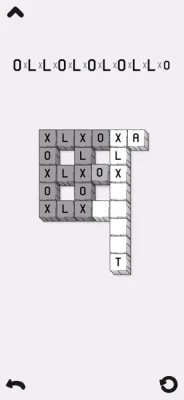
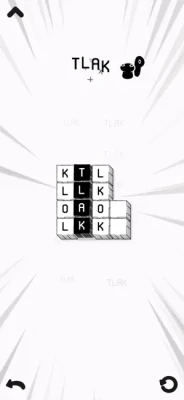
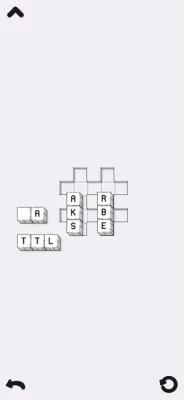
Each puzzle presents a grid of white tiles containing letters and spaces. Your objective is to discover valid words, use their unique effects, and ultimately turn the necessary tiles black. The creatures known as LOKs can survive only on blackened tiles, so every successful puzzle helps their strange little civilization expand.
The game gradually introduces new rules across 15 distinct worlds and more than 150 campaign puzzles, making the experience progressively deeper without overwhelming the player at the beginning. There is also a daily puzzle mode with procedurally generated challenges and leaderboard competition.
What Makes LOK Digital Different?
LOK Digital combines several puzzle concepts without behaving like a conventional crossword or word-search game.
The important difference is that words are actions.
A discovered word can change the board, allowing you to create new opportunities for additional words. As new mechanics appear, familiar patterns can suddenly work in completely different ways.
The game therefore rewards players who think about:
Letter placement
Word combinations
Board positioning
Chain reactions
Future moves
Newly discovered mechanics
Efficient use of available tiles
The result is a relaxing-looking puzzle game that can become surprisingly demanding as the campaign progresses.
LOK Digital Gameplay and Core Mechanics
The basic objective is straightforward: solve the board by spelling the appropriate LOK words and blackening the required tiles.
However, the challenge comes from understanding what each word does.
1. Study the Entire Board
Before making a move, look at the complete arrangement of tiles.
Do not immediately select the first recognizable word. A move that appears useful can sometimes remove an important possibility for a later move.
Look for:
Connected letters
Repeated patterns
Potential word paths
Tiles that can participate in several words
Areas that appear difficult to reach later
A few seconds of observation can save several failed attempts.
2. Learn Every New Word
LOK Digital gradually teaches its vocabulary through the campaign.
Whenever you encounter a new word or mechanic, don't treat it as a one-time solution. Think about the rule behind it.
Ask yourself:
What changed when I used this word?
Understanding the underlying mechanic is more valuable than memorizing a single puzzle solution.
3. Think About Consequences
A successful move should not only solve part of the current puzzle. Ideally, it should also make the remaining board easier.
Before selecting a word, consider:
Which tiles will change?
Which letters will remain available?
Can another word be formed afterward?
Could this move block another route?
Does the move create a better position for the next action?
This forward-thinking approach becomes increasingly important in later worlds.
LOK Digital Strategy Guide
Beginner Strategy
Start With the Most Obvious Words
During the early campaign, don't overcomplicate the board.
Look for the easiest recognizable word first and use it to understand what the game expects from you. The early levels are designed to teach the fundamental rules gradually.
The goal isn't to finish every puzzle as quickly as possible.
The goal is to understand why the solution works.
Don't Treat LOK Digital Like a Normal Word Search
One of the biggest mistakes new players make is concentrating exclusively on finding familiar words.
LOK Digital is more about word mechanics than vocabulary.
A word is valuable because of what it does to the board, not simply because it can be spelled.
When stuck, stop asking:
"What word can I find?"
Instead ask:
"What action does the board need right now?"
That change in perspective can make difficult puzzles much easier.
Look for Multiple Uses of the Same Tiles
Some board positions become useful because a group of letters can participate in different solutions.
Before committing to a move, inspect nearby letters and consider whether the same area could be used again.
This is particularly useful when the board contains several possible word paths.
A good general rule is:
Preserve flexibility until you understand what the puzzle requires.
Work From the Most Restrictive Area
If several parts of the board are available, concentrate on the area with the fewest possible options.
A large open section usually gives you more freedom.
A small isolated section may have only one realistic solution.
Solving the restrictive area first can reveal the move needed to unlock the rest of the puzzle.
Use Failed Attempts as Information
Getting stuck doesn't necessarily mean the puzzle was designed incorrectly.
In LOK Digital, an unsuccessful move can tell you something about the rules.
If a word doesn't produce the result you expected, examine what actually happened.
Ask:
Did the word affect different tiles?
Did it introduce a new possibility?
Did I misunderstand its special effect?
Was another word supposed to be used first?
Treat mistakes as experiments rather than simply failures.
How to Solve Difficult LOK Digital Puzzles
When a puzzle becomes difficult, use this process.
Step 1: Stop Making Random Moves
Randomly testing words can quickly make the board harder to understand.
Pause and inspect the complete layout.
Step 2: Identify Known Mechanics
List the mechanics you have already learned in the current world.
Then determine which one appears relevant to the current board.
Step 3: Search for a Setup Move
The correct first move may not immediately solve anything.
Sometimes its purpose is to create the conditions required for a second or third word.
Step 4: Work Backward
If you know what the final board should look like, think backward.
Ask:
What must happen immediately before the puzzle is completed?
Then determine which move creates that situation.
Step 5: Preserve Important Tiles
Avoid using useful letters simply because a word is available.
A move can be valid but strategically poor.
Step 6: Reset and Try Again
If your current position becomes difficult, restarting is often better than continuing with a bad sequence.
Because the puzzles are logic problems, finding the correct sequence is more important than playing quickly.
LOK Digital World Progression
LOK Digital contains 15 distinct worlds, with each world introducing or developing different puzzle mechanics. The campaign contains 150+ puzzles, while additional challenges and bonus content give experienced players more to explore.
The early progression introduces the basic concept of using words to manipulate the board. Later worlds increasingly combine mechanics, forcing you to remember earlier rules while learning new ones.
Some walkthrough material identifies early worlds such as:
World 1 – Fire
World 2 – Wheel
World 3 – City
World 4 – Electricity
World 5 – Factory
World 6 – Station
World 7 – Rocket
World 8 – Space
World 9 – Infinity
The later campaign also introduces additional worlds and mechanics, providing more complex puzzles for players who want to complete the game fully.
Tip: Avoid reading complete solutions for later worlds too early. Much of LOK Digital's appeal comes from discovering its rules yourself.
Daily Puzzle Mode
After learning the core mechanics, the daily puzzle mode provides another reason to return.
These puzzles are designed around the game's established mechanics and offer an additional test of your understanding. The App Store listing describes the daily puzzles as procedurally generated, while the campaign itself teaches the mechanics needed to approach them.
Daily Puzzle Tips
Review familiar mechanics before starting.
Don't rush your first move.
Search for the most restrictive area.
Look for potential word chains.
Think several moves ahead.
Avoid committing to a solution simply because the first move works.
Compare your approach with previous successful strategies.
Daily puzzles are particularly useful for improving pattern recognition because they encourage you to apply familiar rules to unfamiliar layouts.
LOK Digital Puzzle Tips and Tricks
Tip 1: Think Before You Spell
The fastest-looking word isn't always the best move.
Tip 2: Learn Mechanics, Not Just Answers
Understanding why a solution works helps you solve future puzzles.
Tip 3: Protect Future Options
Don't unnecessarily eliminate tiles that could be important later.
Tip 4: Search for Chains
Many puzzles become easier when one word creates the conditions for another.
Tip 5: Look at the Whole Board
Don't focus exclusively on the letters immediately surrounding your current position.
Tip 6: Use Logic Before Guessing
LOK Digital is designed around discovery and deduction, so carefully examining the board is usually more effective than random experimentation.
Tip 7: Revisit Earlier Ideas
A mechanic introduced several worlds earlier may become useful again in a later puzzle.
Tip 8: Don't Fear a Restart
Restarting a puzzle is often the quickest way to escape a bad sequence.
Tip 9: Solve for the Remaining Problem
Once most of the board is complete, don't simply search for any available word. Determine exactly what the remaining tiles require.
Tip 10: Take Your Time
LOK Digital is better suited to deliberate puzzle solving than rapid tapping. Its calm presentation and meditative soundtrack reinforce that slower approach.
LOK Digital Difficulty
LOK Digital starts with approachable mechanics but becomes significantly more demanding as new rules are introduced.
The difficulty doesn't simply come from making larger boards. The game increasingly asks you to combine ideas that you have already learned.
That makes the later puzzles satisfying because the solution often comes from understanding the system rather than guessing the correct word.
Player feedback on the App Store also highlights the gradual increase in difficulty and the way new mechanics keep the puzzles fresh.
LOK Digital Graphics and Sound
LOK Digital uses an elegant hand-drawn visual style rather than realistic graphics.
The small LOK creatures give the otherwise abstract puzzle boards a sense of personality, while the soundtrack creates a calm atmosphere suited to thoughtful gameplay.
The App Store specifically highlights the game's hand-drawn artwork and meditative soundtrack.
This combination makes LOK Digital a good choice for players who enjoy quiet puzzle games rather than action-heavy mobile titles.
LOK Digital Controls and Platforms
The iOS version supports iPhone and iPad and is listed as a Puzzle game for players aged 4+. The App Store listing also shows support for multiple languages and accessibility options including a dark interface, sufficient contrast, and ways to differentiate information without relying only on color.
LOK Digital is also available on Android and PC platforms, giving players several ways to experience the same word-based puzzle concept.
LOK Digital Free Version and Full Game
LOK Digital can be started for free, with the full game unlocked through a single purchase rather than requiring a separate purchase for every individual puzzle.
This makes the free portion useful for deciding whether the game's unusual word mechanics are a good fit before unlocking the complete campaign.
LOK Digital Pros and Cons
Pros
Creative word-based puzzle mechanics
150+ campaign puzzles
15 distinct worlds
New mechanics introduced throughout progression
Daily puzzle mode
Leaderboard competition
Hand-drawn artwork
Relaxing soundtrack
Charming LOK creatures
No need for fast reflexes
Easy to begin but increasingly challenging
Cons
Some later puzzles can be genuinely difficult
Players looking for action may find the slow pace too quiet
Understanding the special word mechanics can take time
Looking up solutions can reduce the satisfaction of discovering the rules yourself
Who Should Play LOK Digital?
LOK Digital is especially appealing to players who enjoy:
Logic puzzle games
Word puzzles
Crossword-style challenges
Brain-training games
Minimalist indie games
Relaxing mobile games
Challenging single-player puzzles
Games built around experimentation
Daily puzzle challenges
It is less suitable for someone looking for combat, character progression, multiplayer battles, or fast-paced action.
LOK Digital Final Verdict
LOK Digital is a thoughtful and unusually creative puzzle game that turns words into gameplay mechanics.
Its strongest feature is the way it teaches the player gradually. You begin by learning simple rules, but those rules become building blocks for increasingly complicated puzzles.
The 15-world campaign, 150+ puzzles, daily challenges, distinctive artwork, and relaxing presentation give it considerably more depth than a typical mobile word game.
If you enjoy puzzle games where solving the problem yourself is part of the reward, LOK Digital is well worth trying.
Frequently Asked Questions
What is LOK Digital?
LOK Digital is a word-based logic puzzle game in which players discover a mysterious language and use special words to manipulate puzzle boards and help the LOK creatures expand their civilization.
How many puzzles are in LOK Digital?
The campaign contains more than 150 puzzles spread across 15 distinct worlds.
Is LOK Digital free?
You can start LOK Digital for free. The complete game is unlocked through a single in-app purchase.
Is LOK Digital difficult?
The early puzzles are designed to teach the basic mechanics, while later levels become substantially more challenging as multiple rules are combined.
Does LOK Digital have daily puzzles?
Yes. LOK Digital includes a daily puzzle mode with additional challenges and leaderboard competition.
Can I play LOK Digital on iPhone and iPad?
Yes. The App Store version supports both iPhone and iPad.
Does LOK Digital have a story?
Rather than relying on a conventional narrative, the game gives you a simple goal: help the LOK creatures thrive by solving puzzles and expanding the blackened areas where they can live.
What is the best LOK Digital strategy?
The most effective approach is to learn what each word does, examine the entire board before acting, preserve useful tiles, and think several moves ahead instead of simply selecting the first available word.
Is LOK Digital good for casual players?
Yes. Its mechanics are introduced gradually, and there is no requirement for fast reflexes. However, later puzzles can provide a serious challenge for experienced puzzle players.
Rate the Game
User Reviews











Popular Games



















 Android
 iOS
iOS Windows
 Xbox
Xbox