


Latest Version
September 25, 2026
MoonDrip FZ-LLC
Simulation
iOS
0
Report a Problem
More About :game
Despite its Bitcoin-inspired presentation, the App Store states that the game itself does not provide a cryptocurrency wallet or process cryptocurrency transactions; those functions are handled by a third party.
What Is Bitcoin Farm: Satoshi Empire?
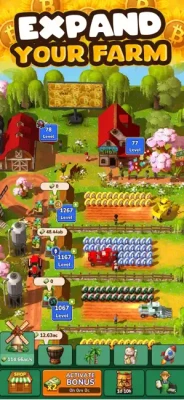
Bitcoin Farm: Satoshi Empire is built around the familiar idle-management loop: start with a modest operation, improve production, automate repetitive work, expand your facilities, and use accumulated resources to unlock stronger progression.
The game combines idle farming, resource management, tycoon progression, automation, Manager cards, upgrades, limited-time events, and world expansion. Your farm continues making progress while you are offline, so the goal is not simply to tap as quickly as possible but to build a production system that becomes increasingly efficient.
The App Store currently lists the game as a free Casual title with in-app purchases. It supports iPhone and iPad and requires iOS 16 or later.
Main Gameplay Features
Build Your Virtual Farm
Your first objective is to develop a small futuristic farm into a much larger operation. Resources generated by the farm can be reinvested into production and infrastructure.
The basic progression loop is:
Produce → collect resources → upgrade → automate → expand → unlock new content → repeat
The important part is reinvesting resources rather than allowing your production systems to remain at their starting efficiency.
Idle Offline Progress
One of the biggest features is offline progression. Your farm continues producing resources while you are away, meaning the game does not require constant active play.
This changes the way you should approach upgrades. An improvement that increases your long-term production can continue paying off after you close the game.
Upgrade Equipment
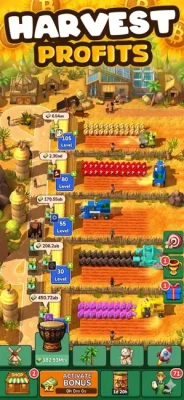
Bitcoin Farm includes different tools, machinery, and advanced farming technology that can improve production and automation.
Upgrades can affect important areas such as:
- Production speed
- Resource generation
- Automation
- Storage
- Farm expansion
- Overall efficiency
The best upgrade depends on what is currently limiting your farm.
Hire Specialized Managers
Managers are an important part of the automation system.
You can collect and upgrade Manager cards, with individual Managers offering different skills designed to improve productivity.
Rather than treating Managers as simple collectibles, think of them as production multipliers. A well-developed management setup can make your entire farm more efficient.
Boosters and Airdrops
The game also provides boosters and special Airdrop features that can accelerate progress.
These are particularly useful when you want to push through an upgrade, event objective, or expansion requirement instead of waiting for normal production.
Barn and Shop Infrastructure
Barn and Shop development forms part of the game's wider management system.
Do not look at these buildings in isolation. Your farm works best when production, storage, and supporting infrastructure develop together.
Cyclic Events
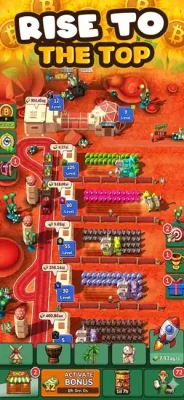
Bitcoin Farm includes limited-time events with different environments and challenges.
The App Store specifically mentions worlds ranging from:
- Post-apocalyptic environments
- Fantasy realms
- High-tech futuristic cities
These events add variety to the normal farming loop and can provide additional progression opportunities.
Season Pass and Daily Tasks
The Season Pass system includes daily missions and special tasks that can unlock additional rewards and limited-time content.
For players who regularly return to the game, these objectives can be incorporated into the normal upgrade routine instead of treated as a separate grind.
Global Expansion
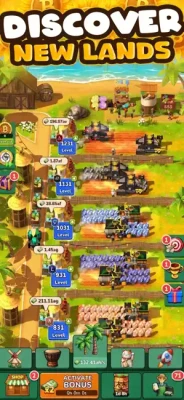
As your empire develops, you can unlock new maps, advanced locations, and rarer assets.
This gives the game a broader progression structure beyond simply upgrading the original farm.
Complete Bitcoin Farm: Satoshi Empire Strategy Guide
1. Understand Your Production Bottleneck
Before spending resources, identify what is actually slowing you down.
Ask yourself:
Is production too slow?
Improve production efficiency.
Is storage filling too quickly?
Invest in capacity or supporting infrastructure.
Are upgrades taking too long to afford?
Prioritize improvements that increase resource generation.
Are you progressing through content too slowly?
Look for automation, Managers, boosters, or expansion opportunities.
This simple habit prevents resources from being wasted on upgrades that have little immediate impact.
2. Build a Strong Early Production Base
Early progression should focus on creating a reliable resource-generating foundation.
Avoid spreading your resources across every available upgrade just because it is unlocked.
Instead, establish a simple priority:
Production first → automation second → infrastructure third → expansion
Once the basic operation is producing consistently, your later upgrades become easier to afford.
3. Upgrade Production Before Chasing Expansion
New areas are attractive because they represent visible progression, but expansion is more useful when your existing operation can support it.
If you are struggling to afford upgrades, spend some time improving your current production system.
A stronger farm produces the resources needed to finance future expansion.
Think of expansion as a reward for building an efficient economy, rather than something you should rush regardless of your production strength.
4. Use Managers Strategically
Managers can be one of the most important parts of your long-term setup.
When deciding which Manager to improve, consider:
- What production system needs help?
- Which Manager skill benefits your current bottleneck?
- Will the upgrade improve active production?
- Will the benefit continue helping while you are offline?
- Does the Manager complement your current setup?
Do not automatically upgrade every Manager equally.
A concentrated investment in useful automation can be more practical than spreading resources thinly across a large collection of cards.
5. Make Offline Progress Work for You
Offline production is one of the strongest reasons to think about your farm as a long-term system.
Before leaving the game:
- Collect available resources.
- Purchase useful upgrades.
- Activate appropriate automation.
- Make sure your production chain is operating.
- Check storage and supporting infrastructure.
- Leave the farm running.
When you return, use the accumulated resources to fund another meaningful upgrade.
This creates a productive cycle:
Prepare → leave → collect offline progress → upgrade → prepare again.
6. Do Not Waste Every Booster Immediately
Boosters are most valuable when they create a meaningful jump in progression.
Instead of activating every boost as soon as you receive it, consider saving stronger boosts for situations such as:
- A major upgrade
- An event objective
- A difficult progression wall
- A new expansion
- A period when multiple production systems can benefit simultaneously
The objective is to multiply an already productive setup rather than temporarily accelerate a weak one.
7. Use Airdrops With a Purpose
Airdrops can provide another way to accelerate progression.
Before using one, identify what you actually need.
If you are close to an important upgrade, an acceleration feature can be more useful than spending resources randomly.
The best question is not:
“Can I use this now?”
It is:
“What does using this now allow me to unlock sooner?”
8. Keep Storage and Production Balanced
A farm with strong production but inadequate supporting capacity can become inefficient.
Likewise, investing heavily in capacity while production remains weak can leave resources tied up without producing a meaningful return.
Try to maintain a balance between:
Production + Storage + Automation + Infrastructure
Whenever one area clearly becomes the limiting factor, redirect your next upgrades there.
9. Treat Events as Separate Opportunities
Cyclic events introduce different worlds and limited-time challenges.
Do not automatically abandon your normal progression just because an event appears.
Instead, determine what the event offers and whether your current resources and upgrades allow you to make useful progress.
For event-focused play:
- Check the event objectives first.
- Identify the main reward path.
- Use boosters where they have the greatest impact.
- Avoid spending resources without a clear objective.
- Complete easy daily objectives consistently.
- Return to your main farm when the event requires excessive investment.
10. Complete Daily Tasks Efficiently
The Season Pass includes daily missions and special tasks.
The efficient approach is to combine these objectives with your normal gameplay.
For example, if a task requires upgrading production, do that upgrade when you were already planning to improve production.
This avoids turning every daily objective into an additional grind.
A good daily routine is:
Collect → check tasks → complete easy objectives → upgrade → use useful boosts → prepare for offline progress.
11. Plan Around Long-Term Growth
Idle games reward patience.
A small improvement that works continuously can eventually become more valuable than a short burst of progress.
When choosing between two upgrades, consider:
How often will I benefit from this?
An upgrade that improves your production every minute can be extremely valuable because the benefit continues during both active and offline periods.
12. Expand When Your Economy Is Ready
Global expansion introduces new maps, advanced locations, and rarer assets.
Before expanding, make sure your existing operation is healthy.
A good expansion checkpoint is when:
- Your normal production is stable.
- Your important automation is active.
- Your core Managers are upgraded.
- You have enough resources for the next several improvements.
- Your current production bottleneck is under control.
Expansion should increase your opportunities rather than create an economy that is difficult to maintain.
13. Use the Idle System to Your Advantage
You do not need to play constantly to make progress.
A practical routine is to play actively for a few minutes, make the important upgrades, then leave the game.
When you return:
Collect offline rewards → upgrade production → improve automation → check events → repeat.
This is particularly effective for players who enjoy management games but do not want a game that demands constant attention.
14. How to Progress Faster Without Overspending
The game offers optional purchases such as Farm Field Boosts, VIP Access, special offers, Investor Gems, and Premium Pass options.
You do not need to treat purchases as part of the basic strategy.
For free-to-play progression, concentrate on:
- Offline earnings
- Regular upgrades
- Manager development
- Daily tasks
- Free boosters
- Event rewards
- Efficient reinvestment
If you do spend, evaluate an offer according to the amount of progression it provides rather than buying simply because it appears during a temporary slowdown.
Best Upgrade Strategy
A useful general upgrade priority is:
Early Game
Production → automation → storage/infrastructure → expansion
Mid Game
Managers → production efficiency → infrastructure → event progression → expansion
Later Game
Automation optimization → high-value Managers → advanced equipment → new maps → rare assets
This is not a rigid rule because your current bottleneck should always determine the next upgrade.
Beginner Tips
Tip 1: Upgrade With a Reason
Do not spend resources just because an upgrade is available.
Tip 2: Watch Your Bottleneck
The slowest part of your economy deserves attention first.
Tip 3: Value Automation
Managers are particularly important because they help turn manual progression into an automated system.
Tip 4: Remember Offline Progress
Prepare the farm before closing the game.
Tip 5: Combine Tasks
Complete Season Pass objectives while performing upgrades you already need.
Tip 6: Save Powerful Boosts
Use major acceleration effects when they can produce a meaningful progression jump.
Tip 7: Do Not Rush Every Expansion
A stronger economy makes later expansion easier.
Tip 8: Check Events Regularly
Limited-time content can change what is worth doing during a play session.
Advanced Strategy
Once your farm becomes established, stop thinking about individual upgrades and start thinking about production cycles.
A strong cycle looks like this:
Resource collection → high-value upgrade → automation improvement → offline production → resource collection → expansion
The goal is to make every cycle stronger than the previous one.
If an upgrade does not noticeably improve your next cycle, consider whether another investment would provide a greater immediate benefit.
Bitcoin Farm Satoshi Empire Game Information
| Information | Details |
|---|---|
| Game | Bitcoin Farm Satoshi Empire |
| Store Category | Casual |
| Developer | MoonDrip FZ-LLC |
| Platform | iPhone, iPad |
| Minimum OS | iOS 16 / iPadOS 16 |
| Size | 399 MB |
| Age Rating | 13+ |
| Languages | English + 32 more |
| Business Model | Free with in-app purchases |
| Main Genre | Idle Farming / Tycoon / Management |
| Core Systems | Farming, automation, Managers, upgrades, events, expansion |
| Offline Progress | Yes |
| Game Center | Achievements |
The App Store also lists advertising, messaging/chat, user-generated content, and loot boxes among the game's age-rating content descriptors.
Recent Updates
The App Store version history shows version 1.1.0 dated August 25, following versions 1.0.0 on July 22, 0.9.0 on June 26, and 0.8.0 on June 5. The listed update notes are primarily bug-fix/support oriented rather than a detailed feature changelog.
Because the game is still receiving updates, some balancing, rewards, event structures, or progression details may change over time.
Player Feedback
The U.S. App Store listing currently shows a 4.6/5 rating from more than 200 ratings. Reviews include players who enjoy the relaxing farming loop and others discussing advertising, progression, reward systems, or technical/account-related issues.
That feedback suggests that player experiences can vary depending on how actively they use the game's advertising and reward systems.
Is Bitcoin Farm: Satoshi Empire a Real Bitcoin Mining App?
This distinction is important.
The game uses Bitcoin-themed terminology and presents a virtual farming/earning experience, but the App Store explicitly states that Bitcoin Farm itself does not provide a cryptocurrency wallet or process cryptocurrency transactions. Cryptocurrency-related transactions are handled by a third party.
Therefore, players should read the game's in-app instructions and applicable terms carefully rather than assuming that the virtual farming mechanics are equivalent to operating a real Bitcoin mining system.
Pros and Cons
Pros
- Relaxing idle-farming gameplay
- Offline progression
- Large upgrade system
- Automated production
- Specialized Manager cards
- Boosters and Airdrops
- Multiple worlds and environments
- Cyclic events
- Season Pass objectives
- Long-term empire expansion
Cons
- Progress can become dependent on optimization and waiting
- Advertising is part of the experience
- Some systems may feel complicated for players unfamiliar with idle tycoon games
- Limited-time events can add additional objectives to manage
- Some player reviews mention issues involving rewards, accounts, or progression
Frequently Asked Questions
What is Bitcoin Farm: Satoshi Empire?
It is a futuristic idle farming and tycoon simulator focused on resource production, upgrades, automation, Managers, events, and expansion.
Does Bitcoin Farm work offline?
Yes. The App Store describes offline progress as one of the game's core features.
What are Managers in Bitcoin Farm?
Managers are collectible and upgradeable cards with individual skills that help automate and improve farm productivity.
What should I upgrade first?
Focus on the system currently limiting your production. Early on, production and automation are generally the most important areas to develop.
Are there events?
Yes. The game features cyclic, limited-time events with different worlds and challenges.
Does the game have a Season Pass?
Yes. The App Store description says the Season Pass includes daily missions and special tasks with rewards and limited-time content.
Can I expand to new locations?
Yes. Global expansion allows players to unlock new maps, advanced locations, and rarer assets as they progress.
Is Bitcoin Farm a cryptocurrency wallet?
No. The App Store specifically says the game itself does not provide a cryptocurrency wallet or process cryptocurrency transactions.
What devices support Bitcoin Farm?
The App Store lists iPhone and iPad compatibility and requires iOS 16 or later.
Final Strategy
The key to Bitcoin Farm: Satoshi Empire is not simply tapping and collecting as quickly as possible. The deeper strategy is to build an increasingly efficient automated economy.
Start by strengthening production, improve automation with Managers, maintain enough supporting infrastructure, use boosters when they can create meaningful progress, complete useful daily objectives, and take advantage of offline earnings.
As your production becomes stronger, reinvest those resources into expansion and new worlds. The best long-term approach is to make each production cycle more efficient than the last.
Rate the Game
User Reviews













Popular Games


















 Android
 iOS
iOS Windows
 Xbox
Xbox