



Latest Version
September 27, 2026
Solid Games
Puzzle
iOS
0
Report a Problem
More About :game
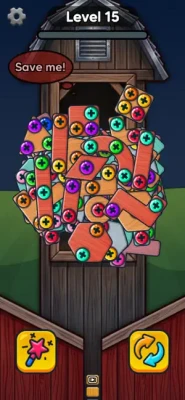
Instead of relying on speed alone, Piggy Escape rewards careful observation and planning. Matching two screws of the same color removes them together, while poorly chosen screws can occupy valuable spaces and leave you with no room to make the next move.
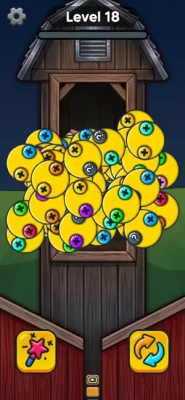
As the levels become more complicated, players encounter additional colors, unusual metal-plate shapes and screws hidden behind other pieces. The result is a puzzle experience that starts casually but gradually demands much more attention.
What Is Piggy Escape?
Piggy Escape is a screw-matching puzzle game from Solid Games. The objective is to remove the screws holding metal plates in place and eventually free the pig trapped underneath.
The core mechanic is straightforward: find two screws with matching colors and tap them so they can be removed together. When a screw is selected, it moves into one of five storage slots. This means every move needs to be considered because filling all five slots with unmatched screws can leave the puzzle unsolvable.
The game is available on iPhone and iPad and is listed in the Puzzle category on the App Store. It requires iOS 15.0 or later.
Piggy Escape Gameplay
The gameplay revolves around three things: identifying matching screws, managing the five available slots, and revealing screws that are hidden by metal plates.
At the beginning of a puzzle, the board may look easy because only a few colors and simple shapes are involved. However, later layouts can contain more colors and overlapping or unusual plate structures.
The most important habit is to look at the entire board before making unnecessary moves. A screw that appears convenient may actually be needed to expose another screw or complete an important pair later.
Match Two Screws
Two screws of the same color can be matched and removed.
Whenever possible, look for pairs that can be cleared immediately. Removing a pair gives you additional space and can also change the board by allowing metal plates to fall away.
Manage the Five Screw Slots
The five storage slots are one of the most important parts of Piggy Escape.
A misplaced screw is not necessarily a mistake, but filling several slots with different colors can quickly create a dangerous situation. Before tapping a screw, try to identify where its matching screw is located.
A good rule is:
Do not use a slot unless you have a reasonable plan for clearing it.
Remove Metal Plates
The screws are not simply collectibles. They are holding the metal plates in place.
Removing the correct screws gradually clears the board and exposes more of the puzzle. This makes the game partly about matching colors and partly about understanding the physical arrangement of the plates.
Find Hidden Screws
Some screws can be difficult to see because other pieces are positioned over them.
Before committing to a move, inspect the visible screws and think about which plate will move after the next pair is removed. Sometimes the best move is not the pair that is easiest to see, but the pair that opens an important section of the board.
Piggy Escape Strategy Guide
1. Study the Board Before Tapping
The first few seconds of a level can be more valuable than immediately making a move.
Scan the entire puzzle and identify:
- Visible matching pairs
- Screws with unclear matches
- Screws blocking other pieces
- Colors that appear frequently
- Areas likely to open after a plate is removed
This gives you a basic roadmap instead of forcing you to react to every move.
2. Clear Easy Pairs Early
If two matching screws are already available and removing them will not interfere with another planned move, clearing them is usually useful.
A successful pair removes two screws and creates more room in the storage area.
However, do not automatically match every visible pair. Consider what the removal will reveal before committing.
3. Protect Your Empty Slots
The five slots are effectively your safety margin.
Try to keep at least one or two spaces available whenever possible. Having free space gives you flexibility when a newly exposed screw does not immediately have an obvious match.
If four slots are already occupied by different colors, think very carefully before selecting another screw.
4. Look for the Second Screw Before Taking the First
One of the easiest mistakes is tapping a screw simply because it is available.
Before selecting it, ask:
Where is its matching color?
If the answer is unclear, another move may be safer.
This is particularly important when the board contains many colors or when screws are partially hidden.
5. Think About What Each Plate Is Hiding
Piggy Escape becomes more interesting when the board starts using layered metal plates.
Instead of looking only at individual screws, think of each plate as part of a larger puzzle.
Ask:
- Which screws are holding this plate?
- What will become visible if the plate moves?
- Could removing this pair reveal a useful matching screw?
- Is another plate blocking a better move?
This approach helps turn the game from simple color matching into a spatial puzzle.
6. Avoid Filling the Slots With Random Colors
A common losing pattern is:
- Tap a red screw.
- Tap a blue screw.
- Tap a yellow screw.
- Tap a green screw.
- Discover that none of their partners can currently be reached.
The five slots are now full, leaving very little room for recovery.
Instead, build pairs whenever the board allows it.
7. Prioritize Moves That Open the Board
When several moves are possible, consider choosing the one that exposes more of the puzzle.
A pair that reveals several previously hidden screws can be more useful than a pair that simply removes two screws from an already open area.
8. Keep Track of Difficult Colors
When many colors are introduced, mentally group screws by color.
For example:
- Red → possible partner
- Blue → possible partner
- Green → blocked
- Yellow → immediately clearable
This simple mental organization can prevent accidental slot filling.
9. Do Not Rush
Piggy Escape does not use a normal countdown timer according to its App Store description. That means you can focus on solving the board rather than trying to make every move as quickly as possible.
Take advantage of that.
Look at the board, consider the next two or three moves, and then tap.
10. Recheck the Board After Every Pair
Removing a pair can change what is accessible.
After a successful match:
- Stop for a moment.
- Check which plates moved.
- Look for newly visible screws.
- Identify new matching opportunities.
- Recalculate your next move.
Treat every successful match as a new puzzle state.
Advanced Piggy Escape Tips
Use a “Safe Pair” Mindset
A safe pair has two characteristics:
- Both screws have the same color.
- Removing them does not create a worse position.
If a pair is clearly available and creates additional space, it is often a strong candidate.
Separate Known Matches From Unknown Screws
You can mentally divide the board into two groups.
Known: screws whose matching partner you can identify.
Unknown: screws whose partners are hidden or difficult to locate.
Deal with known pairs first when doing so does not block access to the unknown pieces.
Think Two Moves Ahead
Do not only ask, “What can I remove now?”
Ask:
“What will I be able to remove after this?”
That small change in thinking can make difficult levels much easier.
Avoid Creating a Dead-End
A dead-end occurs when the remaining screws cannot be organized into the available slots without creating a mismatch problem.
Before making a move that occupies another slot, make sure it contributes toward a future pair or opens another section of the board.
Piggy Escape Level Tips
Early Levels
Use the early stages to learn how the screws and plates interact.
Focus on:
- Matching colors
- Understanding the five slots
- Watching how plates move
- Recognizing which screws are hidden
Do not worry about finishing quickly.
Medium-Difficulty Levels
More colors and complicated arrangements make planning more important.
Start identifying pairs before tapping anything. Try to maintain empty slots and prioritize moves that expose additional screws.
Harder Levels
The later puzzles require more deliberate planning.
Instead of searching for the easiest pair, look for the move that improves the entire board position. Hidden screws, unusual plate shapes and multiple colors can make a seemingly simple move much more important than it first appears.
Common Piggy Escape Mistakes
Tapping the First Available Screw
Availability does not mean usefulness. A screw can consume a slot without helping you progress.
Ignoring the Board Layout
Piggy Escape is not only a color-matching game. The position of the metal plates matters.
Filling All Five Slots
Once all five spaces contain unmatched screws, your options become extremely limited.
Forgetting Newly Revealed Screws
After a plate moves, always scan the newly exposed area.
Playing Too Quickly
Because the game is based on planning rather than a standard countdown, speed should not come at the expense of good decisions.
Piggy Escape Features
Based on the current store listing, Piggy Escape includes:
- Screw-matching puzzle gameplay
- Five storage slots
- Color-based screw matching
- Metal plate removal
- Increasingly complex layouts
- Hidden screws
- Multiple colors
- Pig rescue objective
- No standard timer
- Friend competition
- iPhone and iPad support
- Free-to-play access with advertising and optional in-app purchases
The App Store currently lists the game as a 4+ Puzzle title from Solid Games. The listing also shows an optional $9.99 Remove Ads purchase in the U.S. store.
Piggy Escape Difficulty
Piggy Escape starts with an accessible matching concept, but the difficulty comes from managing limited space rather than simply finding colors.
As the board becomes more complicated, players need to consider:
- Which screws are accessible
- Which screws are hidden
- Which plates can be removed
- How many slots remain
- Which pair should be cleared first
- What the next board state will look like
That gradual increase in complexity gives the game more depth than a basic color-matching puzzle.
Is Piggy Escape Easy to Play?
Yes, the controls are simple: the player taps screws and attempts to match colors. The challenge comes from deciding which screw to select rather than learning complicated controls.
The game's store description emphasizes that later stages introduce more colors and more complicated metal-plate shapes, making the puzzles progressively harder.
Piggy Escape Tips for Beginners
If you are just starting, remember these five rules:
- Look at the whole board first.
- Find a screw's partner before selecting it.
- Keep the five slots from filling with different colors.
- Use matches that expose useful new screws.
- After every pair, scan the board again.
These habits are more valuable than trying to memorize a fixed solution for every level.
Piggy Escape Pros and Cons
Pros
- Simple controls
- Easy-to-understand objective
- Short puzzle sessions
- Color matching combined with spatial planning
- Increasing puzzle complexity
- No conventional countdown timer
- Cute pig rescue theme
Cons
- Later boards can become significantly more demanding
- Similar colors may require careful visual attention
- Limited storage slots can make mistakes costly
- Advertising is part of the free experience
- Some players may find the difficulty increases quickly
The App Store currently shows a 4.7/5 rating from 710 ratings, while individual reviews also show that players have differing reactions to the difficulty and advertising experience.
Piggy Escape Updates
The App Store listing shows frequent early updates. The current version shown there is 0.2.3, with the latest update described as increasing clearance copywriting and updating the SDK. Earlier updates included bug fixes, difficulty adjustments, backend changes and changes to screw interaction.
Because the game is relatively new, its mechanics and presentation may continue to change with future updates.
Piggy Escape Game Information
Game: Piggy Escape - Puzzle Game
Developer: Solid Games
Genre: Puzzle
Platform: iPhone, iPad
Age Rating: 4+
Price: Free with advertising and optional in-app purchases
Compatibility: iOS 15.0 or later
Languages: English plus 13 additional languages
Core mechanic: Match two screws of the same color
Main objective: Remove the screws and free the piggy
Storage: Five screw slots
Timer: No standard timer
Current App Store version: 0.2.3
U.S. Remove Ads purchase: $9.99
Frequently Asked Questions
What is Piggy Escape?
Piggy Escape is a puzzle game where players match screws by color, remove metal plates and free a trapped piggy.
How do you play Piggy Escape?
Tap screws and match two screws of the same color. The screws disappear together, helping remove the metal plates and open the board.
How many screw slots are there in Piggy Escape?
There are five storage slots. Managing these slots is a major part of solving the puzzles.
Does Piggy Escape have a timer?
The App Store description says there is no timer. Players can instead focus on solving the puzzle and can compete with friends over rescue speed.
How do you avoid getting stuck in Piggy Escape?
Avoid filling all five slots with unrelated screws. Look for matching partners before selecting a screw and prioritize moves that create additional space or reveal new pieces.
Does Piggy Escape get harder?
Yes. The developer's description states that later levels introduce more colors, unusual metal-plate shapes and screws hidden behind other pieces.
Is Piggy Escape free?
Yes. Piggy Escape is listed as free on the App Store, with advertising and optional in-app purchases.
Can I play Piggy Escape on iPad?
Yes. The App Store lists Piggy Escape for iPhone and iPad.
Final Thoughts
Piggy Escape takes a familiar matching idea and adds a useful layer of planning through its limited screw slots and metal-plate layouts. The objective is easy to understand, but solving the harder boards requires players to look ahead instead of simply tapping whatever screw is available.
The best approach is to stay patient, protect your empty slots, identify matching pairs before committing to a move, and pay attention to what each cleared plate reveals. Once you start treating the board as a sequence of decisions rather than a collection of individual screws, the puzzles become much easier to read.
Rate the Game
User Reviews








Popular Games



















 Android
 iOS
iOS Windows
 Xbox
Xbox