
Latest Version
September 27, 2026
Yso Corp
Puzzle
iOS
0
Report a Problem
More About :game
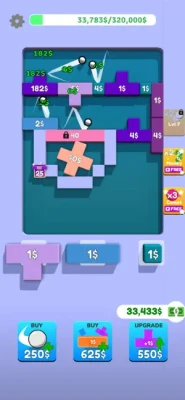
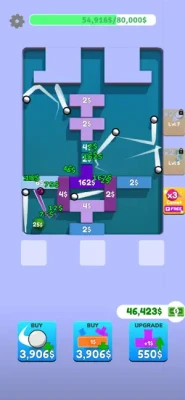
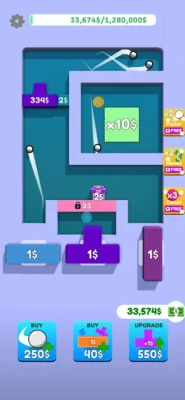
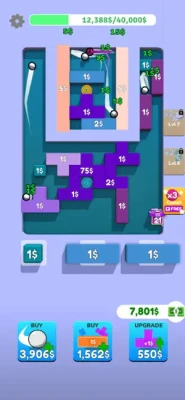
Money Bounce 3D! takes a simple idea and turns it into a surprisingly engaging physics puzzle: place blocks, make balls bounce, and earn money.
Instead of directly controlling every movement of the balls, you influence their paths by positioning blocks around them. Every collision can contribute to your earnings, so the objective is to create arrangements that keep the balls active for as long as possible.
The official App Store description specifically highlights dragging and dropping blocks, earning money from ball bounces, purchasing additional blocks and balls, and trapping balls in smaller spaces to increase their bounce activity.
Money Bounce 3D! Gameplay Features
Physics-Based Ball Bouncing
The game's central mechanic is based on physics.
Balls move around the play area and interact with the blocks you place. Your job is to influence their movement by creating useful barriers and surfaces.
Every successful bounce can contribute toward your earnings.
Drag-and-Drop Block Placement
Controls are intentionally simple. You select a block and place it where you want it.
The difficulty comes from deciding where to put the block rather than figuring out complicated controls.
A small change in position can alter the ball's trajectory and change how frequently it hits other blocks.
Earn Money From Bounces
The more effectively you keep balls interacting with your block arrangement, the more opportunities you have to generate money.
This creates a satisfying loop:
Place → Bounce → Earn → Buy → Improve → Bounce Again
Buy More Blocks
Additional blocks give you more control over the ball's movement.
As your setup becomes more complicated, you can experiment with different layouts and create more opportunities for repeated collisions.
Buy More Balls
Increasing the number of balls gives you additional activity on the board and can potentially create more simultaneous bounce opportunities.
However, more balls do not automatically mean a better setup. Good positioning remains important.
How to Play Money Bounce 3D!
The basic gameplay is straightforward.
Start by placing blocks around the area where the balls are moving. Watch how the balls react to each block and look for positions that create repeated collisions.
Once your setup starts generating money, use your earnings to purchase additional blocks or balls.
The real skill comes from experimenting with placement.
A block should not simply be placed anywhere. Think about:
- The direction of the ball
- Its current trajectory
- Nearby blocks
- Open spaces
- Potential collision points
- Whether the arrangement encourages repeated bouncing
Full Money Bounce 3D! Strategy Guide
1. Study the Ball's Movement First
Before adding lots of blocks, watch how the ball naturally moves.
This gives you valuable information about its trajectory.
Instead of immediately covering the entire area with blocks, identify:
Where is the ball traveling?
Where does it normally bounce?
Which direction does it move after a collision?
Once you understand those patterns, you can place blocks more intelligently.
2. Place Blocks to Create Multiple Collisions
A single bounce is useful, but repeated bouncing is where your setup becomes more productive.
Try to position blocks so a ball can move from one collision to another.
For example:
Block → Ball → Block → Ball → Block
The goal is to keep the ball active rather than allowing it to quickly escape into an unproductive area.
3. Create Controlled Spaces
One of the most important ideas in Money Bounce 3D! is using blocks to create tighter areas.
The App Store description specifically recommends trapping balls in small spaces between blocks to make money rapidly.
This makes spacing extremely important.
You want enough room for the ball to move, but not so much open space that it spends most of its time traveling without hitting anything.
4. Don't Randomly Stack Blocks
More blocks do not automatically create a better setup.
If blocks are placed randomly, they can interfere with the ball's movement rather than improving it.
Instead, add one block at a time and observe the result.
Ask yourself:
Did the new block create more useful collisions?
If yes, keep the arrangement.
If it sends the ball into an unproductive direction, reposition it.
5. Use Existing Blocks as a Foundation
Once you have a useful arrangement, don't completely rebuild it every time you earn enough money for another block.
Treat successful layouts as a foundation.
Add new blocks around the existing structure and see whether they improve the bounce pattern.
This reduces unnecessary experimentation.
6. Prioritize Bounce Frequency
When choosing between two possible placements, think about how frequently the ball will interact with blocks.
A setup that produces frequent collisions can be more valuable than one that simply looks complicated.
The objective isn't to create the most blocks.
The objective is to create productive ball movement.
7. Experiment With Angles
Small changes in block positioning can change the direction of a bouncing ball.
Use this to your advantage.
If a ball repeatedly moves toward an empty section of the screen, try positioning a block so that the next collision redirects it toward another useful area.
Think of every block as a tool for shaping the ball's path.
8. Add Balls When Your Layout Can Support Them
Buying more balls can increase activity, but adding them too early may make it harder to understand what is happening.
First create a reliable block arrangement.
Then increase the number of balls and observe whether the additional activity improves your setup.
A good order is:
Reliable layout → More balls → Observe → Adjust → Expand
9. Improve Rather Than Constantly Rebuild
Once you discover an efficient arrangement, refine it.
Move one block.
Test it.
Move another.
Test again.
This controlled approach makes it easier to understand which changes actually improve your earnings.
10. Look for High-Activity Areas
Some sections of the board may naturally produce more useful collisions than others.
When you notice an area where the ball repeatedly interacts with several blocks, build around that area.
Creating a concentrated bounce zone can be more effective than spreading blocks evenly across the entire play area.
Advanced Money Bounce 3D! Tips
Build a Bounce Chain
The ideal setup encourages a ball to move through several collision points rather than bouncing once and leaving the useful area.
Think of your blocks as links in a chain.
Collision 1 → Collision 2 → Collision 3 → Collision 4
The longer the useful chain, the more opportunities the ball has to generate income.
Use Narrow Gaps Carefully
Narrow spaces can be useful because they may keep balls interacting with nearby blocks.
However, avoid creating arrangements that completely stop useful movement.
The goal is controlled bouncing, not simply trapping the ball without productive movement.
Make Small Adjustments
Physics-based games reward experimentation.
If a setup is almost working, don't immediately delete everything.
Try moving one block slightly.
Sometimes a tiny adjustment is enough to send the ball into a much more productive trajectory.
Think About Ball Direction
Don't only look at where the ball is now.
Think about where it will go after the next collision.
This is one of the biggest differences between random block placement and deliberate strategy.
Best Beginner Strategy
For new players, follow this simple method:
Step 1
Watch the ball's natural movement.
Step 2
Place your first blocks near useful collision points.
Step 3
Observe the new trajectory.
Step 4
Add another block where it can create another bounce.
Step 5
Try to create a compact area with repeated collisions.
Step 6
Use your earnings to purchase additional blocks.
Step 7
Add more balls once your layout is working effectively.
Step 8
Continue making small adjustments instead of completely rebuilding the board.
Money Bounce 3D! Money-Making Strategy
The game's money system is directly connected to ball activity.
The most useful way to think about earnings is:
More useful bounces = more earning opportunities.
That means your priority should not simply be increasing the number of objects on screen.
Instead, build a setup that encourages balls to interact with blocks repeatedly.
A compact, controlled arrangement can therefore be more useful than a large but poorly organized one.
Common Mistakes to Avoid
Placing Blocks Randomly
Random placement can produce unpredictable and inefficient ball paths.
Using Too Much Open Space
Large empty areas can allow balls to travel without producing useful collisions.
Adding Too Many Blocks Too Quickly
A crowded setup can become difficult to understand and adjust.
Ignoring Ball Trajectory
Always consider where the ball will go after hitting your block.
Rebuilding a Successful Setup
If your current layout is working, improve it gradually rather than starting over.
Buying Without a Plan
Use new blocks and balls to solve a specific problem or improve an existing setup.
Money Bounce 3D! Game Information
| Feature | Details |
|---|---|
| Game | Money Bounce 3D! |
| Developer | Yso Corp |
| Genre | Puzzle / Casual |
| Main Mechanic | Physics-based ball bouncing |
| Controls | Drag and drop |
| Main Objective | Create productive bounce setups and earn money |
| Progression | Buy additional blocks and balls |
| Platform | iPhone, iPad |
| iOS Requirement | iOS 13.0 or later |
| Age Rating | 4+ |
| App Size | 168.8 MB |
| App Store Status | Free |
| Languages | English plus 13 additional languages |
The current App Store listing identifies Yso Corp as the developer, categorizes the game as Puzzle, and lists iPhone and iPad compatibility with iOS/iPadOS 13 or later.
Money Bounce 3D! Updates
The App Store version history currently shows version 23.1, released October 7, 2024, with bug fixes. An earlier version was released June 5, 2024.
Because the current store history does not show newer version entries, avoid describing the game as actively receiving frequent updates unless a newer official listing becomes available.
Money Bounce 3D! Difficulty
Controls: Easy
Basic Mechanics: Easy
Physics: Easy to understand
Block Placement: Moderate
Optimization: Moderate
Long-Term Challenge: Moderate
The controls are simple, but getting the most out of the physics system requires experimentation and careful positioning.
Is Money Bounce 3D! Easy to Play?
Yes. The basic controls are extremely accessible because the main interaction involves dragging and dropping blocks.
The deeper challenge is creating an arrangement that makes the balls bounce repeatedly and efficiently.
That combination makes the game easy to start but gives players room to experiment with different layouts.
Money Bounce 3D! Pros and Cons
Pros
- Simple drag-and-drop controls
- Physics-based gameplay
- Satisfying bouncing mechanics
- Easy-to-understand money system
- Multiple blocks to experiment with
- Ability to purchase additional balls
- Encourages creative layouts
- Casual puzzle experience
- Free to download
Cons
- The gameplay can become repetitive for players who prefer complex puzzle systems.
- Finding the best layouts relies heavily on experimentation.
- Some App Store reviewers have criticized the frequency of advertisements.
- The App Store currently shows a 2.9/5 rating from 154 ratings, so player reception is mixed.
Frequently Asked Questions
What is Money Bounce 3D!?
Money Bounce 3D! is a physics-based puzzle game where players place blocks and use bouncing balls to generate money.
How do you make money in Money Bounce 3D!?
You earn money when the balls bounce against the blocks in your setup.
How do you place blocks?
The game uses a drag-and-drop system. You drag blocks into the play area and position them to influence the movement of the balls.
Can you buy more balls?
Yes. The game's store description specifically mentions purchasing additional balls as part of progression.
Can you buy more blocks?
Yes. Additional blocks can be purchased to create more complicated bounce arrangements.
How can you earn money faster?
Try creating compact areas where balls repeatedly bounce between blocks. The official description specifically highlights trapping balls in small spaces between blocks as a way to increase earnings.
Is Money Bounce 3D! free?
Yes. The App Store currently lists Money Bounce 3D! as free to download.
Is Money Bounce 3D! available on iPhone?
Yes. The game is listed for iPhone and iPad and requires iOS/iPadOS 13.0 or later.
Who made Money Bounce 3D!?
Money Bounce 3D! was developed by Yso Corp.
Is Money Bounce 3D! a puzzle game?
Yes. Apple currently categorizes it as a Puzzle game.
Final Thoughts
Money Bounce 3D! turns simple physics into a casual puzzle challenge. The controls are straightforward, but the placement of each block can significantly change how the balls move around the board.
The most important strategy is to think about trajectories rather than simply adding more blocks. Build compact bounce areas, create repeated collision opportunities, watch how each adjustment changes the ball's path, and gradually expand a setup that is already working.
For beginners, the best starting point is simple: watch the ball, place a block, observe the bounce, and refine the arrangement. As you earn more money, additional blocks and balls give you more possibilities for creating efficient bounce setups.
Rate the Game
User Reviews







Popular Games


















 Android
 iOS
iOS Windows
 Xbox
Xbox