The game is easy to understand but becomes increasingly strategic when you start planning several moves ahead. Its colorful underwater presentation, physics-based jellyfish movement and chain reactions give the classic falling-block puzzle concept a more relaxed personality.
What Is Oh Jellies!?
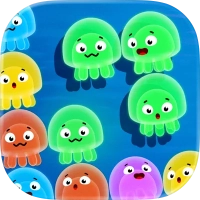
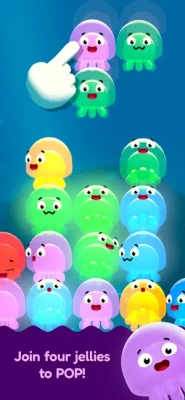
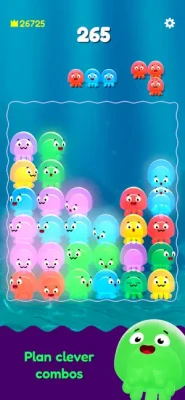
Oh Jellies! is a casual puzzle game developed by Thomas Young, the creator behind games including the Dadish series. The main objective is to place jellyfish on the board and create groups of four or more matching colors.
The interesting part happens after a group is cleared. Jellyfish above the empty space fall downward, and their new positions can create additional matches. A carefully planned move can therefore trigger several consecutive pops and produce a much larger combo.
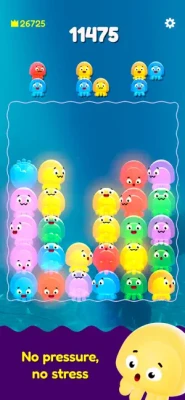
There are no countdown timers forcing you to make rushed decisions. The game is built around taking your time, studying the board and finding placements that create the best possible chain reactions.
Oh Jellies! Gameplay Features
Relaxing Puzzle Gameplay
The basic gameplay loop is straightforward:
-
Choose a jellyfish.
-
Drag it onto the board.
-
Connect four or more matching jellyfish.
-
Watch the group burst.
-
Let the jellyfish above fall.
-
Look for automatic matches.
-
Continue building your score.
Because there is no timer, the emphasis is on planning rather than speed.
Chain Reactions
Chain reactions are the heart of Oh Jellies!.
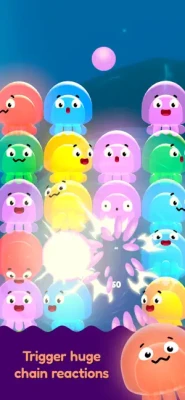
Clearing one group can change the position of several jellyfish. If the falling pieces create another group of four or more, the second group automatically pops as well.
That creates the game's most satisfying moments: one carefully chosen placement can turn into a long sequence of consecutive clears.
High-Score Chasing
The game includes global leaderboards, giving experienced players a reason to keep improving their scores after learning the basic mechanics. Game Center support also includes leaderboards and achievements.
Colorful Jellyfish and Effects
The underwater presentation is one of the game's defining characteristics. The jellyfish are bright and expressive, while the popping and falling animations provide visual feedback whenever a successful combination occurs.
Several App Store reviewers specifically highlighted the colorful presentation, animations and relaxing atmosphere. These are user opinions rather than objective performance measurements, but they help explain the game's appeal.
Full Oh Jellies! Strategy Guide
1. Don't Automatically Clear the First Match
When you see four matching jellyfish, it can be tempting to pop them immediately.
Sometimes that's the correct move.
But if you're trying to achieve a high score, first look at what will happen after the pieces disappear.
Ask yourself:
-
Which jellyfish will fall?
-
Will another color become connected?
-
Can the falling pieces create a second group?
-
Will clearing this area open space for a better setup?
The immediate match isn't always the most valuable move.
2. Think About What Is Above the Group
The falling mechanic is what separates Oh Jellies! from a simple matching game.
Before making a move, look vertically through the board.
If a large number of jellyfish are positioned above the group you are about to clear, removing the lower group can dramatically change the board.
This gives you an opportunity to prepare cascade setups.
Basic example
Imagine you have:
Blue group → underneath several red jellyfish
If removing the blue group causes the red jellyfish to fall together, those red jellyfish may form another match.
That second clear can then cause another group to fall.
3. Plan Two or Three Steps Ahead
You don't need to predict the entire board.
Start by thinking:
"What happens immediately after this group disappears?"
Once you become comfortable with that, extend your thinking:
"What happens after the next group disappears?"
This simple change in thinking can significantly improve your results.
4. Save Useful Positions
Don't rush to fill every available space.
Sometimes leaving an area open is useful because it gives future jellyfish room to connect.
A crowded board can make it harder to create the chain reactions you need.
Think of empty spaces as part of your strategy rather than wasted space.
5. Build Around Large Groups
If you already have three matching jellyfish together, consider how you can bring a fourth one into position.
A group of four is the basic requirement for a pop, so creating a fourth matching jellyfish can be more valuable than starting an unrelated group elsewhere.
However, always consider the resulting fall before committing.
6. Look for Cascades Before Simple Clears
A good move may produce:
Match → Drop → Match → Drop → Match
Instead of:
Match → Drop → Nothing
The first sequence is much more valuable when you're chasing a high score.
Whenever possible, prioritize moves that can cause multiple groups to fall into matching positions.
7. Don't Focus Only on the Bottom
Because the board changes after every clear, the most important jellyfish may not be the ones immediately around your next placement.
Look across the entire board.
A move near the bottom can potentially affect pieces much higher up.
This is why taking your time is important.
8. Use Small Matches to Prepare Bigger Ones
Not every move needs to create an enormous chain reaction.
Sometimes the correct strategy is to build the board gradually.
For example:
Move 1: Position three matching jellyfish.
Move 2: Create the fourth.
Move 3: Clear the group.
Move 4: Use the resulting fall to create another match.
This approach gives you more control over the board.
9. Avoid Random Placement
Randomly dropping jellyfish may occasionally produce impressive chains, but it isn't a reliable high-score strategy.
Instead, before placing each jellyfish, identify your intended result.
Ask:
"What am I trying to make happen with this placement?"
If you can't answer that, look at the board again before committing.
10. Protect Your Future Moves
A strong current move can sometimes create a terrible board for your next several moves.
Try to avoid creating situations where:
-
Matching colors become isolated.
-
Important spaces become blocked.
-
Potential groups are separated.
-
You have very few useful placement options.
Think beyond the current pop.
How to Create Bigger Chain Reactions
The best way to improve your chain reactions is to understand gravity.
When a group disappears, everything above it moves downward.
That means you can deliberately create situations where different colors are waiting above a group.
The basic chain strategy
Step 1: Identify a group you can clear.
Step 2: Examine the jellyfish above it.
Step 3: Predict where they will land.
Step 4: Check whether they form four or more of the same color.
Step 5: If they do, consider whether that second clear can produce another match.
This turns the board into a puzzle that you solve several moves ahead.
High Score Strategy
If your goal is simply to relax, you can play naturally.
If your goal is a leaderboard score, your approach should be more deliberate.
High-score priorities
1. Look for chain reactions.
A single clear is useful, but cascades are where the board becomes especially rewarding.
2. Don't rush.
There is no timer, so use the available thinking time.
3. Study the entire board.
Don't make decisions based only on the most obvious group.
4. Prepare future matches.
A move that looks modest can become powerful if it sets up the next cascade.
5. Learn from failed placements.
If a move creates a dead area, remember what caused it and adjust your next attempt.
Beginner Tips for Oh Jellies!
If you're just starting, keep these five rules in mind:
Tip 1: Start Simple
Learn how matching and falling work before worrying about massive combos.
Tip 2: Watch the Falling Pieces
The pieces that drop after a clear are often more important than the original group.
Tip 3: Don't Rush
The game has no timer, so you can carefully inspect the board.
Tip 4: Look for Four
Four matching jellyfish are enough to trigger a pop.
Tip 5: Think Beyond One Move
Try to predict at least the next resulting match.
Advanced Puzzle Techniques
The Setup Move
Instead of immediately clearing a group, position a jellyfish so that your next move creates a larger combination.
This is particularly useful when there isn't currently an obvious chain.
The Gravity Setup
Look for groups positioned beneath several matching jellyfish.
Clearing the lower group can cause the upper pieces to fall together.
The Cascade Preparation
Sometimes you can arrange one group so that its removal causes another group to become connected.
This is the foundation of longer combos.
The Space Management Strategy
Keep useful areas of the board open.
An empty area can provide the flexibility needed to connect future jellyfish.
Oh Jellies! Difficulty
The basic rules are extremely easy to understand: match four or more identical jellyfish and pop them.
The challenge comes from planning the consequences of each move.
That makes Oh Jellies! a good example of an "easy to learn, tricky to master" puzzle. The developer's App Store description specifically presents it this way.
The absence of a timer also changes the nature of the challenge. Instead of testing reaction speed, the game primarily rewards observation, spatial planning and patience.
Oh Jellies! Atmosphere and Presentation
The game's underwater setting gives the familiar matching-puzzle formula a distinctive personality.
Bright jellyfish, glowing effects and falling animations make successful combinations visually satisfying. App Store reviewers have also commented positively on the game's colorful characters, atmosphere and animations.
The result is a puzzle game that feels deliberately calm rather than frantic.
Oh Jellies! Ratings and Player Reception
At the time of checking, the US App Store listing showed 4.8 out of 5 from 140 ratings, with an age rating of 4+. The listing categorizes it as a Casual game and identifies Thomas Young as the developer.
The Google Play listing currently shows 4.9 stars from 139 reviews.
These ratings are snapshots that can change as additional players review the game.
Oh Jellies! Updates
The App Store version history shows several early updates focused on performance improvements and bug fixes.
Version 1.0.4 also introduced a setting allowing players to disable optional ads used to clear the top three rows. The current App Store listing shows version 1.0.7 and records additional performance and bug-fix updates.
Pros and Cons
Pros
-
Relaxing puzzle gameplay
-
No countdown timer
-
Easy-to-understand rules
-
Satisfying chain reactions
-
Colorful jellyfish presentation
-
Strategic placement
-
Global leaderboards
-
Game Center support
-
Suitable for short or longer sessions
-
Simple mechanics with room for advanced strategy
Cons
-
Players looking for fast-paced action may find the relaxed pace too slow
-
High scores require considerably more planning than basic play
-
Advertising is present
-
Some advanced strategy depends heavily on understanding future board movement
The advertising and in-app purchase information are confirmed by the current App Store listing.
Oh Jellies! Game Information
| Feature | Details |
|---|
| Game | Oh Jellies! |
| Developer | Thomas Young |
| Genre | Casual / Puzzle |
| Platform | iPhone, iPad |
| iOS Requirement | iOS 16.0+ |
| iPad Requirement | iPadOS 16.0+ |
| Mac | macOS 13.0+ with Apple M1 or later |
| Size | 241.6 MB |
| Age Rating | 4+ |
| Languages | English + 8 more |
| Gameplay | Drag-and-place puzzle |
| Main Objective | Match 4+ jellyfish |
| Chain Reactions | Yes |
| Timer | None |
| Leaderboards | Yes |
| Game Center | Yes |
| Achievements | Yes |
| Advertising | Yes |
| In-App Purchases | Yes |
| Remove Forced Ads | $8.99 |
The platform, compatibility, size, languages, age rating, advertising, purchase and Game Center details come from Apple's current listing.
Frequently Asked Questions
What is Oh Jellies!?
Oh Jellies! is a relaxing jellyfish matching puzzle where you drag pieces onto a board and connect four or more matching jellyfish to make them pop.
How do you play Oh Jellies!?
Place jellyfish on the board and create groups of four or more matching colors. When they pop, the jellyfish above fall down and can create additional matches.
Does Oh Jellies! have a timer?
No. The game is specifically designed without time pressure, allowing players to think about their placements.
How do you get high scores in Oh Jellies!?
Focus on chain reactions rather than isolated matches. Before clearing a group, study the jellyfish above it and predict whether their fall will create another combination.
Does Oh Jellies! have leaderboards?
Yes. The game includes global leaderboards, and Apple's listing also confirms Game Center support with leaderboards and achievements.
Is Oh Jellies! free?
The App Store lists Oh Jellies! as free with in-app purchases and advertising. A current $8.99 "Remove Forced Ads" purchase is listed.
What devices can run Oh Jellies!?
The current Apple listing supports iPhone and iPad, requiring iOS 16.0 or later and iPadOS 16.0 or later. It also supports Apple-silicon Macs running macOS 13.0 or later and Apple Vision.
Is Oh Jellies! difficult?
The basic mechanics are easy to learn, but creating long chain reactions and achieving high scores requires increasingly careful planning.
Final Thoughts
Oh Jellies! takes a familiar matching-puzzle concept and makes it more deliberate and relaxing. The absence of a timer means you can study the board rather than react under pressure, while the falling-jellyfish system gives every clear the potential to create another match.
The biggest strategic lesson is simple: don't just look at the group you're about to pop—look at what will fall afterward. Once you start planning around those cascades, the game becomes much deeper than simply matching four jellyfish.

























 Android
 iOS
iOS Windows
 Xbox
Xbox