






Latest Version
September 23, 2026
LinkDesks Classic Puzzle Games
Puzzle
0
Report a Problem
More About :game
The game uses one-finger controls, 3D bottles and tubes, customizable themes, offline play and unlimited time for solving puzzles. It is easy to understand during the first few levels, but the puzzles become much more demanding when more colors and tube arrangements are introduced.
The Google Play listing currently shows 1M+ downloads, a 4.5-star rating from about 4.4K reviews, and an Everyone content rating. The latest listed update was August 18, 2026, with 50 new levels plus bug fixes and performance improvements.
How Water Sort Puzzle Works
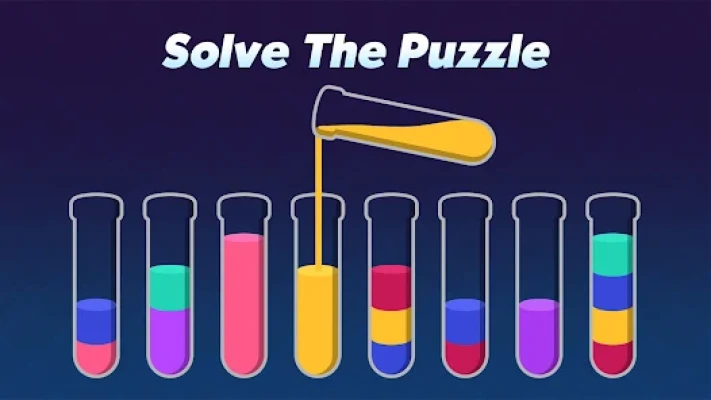
Each level gives you several tubes containing layers of different colored water. Some tubes may also be empty, giving you temporary storage space.
The basic rules are straightforward:
- Tap a tube to select it.
- Tap another tube to pour.
- Water can be poured onto the same color.
- The receiving tube must have enough room.
- You cannot pour a color onto a different color.
- The objective is to separate the colors so that each completed tube contains one color.
There is no countdown clock, so the real challenge is planning your sequence of moves before committing to a pour.
Why Empty Tubes Are So Important
An empty tube is not just spare space. It is one of your most valuable strategic tools.
A common beginner mistake is using an empty tube immediately because a move is available. That can make the next part of the puzzle much harder.
Instead, think of an empty tube as a temporary workspace.
For example, if a color is trapped underneath another color, you may need to move the upper layers somewhere else before accessing it. The empty tube gives you the room needed to perform that operation.
A useful rule
Do not fill your last useful empty tube unless you already know what you will gain from doing it.
Keeping at least one flexible space available can prevent an otherwise solvable puzzle from becoming tangled.
Water Sort Puzzle Strategy for Beginners
1. Look at the entire board first
Before making your first move, inspect every tube.
Identify:
- Colors already close to being completed
- Colors buried underneath other layers
- Tubes containing repeated colors
- Available empty tubes
- Colors that will require several temporary moves
The first move should be based on the whole board rather than whichever pour looks attractive.
2. Complete easy color groups when possible
If the same color is already exposed in multiple tubes, combining those layers can reduce clutter.
However, don't automatically merge every matching color.
First ask:
Will this move expose another useful color?
A good move solves two problems at once.
3. Protect your working space
Empty tubes allow you to rearrange the board.
Once too many tubes become partially filled with mixed colors, your options become restricted.
Try to preserve at least one tube that can be used for temporary storage.
4. Work from the top down
The top layer controls what you can access next.
If an important color is buried underneath two or three other colors, you need to remove those upper layers first.
This makes Water Sort Puzzle more about access management than simply matching colors.
The Most Important Water Sort Puzzle Technique
One of the strongest techniques is to think several moves ahead.
Suppose you see:
Red → Blue → Green
and another tube contains:
Green → Yellow
You might want to move Green immediately.
But if doing so occupies your only available space, you could lose the ability to separate Red and Blue later.
Instead, ask:
- What color becomes exposed after this pour?
- Where can that color go?
- Will I still have an empty tube afterward?
- Does the move create another useful combination?
- Can I undo the resulting arrangement if necessary?
This five-question check can prevent many dead-end situations.
How to Avoid Getting Stuck
Getting stuck usually happens because too much attention was given to the current move instead of the next few moves.
Watch for these warning signs:
Filling every tube
A board with every tube occupied can become extremely restrictive.
Breaking a useful color stack
Sometimes two matching layers are already positioned well. Moving them unnecessarily can create extra work.
Using the only empty tube
If you need temporary storage later, losing your final free tube can make the puzzle much harder.
Creating small mixed stacks
A tube containing several different colors may require multiple operations before anything useful can be completed.
Moving without a purpose
A move should generally accomplish something:
- Combine a color
- Expose a hidden color
- Create workspace
- Complete a tube
- Prepare a future sequence
If a move accomplishes none of these, reconsider it.
How to Solve Difficult Levels
As the board becomes more complicated, stop thinking in terms of individual pours and start thinking in sequences.
Step 1: Find the easiest color
Look for a color that is already exposed and has another matching layer nearby.
Step 2: Find the hardest color
Identify the color buried deepest in the board.
That color often determines the order in which you should solve the puzzle.
Step 3: Create access
Move the colors blocking the difficult color into useful positions.
Step 4: Build complete tubes
Once a color can be safely consolidated, finish it.
Step 5: Reuse the freed space
A completed tube can sometimes function as a stable part of the board while your remaining colors are reorganized.
The important idea is to turn each completed color into progress rather than immediately disturbing it again.
Advanced Water Sort Puzzle Strategy
Think in terms of mobility
A good board position gives you several legal moves.
A bad position leaves only one or two possible pours.
When choosing between two legal moves, prefer the one that preserves more future options.
Use colors as keys
A top color may look unimportant, but moving it could unlock another color underneath.
Before pouring, ask:
What does this move reveal?
That question is often more valuable than asking what the move completes.
Build around the most restricted color
Some colors have many possible destinations. Others have very few.
Solve the restricted colors first when doing so does not destroy your workspace.
Don't rush completion
A nearly completed tube can be tempting to finish immediately.
Sometimes leaving it temporarily incomplete gives you more flexibility.
The shortest-looking move is not always the best move.
How to Recover From a Bad Position
If the board becomes messy, don't immediately restart.
First examine whether you can create a new empty space.
Look for:
- A tube that can be completely consolidated
- A matching color that can be combined
- A top layer that can be moved safely
- A color that can be temporarily parked elsewhere
Often, what looks like a failed position only requires one carefully planned sequence to reopen the board.
If you repeatedly reach the same dead end, however, that is a sign that an earlier move probably used your workspace incorrectly.
Common Mistakes to Avoid
Mistake 1: Pouring because you can
A legal move is not necessarily a useful move.
Mistake 2: Completing colors too early
Completion is helpful, but not if it removes the flexibility you need for another color.
Mistake 3: Ignoring buried colors
The lower layers of a tube should influence your decisions from the beginning.
Mistake 4: Using empty tubes as permanent storage
They are much more useful as temporary working areas.
Mistake 5: Solving only one tube at a time
Water Sort Puzzle often requires several colors to be rearranged simultaneously.
Water Sort Puzzle Tips for Faster Solving
For players who want to become more efficient:
- Scan the whole board before your first move.
- Identify the most restricted color.
- Preserve an empty working tube.
- Combine matching colors when the move also creates access.
- Avoid unnecessary pours.
- Think at least two or three moves ahead.
- Don't disturb a useful completed stack without a reason.
- Use temporary moves to expose buried colors.
- Prioritize board flexibility over immediate visual progress.
- When stuck, look for a way to create space rather than randomly moving colors.
Because the game has no time limit, there is little reason to rush.
3D Bottles and Custom Themes
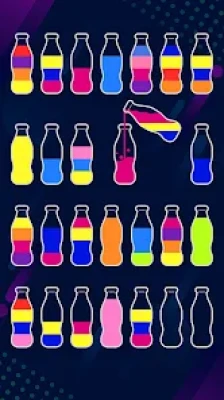
One of the visual features of Water Sort Puzzle is its collection of customizable themes and different 3D bottles and tubes.
This gives the game a more polished presentation than a purely abstract color-sorting board. The underlying puzzle remains simple, while the visual presentation provides some variety between sessions.
Offline Gameplay
Water Sort Puzzle is listed as an offline game, meaning the core puzzle experience can be played without an internet or Wi-Fi connection. That makes it suitable for short sessions while traveling, waiting, or simply taking a break.
The listing also describes the game as having no time limits, so players can stop and think about difficult arrangements without being pressured by a countdown.
Difficulty and Progression
The early experience is deliberately easy to understand. The challenge comes from the increasing number of possible color arrangements and the need to preserve enough space for future moves.
A player who only looks for immediate matches may find later boards surprisingly difficult.
A player who learns to manage empty tubes, buried colors and move sequences will have a much easier time handling complicated layouts.
Atmosphere and Overall Feel
Water Sort Puzzle: Color Games is built around a calm puzzle atmosphere rather than speed or action.
The combination of colorful liquids, 3D tubes, simple touch controls and unlimited solving time makes it well suited to relaxed puzzle sessions. The game is easy to pick up for a few minutes but has enough planning depth to keep more serious puzzle players occupied.
It works particularly well as a casual brain-training game because there is no need to memorize complicated controls or learn a large set of mechanics.
Honest Feedback
The strongest part of Water Sort Puzzle is its basic puzzle design. The rules can be understood almost immediately, but difficult arrangements still require genuine planning.
The offline functionality and lack of a time limit are also useful for players who prefer relaxed puzzle sessions.
The main point to keep in mind is the advertising model: Google Play lists the game as containing ads and offering in-app purchases. Player reviews on the listing have also included differing opinions about the frequency of advertising, so the experience may not feel identical for every player.
For the puzzle itself, however, the appeal is clear: there is no complicated story or unnecessary system to learn. The focus stays on solving the color arrangement in front of you.
Pros and Cons
Pros
- Easy-to-understand color sorting mechanics
- Increasing puzzle challenge
- One-finger controls
- 3D bottles and tubes
- Customizable themes
- No time limit
- Offline gameplay
- Suitable for short or long sessions
- Relaxing presentation
Cons
- Advertising is part of the free experience
- Later puzzles can become repetitive for players who want more variety
- Players who dislike trial-and-error sorting puzzles may find the core mechanic too simple
The Google Play listing confirms ads and in-app purchases, while its current store information categorizes the game as Puzzle, Sort, Casual, Single player, Abstract and Offline.
Water Sort Puzzle: Color Games – Game Information
| Feature | Details |
|---|---|
| Game | Water Sort Puzzle: Color Games |
| Developer | LinkDesks Classic Puzzle Games |
| Genre | Puzzle / Sort / Casual |
| Style | 3D color liquid sorting |
| Controls | One-finger touch |
| Modes | Single player |
| Internet | Offline play supported |
| Time Limit | None |
| Platform | Android, Windows |
| Age Rating | Everyone |
| Monetization | Ads and in-app purchases |
| Current Rating | 4.5★ |
| Downloads | 1M+ |
| Latest Listed Update | August 18, 2026 |
These details are based on the current Google Play listing.
Frequently Asked Questions
What is Water Sort Puzzle: Color Games?
It is a color-sorting puzzle game where players pour layers of colored water between tubes until each color is separated into the correct tube.
How do you play Water Sort Puzzle?
Tap one tube and then another tube to pour the water. You can only pour onto the same color, and the destination tube must have enough available space.
Is Water Sort Puzzle offline?
Yes. The Google Play listing specifically identifies the game as playable offline without internet or Wi-Fi.
Does Water Sort Puzzle have a time limit?
No. The developer describes the game as having no time limits, allowing players to solve levels at their own pace.
Is Water Sort Puzzle difficult?
The basic rules are easy to learn, but complex tube arrangements can require several moves of planning. The challenge comes from managing space and exposing colors in the correct order.
How can I avoid getting stuck?
Preserve an empty tube whenever possible, avoid unnecessary pours, and think about what each move will expose before making it.
Does Water Sort Puzzle have 3D graphics?
Yes. The game uses 3D bottles and tubes and offers customizable themes.
Does Water Sort Puzzle contain ads?
Yes. Google Play currently lists the game as containing ads and offering in-app purchases.
Final Water Sort Puzzle Strategy
The secret to Water Sort Puzzle is not pouring as quickly as possible. It is maintaining control of the board.
Protect your empty space, expose buried colors carefully, combine matching layers when they create new opportunities, and think several moves ahead.
Once you stop treating each pour as an isolated action and start treating the tubes as a system, difficult levels become much easier to understand.
The game may look simple, but its best puzzles reward patience, spatial awareness and careful planning.
Rate the Game
User Reviews








Popular Games


















 Android
 iOS
iOS Windows
 Xbox
Xbox