



Latest Version
October 16, 2024
AI GAMES FZ LLC
Casual
iOS
0
Report a Problem
More About :game
The game combines exploration with time pressure. Instead of simply running through a level, you need to learn the layout, complete objectives, manage your movement, recognize danger, and choose the right moment to make a break for the exit.
The App Store currently lists the game at 4.6 out of 5 from around 22,000 ratings, with a 9+ age rating. It is free to play with optional in-app purchases.
What Makes Hide in The Backroom: Nextbots Different?
The main attraction is the combination of a familiar backrooms setting and hide-and-seek gameplay.
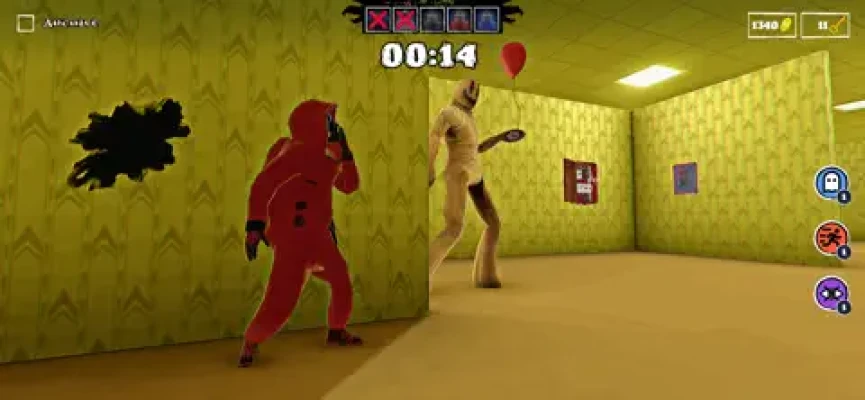
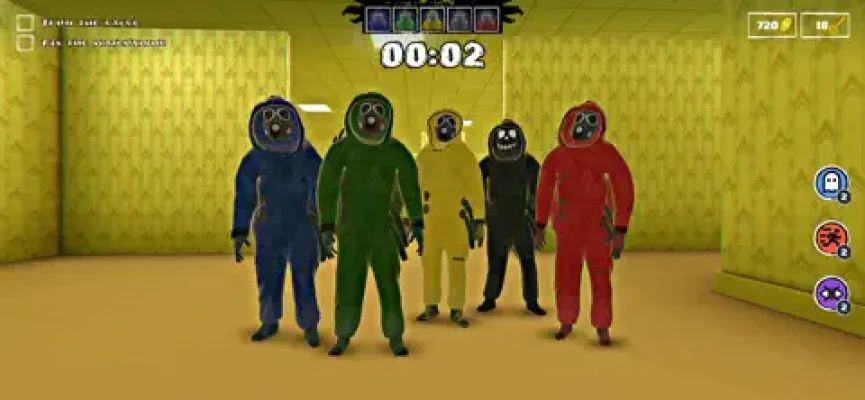
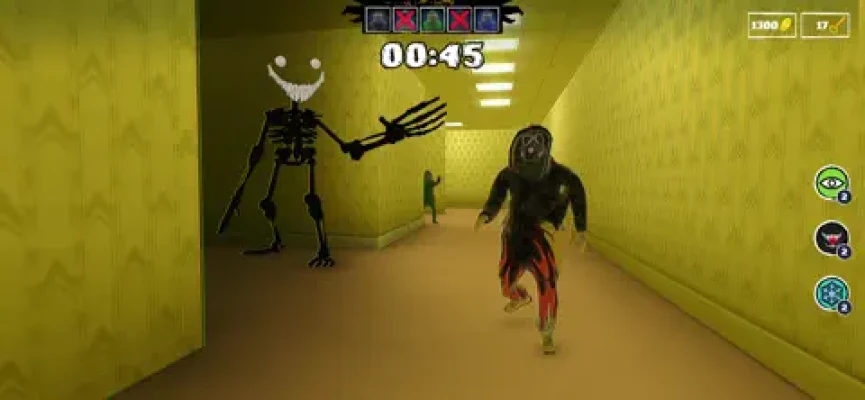
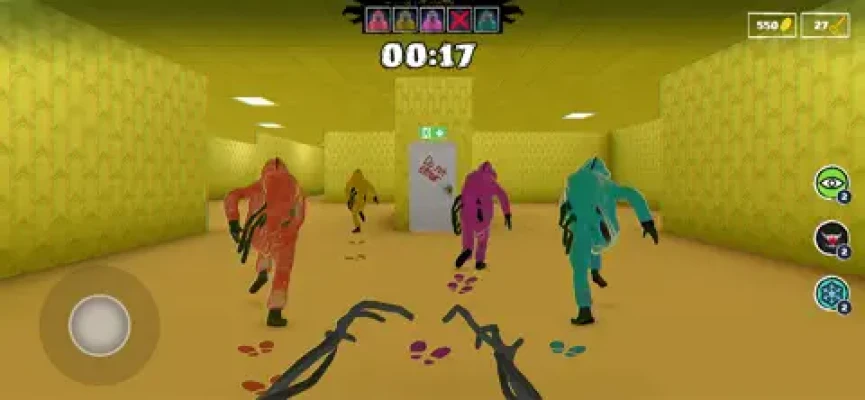
The environments are intentionally confusing. Long yellow corridors, corners, open rooms, strange noises, and monsters create a constant feeling that something could appear behind you.
The game offers two primary roles:
- Fugitive: Explore the map, complete objectives, find what you need and escape before the timer expires.
- Hunter: Search the backrooms and catch the fugitives before they can complete their escape.
- Nextbots: Hostile creatures add another layer of danger and make familiar routes much less comfortable.
- Special abilities: Certain powers can dramatically change how you move around the map.
- Timed objectives: Waiting too long can turn a manageable escape into a desperate chase.
The official description specifically highlights abilities such as moving through walls, moving extremely quickly, and becoming invisible.
Gameplay and Atmosphere
The strongest part of the game is its atmosphere.
The mostly yellow environments create an intentionally repetitive visual style, making it surprisingly easy to lose your sense of direction. Sound becomes just as important as sight because strange noises can warn you that something is nearby.
The best way to play is therefore not to sprint constantly. You need to balance exploration with awareness.
A good player learns to ask:
- Where have I already been?
- Where is the nearest safe turn?
- Where is the objective?
- Which route leads back toward the exit?
- How much time remains?
- Have I actually heard the monster, or am I reacting to a false alarm?
That decision-making is what turns the game from a simple chase into a more interesting survival experience.
Full Strategy Guide
1. Learn the Map Before You Rush
Your first few attempts should be treated as reconnaissance.
Don't worry about completing everything immediately. Pay attention to recognizable landmarks, unusual rooms, intersections, dead ends and major pathways.
Try to mentally divide the map into sections.
For example:
Starting area → objective area → central junction → secondary area → exit
You don't need a perfect mental map. You simply need enough information to avoid running around randomly when the monster appears.
2. Never Run Without a Destination
One of the easiest mistakes is sprinting as soon as you become frightened.
Running blindly can actually make things worse.
Instead, decide where you are going before moving:
Corner → corridor → landmark → objective → return route
If a monster suddenly appears, you will already have an idea of where to turn.
This is especially important in environments where many corridors look almost identical.
3. Use Corners to Your Advantage
Straight corridors are dangerous because they give pursuers a clear line of sight.
Corners are much more valuable.
When escaping:
- Run toward a junction.
- Turn sharply.
- Change direction when appropriate.
- Use the new corridor to create distance.
- Avoid immediately returning to the same path.
If you keep making predictable turns, a pursuer can anticipate your route.
4. Don't Waste Your Special Powers
The game's special abilities can provide major advantages, but using them randomly reduces their value.
If you have an ability that increases movement speed, save it for moments when you genuinely need to create distance.
If you can move through walls, think about it as an emergency escape option rather than a normal movement method.
If invisibility is available, its value is highest when detection would otherwise be almost unavoidable.
The general rule is simple:
Use powers to solve dangerous situations, not ordinary ones.
5. Complete Objectives Efficiently
Objectives are important because wandering around consumes valuable time.
Don't repeatedly search the same section of the map unless you have a reason to return.
A better approach is to establish a route and clear one area at a time.
If you find an objective, remember the route that brought you there. This can save valuable seconds during the return journey.
6. Keep Track of the Timer
The timer changes how aggressively you should play.
Early in a run, exploration is acceptable.
As the timer gets lower, hesitation becomes increasingly dangerous.
A useful approach is:
Early: Learn and explore.
Middle: Complete objectives efficiently.
Late: Stop unnecessary exploration and prioritize the escape route.
If you have completed your main objective and know where to go, don't keep searching for unnecessary items simply because there is still time available.
7. Listen for Danger
Sound can be an important warning system.
When you're moving through an empty corridor, don't treat the silence as an invitation to switch off your attention.
Pay attention to unusual sounds and changes in the environment.
If you suspect something is nearby, slow down briefly and determine your next direction instead of blindly continuing forward.
8. Don't Panic When You See a Monster
Seeing the enemy does not automatically mean the run is over.
The worst reaction is often freezing in place.
Immediately look for:
- A nearby corner
- A branching corridor
- A route around an obstacle
- A potential escape direction
- A useful ability
The goal is to break the enemy's expected route rather than simply running in a straight line.
9. Change Your Escape Pattern
If the same route keeps getting you caught, stop repeating it.
Try:
- Earlier turns
- Wider loops
- Different corridors
- Short direction changes
- Returning through a previously visited area from another entrance
Predictability is one of the biggest weaknesses of a fleeing player.
10. Hunter Strategy
Playing the hunter requires a completely different mindset.
Don't simply run through every corridor looking for movement.
Instead, think about where a fugitive is likely to go.
Good areas to monitor include:
- Objective locations
- Narrow passages
- Important intersections
- Likely escape routes
- Areas connecting objectives to exits
A fugitive under pressure usually becomes less careful. If you understand the map, you can use that behavior against them.
11. Don't Always Chase Directly
A direct chase can be inefficient.
If the fugitive turns a corner, don't automatically follow the exact same path.
Think about where they are likely to emerge.
Cutting off a route can be much more effective than following behind.
12. Use the Environment
The maze itself is part of the strategy.
Corners, junctions and narrow passages can all influence a chase.
As a hunter, learn which areas allow you to intercept movement.
As a fugitive, learn which areas give you multiple options when you're being pursued.
Best Tips for Beginners
- Learn the map before attempting fast runs.
- Remember major landmarks rather than every individual corridor.
- Avoid running in a straight line when being chased.
- Save special abilities for dangerous moments.
- Don't waste time revisiting areas unnecessarily.
- Listen carefully for approaching threats.
- Keep an escape route in mind while completing objectives.
- Change direction when a pursuer gets too close.
- Don't panic when the timer starts getting low.
- As a hunter, predict where the fugitive will go instead of simply following them.
Advanced Escape Strategy
Once you're comfortable with the basic mechanics, start planning complete routes.
Instead of thinking about individual objectives separately, connect them into one efficient loop.
For example:
Start → Objective A → nearby Objective B → central route → key/required item → exit
This reduces unnecessary backtracking.
The biggest improvement comes from reducing wasted movement. Every corridor you travel without accomplishing anything is time that could have been spent progressing toward the escape.
How to Survive a Chase
When a monster is close, don't immediately commit to the longest corridor you can see.
Look for opportunities to force a change of direction.
A strong escape sequence can look like:
Straight run → sharp turn → second turn → ability → alternate corridor → escape
The idea is to make your movement difficult to predict.
If the enemy is following directly behind you, creating distance is useful. If the enemy is already anticipating your route, changing direction becomes even more important.
How to Improve as a Hunter
Good hunting isn't just about speed.
You need to understand player behavior.
A fugitive usually wants to:
- Find objectives.
- Avoid enemies.
- Obtain what is necessary for escape.
- Return toward an exit.
That means the most important routes are often predictable.
Rather than searching every corner equally, prioritize locations that connect objectives and escape routes.
Progression, Updates and New Content
The game has continued receiving updates.
The current App Store history shows version 1.28.0 dated August 28, 2026, with minor bug fixes. Earlier 2026 updates include versions 1.26.1, 1.24.0, 1.23.0 and 1.22.0.
One of the more notable additions was the Eternal Suburbia chapter, introduced in version 1.19.0. It moves beyond the familiar yellow backrooms into unsettling suburban environments containing anomalies and hostile entities.
The game also added a VIP Status feature in version 1.11.4, offering benefits including double coins, premium skins, daily power-ups and no ads.
Graphics and Horror Design
Hide in The Backroom: Nextbots does not depend on extremely detailed graphics to create tension.
Instead, the game uses:
- Repetitive environments
- Empty corridors
- Strange sounds
- Unusual monsters
- Sudden encounters
- Limited time
- Confusing navigation
That combination works particularly well because the environment itself becomes part of the horror.
A corridor that looked harmless a few seconds earlier can become threatening once you know something is chasing you.
Player Reviews and Feedback
The game currently has a strong 4.6/5 rating from approximately 22K App Store ratings, showing that the core concept has found a large audience.
Players frequently praise the atmosphere, maps and fun factor. One recent reviewer said the game had grown substantially and specifically praised being able to play without an internet connection, while also mentioning some bugs.
There is also constructive criticism. Some players feel that the objective structure can become repetitive and have requested more monsters, traps, larger maps, additional modes and more challenging enemy behavior. Another recent review suggested that some monster bots could be smarter and better at navigating the maps.
So the game's biggest strength is also its biggest limitation: the simple hide-and-escape formula is easy to understand, but players looking for deeper variety may eventually want more mechanics.
Pros and Cons
Pros
- Strong backrooms atmosphere
- Simple controls and easy-to-understand objectives
- Hunter and fugitive roles
- Large maze-like environments
- Special abilities add variety
- Lots of horror tension without requiring complicated mechanics
- Regular updates and new chapters
- Strong App Store rating
- Can be enjoyable for short sessions
Cons
- Some gameplay can become repetitive
- Enemy AI has received criticism from players
- Bugs have occasionally been reported
- Players have requested more modes and mechanics
- Advertising and optional purchases may not appeal to everyone
Technical Information
Game: Hide in The Backroom: Nextbots
Developer: AI Games FZ
Genre: Casual / Horror
Age Rating: 9+
Price: Free with in-app purchases
App Size: About 433.9 MB
Platforms: iPhone and iPad, with Apple Vision support
Required iOS: iOS 13.0 or later
Required iPadOS: iPadOS 13.0 or later
Latest listed version: 1.28.0
Latest listed update: August 28, 2026
The App Store lists horror/fear themes, infrequent cartoon or fantasy violence, advertising and in-app purchases.
In-App Purchases
The current U.S. App Store listing includes:
- No Ads: $2.99
- Weekly VIP Subscription: $7.99
- Monthly VIP Subscription: $19.99
- Yearly VIP Subscription: $99.99
VIP includes additional benefits such as premium skins, extra coins, daily power-ups and an ad-free experience.
Is Hide in The Backroom: Nextbots Worth Playing?
Yes, especially if you enjoy maze games, chase sequences, backrooms horror and short survival challenges.
Its strongest feature is atmosphere rather than deep storytelling. The tension comes from not knowing what is around the next corner and having to make quick decisions while navigating confusing environments.
The experience is less appealing if you need complex progression or constantly changing objectives. Some players have specifically criticized repetition, which is worth knowing before starting.
Overall: a fun and accessible backrooms horror game with a strong atmosphere, plenty of chase tension and enough content to keep casual players busy, although additional gameplay variety would make the experience even stronger..
Frequently Asked Questions
What is Hide in The Backroom: Nextbots?
It is a horror maze game where players explore mysterious backrooms while completing objectives, escaping monsters or hunting other characters.
Can you play as the monster?
Yes. The game features both hunter and fugitive gameplay, allowing players to experience the chase from different sides.
Is Hide in The Backroom: Nextbots free?
Yes. The game is free to download, but it contains advertising and optional in-app purchases.
Does the game have special abilities?
Yes. The game includes abilities that can provide advantages such as increased movement speed, wall movement and invisibility.
What is the best way to escape monsters?
Learn the map, avoid predictable straight-line movement, use corners to break pursuit, conserve special abilities and always keep an alternate route in mind.
What is the newest chapter?
The update history lists Eternal Suburbia as a chapter added in version 1.19.0, featuring eerie suburban environments and new anomalies.
Does the game require internet?
A recent App Store reviewer specifically reported enjoying the game without an internet connection. However, availability of individual features can depend on the current version and device.
What devices support the game?
The App Store lists support for iPhone and iPad, requiring iOS/iPadOS 13 or later. Apple Vision is also supported, while Mac compatibility requires macOS 11 or later and an Apple M1 chip or later.
Final Verdict
Hide in The Backroom: Nextbots succeeds because it makes simple movement and exploration feel dangerous. The yellow maze may look basic, but the combination of confusing paths, hostile creatures, objectives and a countdown creates plenty of tense moments.
The best players aren't necessarily the fastest. They are the ones who understand the map, remember useful routes, stay calm during chases and know when to use their abilities.
If you enjoy backrooms games, horror maze games, nextbot chases and hide-and-seek survival gameplay, this is an easy game to recommend.
Rate the Game
User Reviews















Popular Games



















 Android
 iOS
iOS Windows
 Xbox
Xbox