

Latest Version
August 20, 2025
ustwo Games Ltd
Board
iOS
0
Report a Problem
More About :game
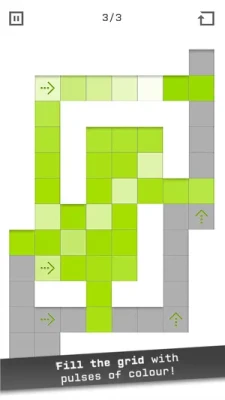
Blip Blup is a puzzle game built around a deceptively simple idea: tap a tile and watch a pulse of color spread across the board.
The challenge is not simply to make the board colorful. You need to work out where each pulse should begin, how it will travel and how many pulses are required to completely fill the level.
Walls, obstacles and special tiles change the path of the color, turning what initially appears to be a straightforward coloring puzzle into a game of careful planning.
The result is an experience that is easy to understand but increasingly difficult to solve perfectly.
Blip Blup was developed by ustwo games, the studio later known for Monument Valley. The original iOS release arrived in April 2013.
Blip Blup Gameplay Overview
Every puzzle presents you with a board made up of tiles.
Your objective is to color the entire board.
To create a pulse, simply tap a tile. The pulse then spreads outward through the available spaces, interacting with the level's walls, obstacles and special tiles.
The important part is deciding where to place each pulse.
A careless tap can leave sections of the board uncolored or force you to use additional pulses. A carefully planned move can cover a large portion of the level in one action.
That makes Blip Blup a game about prediction rather than speed.
How to Play Blip Blup
1. Examine the Board
Before making your first move, look at the complete arrangement of tiles, walls and special objects.
2. Choose a Starting Tile
Tap a tile to create your first pulse of color.
3. Watch the Pulse
The color spreads outward according to the layout of the board.
4. Study the Result
See which tiles have been filled and which areas remain untouched.
5. Plan the Next Pulse
Choose another position that will cover as much of the remaining area as possible.
6. Minimize Your Moves
The goal is to complete the puzzle using as few pulses as possible.
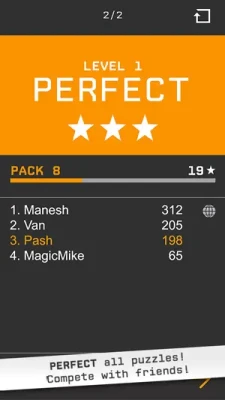
7. Chase Three Stars
For players seeking mastery, try to achieve the best possible result and earn three stars on each level.
Core Gameplay Mechanics
Color Pulses
The pulse is the central mechanic of Blip Blup.
Every tap sends color outward from the selected tile. Understanding the direction and reach of that pulse is essential to solving later puzzles.
Walls
Walls prevent color from traveling freely across the board.
They create boundaries that you need to account for before placing a pulse.
Obstacles
Different obstacles alter the way your pulse behaves.
Instead of simply memorizing a pattern, you must understand how the board's geometry affects each move.
Special Tiles
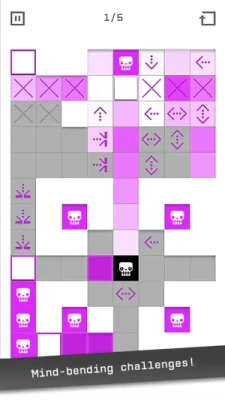
Blip Blup introduces special tiles that can dramatically change a solution.
The App Store specifically mentions gate tiles and explosive death tiles, among other special mechanics.
Pulse Efficiency
A major part of the challenge is completing a board with as few pulses as possible.
This gives experienced players a reason to replay levels even after they have already found a solution.
Main Features
- 140+ puzzle levels
- 10 challenge packs
- Minimalist visual design
- One-touch pulse mechanic
- Color-based puzzle solving
- Walls and environmental obstacles
- Special trick tiles
- Gate tiles
- Explosive death tiles
- Three-star level challenges
- Global leaderboards
- 34 achievements
- Game Center integration
- iCloud progress synchronization
- Retina display support
- iPhone and iPad support
140+ Puzzle Levels
The game's biggest attraction is its substantial collection of puzzles.
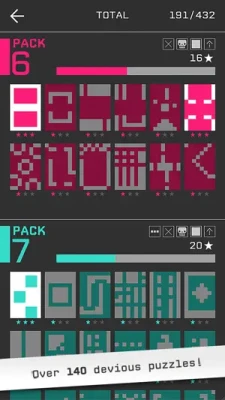
The App Store listing advertises more than 140 puzzles, giving players a large selection of increasingly complicated boards to solve.
The levels are not simply copies of the same board.
As you progress, new layouts and mechanics require you to rethink how you approach each puzzle.
This gradual introduction of complexity is one of the reasons Blip Blup can remain interesting long after the basic pulse mechanic becomes familiar.
10 Challenge Packs
Blip Blup organizes its puzzles into 10 packs of challenges.
Each pack introduces new situations and variations that require different approaches.
The early stages help establish the basic rules, while later packs demand more careful planning and a stronger understanding of how color moves through the board.
Special Tiles
Special tiles are where Blip Blup's puzzle design becomes particularly interesting.
Gate Tiles
Gate tiles can restrict or alter the movement of your color pulse.
Their position means that a seemingly obvious tap may not produce the result you expect.
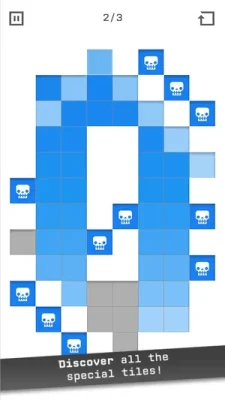
Explosive Death Tiles
Some tiles can create dangerous consequences when interacted with incorrectly.
These mechanics force you to think beyond simply coloring the largest possible area.
Trick Tiles
The broader collection of special tiles changes the normal behavior of a pulse, requiring players to anticipate what will happen before committing to a move.
Strategy and Puzzle Solving
Blip Blup rewards planning more than reaction speed.
Before tapping, consider:
- Where will the pulse travel?
- Which walls will block it?
- Which tiles will remain uncolored?
- Can one pulse cover multiple sections?
- Will a special tile change the pulse's direction?
- Is there a safer starting position?
- Can the puzzle be completed with fewer moves?
The strongest solutions usually come from thinking several moves ahead rather than experimenting randomly.
Beginner's Guide
If you are new to Blip Blup, resist the temptation to tap immediately.
Spend a few seconds studying the board.
Look for large open areas and identify the walls that could block your pulse. Think about how the board is divided and which areas might require separate pulses.
When you make a move, pay attention to exactly how the color spreads.
Understanding the game's movement rules is more valuable than simply memorizing solutions.
Advanced Tips
Think Before You Blip
The most important skill is learning to visualize what will happen before you tap.
Start With the Board's Structure
Look at walls and boundaries first. They often determine the best starting position.
Work Backward
If a particular corner remains difficult to reach, think about which pulse could eventually reach it.
Avoid Unnecessary Pulses
A solution may work but still be inefficient. Experiment with different starting positions to reduce the number of moves.
Learn Special Tiles
Later levels become much easier once you understand exactly how each special tile behaves.
Replay Earlier Levels
Returning to completed puzzles can help you discover more efficient solutions and improve your three-star results.
Difficulty
Overall Difficulty: Moderate to Hard
Blip Blup has an accessible core mechanic, but the puzzle difficulty increases considerably as new board layouts and special tiles appear.
Some App Store reviewers have praised its addictive nature while also noting that later levels can become frustrating.
Controls: Very Easy
Learning Curve: Easy
Puzzle Difficulty: Moderate to Hard
Mastery: Hard
Reaction Speed Required: Low
Strategic Thinking Required: High
Visual Style
Blip Blup uses a minimalist visual presentation built around geometric boards and expanding fields of color.
There is little unnecessary decoration.
The clean presentation keeps your attention on the puzzle itself and makes the movement of each pulse easy to follow.
The result is a game that feels more like an interactive visual puzzle than a conventional arcade title.
Contemporary coverage praised the game's clean interface and visual design, with TouchArcade describing its simple rule set as particularly well suited to ustwo's strengths in interaction and interface design.
Sound and Atmosphere
Blip Blup does not need an elaborate story or cinematic presentation to create an atmosphere.
Its appeal comes from the combination of minimalist visuals, satisfying color movement and carefully designed puzzle interactions.
Each successful solution provides a simple but rewarding sense of completion.
Game Progression
Blip Blup's progression is based on increasingly complex puzzles.
A typical progression looks like this:
- Learn the basic pulse mechanic.
- Solve simple boards.
- Understand how walls affect pulses.
- Encounter new board structures.
- Learn special tiles.
- Solve increasingly complex layouts.
- Improve your pulse efficiency.
- Earn three-star results.
- Complete challenge packs.
- Chase achievements and leaderboard positions.
Stars and Level Mastery
Blip Blup encourages players to do more than simply finish a puzzle.
The game supports three-star level completion, giving experienced players an additional objective.
This creates two different ways to play:
Casual approach: Solve the puzzle and move forward.
Mastery approach: Find the most efficient solution and aim for the highest rating.
That distinction significantly improves replay value.
Achievements
Blip Blup includes 34 achievements that players can earn through Game Center.
Achievements provide additional goals for players who want to complete more than the core puzzle campaign.
Leaderboards
Competitive players can use the game's leaderboard support to compare their performance with other players.
This is particularly useful for a puzzle game because solving a level is only part of the challenge. Finding a more efficient solution gives you another way to compete.
iCloud and Game Center
The App Store listing includes iCloud and Game Center support, allowing players to maintain progress across supported devices and participate in Apple's gaming features.
Controls
Blip Blup uses an exceptionally simple control system.
| Action | Control |
|---|---|
| Create a pulse | Tap a tile |
| Color the board | Position pulses strategically |
| Avoid obstacles | Plan around walls and special tiles |
| Improve score | Use fewer pulses |
| Replay | Select completed levels |
There are no complicated buttons or virtual joysticks.
The difficulty comes entirely from deciding where and when to tap.
Accessibility and Ease of Use
The game's basic input system is highly accessible because it requires only tapping the screen.
There are no complicated controls to learn, making the game easy to pick up for new players.
However, the puzzle difficulty itself can become demanding. The physical controls are simple; the mental challenge is not.
Player Experience
Blip Blup is particularly appealing to players who enjoy:
- Logic puzzles
- Spatial reasoning
- Minimalist games
- Color-based puzzles
- Brain teasers
- Strategic mobile games
- Short puzzle sessions
- Completion challenges
- Three-star level systems
It is less suitable for players who prefer action, storytelling or fast-paced gameplay.
Pros and Cons
Pros
- Extremely simple controls
- Clever core mechanic
- 140+ puzzles
- 10 challenge packs
- Increasing difficulty
- Creative special tiles
- Attractive minimalist presentation
- Three-star goals
- 34 achievements
- Leaderboards
- Game Center support
- iCloud support
- Strong replay value
Cons
- Later puzzles can become frustrating
- No major story campaign
- Gameplay is entirely puzzle-focused
- Players looking for action may find it too slow
- The difficulty can feel uneven in later sections
Who Should Play Blip Blup?
Blip Blup is an excellent choice for players who enjoy thoughtful mobile puzzles.
It is particularly suited to people who like games where the rules are simple but the solutions are not.
If you enjoy games such as minimalist logic puzzles, spatial challenges or color-based brain teasers, Blip Blup offers a distinctive alternative to conventional match-three and tile-matching games.
Games Similar to Blip Blup
Players searching for games similar to Blip Blup may enjoy:
Monument Valley
Another highly regarded puzzle experience from ustwo, although its gameplay focuses on perspective, architecture and environmental manipulation rather than color pulses.
World of Goo
A physics-based puzzle game that similarly rewards experimentation and problem solving.
The Room
A more atmospheric puzzle series focused on objects, mechanisms and exploration.
Mini Metro
A minimalist strategy puzzle where players must plan efficient routes and manage increasingly complex systems.
Blip Blup vs Traditional Puzzle Games
Blip Blup differs from many conventional mobile puzzle games because there is no emphasis on matching three identical objects, swapping gems or clearing rows.
Instead, the central question is:
Where should the next pulse begin?
That small difference gives the game its identity.
It turns a simple coloring concept into a spatial planning challenge.
Expert Rating
Gameplay: 9/10
Puzzle Design: 9/10
Graphics: 9/10
Controls: 10/10
Originality: 9/10
Replay Value: 8.5/10
Overall: 9/10
Final Verdict
Blip Blup is a beautifully focused puzzle game that demonstrates how a tiny gameplay idea can support an impressive amount of depth.
The controls could hardly be simpler: tap a tile and create a pulse of color.
But solving the board efficiently requires observation, spatial reasoning and careful planning. Walls, obstacles and special tiles continually change the rules you need to consider.
With 140+ puzzles, 10 challenge packs, three-star goals, 34 achievements and leaderboard support, there is plenty here for players who enjoy mastering logic challenges.
Its minimalist presentation is another major strength. Instead of overwhelming players with menus, characters and unnecessary effects, Blip Blup puts the puzzle itself at the center of the experience.
If you are looking for a challenging color puzzle game, minimalist iPhone puzzle, strategic iPad game or brain teaser with simple controls, Blip Blup is well worth exploring.
Frequently Asked Questions
What is Blip Blup?
Blip Blup is a minimalist puzzle game developed by ustwo games. Players tap tiles to create pulses of color and attempt to fill the entire board using as few pulses as possible.
How do you play Blip Blup?
Tap a tile to create a pulse. The pulse spreads across the board, and you must use carefully positioned pulses to color every tile while accounting for walls and special tiles.
How many puzzles are in Blip Blup?
The current App Store description advertises 140+ puzzles.
How many challenge packs are there?
Blip Blup features 10 challenge packs according to the current App Store listing.
Is Blip Blup difficult?
The basic gameplay is easy to understand, but later puzzles can become challenging because of increasingly complex layouts and special tiles. Player reviews also mention the difficulty becoming frustrating in later levels.
Does Blip Blup have achievements?
Yes. The game features 34 achievements through its Game Center integration.
Does Blip Blup have leaderboards?
Yes. Blip Blup includes leaderboard support, allowing players to compete for better results.
Does Blip Blup have special tiles?
Yes. Special tiles can alter the behavior of your color pulses. The game includes mechanics such as gate tiles and explosive death tiles.
Who made Blip Blup?
Blip Blup was developed by ustwo games, the studio behind Monument Valley and Whale Trail.
When was Blip Blup released?
The original iOS release date was April 4, 2013.
Is Blip Blup available on iPhone?
Yes. The current App Store listing supports iPhone and iPad.
Is Blip Blup available on iPad?
Yes. The App Store identifies it as designed for iPad as well as supporting iPhone.
What age rating does Blip Blup have?
The U.S. App Store currently gives Blip Blup an 4+ age rating.
How much does Blip Blup cost?
The current U.S. App Store listing shows Blip Blup at $1.99.
Technical Details
Game: Blip Blup
Developer: ustwo games
Genre: Puzzle
Original Release: April 4, 2013
Platforms: iPhone, iPad
Age Rating: 4+
Current U.S. Price: $1.99
App Size: 187.9 MB
Language: English
Category: Puzzle
Game Modes: Single-player puzzle progression
Achievements: 34
Puzzle Count: 140+
Challenge Packs: 10
Game Center: Yes
Leaderboards: Yes
iCloud: Yes
Retina Display: Supported
Official App Store
Blip Blup is available on the Apple App Store for iPhone and iPad. The current U.S. listing identifies ustwo games as the developer and lists the game as a Puzzle title with a 4+ rating.
Rate the Game
User Reviews


Popular Games

















 Android
 iOS
iOS Windows
 Xbox
Xbox