








Latest Version
September 16, 2026
Gameberry Labs
Board
iOS
0
Report a Problem
More About :game
The game uses two dice and four pieces per player, with pieces traveling around the outer track before entering the home path and eventually reaching the central finishing area. This makes every turn a balance between advancing pieces, creating threats, avoiding captures, and deciding when to take a risk.
Whether you already know Parchisi or are learning the game for the first time, the biggest improvement comes from treating your four pieces as a team instead of moving whichever piece happens to be closest to home.
What Is Parchisi STAR?
Parchisi STAR is an online version of the traditional Parchisi/Parchis board game. The App Store describes it as an adaptation of Pachisi, the Indian cross-and-circle board game family, with online multiplayer added for modern mobile play.
You can play against other players, communicate during matches, send emojis, unlock achievements, and collect rewards. The game also includes seasonal and special-event content that adds additional variety beyond the classic board experience.
The current App Store listing is rated 4.7 from around 170,000 ratings in the U.S. storefront, showing the scale of its player base. The Saudi App Store listing currently shows a 4.6 rating from about 3,500 ratings.
How to Play Parchisi STAR
A standard Parchisi STAR match revolves around four pieces for each player.
The basic objective is straightforward:
- Get your pieces onto the board.
- Move them around the track using your dice rolls.
- Take opportunities to capture opposing pieces.
- Keep your own pieces away from unnecessary danger.
- Enter the home path when appropriate.
- Get your pieces safely to the central finishing area.
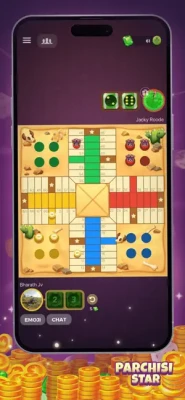
The App Store describes the board as having an outside track, corner areas, home paths and a central finishing point. It also notes that commonly used Parchisi boards have 68 spaces around the edge, including 12 darkened safe spaces.
The exact interaction and special-event rules can vary as the app receives updates and introduces additional modes, so use the in-game instructions when a special mode has different mechanics.
Full Parchisi STAR Strategy Guide
1. Do Not Focus on Only One Piece
One of the most common mistakes in Parchisi is putting nearly all your attention on the piece that is closest to home.
That can look attractive because it creates visible progress, but it can also leave your other pieces sitting in vulnerable positions.
Instead, think about your four pieces as a small team.
A healthy position can contain:
- One piece making strong progress
- One piece positioned for a useful capture
- One piece advancing through a relatively safe section
- Another piece available for future movement
You do not need to keep every piece at the same distance. The goal is to maintain multiple useful options.
2. Think About the Opponent's Dice Range
Before moving, look at the opponent's pieces and estimate which ones can realistically reach your piece on their next roll.
You do not need to predict the exact dice result.
Instead, ask:
"Which enemy pieces are close enough to threaten me?"
This simple question can completely change the best move.
A piece that can move five spaces may look like the obvious choice, but if an opponent can potentially capture it immediately, another move may be safer.
Good Parchisi players are constantly thinking about the next turn rather than only the current roll.
3. Use Safe Spaces Intelligently
Safe spaces are valuable because they can reduce the danger of being captured.
The App Store description specifically identifies darkened safe spaces as part of the traditional board structure.
However, do not automatically move to a safe space every time one is available.
Consider what happens afterward.
A safe position is especially useful when:
- An opponent is approaching
- Your piece has already made substantial progress
- You need time to bring another piece forward
- Moving farther would put the piece into an obvious attack zone
Sometimes a slightly more aggressive move creates a better position than simply stopping on safety.
4. Capture Only When It Helps
Capturing an opponent is satisfying, but not every capture is strategically valuable.
Before making a capture, ask three questions:
Can I capture safely?
Where will my piece land afterward?
Does the capture expose my piece to another attack?
A capture that sends an opponent backward can be valuable, but if your attacking piece immediately becomes vulnerable, the exchange may not be worth it.
The strongest captures usually accomplish more than one thing.
For example, a good capture may:
- Remove a dangerous opponent
- Advance your own piece
- Improve your board position
- Reduce pressure on another piece
5. Keep Your Pieces Moving
Stalling can be dangerous.
If several of your pieces remain near their starting areas while opponents are already progressing around the board, you may eventually have fewer useful options.
When you have a reasonable opportunity to activate another piece, consider taking it.
Having several pieces in play gives you more possible moves when future dice rolls arrive.
This is particularly important in matches where one piece becomes trapped in an awkward position.
Opening Strategy
The opening is about creating options.
Do not treat your first useful move as a race to push one piece as far as possible.
Instead, consider:
Activate Your Position
Getting additional pieces into play can give you more movement choices later.
Avoid Early Recklessness
A fast start does not guarantee a strong position.
If your first advanced piece becomes an easy target, your apparent advantage can disappear quickly.
Watch the Opponent
Pay attention to which opposing pieces are becoming active.
An opponent who quickly develops several pieces may have more tactical options than someone concentrating on one runner.
Mid-Game Strategy
The middle of a Parchisi STAR match is where decision-making becomes particularly important.
There may be pieces at different stages of the track, opponents within capture range, and several possible moves from the same dice result.
Create Multiple Threats
If you have two pieces that can potentially create problems for your opponent, they must account for both.
This is often more useful than placing all your progress into a single piece.
Avoid Predictable Movement
If every turn simply moves your most advanced piece, opponents can concentrate their attention on it.
Mixing advancement between pieces can make your position harder to exploit.
Watch the Board, Not Just Your Pieces
A strong move depends on where everybody is.
Before choosing a piece, quickly scan:
- Your four pieces
- Opponent locations
- Safe spaces
- Possible capture opportunities
- Pieces approaching home
- Potential danger zones
Endgame Strategy
The endgame requires patience.
When one of your pieces is close to finishing, it can be tempting to move it at every opportunity.
But reaching the final stage does not mean danger has disappeared.
Keep checking whether another opponent can interfere with your route.
At the same time, avoid unnecessarily delaying a piece that has a clear path toward completion.
A useful endgame priority is:
- Protect pieces that are already highly advanced.
- Look for safe opportunities to finish them.
- Continue developing your remaining pieces.
- Avoid risky captures unless they significantly improve your position.
- Recalculate the board after every dice roll.
Parchisi STAR Capture Strategy
Capturing is one of the most important tactical elements of Parchisi.
But strong capture play is not simply about taking as many opposing pieces as possible.
Capture a Dangerous Piece
If an opponent is close to completing its route, removing that piece may be more valuable than capturing an opponent that has barely started.
Capture for Position
A capture can be useful when it puts your piece in a stronger location.
Do Not Sacrifice Automatically
After a capture, look at the surrounding board.
If the opponent has an immediate opportunity to send your attacking piece back, think carefully before committing.
Defensive Strategy
Parchisi is partly a race and partly a positioning game.
A defensive player constantly asks:
Which of my pieces is currently easiest to attack?
If one piece is exposed while another can move into a safer position, the safer move may be more valuable.
Protect Your Most Valuable Piece
Your most advanced piece often represents significant progress.
Do not expose it unnecessarily just because another move looks exciting.
Avoid Creating Multiple Vulnerable Pieces
Moving several pieces aggressively can sometimes leave your entire board exposed.
Balance progress with survival.
Use Safety as a Tool
Safe spaces can give you breathing room when an opponent is close.
How to Handle Bad Dice Rolls
You cannot control the dice.
You can control how efficiently you respond.
A poor roll does not necessarily mean the turn is wasted.
Look for:
- A safer position
- A secondary piece to advance
- A defensive move
- A setup for the next turn
- A way to reduce the opponent's options
Do not become frustrated because a roll does not produce the exact number you wanted.
Good board positioning can make even an ordinary roll useful.
Two Dice: Think About the Whole Turn
Parchisi uses two dice, so do not automatically evaluate each result separately.
Think about what the available movement creates across the entire turn.
For example, one movement may:
- Advance a nearly finished piece
- Move another piece away from danger
- Create a capture
- Reach a safer position
The best move is often the one that gives you the strongest overall board position, not necessarily the move that produces the largest immediate distance.
Four-Piece Management
Managing four pieces is one of the biggest differences between casual and thoughtful play.
The Leader
Your most advanced piece.
Protect it when its position is valuable.
The Attacker
A piece positioned to create capture opportunities.
Do not sacrifice it without considering the follow-up.
The Runner
A piece making steady progress toward the home path.
The Reserve
A less-developed piece that provides additional options.
These labels are strategic ideas rather than official Parchisi STAR classes. They are useful because they help you think about your pieces according to their current purpose.
Multiplayer Strategy
Parchisi STAR is built around online multiplayer and supports 2-player and 4-player games, along with chat and emoji communication.
Multiplayer matches require more awareness than playing casually against a predictable opponent.
In Two-Player Matches
Every opponent move directly affects you.
Pay close attention to:
- Their closest piece
- Their strongest attacking position
- Your most exposed piece
- Safe-space opportunities
- Their potential next-turn captures
In Four-Player Matches
The board becomes more complicated.
There may be several threats at once, so avoid focusing exclusively on the nearest opponent.
Sometimes the player who looks least threatening now can become the biggest problem later.
Team Thinking in Four-Player Games
When playing a mode or match structure involving teammates, communication and board awareness become important.
Instead of considering only your own progress, look at the overall position.
A move that gives you less immediate progress may still help your side if it:
- Removes a threat
- Protects a teammate's position
- Creates pressure on an opposing player
- Changes who controls an important area of the board
Parchisi STAR Daily Rewards and Achievements
Parchisi STAR includes a Daily Magic Chest, which the App Store says can provide up to 50K coins, as well as achievements that can be unlocked while playing.
If you play regularly, check your available rewards rather than ignoring them.
The game also features seasonal and event content. The current App Store version history has highlighted content such as Season Pass rewards and special events, including Máximo Mode, which introduces mechanics such as mines, shields and additional power-play elements.
Because event rules can change, treat special modes separately from classic Parchisi strategy.
Classic Parchisi vs Special Modes
Classic board strategy revolves around movement, captures, positioning and reaching the home area.
Special modes can introduce additional mechanics.
For example, the App Store's recent version notes describe Máximo Mode as adding mines and shields.
That means a strategy that works perfectly in a traditional match may not translate directly into an event mode.
When entering a new mode:
- Read its instructions.
- Identify the new mechanics.
- Determine what creates danger.
- Learn what protects your pieces.
- Adjust your normal movement priorities.
Common Parchisi STAR Mistakes
Moving Only the Leading Piece
This can leave the rest of your board underdeveloped.
Chasing Every Capture
A capture is not automatically a good move.
Ignoring Opponent Threats
Your best move can change completely when an opponent is within attacking distance.
Forgetting Safe Spaces
Safety can be more valuable than a few extra spaces of movement.
Taking Unnecessary Risks
You do not need to attack every time an opportunity appears.
Ignoring the Endgame
Once a piece is close to home, every movement becomes more important.
Playing Too Quickly
Online board games reward observation.
Take a moment to scan the board before committing to a move.
Beginner Tips for Parchisi STAR
If you are new to Parchisi STAR, start with these habits:
- Learn what each board area means.
- Keep more than one piece active.
- Check opponent positions before every move.
- Use safe spaces when they genuinely improve your position.
- Do not chase captures blindly.
- Protect advanced pieces.
- Think about what your move allows on the opponent's turn.
- Learn from situations where you repeatedly lose pieces.
- Experiment with different movement patterns.
- Treat each dice roll as a positioning decision rather than simply a number.
Advanced Parchisi STAR Tips
Once the basic strategy becomes comfortable, start thinking several moves ahead.
Calculate Threat Zones
Instead of asking whether an opponent can capture you now, consider where their pieces could become dangerous after their next roll.
Preserve Options
A move that leaves two useful possibilities next turn can be stronger than one that commits you to a single route.
Force Difficult Choices
Position your pieces so your opponent has to decide which threat to address.
Value Position Over Distance
Moving farther is not always better.
A slightly shorter move that reaches a safer or more flexible position can be strategically stronger.
Reassess After Every Roll
The board changes constantly.
Do not enter the turn with a fixed plan and ignore what the new dice have created.
Parchisi STAR Social Features
Parchisi STAR includes chat and emoji communication during matches, giving multiplayer games a social element in addition to the board-game mechanics.
The game is designed for phone and tablet play and supports Game Center. The App Store currently lists compatibility with iPhone and iPad, as well as Mac computers with Apple silicon and Apple Vision.
Parchisi STAR Features
According to the current App Store listing, notable features include:
- Online multiplayer Parchisi
- 2-player and 4-player games
- Four pieces per player
- Two-dice gameplay
- Traditional Parchisi-inspired board
- Chat and emojis
- Daily Magic Chest
- Achievements
- Seasonal content
- Special events
- In-app purchases
- Game Center support
- iPhone and iPad support
Is Parchisi STAR Easy to Learn?
Yes, the basic concept is straightforward if you already know Parchisi or Ludo-style board games.
The harder part is learning how to make better decisions.
Understanding the rules takes much less time than learning:
- When to attack
- When to protect
- When to spread your pieces
- When to take a risk
- When to use a safe space
- Which opponent deserves attention
- How to manage the final stages of a match
That strategic layer is what makes repeated games more interesting.
Parchisi STAR on iPhone and iPad
The current App Store listing supports iPhone and iPad and requires iOS/iPadOS 12.0 or later. It is also listed for Mac with macOS 11 or later on Macs using an Apple M1 chip or newer, plus Apple Vision.
The U.S. App Store currently lists the game at approximately 502.9 MB and under the Casual category.
Parchisi STAR FAQ
What is Parchisi STAR?
Parchisi STAR is an online multiplayer adaptation of the classic Parchisi board game from Gameberry Labs.
How many players can play Parchisi STAR?
The App Store describes 2-player and 4-player Parchisi matches.
How many pieces does each player have?
The game uses four pieces per player.
Does Parchisi STAR use dice?
Yes. The listed Parchisi rules use two dice.
Does Parchisi STAR have multiplayer?
Yes. Online multiplayer is one of the game's main features.
Can players chat during games?
Yes. The App Store listing says players can chat and send emojis during matches.
Does Parchisi STAR have rewards?
Yes. The game includes a Daily Magic Chest and achievements, while seasonal and event content can provide additional rewards.
Is Parchisi STAR free?
The app is listed as free with optional in-app purchases.
What is the best basic strategy?
Keep several pieces active, watch opponent threat ranges, use safe positions intelligently, avoid unnecessary captures, and protect pieces that have already made substantial progress.
Final Parchisi STAR Tips
Parchisi STAR may look like a simple dice game, but strong play comes from managing risk.
The most useful habits are simple:
Keep multiple pieces active.
Watch the opponent before choosing your move.
Do not capture just because you can.
Use safe spaces when they solve a real problem.
Protect valuable progress.
Think about the opponent's next turn.
Adapt when special modes introduce new mechanics.
And most importantly, do not let one unlucky dice roll determine how you view the whole match. A strong position is built from many decisions, and good board awareness can turn ordinary rolls into useful opportunities.
Parchisi STAR combines the familiar structure of traditional Parchisi with online competition, social communication, rewards, seasonal content and changing events, giving players plenty of reasons to keep learning the board and refining their strategy.
Rate the Game
User Reviews











Popular Games



















 Android
 iOS
iOS Windows
 Xbox
Xbox