




Latest Version
October 10, 2026
Oakever Games
Puzzle
0
com.oakever.meowdoku
Report a Problem
More About :game
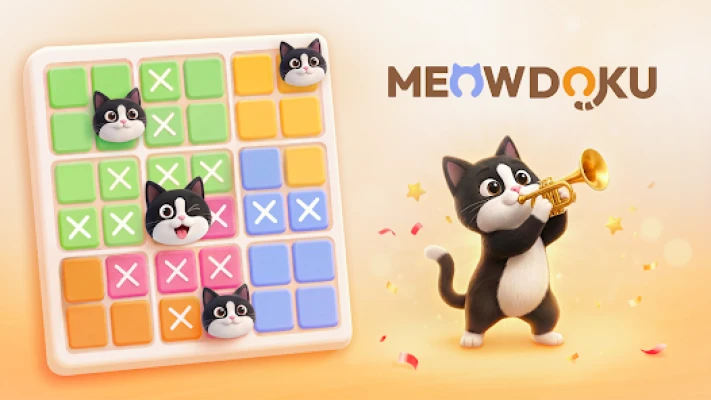
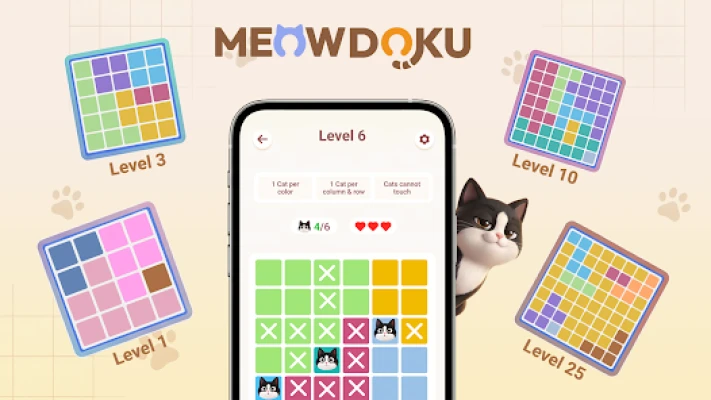
Meowdoku: Brain Puzzle Games puts a playful twist on traditional number-based logic puzzles. Instead of filling a grid with numbers, you must find the correct locations for cats scattered across a board divided into colored regions.
The concept is simple, but finding a valid arrangement requires attention to detail. Every cat must occupy its own colored region, and the placement must follow strict spacing rules. A position that looks correct at first may prevent you from placing the remaining cats.
The game is ideal for players who enjoy Sudoku, Minesweeper, nonogram puzzles, and other games that reward logical deduction rather than quick reflexes.
Published by Oakever Games, Meowdoku is a single-player puzzle game available on Android, with offline play supported. Its cute presentation makes it approachable, while the placement rules give each puzzle a satisfying mental challenge.
Main Features of Meowdoku
Unique Cat Placement Puzzles
Every puzzle asks you to find the correct position for each cat. You must consider the colored regions, rows, columns, and surrounding tiles before making a decision.
Sudoku-Inspired Logic
Like Sudoku, Meowdoku requires you to follow restrictions across a grid. However, instead of arranging numbers, you place cats in positions that satisfy several conditions simultaneously.
Minesweeper-Style Deduction
The game rewards you for ruling out impossible positions and narrowing down the remaining choices. Each confirmed placement provides information that can help you solve the rest of the board.
Color-Coded Regions
The board is divided into colored territories. Each region must contain exactly one cat, so recognizing which spaces remain available in each territory is essential.
Strict Spacing Rules
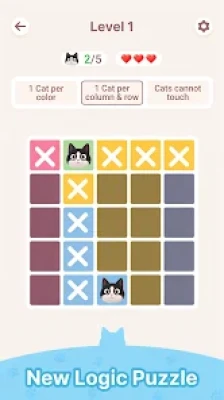
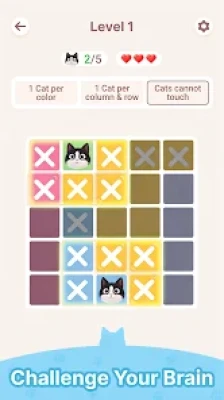
Cats cannot share a row or column, and they cannot touch each other, including diagonally. These restrictions create the main challenge and make careless placements risky.
Three Mistake Chances
The game provides three chances to make a mistake. Incorrect guesses can cost hearts, making logical reasoning more valuable than randomly trying different tiles.
Simple Controls
The controls are easy to learn. Double-tap a tile to place a cat, following the game's placement rules and the available board information.
Offline Puzzle Gameplay
Meowdoku supports offline play, making it suitable for short puzzle sessions while travelling, waiting, or relaxing away from an internet connection.
Casual, Cat-Themed Presentation
The cute feline theme gives the game a friendly atmosphere without removing the need for careful concentration. It is a good fit for players who prefer brain teasers with a lighter visual style.
How to Play Meowdoku
The objective is to place every cat correctly while following all the board's rules.
Examine the colored regions: Identify the different territories on the board and determine where each cat could potentially go.
Check the rows: Cats cannot occupy the same horizontal row.
Check the columns: Each cat must have its own vertical column.
Avoid adjacent cats: Two cats cannot touch horizontally, vertically, or diagonally.
Find forced positions: Look for regions or rows where only one legal tile remains.
Place a cat: When you have identified a valid position, double-tap the tile to place the cat.
Recheck the board: After every placement, examine how the available positions have changed.
Protect your hearts: Avoid guessing when the current information is insufficient.
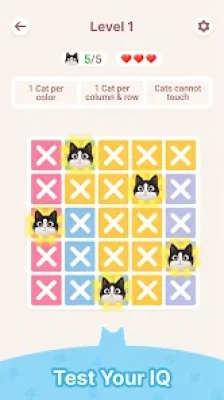
Complete every region: Finish the puzzle by placing exactly one cat in each colored territory without breaking any restrictions.
The most important principle is that a valid placement must satisfy all the rules at once. A tile is not correct simply because it belongs to an empty region.
Complete Meowdoku Strategy Guide
1. Understand All the Rules Before Placing a Cat
Before starting a puzzle, make sure you understand the four essential restrictions:
Each colored region must contain exactly one cat.
No two cats may share a row.
No two cats may share a column.
Cats cannot touch, even diagonally.
These rules work together. A tile may be available within its colored region but still be invalid because another cat occupies the same row, column, or a neighboring tile.
Checking all four conditions before placing a cat will prevent many avoidable mistakes.
2. Start With the Most Restricted Region
Not every colored region offers the same number of possible positions. Some may have several available tiles, while others may have only one or two.
Begin with the region that has the fewest legal options. If only one tile satisfies every rule, that placement is forced.
This approach reduces uncertainty early and often makes other regions easier to solve.
3. Eliminate Impossible Tiles
One of the strongest techniques in Meowdoku is to focus on where cats cannot go.
If a cat already occupies a row, eliminate other tiles in that row as candidates. Apply the same reasoning to its column and all neighboring tiles, including diagonal neighbors.
Then consider the one-cat-per-region rule. If a region already contains its cat, every other tile in that region is unavailable.
Each eliminated tile narrows the puzzle until the correct positions become clearer.
4. Pay Special Attention to Diagonal Neighbors
Diagonal restrictions are easy to overlook, especially when the board becomes crowded with cats.
A cat placed in one tile prevents another cat from occupying any of the eight immediately surrounding tiles, where those tiles exist.
For example, if you place a cat in the center of a small square, the tiles directly above, below, left, right, and at all four corners around it cannot contain another cat.
Always inspect the diagonal positions before confirming a placement. A move that satisfies the row and column rules may still violate the adjacency rule.
5. Solve One Forced Placement at a Time
When you find a tile that is the only legal option for its region, row, or column, place the cat and reassess the board.
Do not attempt to solve every region mentally at once. Confirming a forced placement reduces the number of possibilities and can reveal new forced positions elsewhere.
This step-by-step method is more reliable than trying to remember every possible arrangement simultaneously.
6. Use Rows and Columns Together
Rows and columns provide valuable clues when combined with colored regions.
Suppose a region has only two possible tiles, but one shares a row with a cat already placed. That tile is invalid, leaving the other as the only legal option.
The same reasoning applies when a column or diagonal neighbor rules out one of the remaining candidates.
The best solutions often come from combining several small deductions rather than finding one obvious answer.
7. Look for Regions With Only One Legal Tile
A colored region may appear to have plenty of empty space, but many of its tiles can be eliminated by existing cats.
Scan each region and count the positions that remain legal. When only one remains, the next placement is clear.
Repeat this check after every confirmed cat. New placements change the availability of tiles throughout the board, so a region that was previously uncertain may become easy to solve.
8. Avoid Random Guessing
Meowdoku gives you three mistake chances, so guessing can quickly make a promising attempt more difficult.
Before placing a cat, ask yourself:
Does this tile belong to an unoccupied region?
Is its row free of other cats?
Is its column free of other cats?
Is it separated from all other cats, including diagonally?
Does this placement leave the remaining regions with legal positions?
If you cannot answer these questions confidently, examine the other regions and look for additional deductions.
9. Think About the Consequences of Each Placement
A tile can be legal now but still leave you with a difficult or impossible arrangement later. Strong puzzle-solving involves considering how a placement affects the rest of the board.
Before committing, check whether the move leaves at least one legal position for every unoccupied region. Also consider whether it blocks all available positions in a row or column that still needs a cat.
This forward-looking approach helps you avoid choices that create problems several moves later.
10. Recheck the Board After Every Cat
Do not continue using the same assumptions after a placement. A newly placed cat immediately removes potential positions from its row, column, and neighboring tiles.
After each move:
Identify the newly unavailable tiles.
Check which regions have fewer remaining options.
Look for a region with one legal tile.
Reconsider rows and columns that now have restricted choices.
Repeat until the next placement becomes clear.
This routine keeps the puzzle manageable and reduces the chance of overlooking an important restriction.
11. Use a Simple Candidate-Tracking Method
When a puzzle becomes difficult, mentally track the possible positions for each region.
You do not need to remember every tile on the board. Focus on the most restricted regions and note which positions remain legal after applying the rules.
For example, if a region has three possible tiles and two become invalid because of row conflicts, the remaining tile may be forced.
Working with a small number of candidates at a time makes complex puzzles easier to understand.
12. Protect Your Remaining Hearts
The mistake limit encourages deliberate play. If you have already lost a heart, become even more careful about uncertain placements.
Review the rules and the positions of existing cats before making another move. If no obvious placement is available, search for a restricted region, a row with limited options, or a column that eliminates several candidates.
A pause to reconsider the board is usually more useful than making another unsupported guess.
Beginner Tips for Meowdoku
Start with the easiest deduction. Look for a region that has only one legal position.
Check every rule. Region, row, column, and diagonal restrictions must all be satisfied.
Look for impossible placements. Eliminating incorrect options is often easier than identifying the answer immediately.
Do not overlook diagonal contact. Cats need space from neighboring tiles in every direction.
Reassess after each move. Every confirmed placement changes the remaining possibilities.
Save your hearts. Avoid testing positions when you can still gather more information.
Focus on small deductions. A single eliminated tile may be enough to unlock the next move.
Be patient. Meowdoku rewards careful thinking rather than fast tapping.
Advanced Meowdoku Techniques
Find the Most Constrained Choice
When several regions remain unsolved, focus on the one with the fewest legal tiles. This gives you the greatest chance of making progress without guessing.
Combine Multiple Restrictions
A candidate tile might be eliminated by its row, another by its column, and a third by diagonal contact. Applying all restrictions together often reveals a single valid position.
Check for Contradictions Before Committing
Imagine placing a cat in a candidate tile and consider the consequences. If that choice leaves another region with no legal position, the candidate cannot be correct in a valid solution.
Use this reasoning to reject impossible arrangements before committing to a move.
Look for Hidden Forced Positions
Sometimes a region has several possible tiles, but only one can satisfy the remaining row and column requirements. Similarly, a row may have several empty spaces but only one that is compatible with the colored regions.
Examine the board from multiple perspectives instead of checking each region in isolation.
Avoid Solving Only From Left to Right
The easiest-looking region is not necessarily the most useful starting point. A difficult region near the opposite edge of the board may provide the deduction that unlocks several other placements.
Follow the strongest available clue rather than using a fixed direction.
Common Mistakes to Avoid
Ignoring diagonal contact: A cat can violate the rules even when its row and column are clear.
Focusing only on colors: Every region needs one cat, but its legal positions are also limited by the rest of the board.
Guessing too early: Several restrictions may reveal the answer if you examine the puzzle more carefully.
Forgetting previous placements: Every cat changes which tiles remain available.
Overlooking a forced move: A region with only one legal tile should take priority over regions with many options.
Making moves without checking the consequences: A placement should not leave another region without a legal candidate.
Rushing through difficult puzzles: Taking time to eliminate possibilities is more reliable than repeatedly losing hearts.
Is Meowdoku Worth Playing?
Meowdoku is a strong choice for players who enjoy logic puzzles but want something different from traditional number-based Sudoku. Its cat-placement system introduces a distinct challenge built around colored regions, row and column restrictions, and diagonal spacing.
The game is easy to understand, yet solving difficult boards requires patience and careful deduction. Its adorable visual theme makes the experience approachable, while the limited mistake chances encourage players to think before acting.
Offline support is useful for casual play, although the presence of advertisements and optional in-app purchases may affect the experience for some players. Those who prefer action games or puzzles that rely on quick reactions may find its deliberate pace less appealing.
Overall, Meowdoku is worth trying if you like brain teasers that reward logic, observation, and methodical problem-solving.
Pros and Cons
Pros
A distinctive alternative to traditional Sudoku.
Combines region-based placement with spatial logic.
Cute cat-themed presentation.
Straightforward rules that are easy to learn.
Challenging deductions for experienced puzzle fans.
Three-heart mistake system encourages careful thinking.
Offline gameplay support.
Suitable for short or longer puzzle sessions.
Cons
Difficult puzzles can require considerable concentration.
Diagonal restrictions are easy to overlook.
The mistake limit can be frustrating when a rule is missed.
Repeated puzzle-solving may feel familiar over long sessions.
Advertisements and optional purchases may not suit every player.
Frequently Asked Questions
What is Meowdoku?
Meowdoku is a cat-themed logic puzzle game that combines Sudoku-inspired placement restrictions with deduction mechanics. Players must find the correct tile for every cat while following the board's rules.
How do you play Meowdoku?
Place exactly one cat in each colored region. No two cats can share a row or column, and cats cannot touch each other, even diagonally. Double-tap a tile to place a cat.
What is the main objective of Meowdoku?
The objective is to complete the puzzle by placing every cat in a legal position while satisfying all region, row, column, and adjacency restrictions.
How many mistakes can you make in Meowdoku?
The game description specifies three chances to make a mistake, represented by hearts. Protecting those chances makes careful deduction especially important.
Is Meowdoku similar to Sudoku?
Yes, in the sense that both games require logical placement under strict restrictions. However, Meowdoku uses cats, colored regions, and a rule preventing cats from touching, including diagonally, rather than traditional number placement.
Is Meowdoku similar to Minesweeper?
It shares a deduction-focused style of puzzle-solving. Players eliminate impossible options and use the available information to determine valid placements rather than relying on random guesses.
How can I solve difficult Meowdoku levels?
Start with the region that has the fewest legal positions. Eliminate tiles that conflict with existing cats, pay attention to diagonal neighbors, and reconsider the board after each placement.
Can you play Meowdoku offline?
Yes. The game supports offline play, making it suitable for solving puzzles without a continuous internet connection.
Is Meowdoku suitable for beginners?
Yes. The basic rules are easy to learn, and beginners can improve by practicing elimination, identifying forced positions, and checking every placement against all the restrictions.
Does Meowdoku contain ads or in-app purchases?
Yes. The Google Play listing identifies both advertisements and in-app purchases.
Is Meowdoku a relaxing game?
Its cat-themed presentation and methodical gameplay can make it a relaxing choice for puzzle fans. However, challenging boards may require sustained concentration and careful reasoning.
Final Verdict
Meowdoku brings a fresh idea to the logic puzzle genre by replacing traditional number grids with adorable cats and colored territories. Its rules are straightforward, but the combination of region placement, row and column restrictions, and diagonal spacing creates a rewarding challenge.
The best strategy is to eliminate impossible positions, prioritize the most restricted regions, and confirm every placement before moving on. By relying on logical deductions instead of guesses, you can solve puzzles more consistently and protect your limited mistake chances.
For players looking for a cat puzzle game that combines cute visuals with serious brain-teasing gameplay, Meowdoku is a worthwhile option.
Rate the Game
User Reviews











Popular Games



















 Android
 iOS
iOS Windows
 Xbox
Xbox