
Latest Version
December 09, 2025
UDO GAMES OYUN YAZILIM ANONIM SIRKETI
Puzzle
iOS
0
Report a Problem
More About :game
What Is Lock Jam: Block Puzzle?
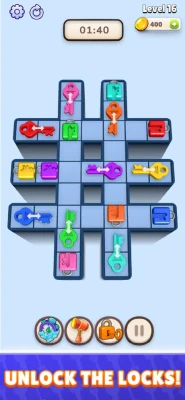
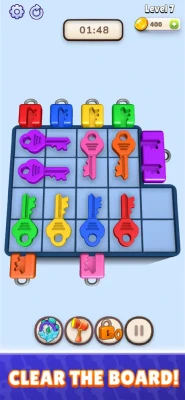
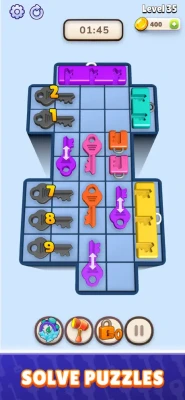
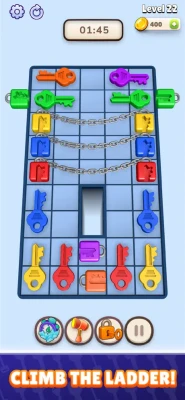
Lock Jam: Block Puzzle is a strategic mobile puzzle game where your objective is to connect keys with their matching locks.
At first, the concept looks simple. You move a key toward a lock of the same color and clear it from the board.
The challenge comes from the fact that keys can block one another's paths. Every movement therefore needs to be considered carefully.
One careless move can interfere with another key, forcing you to rethink the sequence and sometimes backtrack.
This creates a puzzle experience that combines logic, spatial awareness, planning, and problem-solving.
Lock Jam Gameplay
The core gameplay is based on three simple actions:
Slide → Match → Unlock
You move keys around the puzzle grid and attempt to guide them toward their corresponding locks.
Keys cannot simply pass through one another whenever you want. Their positions and available routes affect the solutions you can create.
The result is a puzzle where the order of your moves matters.
The official game description emphasizes that the controls are simple while the puzzles become increasingly challenging, making the game suitable for quick sessions as well as longer puzzle-solving sessions.
How the Key and Lock System Works
Every puzzle contains keys and matching locks.
Your task is to determine which key belongs to which lock and then find a safe route across the board.
The matching process is straightforward:
- Identify a key.
- Locate its matching lock.
- Check the available path.
- Move the key toward the lock.
- Avoid blocking other keys.
- Complete all required matches.
- Clear the board.
The difficulty isn't in understanding the objective—it's in finding the correct sequence of movements.
Think Before You Move
Lock Jam rewards players who pause and examine the entire board before making a move.
A key may appear to have a clear path, but moving it too early could prevent another key from reaching its destination.
This makes forward planning one of the most important skills in the game.
Instead of asking only:
"Can I move this key?"
you should also ask:
"What happens to the rest of the board after I move it?"
Strategic Path Planning
Path planning is at the heart of Lock Jam.
Each key has to reach its matching lock without creating an unnecessary blockage.
As boards become larger and more complicated, players need to understand:
- Which keys should move first
- Which paths must remain open
- Which keys are blocking others
- Where a key can safely travel
- When to delay a particular move
- When to backtrack and try another sequence
This gives the game a strong logic-puzzle character rather than relying on fast reactions.
Increasing Puzzle Difficulty
Lock Jam starts with accessible layouts and gradually introduces more complicated challenges.
The Android listing describes progression from smaller 4×4 grids to more demanding 8×8 mazes, requiring increasingly careful planning.
The larger the board becomes, the more possibilities you need to consider.
A solution that works on a small grid may require much more planning when additional keys and obstacles are introduced.
Unlimited Levels
One of the game's main attractions is its unlimited-level structure.
Rather than completing a short fixed campaign and stopping, players can continue tackling new puzzle challenges.
The App Store specifically promotes unlimited levels with increasing difficulty and fresh challenges.
This makes Lock Jam suitable for players who enjoy games they can return to repeatedly.
Relaxing Puzzle Experience
Despite its strategic difficulty, Lock Jam is designed to provide a relatively relaxing puzzle experience.
There are no complicated combat controls or fast reflex requirements.
Instead, players can take their time, examine the board, plan their route, and make their move.
That combination of calm presentation and increasingly challenging puzzles makes it a good choice for short breaks or longer brain-training sessions.
One-Hand Controls
The game is designed around simple touchscreen interactions.
Keys can be dragged across the board using straightforward gestures, making the basic controls easy to understand.
The App Store specifically highlights easy one-hand controls.
This is useful for mobile players who want a puzzle game that doesn't require a complicated control scheme.
No Fast Reflexes Required
Lock Jam is primarily about thinking rather than reacting.
You don't need lightning-fast fingers to succeed.
The important skills are:
- Observation
- Logic
- Planning
- Spatial reasoning
- Patience
- Problem solving
That makes the game appealing to players who prefer thoughtful puzzle challenges.
Level Progression
Lock Jam's progression is driven primarily by increasingly difficult puzzle layouts.
Early boards teach the basic relationship between keys and locks.
Later puzzles require players to understand the consequences of every movement and plan a complete solution before committing to it.
The progression from smaller boards toward larger and more complicated layouts provides a natural learning curve.
Puzzle Strategy Guide
Start With the Most Restricted Key
Look for keys that have very limited movement options.
These pieces may need to be solved before other keys can move freely.
Identify the Matching Lock
Before dragging anything, locate the destination for each key.
Understanding the complete board can reveal the intended sequence.
Look for Blocking Pieces
A key that appears unimportant may actually be preventing another key from reaching its lock.
Identify these bottlenecks before moving.
Think Several Moves Ahead
Don't judge a move only by its immediate result.
Consider how the board will look after one, two, or several additional moves.
Keep Routes Open
Avoid unnecessarily placing keys in positions that block important pathways.
Backtrack When Necessary
If a sequence creates a dead end, don't continue making random moves. Retrace your decisions and try a different order.
Beginner's Guide
1. Learn the Board
Take a few seconds to understand the positions of all keys and locks.
2. Match Colors
Identify which key corresponds to each lock.
3. Check Movement Paths
Determine whether other keys are blocking the route.
4. Find the Correct Order
Some keys should be moved before others.
5. Avoid Random Moves
Every move changes the available space on the board.
6. Restart or Backtrack When Needed
If you create an impossible situation, reconsider the previous sequence instead of repeatedly making moves that don't work.
Advanced Strategy
Experienced players can improve their solving speed by treating each puzzle as a complete system rather than a series of individual moves.
Work Backward
Instead of starting with the first key you notice, identify which key appears easiest to solve last.
Then work backward to determine which pieces need to move first.
Find Bottlenecks
Look for narrow routes where one key controls access for several other pieces.
Minimize Unnecessary Movement
The fewer unnecessary movements you make, the easier it is to preserve useful paths.
Solve the Most Constrained Area First
When multiple areas exist on a large board, focus on the section with the fewest available routes.
Predict the Board State
Before every major move, imagine how the remaining keys will be positioned afterward.
Game Difficulty
Lock Jam follows a straightforward difficulty curve.
Early levels: Learn the movement system.
Middle levels: Deal with blocked paths and more complicated sequences.
Advanced levels: Solve larger layouts requiring careful planning.
The Google Play description specifically notes progression from 4×4 boards to challenging 8×8 mazes.
The game is therefore easy to understand but capable of becoming genuinely demanding.
Game Theme and Atmosphere
Lock Jam doesn't depend on an elaborate story or fantasy world.
Its identity comes from the satisfying interaction between keys, locks, movement, and puzzle solving.
The overall atmosphere is designed to feel relaxing while still giving the player enough mental challenge to remain engaging.
The App Store describes it as a relaxing yet challenging puzzle experience.
Story
Lock Jam: Block Puzzle is primarily a gameplay-focused puzzle title rather than a story-driven adventure.
There is no major character narrative required to understand the game.
Instead, the player's progression comes from solving boards, unlocking locks, and overcoming increasingly complicated puzzles.
This keeps the focus on the central logic challenge.
Controls and Interface
The controls are intentionally simple.
Main Interaction
Drag a key across the board toward its corresponding lock.
Navigation
Tap the relevant interface elements to progress through levels and game menus.
Puzzle Interaction
Move keys carefully while observing the available routes and other pieces.
The simple control scheme means that most of the difficulty comes from puzzle logic rather than complicated controls.
Game Features
- Key-and-lock puzzle mechanics
- Color-based matching
- Strategic movement
- Blocked-path challenges
- Increasing difficulty
- Unlimited levels
- One-hand controls
- Relaxing puzzle design
- Larger puzzle grids
- Spatial reasoning challenges
- Backtracking and planning
- Mobile-friendly gameplay
- Fresh puzzle challenges
- Optional boosters and reward systems
- Free-to-play model with optional purchases
The App Store lists unlimited levels, increasing difficulty, one-hand controls, and lock-and-key mechanics among the game's core features.
Rewards and Additional Systems
Lock Jam has expanded beyond its original basic puzzle format through updates.
Its App Store history shows the addition of:
- New levels
- New lock designs
- Boosters
- Ladder system
- Rewards
- Weekly quests
- Monthly Pass
- Additional content
- Level balancing
- Gameplay improvements
These updates indicate that the game has continued to add progression and reward elements around its central puzzle mechanic.
Ladder and Reward System
The game's update history introduced a ladder system with rewards.
This adds another progression layer for players who want more than simply solving individual levels.
It gives regular players additional goals to work toward while continuing through the puzzle collection.
Weekly Quests
Weekly quests were introduced as another source of rewards.
These objectives encourage players to return regularly and complete additional challenges beyond the standard level progression.
Monthly Pass
The game has also introduced a Monthly Pass system.
This provides an additional reward-oriented progression layer for players who want to participate in the game's ongoing content systems.
Updates and What's New
The App Store currently lists version 1.2.4, with the latest listed update dated August 20, 2026 and described as a bug fix.
Earlier updates introduced new levels, new lock designs, visual improvements, performance optimization, level balancing, boosters, ladder rewards, weekly quests, and other gameplay improvements.
The Android version was also updated on August 21, 2026 according to Google Play.
Player Experience
Lock Jam is particularly effective when you want a puzzle that can be understood immediately but still requires genuine thought.
The basic objective is extremely clear:
Get the keys to their matching locks.
However, blocked paths and movement order prevent the game from becoming completely automatic.
Current App Store reception is positive, with a 4.6/5 rating from 273 ratings on the U.S. listing.
Some player feedback also indicates that later levels can become quite difficult, while other players describe the game as addictive and enjoy pushing through increasingly challenging stages.
Pros and Cons
Pros
- Simple concept
- Easy touchscreen controls
- Strategic puzzle mechanics
- Satisfying key-and-lock system
- Unlimited levels
- Increasing difficulty
- Larger puzzle grids
- Relaxing presentation
- Good for short sessions
- Encourages logical thinking
- Requires planning rather than reflexes
- Regular content updates
- Additional reward systems
Cons
- Later puzzles can become very difficult
- Some players may find certain levels frustrating
- Ads are included
- Optional in-app purchases are available
- Players looking for story-driven gameplay may find the experience too focused on puzzles
Technical Details
| Detail | Information |
|---|---|
| Game | Lock Jam: Block Puzzle |
| App Store ID | 6744099663 |
| Developer | UDO GAMES OYUN YAZILIM ANONIM SIRKETI |
| Genre | Puzzle |
| Platforms | iPhone, iPad |
| Price | Free |
| Monetization | Ads + In-App Purchases |
| Age Rating | 9+ |
| iOS Requirement | iOS 15.0 or later |
| iPad Requirement | iPadOS 15.0 or later |
| Current App Size | Approximately 297.9 MB |
| Language | English |
| Game Center | Supported |
The U.S. App Store currently lists the game as free with in-app purchases, in the Puzzle category, with a 9+ age rating and iOS 15.0-or-later compatibility.
The listing also supports iPhone and iPad, while compatibility information includes Apple silicon Mac and Apple Vision.
In-App Purchases
The current App Store listing includes optional purchases such as:
- Mini Bundle
- Fail Bundle
- No Ads
- 1,000 Gold
- Golden Ticket
- 5,000 Gold
- No-Ads Bundle
- Large Bundle
- 100,000 Gold
The U.S. listing shows prices ranging from approximately $0.99 to $69.99, depending on the item.
Lock Jam vs. Traditional Block Puzzle Games
Traditional block puzzle games often ask players to place pieces into an arrangement or clear lines.
Lock Jam takes a different approach.
Instead of primarily arranging blocks, players must navigate keys through a board and match them with corresponding locks.
The challenge is therefore based more heavily on:
- Movement order
- Path planning
- Spatial reasoning
- Blocking mechanics
- Logical sequencing
This gives Lock Jam its own identity within the broader mobile puzzle genre.
Who Should Play Lock Jam?
Lock Jam is a good choice for players who enjoy:
- Logic puzzles
- Block puzzles
- Brain games
- Key-and-lock puzzles
- Matching puzzles
- Casual mobile games
- Strategy puzzles
- Spatial reasoning games
- Offline-style puzzle sessions
- Relaxing brain teasers
- Challenging mobile puzzles
- One-hand games
It's especially appealing if you like games where the rules are simple but solving the later levels requires serious thought.
Expert Rating
Overall Rating: 8.4/10
| Category | Rating |
|---|---|
| Puzzle Mechanics | 8.7/10 |
| Strategic Depth | 8.6/10 |
| Controls | 9.0/10 |
| Difficulty Curve | 8.3/10 |
| Replay Value | 8.6/10 |
| Accessibility | 8.8/10 |
| Presentation | 8.1/10 |
| Overall Enjoyment | 8.4/10 |
Verdict
Lock Jam: Block Puzzle succeeds because it doesn't overcomplicate its central idea.
The objective is immediately understandable: move each key to its matching lock.
The strategic depth comes from everything that happens between those two points.
Keys can interfere with one another, routes can become blocked, and the order of your movements can determine whether a puzzle is solved or becomes impossible. As the boards grow from smaller layouts toward larger grids, the game increasingly rewards careful planning and spatial reasoning.
Its unlimited levels, simple one-hand controls, relaxing presentation, and steadily increasing difficulty make it a strong choice for fans of casual brain games and logic puzzles.
If you enjoy block puzzles, matching games, brain teasers, key-and-lock puzzles, and strategic mobile games, Lock Jam: Block Puzzle is worth adding to your puzzle collection.
Frequently Asked Questions
What is Lock Jam: Block Puzzle?
Lock Jam: Block Puzzle is a mobile puzzle game where players move keys across a board and match them with corresponding locks while avoiding blocked paths.
How do you play Lock Jam?
Drag keys across the board and guide each one to its matching lock. You need to plan the order of your movements because keys can block one another's routes.
Is Lock Jam free?
Yes. Lock Jam: Block Puzzle is free to download, but it contains advertisements and optional in-app purchases.
Does Lock Jam have unlimited levels?
Yes. The App Store listing describes the game as having unlimited levels with increasing difficulty and fresh challenges.
Is Lock Jam difficult?
The basic mechanics are easy to learn, but the puzzles become progressively more challenging. Google Play describes progression from 4×4 grids to more difficult 8×8 layouts.
Does Lock Jam require fast reactions?
No. The game is primarily based on planning, spatial reasoning, and logical movement rather than fast reflexes.
Does Lock Jam have boosters?
Yes. The App Store version history shows that boosters were added as part of the game's updates.
Does Lock Jam have rewards?
Yes. Updates have added ladder rewards, weekly quests, and other reward systems.
Does Lock Jam have a Monthly Pass?
Yes. The game's update history includes a Monthly Pass system.
What devices support Lock Jam?
The App Store currently lists support for iPhone and iPad, requiring iOS 15.0 or later.
What is the Lock Jam App Store ID?
The Apple App Store ID is 6744099663.
Lock Jam: Block Puzzle delivers a straightforward but surprisingly strategic puzzle experience. Move keys through increasingly complex boards, match them with their locks, avoid blocking important paths, and solve each puzzle using careful planning.
With unlimited levels, one-hand controls, increasing difficulty, larger grids, boosters, quests, rewards, and a relaxing presentation, it offers plenty of reasons to keep solving one more puzzle.
For players searching for a key-and-lock puzzle game, brain teaser, block puzzle, logic game, or relaxing mobile puzzle, Lock Jam: Block Puzzle is a strong option.
Rate the Game
User Reviews











Popular Games















 Android
 iOS
iOS Windows
 Xbox
Xbox