

Latest Version
September 23, 2026
Humble Reeds
Simulation
iOS
0
Report a Problem
More About :game
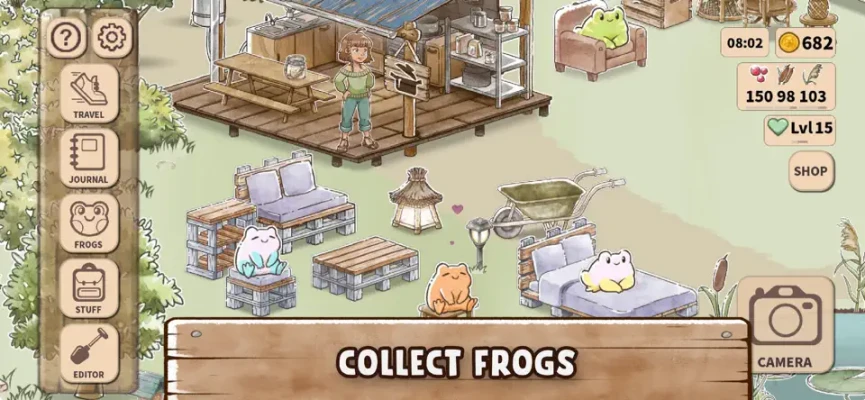
The App Store describes the game as a frog-collecting experience focused on nature, friendship and creating a thriving refuge. It features more than 500 unique frogs, rare color combinations, breeding mini-games and a Frogedex for recording your discoveries.
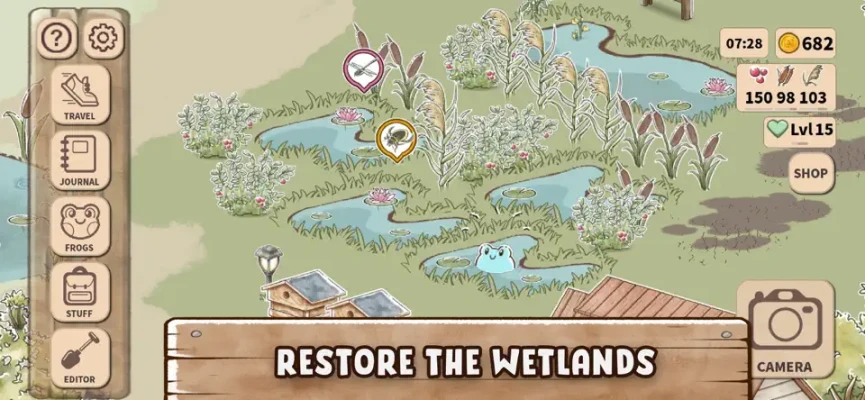
The game also combines its collection mechanics with wetland restoration. Paludiculture, sustainable crops, crafting and furniture placement all contribute to the gradual development of the refuge.
What Makes Kamaeru Different?
Kamaeru is not simply a frog-collecting game.
Its progression comes from several connected systems:
- Frog collection
- Frog breeding
- Frog photography
- Frogedex completion
- Wetland restoration
- Native plants
- Sustainable crops
- Crafting
- Furniture placement
- Furniture customization
- NPC relationships and visitors
- Refuge development
That combination gives the game a relaxed management loop where nearly everything you do contributes to making the wetland more interesting.
How to Start Kamaeru
The best approach during the opening portion is to avoid trying to collect everything immediately.
Instead, establish a productive refuge first.
Your early priorities should be:
- Restore useful parts of the wetland.
- Establish plants and crops.
- Learn how harvesting works.
- Turn resources into useful crafted goods.
- Improve the refuge.
- Watch for visiting frogs.
- Photograph and catalogue new discoveries.
- Gradually expand your frog collection.
The game is deliberately relaxed, so there is little benefit to rushing through the systems.
Understanding the Wetland
The wetland is the center of Kamaeru's progression.
Rather than treating it simply as scenery, think of your refuge as a small ecosystem.
Plants provide resources, cultivated areas support production, furniture changes the appearance of the refuge and frogs interact with the environment.
The official description specifically highlights rebuilding wetlands through paludiculture, planting native species, harvesting sustainable crops and crafting goods to improve the refuge.
Beginner principle
Improve the refuge before obsessing over rare frogs.
A stronger environment gives you more resources and more opportunities to work toward collection goals.
Frog Collection Strategy
The frog collection is one of the main reasons to keep developing your refuge.
Kamaeru features more than 500 unique frogs, including rare colors that can be obtained through breeding mini-games.
When you encounter a frog you haven't catalogued yet, prioritize documenting it.
A new frog is valuable even if you are not particularly interested in its appearance because it contributes to your Frogedex collection.
Keep track of discoveries
A useful routine is:
See frog → photograph frog → catalogue frog → investigate its needs → work toward breeding or attracting related frogs.
This prevents you from accidentally overlooking a rare visitor.
How to Photograph Frogs
Photography is more important than it initially appears.
The game allows you to snap photos as part of completing the Frogedex.
When you see an unfamiliar frog:
- Don't immediately move on.
- Take the opportunity to photograph it.
- Check whether it is already recorded.
- Observe where it appears.
- Pay attention to what is happening around it.
One App Store reviewer specifically mentioned that some frogs can disappear quickly, making photography and feeding harder for certain encounters.
So when a new frog appears, deal with the frog first and decorate later.
How to Tame Frogs
A useful detail for new players is that having a frog recorded in your Frogedex does not automatically mean the frog has been tamed.
According to information highlighted by the game's developer, frogs need to be physically present in the wetlands before you can interact with them for taming.
When a frog is present:
- Select the frog.
- Open its food information.
- Identify the type of bug it wants.
- Feed it the appropriate food.
- Complete the interaction to build the relationship.
This distinction is easy to miss and can save a lot of confusion when trying to build a complete collection.
Frog Breeding Guide
Breeding is one of the most interesting long-term systems in Kamaeru.
The game uses breeding mini-games to help players discover different frog colors and combinations.
Don't treat breeding as something you need to master immediately.
Instead, gradually build your collection and experiment as new possibilities become available.
A practical breeding approach
Start with frogs you already understand.
Then:
- Experiment with different combinations.
- Record unusual results.
- Pay attention to newly discovered colors.
- Keep interesting frogs available for future breeding.
- Use the Frogedex to track what you have already discovered.
The collection becomes much more manageable when you treat breeding as experimentation rather than trying to remember every combination.
How to Build a Better Frog Collection
A strong collection has two sides:
Quantity
You want to discover as many frogs as possible.
Variety
You also want unusual colors and breeding results.
This means that simply collecting the first frog you see isn't enough for long-term completion.
Once the refuge is established, start focusing on the frogs you haven't photographed or catalogued yet.
Farming and Crops
Farming is another important part of the refuge economy.
The game lets you plant native species and harvest sustainable crops, which can then contribute to crafting and further development.
A useful farming cycle is:
Plant → grow → harvest → craft → improve refuge → repeat.
Don't think of crops as an isolated mini-game.
They are part of the larger progression loop.
Farming tip
Keep your production areas organized.
A tidy layout makes it easier to identify what is ready to harvest and prevents you from overlooking resources while concentrating on frogs.
Crafting Strategy
Crafting turns the resources produced by your refuge into useful goods.
Rather than selling or using every resource immediately, consider what your current development goal is.
Ask:
- Do I need this material for an upgrade?
- Can it become a more valuable crafted product?
- Is an NPC currently requesting something related to it?
- Would keeping a small reserve make future progression easier?
A simple resource reserve can save you from having to rebuild your production chain later.
NPCs and Visitors
Kamaeru isn't populated only by frogs.
The game also includes friendly NPCs and new visitors who become part of your growing refuge.
These characters help make the wetland feel like a living place rather than an empty collection screen.
When a new visitor appears, interact with them rather than ignoring them.
Their requests, conversations and activities can introduce additional progression opportunities.
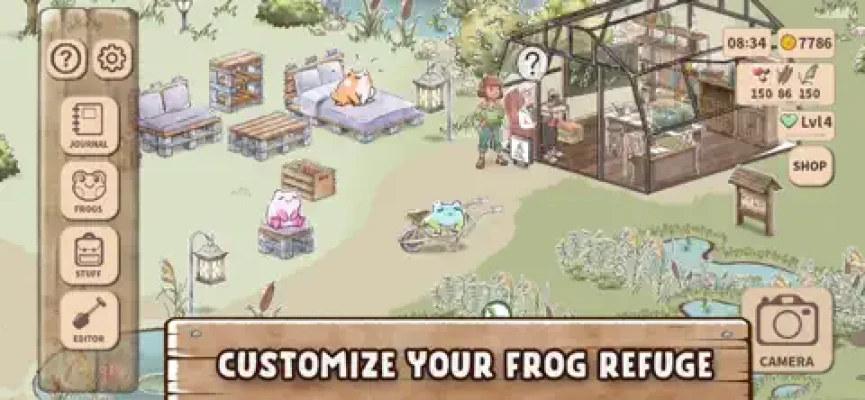
Decorating Your Frog Refuge
Decoration isn't just about making the wetland look attractive.
Kamaeru allows furniture to be placed and repainted, and furniture can reveal special frog poses.
That means decorating has a collection component as well.
Smart decoration strategy
Don't place furniture randomly.
Think about:
- Where frogs are likely to appear.
- Which areas you want to keep visually open.
- Where production activities are concentrated.
- Which furniture pieces you want to photograph.
- Which decorations complement your preferred refuge theme.
The result is a refuge that is both functional and personal.
Furniture and Frog Poses
One charming detail is that furniture can reveal special frog poses.
This creates another reason to experiment with placement rather than treating furniture as purely cosmetic.
If you're trying to complete your collection, keep an eye on frogs interacting with decorated areas.
A piece of furniture may become interesting not because of its appearance, but because of the frog behavior it encourages.
How to Manage Your Time
Kamaeru is designed as a relaxing game, so you don't need to optimize every second.
A good short session can follow this routine:
Quick Daily Routine
1. Check the refuge
Look for frogs and available resources.
2. Photograph new frogs
Don't let an unfamiliar visitor disappear before you've documented it.
3. Feed or tame frogs
Handle important frog interactions while they are available.
4. Harvest crops
Collect anything that is ready.
5. Start another production cycle
Plant or prepare resources for the next session.
6. Craft useful goods
Convert spare resources into something that helps your current goals.
7. Check your collection
See what frogs or discoveries you are still missing.
8. Decorate
Finish by improving the refuge visually.
This creates a natural loop without turning the game into a checklist-heavy management simulator.
How to Find Rare Frogs
Rare frog collection requires patience.
The game specifically highlights rare colors obtained through breeding mini-games.
Rather than constantly chasing one particular frog, develop the entire refuge.
A productive environment gives you more opportunities to encounter and work with frogs.
For collection-focused players
Keep three goals running simultaneously:
- Discover unknown frogs.
- Breed for new colors.
- Continue improving the refuge.
That prevents progress from becoming dependent on one specific frog.
Frogedex Completion Strategy
If your goal is to complete the Frogedex, make documentation a habit.
Every time a new frog appears:
Stop → photograph → identify → record → investigate.
Don't assume you'll remember a frog later.
The Frogedex is specifically designed around documenting your discoveries, so treating it as your long-term collection checklist makes the overall goal much easier to manage.
Beginner Mistakes to Avoid
Ignoring frogs while farming
A new frog can be more important than another harvest.
If an unfamiliar frog appears, investigate it before returning to routine farming.
Decorating too early
Decoration is enjoyable, but early progression benefits from establishing the productive side of the refuge first.
Forgetting photography
Seeing a frog and actually documenting it are two different things.
Assuming every frog is automatically tamed
A frog in your Frogedex is not necessarily a tamed frog. Physical presence in the wetland matters for the taming interaction.
Spending every resource immediately
Keep useful materials available for crafting and progression.
Trying to complete everything at once
The game is much more relaxing when you rotate between farming, crafting, collecting and decorating.
Advanced Kamaeru Strategy
Once the basic systems are familiar, start managing the refuge as one connected economy.
Build a resource loop
Plant crops that support your current crafting needs.
Maintain production
Avoid long periods where your growing areas are unused.
Combine collection with development
When you're waiting for resources, work on frog photography or breeding.
Use decoration strategically
Furniture isn't merely cosmetic because it can influence frog poses and interactions.
Keep experimenting
The game has a large collection target, so discovery is part of the long-term experience.
Best Strategy for 100% Collection
If your goal is to push toward a very complete collection, divide the task into four categories:
Frog discovery
Find frogs you haven't recorded.
Photography
Document each new discovery.
Taming
Interact with frogs when they are physically present and provide the appropriate food.
Breeding
Experiment with combinations to uncover rare colors.
Trying to do all four simultaneously can become confusing. Work through them as separate collection goals while continuing to improve the refuge.
Atmosphere and Visual Style
The atmosphere is arguably one of Kamaeru's biggest attractions.
The game is built around wetlands, plants, colorful frogs, furniture and gentle environmental restoration rather than combat or competition.
The App Store description emphasizes nature, friendship and preservation, while player reviews repeatedly mention the game's relaxing qualities and visual style.
One recent reviewer described the game as relaxing and praised its art style, while another said it was a good fit for people who enjoy calming aesthetics and collecting cute things. These are individual player opinions, but they match the game's stated cozy design direction.
The result is a game that feels closer to maintaining a digital nature sanctuary than managing a conventional farm.
Honest Feedback
Kamaeru's strongest idea is how its different systems support the same central fantasy: creating a thriving wetland full of frogs.
Farming feeds crafting, crafting helps develop the refuge, the refuge attracts frogs, and frogs create a reason to keep improving and experimenting.
The collection system also gives the game a long-term objective without requiring constant pressure.
The free-to-start structure is straightforward on iOS: the App Store lists the game as free with in-app purchases, with $4.99 to unlock the full game. The store description explicitly says there are no ads.
There are some practical caveats. Several App Store reviews mention frogs disappearing before they can be photographed or fed, while some users have reported their devices becoming warm during longer sessions. Other reviewers report smooth play and no overheating, so these experiences appear to vary by device and usage.
The developer has also released a battery-life improvement and bug fixes, which is particularly relevant given those earlier player comments.
Pros and Cons
Pros
- More than 500 frogs to discover
- Frog breeding and rare colors
- Frogedex collection system
- Wetland restoration
- Farming and sustainable crops
- Crafting
- Furniture customization
- Frog-specific furniture poses
- Friendly NPCs and visitors
- Relaxing atmosphere
- No ads on the iOS version
- Free trial before the one-time full-game unlock
Cons
- Some frogs can disappear quickly during encounters
- Collection-focused players may find the disappearing frogs frustrating
- Some users have reported device heat during longer sessions
- The game requires relatively modern Apple hardware
- Players looking for fast action may find the relaxed pace too slow
The current iOS listing requires iOS/iPadOS 16 or later and an A12 Bionic chip or later.
Kamaeru: A Frog Refuge – Game Information
| Feature | Details |
|---|---|
| Game | Kamaeru: A Frog Refuge |
| Developer | Humble Reeds |
| Genre | Simulation |
| Platform | iPhone, iPad |
| Age Rating | 4+ |
| Frogs | 500+ unique frogs |
| Main Systems | Collecting, breeding, farming, crafting, decorating |
| World | Restorable wetland refuge |
| Collection | Frogedex |
| Ads | No ads |
| Price Model | Free to start + one-time full-game unlock |
| Full Game Unlock | $4.99 on current US App Store listing |
| Current Version | 1.6 |
| Latest Listed Update | Battery-life improvement and small bug fixes |
| Game Center | Achievements supported |
| Size | 380.2 MB |
| Minimum OS | iOS/iPadOS 16.0 |
| Hardware | A12 Bionic or later |
Current store information is from the US App Store listing.
Frequently Asked Questions
What is Kamaeru: A Frog Refuge?
Kamaeru is a cozy simulation game about restoring a wetland, collecting and breeding frogs, growing crops, crafting goods and decorating a personal refuge.
How many frogs are in Kamaeru?
The developer lists more than 500 unique frogs to discover.
Can you breed frogs in Kamaeru?
Yes. Frog breeding includes mini-games that can unlock rare color variations.
What is the Frogedex?
The Frogedex is the game's frog-collection and documentation system. You photograph frogs to record your discoveries.
How do you tame frogs?
The frog needs to be physically present in your wetland. Select it, check its food requirements and feed it the appropriate bug to progress the taming interaction.
Does Kamaeru have farming?
Yes. You can plant native species, harvest sustainable crops and use resources in crafting.
Does Kamaeru have crafting?
Yes. Crafting is one of the systems used to develop and improve your refuge.
Can you decorate your frog refuge?
Yes. Furniture can be placed and repainted, and certain furniture can reveal special frog poses.
Does Kamaeru have ads?
The current iOS listing states NO ADS.
Is Kamaeru free?
You can start the game for free on iOS. The current US App Store listing offers a $4.99 one-time purchase to unlock the full game.
Does Kamaeru work on older iPhones?
The current iOS listing requires iOS 16.0 or later and an A12 Bionic chip or later.
Final Kamaeru Strategy
The best way to approach Kamaeru is to treat your refuge as a living ecosystem rather than a checklist.
Grow resources, improve the wetland, watch for frogs, photograph new discoveries, tame the frogs you encounter, experiment with breeding and gradually personalize the refuge.
Don't rush rare frogs at the expense of the environment that supports them.
The most satisfying progression comes from letting the systems work together: farming supports crafting, crafting improves the refuge, the refuge supports frog collection, and the growing frog collection gives you new reasons to keep experimenting.
That relaxed cycle is the heart of Kamaeru: A Frog Refuge.
Rate the Game
User Reviews















Popular Games



















 Android
 iOS
iOS Windows
 Xbox
Xbox