
Latest Version
September 14, 2026
tinyBuild LLC
Simulation
iOS
0
Report a Problem
More About :game
The game combines crafting, experimentation, shop management, resource planning, and light role-playing. You can buy ingredients from merchants, grow some yourself, negotiate prices, create customized bottles, and decide how you want to deal with the people who visit your shop.
What Is Potion Craft?
Potion Craft: Alchemist Simulator puts you behind the counter of a medieval-style alchemy shop. Your job is to turn raw ingredients into useful potions and sell them to customers who arrive with specific problems.
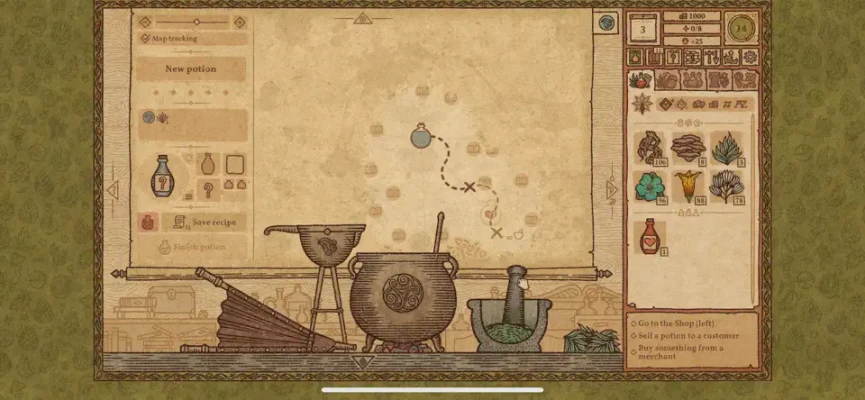
The interesting part is that potion creation is an interactive process. You need to choose ingredients, grind them with the mortar and pestle, move through the Alchemy Map, mix the brew and manage the cauldron until you achieve the desired effect.
The game's presentation is inspired by medieval manuscripts and old medical books, giving the shop a distinctive hand-crafted appearance.
Potion Craft Gameplay Features
Build Your Own Potion Recipes
Potion Craft encourages experimentation rather than simply following a fixed recipe list. Different ingredients can move your potion through different areas of the Alchemy Map, allowing you to discover new effects and combinations.
Learning how ingredients behave is one of the most important parts of the game.
Use the Alchemy Map
The Alchemy Map is effectively your recipe-planning playground. Each potion effect has a location on the map, and your ingredients determine how your brewing path moves toward those effects.
The best results often come from planning your route before throwing ingredients into the cauldron.
Grind and Mix Ingredients
Potion preparation involves physical interactions with your equipment. Ingredients can be processed with the mortar and pestle before being added to the brew.
The amount and fineness of grinding can affect how efficiently you reach the desired destination on the Alchemy Map.
Serve Customers
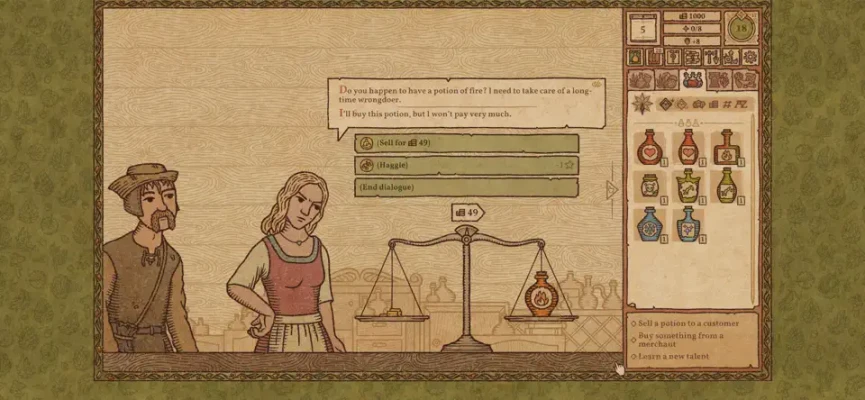
Customers arrive with different requests, and your job is to determine which potion best matches their needs.
Your decisions are not completely isolated from the wider game. Customer interactions can influence relationships, reputation, guild connections and the direction of your shop.
Buy and Grow Ingredients
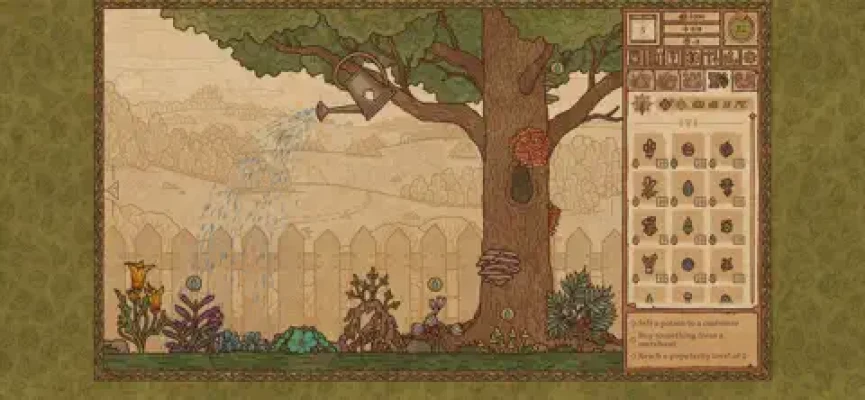
Ingredients can be obtained from traveling merchants, although buying everything can become expensive. Growing ingredients yourself can help reduce costs and give you a more reliable supply of commonly used materials.
Customize Your Potions
Potion Craft gives you considerable freedom when presenting your creations. You can customize bottle shapes, labels, icons, colors, names and descriptions, then display your favorite potions around the shop.
How Potion Brewing Works
A typical brewing session follows a simple but surprisingly flexible process:
- Check the customer's request.
- Identify the potion effect you need.
- Open the Alchemy Map and locate the desired effect.
- Plan a path toward that effect.
- Choose ingredients that move the potion in the required direction.
- Grind ingredients when necessary.
- Add them to the cauldron.
- Adjust the mixture carefully.
- Use heat, stirring and water or another appropriate base when required.
- Finish the potion once you reach the desired effect.
The key is not simply finding an ingredient that sounds appropriate. You need to understand how that ingredient affects your position on the Alchemy Map.
Full Potion Craft Strategy Guide
1. Learn the Alchemy Map Before Chasing Rare Recipes
One of the biggest mistakes new players make is treating potion brewing like a normal crafting system.
Instead, think of the Alchemy Map as a navigation puzzle.
Before adding ingredients, look at where your target effect is located. Then consider which ingredients can move the potion toward that area.
This simple habit will save ingredients and reduce failed experiments.
2. Start With Simple Potions
Do not immediately try to create complicated multi-effect potions.
Begin by learning how individual ingredients behave. Test inexpensive ingredients and observe the direction in which they move your potion.
Once you understand the basic movement patterns, more complicated recipes become much easier to design.
3. Keep Useful Ingredients in Reserve
It is tempting to use every interesting ingredient as soon as you find it.
Avoid doing this.
Keep a healthy supply of ingredients that you frequently use for popular potion effects. When a customer suddenly requests a familiar potion, you will not have to spend valuable money replacing basic materials.
4. Buy Cheaply From Merchants
Merchant visits can become an important part of your economy.
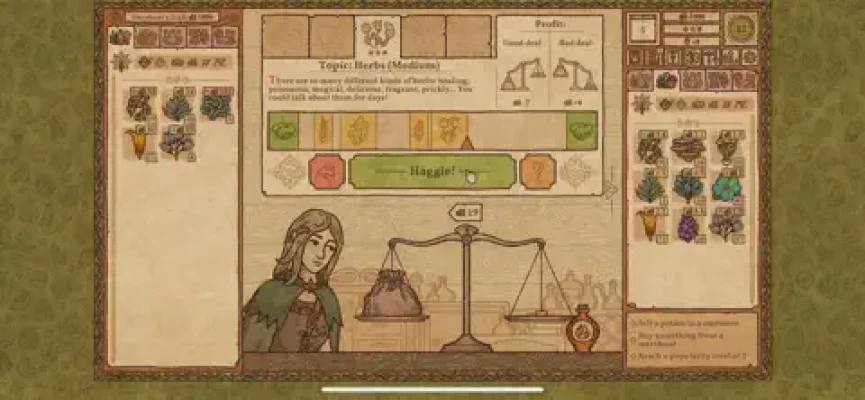
Do not automatically accept the first price. When possible, negotiate for better deals, particularly when purchasing ingredients that you use frequently.
Saving a small amount repeatedly can make a noticeable difference over many in-game days. Successful haggling can reduce the cost of maintaining your ingredient supply.
5. Grow Ingredients Whenever Practical
Purchased ingredients are convenient, but relying entirely on merchants can drain your profits.
Growing useful ingredients yourself gives you another source of materials and makes your shop less dependent on random merchant inventories.
Prioritize ingredients that appear repeatedly in your most profitable recipes.
6. Don't Waste Ingredients on Random Experiments
Experimentation is an important part of Potion Craft, but uncontrolled experimentation can become expensive.
Before testing a new recipe, ask yourself:
- Where is the target effect?
- Which direction do I need to travel?
- Which ingredients can move me there?
- Do I have enough ingredients for a second attempt?
- Is this experiment worth the cost?
This approach keeps experimentation fun without turning every failed attempt into a financial setback.
7. Learn From Failed Brews
A failed potion is not necessarily wasted knowledge.
Pay attention to what happened. Did the ingredient move the potion too far? Did it take you in the wrong direction? Did you use too much of an ingredient?
Record useful discoveries mentally or in your own notes.
Over time, you will develop an understanding of ingredient behavior that makes recipe creation much faster.
8. Focus on Customer Needs
When a customer arrives, read the request carefully instead of immediately selecting the closest potion you remember.
The most obvious solution is not always the only possibility.
Think about the requested effect, your available ingredients and whether creating the potion is economically worthwhile.
Potion Craft allows customer decisions to have consequences, so the shop is more than a simple buy-and-sell system.
9. Protect Your Profits
A profitable alchemist needs to consider both sides of the transaction.
A potion may sell for a good price, but if its ingredients are extremely expensive, the actual profit may be disappointing.
When choosing between multiple possible recipes, consider:
Selling price − ingredient cost = practical profit
Cheap ingredients with reliable recipes can often be more valuable than expensive ingredients used for a flashy potion.
10. Improve Potion Quality Through Practice
Don't rush through every brewing session.
Take time to understand how grinding, mixing, movement and heat affect your potion.
As your familiarity with the system improves, you will naturally become better at reaching desired effects with fewer ingredients.
11. Create a Personal Recipe Library
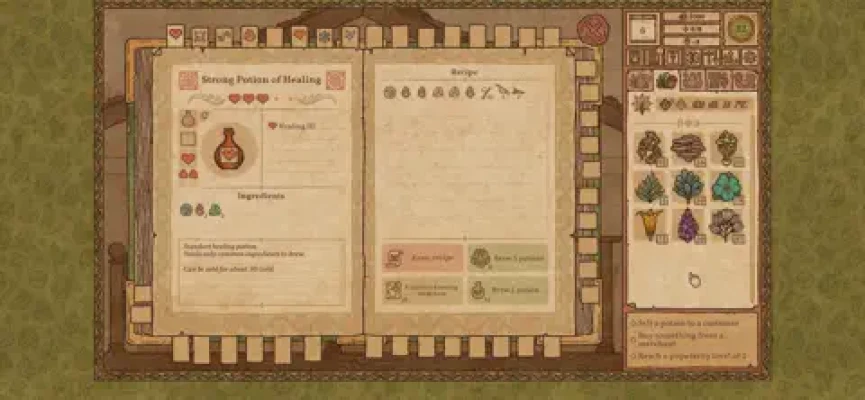
Once you discover a particularly efficient recipe, treat it as one of your shop's core products.
Build your own mental recipe library around common customer requests.
A useful system is to remember recipes in categories such as:
- Healing effects
- Movement-related effects
- Protection
- Utility potions
- Combat-oriented effects
- Special or unusual requests
Having reliable recipes ready makes busy shop days much easier.
12. Don't Ignore Potion Presentation
Customization is more than a cosmetic distraction.
Creating recognizable bottles can help you organize your collection visually. You can give potions distinct bottle shapes, labels, colors and names, making it easier to identify favorite creations.
Use attractive designs for potions you frequently display or sell.
Best Beginner Tips for Potion Craft
Tip 1: Study Before Brewing
Look at the Alchemy Map before choosing ingredients.
Tip 2: Experiment With Cheap Materials
Use inexpensive ingredients when learning how movement works.
Tip 3: Save Rare Ingredients
Don't spend valuable materials simply because you have them.
Tip 4: Grow What You Use
Self-grown ingredients can reduce your dependence on merchants.
Tip 5: Haggle When Appropriate
Better merchant prices can improve your long-term profits.
Tip 6: Read Every Customer Request
Their wording tells you what effect they are looking for.
Tip 7: Keep Proven Recipes
Once you discover an efficient recipe, remember it.
Tip 8: Think About Profit
A high selling price does not automatically mean high profit.
Tip 9: Learn From Mistakes
Failed experiments can teach you how ingredients behave.
Tip 10: Enjoy the Sandbox
There is rarely only one interesting way to approach a brewing problem.
How to Make Money Faster
Making money consistently is about controlling costs rather than simply selling expensive potions.
Start by identifying frequently requested effects. Then determine which ingredients allow you to create those effects efficiently.
Buy commonly needed ingredients when merchant prices are favorable, grow useful materials when possible, and avoid wasting expensive resources on unnecessary experiments.
A good long-term shop routine is:
Collect → Plan → Brew → Sell → Restock → Experiment
This keeps your ingredient supply and finances balanced.
Ingredient Management Guide
Ingredient management becomes increasingly important as your recipe collection grows.
Keep three categories in mind:
Common ingredients:
Use these freely for everyday recipes and experimentation.
Expensive ingredients:
Reserve them for recipes where they provide a meaningful advantage.
Rare or unusual ingredients:
Avoid spending them casually until you understand where they are most useful.
The goal is to maintain enough variety that an unexpected customer request does not force you into an expensive shopping trip.
Alchemy Map Strategy
The Alchemy Map is arguably the most important system to master.
Instead of thinking:
"Which ingredient makes this potion?"
Think:
"Which combination of ingredients can take me to this location?"
That change in mindset makes potion discovery much easier.
When planning a route:
- Locate the target effect.
- Look at the distance from your current position.
- Identify ingredients capable of moving you toward it.
- Choose the cheapest practical route.
- Avoid unnecessary detours.
- Stop once the desired effect is reached.
The shortest route is not always the only good route. Sometimes a slightly longer path may use much cheaper ingredients.
Customer and Shop Strategy
Customers are the heart of the shop-management side of Potion Craft.
Some requests are straightforward, while others encourage you to think carefully about what you are selling.
Pay attention to relationships and consequences rather than treating every visitor as nothing more than a source of gold. The game allows you to interact with guilds and notable characters, and your decisions can affect the broader development of your shop and town.
Potion Craft Progression
Progression comes from becoming a better alchemist rather than simply accumulating money.
As you play, you gradually become better at:
- Understanding ingredient behavior
- Navigating the Alchemy Map
- Discovering new potion effects
- Creating efficient recipes
- Managing ingredients
- Serving customers
- Negotiating with merchants
- Building relationships
- Organizing your potion shop
- Designing and displaying your creations
This makes the game feel more like learning a craft than following a conventional level-based progression system.
What Makes Potion Craft Different?
Potion Craft stands out because brewing is interactive rather than menu-driven.
The medieval manuscript-inspired presentation gives the game a distinctive identity, while the physical handling of ingredients makes simple actions such as grinding and mixing feel unusually tactile.
It also gives players room to decide how they want to run their shop. You can focus on experimentation, careful business management, customer relationships, recipe discovery or simply creating attractive potions.
Honest Review
Potion Craft is an excellent choice for players who enjoy relaxing management games, crafting systems and experimentation.
Its strongest feature is the Alchemy Map because it turns recipe creation into a genuine puzzle rather than a simple crafting menu.
The game is also appealing if you enjoy titles where there is no need to rush. You can spend time experimenting with ingredients, improving recipes and decorating your shop.
The main limitation is that players looking for fast action or traditional combat may find the deliberate pace too slow. Potion Craft is built around patience, discovery and experimentation.
Pros
- Creative potion-brewing system
- Excellent Alchemy Map mechanic
- Relaxing shop-management gameplay
- Large amount of recipe experimentation
- Interesting customer requests
- Ingredient gathering and resource management
- Extensive potion customization
- Distinctive medieval-inspired visual style
- Strong sandbox feel
Cons
- Brewing can feel slow if you prefer fast-paced games
- Experimentation can consume resources
- Some recipes require patience to discover
- The game is more about creativity than traditional action
Is Potion Craft Worth Playing?
Yes, especially if you enjoy alchemy games, crafting simulators, management games, puzzle mechanics and relaxing sandbox gameplay.
The combination of physical potion brewing, recipe discovery, customer management and shop customization gives Potion Craft a personality that many conventional simulation games lack.
Potion Craft on iPhone and iPad
The App Store version is listed for iPhone and iPad and is published by tinyBuild LLC. The current listing describes the game as a simulation title and says the first two chapters can be played for free, with the full game unlocked through a one-time purchase.
Potion Craft FAQ
What is Potion Craft?
Potion Craft is an alchemist simulator where you operate a potion shop, collect ingredients, create recipes, serve customers and experiment with an Alchemy Map.
Is Potion Craft a crafting game?
Yes. Crafting is the central mechanic, but it is combined with shop management, puzzle solving, customer interactions and resource management.
How does the Alchemy Map work?
The Alchemy Map represents the different potion effects you can discover. Ingredients move your brewing process around the map, so you need to plan routes toward the effect you want.
Can you create your own potion recipes?
Yes. Experimentation is a major part of the game, allowing you to discover different ways of reaching potion effects.
Can you customize potions?
Yes. Potion appearance can be customized with different bottle shapes, labels, icons, colors, names and descriptions.
Can you grow ingredients?
Yes. Growing ingredients is one of the ways to maintain your supply instead of purchasing everything from traveling merchants.
Can you negotiate with merchants?
Yes. The game allows you to haggle with traveling merchants, potentially reducing the cost of ingredients.
Is Potion Craft relaxing?
For most players who enjoy slower simulation and crafting games, yes. Its focus is on experimentation, planning and shop management rather than fast action.
Is Potion Craft difficult?
The basic brewing process is easy to understand, but mastering efficient routes and ingredient combinations takes practice.
Final Strategy Checklist
Before finishing a shop day, ask yourself:
- Do I have enough common ingredients?
- Did I save my rare materials?
- Which recipes are currently profitable?
- Which customer requests are worth accepting?
- Can I grow anything I regularly purchase?
- Did I discover anything useful today?
- Have I remembered my most efficient recipes?
- Is there a better route on the Alchemy Map?
- Can I negotiate a better merchant price?
- Which potion should I prepare next?
Master these habits and your potion shop will become much more efficient.
Game Information
Game: Potion Craft
Genre: Simulation, Puzzle, Casual
Developer: niceplay games
Publisher: tinyBuild LLC
Platforms: iPhone, iPad, Android, Windows and consoles
Players: Single-player
Core Gameplay: Potion brewing, crafting, shop management, experimentation and customer service
Main Mechanic: Alchemy Map-based potion creation
App Store: iPhone and iPad
Age Rating: 13+ on the current App Store listing
Potion Craft is ultimately a game about learning through experimentation. The more you understand your ingredients and the Alchemy Map, the less you need to rely on trial and error. Build a collection of efficient recipes, manage your resources carefully, listen to your customers and keep experimenting—the best alchemist is the one who understands why a potion works, not just which ingredients to throw into the cauldron.
Rate the Game
User Reviews







Popular Games



















 Android
 iOS
iOS Windows
 Xbox
Xbox