


Latest Version
December 07, 2024
MobilityWare
Card
0
com.mobilityware.freecell
Report a Problem
More About :game
What Is FreeCell Solitaire?
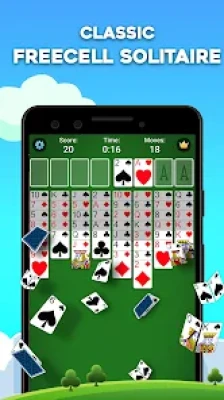
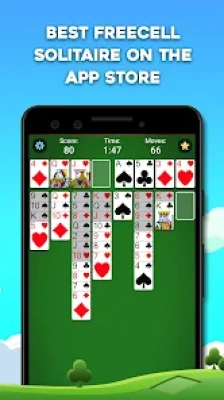
FreeCell Solitaire is one of the world's most popular card games. The objective is to move all 52 cards into four foundation piles, sorted by suit in ascending order from Ace to King. Unlike Klondike Solitaire, every card is visible from the beginning, making success depend more on strategy than luck.
The MobilityWare edition includes:
- Daily goals and challenges
- XP progression
- Hundreds of collectible titles
- Unlimited undo
- Hints system
- Auto-complete functionality
- Detailed statistics tracking
- Multiple screen orientations
- Over one million game variations
Key Features
Daily Goals and Challenges
Complete daily objectives to earn experience points and unlock new titles and achievements. This adds long-term progression beyond traditional FreeCell gameplay.
Unlimited Hints and Undo
Players can experiment with strategies without permanently ruining a game. Unlimited undo allows deeper learning and skill development.
Statistics Tracking
Monitor:
- Win percentage
- Best completion times
- Personal records
- Scoring history
- Daily challenge performance
These statistics help players improve over time.
One Million Solvable Deals
The game contains an enormous collection of layouts, providing virtually endless replayability.
How to Play FreeCell Solitaire
Step 1: Understand the Layout
The game consists of:
- Eight tableau columns
- Four free cells
- Four foundation piles
Every card is visible from the start.
Step 2: Build Foundations
Move cards to foundation piles by suit:
- Ace
- 2
- 3
- 4
- Through King
Step 3: Use Free Cells Carefully
The four free cells act as temporary storage spaces.
Managing these cells effectively is the key to winning.
Step 4: Create Empty Columns
Empty tableau columns provide enormous flexibility and should be prioritized whenever possible.
Step 5: Complete All Foundations
Continue organizing cards until all four suits reach King.
Beginner Walkthrough Guide
Early Game Strategy
When starting a new deal:
- Search for accessible Aces.
- Move low-value cards to foundations.
- Avoid filling all free cells immediately.
- Create movement opportunities.
- Look several moves ahead.
New players often make the mistake of focusing only on immediate moves instead of long-term positioning.
Best FreeCell Strategies
Keep Free Cells Available
The more free cells you have open, the more options you maintain.
A common beginner error is filling every free cell too early.
Rule of Thumb
- 4 empty cells = maximum flexibility
- 0 empty cells = limited movement
Create Empty Columns
An empty tableau column is often more valuable than a free cell because entire card sequences can be moved there.
Advanced players constantly work toward creating additional empty columns.
Move Aces Early
Whenever possible:
- Free Aces
- Build foundations
- Remove low cards quickly
This opens more opportunities throughout the board.
Plan Multiple Moves Ahead
FreeCell rewards long-term planning.
Before moving a card, ask:
- Does this create future options?
- Does it block important cards?
- Can I reverse the move later?
Advanced Winning Techniques
Sequence Management
Strong players focus on preserving alternating-color sequences.
Example:
- Black card
- Red card
- Black card
- Red card
These sequences can later be moved efficiently.
Avoid Foundation Traps
Moving cards to foundations too quickly can occasionally prevent necessary rearrangements.
Balance foundation progress with tableau flexibility.
Count Available Moves
Experienced players calculate how many cards can be moved based on:
- Open free cells
- Empty columns
- Existing sequences
This dramatically improves efficiency.
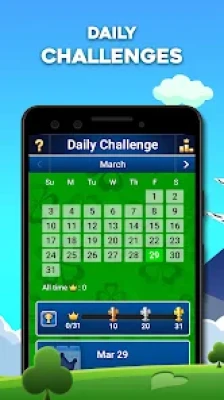
Daily Challenge Guide
The Daily Challenge system offers unique objectives and rewards.
To maximize success:
- Complete challenges consistently
- Maintain streaks
- Prioritize efficient wins
- Improve completion speed
- Focus on accuracy over rushing
Daily play helps unlock progression rewards and titles.
Common Mistakes to Avoid
Filling Every Free Cell
This leaves little room for strategic repositioning.
Ignoring Empty Columns
Empty columns are among the strongest resources in FreeCell.
Moving Cards Without a Plan
Random moves often create unsolvable situations.
Overusing Hints
Hints can help beginners but relying on them prevents strategic growth.
Why FreeCell Is Different From Other Solitaire Games
Unlike many solitaire variants, FreeCell is considered highly skill-based.
Key differences include:
| Feature | FreeCell | Traditional Klondike |
|---|---|---|
| Hidden Cards | No | Yes |
| Strategy Focus | Very High | Moderate |
| Luck Factor | Low | Higher |
| Planning Required | Extensive | Moderate |
| Solvable Deals | Most Deals | Not Always |
Because all cards are visible from the beginning, success depends primarily on decision-making rather than chance.
Frequently Asked Questions
Is FreeCell Based on Luck?
Not primarily. Since all cards are visible at the start, strategy plays a much larger role than luck.
Are Most Games Solvable?
Yes. Most FreeCell deals can be solved when approached with proper strategy.
What Are Free Cells Used For?
Free cells temporarily hold cards while players reorganize the tableau and create better movement opportunities.
Is FreeCell Good for Brain Training?
Many players enjoy FreeCell as a mental exercise because it requires planning, memory, sequencing, and problem-solving skills.
Final Verdict
FreeCell Solitaire remains one of the most strategic and rewarding card games ever created. The MobilityWare version enhances the classic experience with daily challenges, progression systems, statistics tracking, unlimited hints, achievements, and modern quality-of-life improvements. Whether you're a beginner learning card movement fundamentals or an experienced player chasing faster completion times, FreeCell offers nearly endless opportunities to improve your skills and enjoy thoughtful puzzle-solving gameplay.
Rate the Game
User Reviews

Popular Games



















 Android
 iOS
iOS Windows
 Xbox
Xbox