
Latest Version
May 12, 2025
MeeGame Studio
Puzzle
0
com.wood.nuts.wood.puzzle.nut.bolt.unscrew
Report a Problem
More About :game
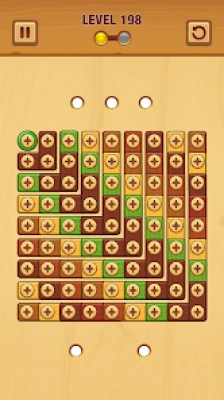
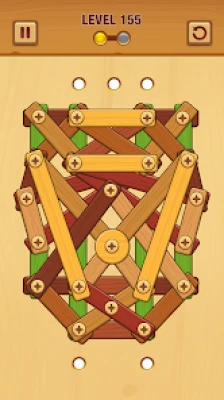
The central challenge is understanding how every move changes the board. Removing one screw can cause a wooden plank to fall, uncover another screw, block an important position, or create the opening needed for your next move.
The game is developed by MeeGame Studio and is available on Android and Windows. Google Play classifies it as a Puzzle, Logic, and Casual title, with single-player and offline support.
The current Google Play listing shows 1M+ downloads, a 4.7-star rating from roughly 69,700 reviews, and an Everyone content rating. It contains ads and optional in-game purchases.
What Is Wood Nuts: Nuts & Bolts?
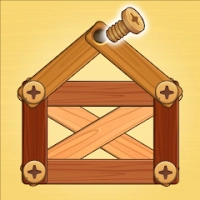
At first glance, Wood Nuts looks like a simple screw puzzle. The basic objective is straightforward: remove the screws holding wooden pieces in place and move the screws into suitable empty holes until the wooden structure has been completely cleared.
The difficulty comes from order and positioning.
You cannot always remove the screw you want immediately. Another wooden piece may be sitting above it, an empty hole may be required for another screw, or removing the wrong fastener can change the entire board.
The official description specifically emphasizes understanding the order of movement and the way wooden bars and screws fall after pieces are released.
That makes Wood Nuts less about fast tapping and more about reading the board before committing to a move.
Wood Nuts: Nuts & Bolts Game Information
| Feature | Details |
|---|---|
| Game | Wood Nuts: Nuts & Bolts |
| Developer | MeeGame Studio |
| Genre | Puzzle / Logic / Casual |
| Mode | Single-player |
| Gameplay | Screw, nut and bolt puzzle solving |
| Platform | Android, Windows |
| Offline Play | Listed as supported |
| Age Rating | Everyone |
| Monetization | Ads and in-game purchases |
| Google Play Downloads | 1M+ |
| Google Play Rating | 4.7 stars |
| Latest listed update | November 14, 2025 |
| Package ID | com.wood.nuts.wood.puzzle.nut.bolt.unscrew |
The Google Play listing describes the game as containing hundreds of wooden puzzle levels, with new puzzles and content being added over time.
How to Play Wood Nuts: Nuts & Bolts
The controls are intentionally simple.
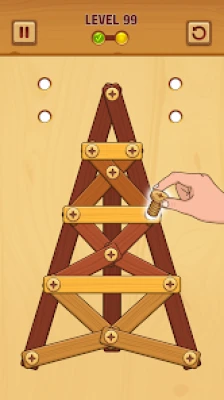
You generally tap a screw or nut to interact with it, then move the selected fastener to an available empty hole. Once the right screws are removed, wooden bars can fall away and reveal additional parts of the puzzle.
The basic gameplay loop is:
Examine the entire wooden structure.
Identify which screws are currently accessible.
Look for empty holes that can accept a removed screw.
Choose the safest screw to move.
Observe what happens to the wooden pieces.
Re-evaluate the board after every major change.
Continue opening new spaces until all wooden pieces are removed.
The official Google Play description confirms that moving nuts and bolts into correct empty positions and understanding the falling behavior of wooden components are central to solving the puzzles.
The Most Important Skill: Plan Before You Unscrew
The biggest mistake beginners make is treating every available screw as an equally good move.
It isn't.
Before tapping anything, look at:
Which wooden piece is being held by each screw.
Which screws are blocked.
How many empty holes are available.
Which wooden piece is likely to fall first.
Whether a falling piece could block another screw.
Whether you will still have somewhere to place the removed screw.
Which move creates the most useful space.
Think of every screw as part of a chain.
Removing one screw changes the state of the puzzle, so the best move is often not the screw that looks easiest to remove. It is the screw that produces the most useful change.
Wood Nuts: Nuts & Bolts Strategy Guide
1. Study the Whole Board First
Do not immediately start tapping.
Spend a few seconds looking at the complete arrangement.
Identify:
Accessible screws
Empty holes
Wooden bars
Overlapping pieces
Screws holding multiple important pieces
Pieces that appear ready to fall
Areas with limited space
This quick inspection can prevent several unnecessary moves.
2. Find the Critical Screw
Some screws have a much greater impact on the board than others.
A screw may:
Release an entire wooden plank.
Open access to another screw.
Cause multiple pieces to shift.
Free an important hole.
Change the available movement options.
Prioritize these screws when the resulting movement gives you more options.
A good question to ask is:
"What will change if I remove this screw?"
If the answer is "almost nothing," another move may be more valuable.
3. Protect Your Empty Holes
Empty holes are effectively your working space.
Do not waste them without thinking about the next few moves.
If you have several screws that could occupy the same area, consider which one will leave you with the most useful hole configuration.
This becomes especially important on complicated boards where available spaces become limited.
4. Think About Gravity
Wood Nuts is not only about screw positions.
The movement of wooden pieces matters too.
Once a screw is removed, a wooden bar may fall or shift. That movement can:
Reveal a hidden screw.
Remove an obstruction.
Change the position of another piece.
Close off part of the board.
Create a new opening.
The official listing specifically highlights the importance of understanding the falling behavior of the wooden bars and screws.
Therefore, always ask:
"Where will this piece go after I release it?"
5. Work From the Outside When Possible
Outer pieces are often easier to understand because they have fewer dependencies.
If a wooden bar is held by only a small number of accessible screws, it may be a good early target.
Removing simpler structures first can reveal the more complicated inner arrangement.
However, don't follow this rule blindly. If an outer piece is blocking an important screw or hole, clearing it may take priority.
6. Don't Fill Every Empty Hole Immediately
An empty hole is an opportunity.
Sometimes it is better to leave a space unused because you may need it for a more important screw later.
Before moving a screw into a hole, consider:
Do I need this hole for another screw?
Will this placement block another movement?
Is this screw likely to move again?
Will removing another wooden piece make this hole unnecessary?
Good puzzle solving is often about preserving future options.
7. Look for Forced Moves
Some boards eventually leave you with only one sensible option.
These are valuable clues.
For example:
A screw may be the only one that can currently move.
A particular empty hole may be the only available destination.
One wooden piece may have to fall before anything else can happen.
When the board gives you a forced move, take advantage of it.
Forced moves reduce uncertainty and can reveal the next stage of the puzzle.
8. Avoid Random Tapping
Random moves are particularly dangerous in screw-and-pin puzzles.
You may accidentally:
Use a useful empty hole.
Release the wrong wooden piece.
Create an awkward arrangement.
Lose valuable attempts.
Force yourself into an unnecessary restart.
Instead, treat each move as a small prediction:
Move → observe → reassess → continue.
9. When Stuck, Stop Moving
If the board suddenly becomes confusing, don't keep experimenting blindly.
Pause and examine:
What is currently blocking progress?
Is it:
A screw?
A wooden bar?
A missing empty hole?
A piece that needs to fall?
An incorrect previous placement?
Then work backward.
Sometimes the solution becomes obvious when you identify the move that should have happened immediately before the current position.
10. Learn From Failed Attempts
A failed attempt is useful if you understand why it failed.
Instead of simply restarting, ask:
Which move caused the problem?
Maybe you:
Moved a screw too early.
Used the wrong hole.
Released a plank before clearing another area.
Ignored a more important screw.
Created a dead-end arrangement.
Remembering these mistakes makes later levels significantly easier.
Advanced Wood Nuts Strategy
Use a Three-Move Mental Plan
You don't always need to solve the entire board in your head.
Try planning approximately three moves ahead:
Move 1: Remove the current obstruction.
Move 2: Use the newly opened space.
Move 3: Release the wooden piece that becomes accessible.
Then reassess.
This is easier than trying to predict every movement on a complicated level.
Prioritize Moves That Increase Options
A strong move usually gives you more possibilities afterward.
For example, removing a screw that:
Opens two new screws
Creates another empty hole
Releases a wooden panel
Exposes a previously inaccessible section
is generally more useful than a move that simply shifts one screw without changing the board.
Think in terms of future options, not just immediate progress.
Separate Safe Moves From Risky Moves
A safe move produces a predictable result.
A risky move creates a large structural change that you haven't fully considered.
When you have a choice, understand the safe option first.
If it does not work, then consider the larger structural move.
How to Beat Difficult Levels
When a level becomes significantly harder, use this process.
Step 1: Count the available empty holes
This tells you how much flexibility you have.
Step 2: Identify the most constrained screw
Look for a screw that has very few possible destinations.
Step 3: Identify the most important wooden piece
Ask which piece is blocking the greatest amount of the board.
Step 4: Determine what is holding it
Trace the screws connected to that piece.
Step 5: Find the safest release order
Do not simply remove every visible screw.
Determine which order creates useful space.
Step 6: Watch the falling behavior
After a piece moves, stop and reassess.
Step 7: Preserve one or more useful spaces
Avoid filling every hole if you don't need to.
Step 8: Continue only when the next move is clear
This approach is slower than random tapping but much more reliable.
Managing Limited Attempts and Assistance
Player reviews on Google Play describe later stages as becoming more demanding and mention mechanics involving lives, ads, and assistance. These are player experiences rather than universal descriptions of every level, so they are best treated as practical feedback rather than fixed rules.
If you reach a difficult level, don't immediately spend an assistance option.
First try:
Restarting your mental analysis.
Looking for the critical screw.
Checking whether you missed an empty hole.
Considering the falling path of the wooden piece.
Reconstructing your previous moves.
Trying a different opening sequence.
The best solution is often found by changing the first few moves, rather than forcing your way through the final part of the puzzle.
Beginner Tips for Wood Nuts: Nuts & Bolts
Tip 1: Look before tapping
The first few seconds of observation can save many moves.
Tip 2: Empty holes are valuable
Treat them as limited puzzle space.
Tip 3: Think about gravity
A released wooden piece can completely change the board.
Tip 4: Don't chase the easiest screw
The easiest move isn't always the best move.
Tip 5: Keep track of blocked screws
A screw that is inaccessible now may become your next important target.
Tip 6: Learn the board's rhythm
Once you understand how pieces fall and reveal new spaces, later puzzles become easier to read.
Tip 7: Restart intelligently
If your opening sequence creates a poor position, changing the first move can be more effective than trying to repair everything afterward.
Tip 8: Don't rush
This is a logic puzzle, not a reflex game.
Common Mistakes Players Make
Removing a Screw Without Checking Its Destination
If you don't have a useful empty hole available, the move can create problems.
Filling the Best Hole Too Early
A convenient hole may be needed later for another screw.
Ignoring Falling Pieces
A wooden bar's movement can be just as important as the screw you removed.
Trying to Solve the Board From One Area
Look at the entire structure. A solution on the opposite side may unlock your current problem.
Repeating the Same Failed Opening
If the first sequence consistently creates a dead end, change it.
Wood Nuts Puzzle Progression
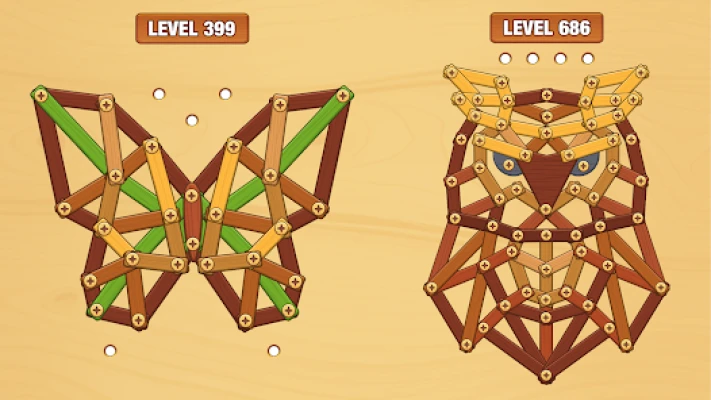
The game is built around a large collection of wooden screw puzzles, moving from relatively straightforward arrangements toward more complicated logic challenges. Google Play describes the levels as ranging from basic wood challenges to advanced puzzles and says the game includes hundreds of puzzles.
The important progression is not simply "levels get bigger."
You gradually learn to recognize:
Screw dependencies
Useful holes
Falling patterns
Structural relationships
Safe movement sequences
Forced moves
Potential dead ends
That knowledge becomes more valuable than memorizing individual solutions.
Sound and Atmosphere
One of the game's distinctive touches is its use of wooden and screw-related sound effects alongside music and ASMR-style audio.
That gives the game a tactile workshop feeling: screws move, wooden pieces shift, and the board gradually comes apart.
The presentation is intentionally simple rather than story-driven. The main attraction is the satisfaction of physically dismantling a wooden structure through logical planning.
Is Wood Nuts: Nuts & Bolts Difficult?
The difficulty depends heavily on how comfortable you are with spatial logic.
Early puzzles can feel straightforward because there are fewer dependencies.
Later puzzles require more planning because:
Several screws interact with the same wooden pieces.
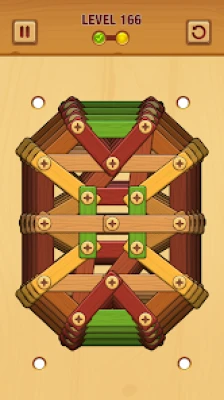
Empty holes become strategically important.
A single movement can change multiple parts of the board.
The correct order becomes less obvious.
Mistakes can force you to reconsider the entire sequence.
The game therefore rewards patience more than speed.
Honest Gameplay Assessment
Wood Nuts: Nuts & Bolts has a very accessible core idea: look at a wooden structure, work out which screws to move, and dismantle it piece by piece.
Its strongest gameplay quality is the cause-and-effect relationship between moves. A small change can reveal a completely different section of the board, making successful solutions satisfying.
The main consideration is its mobile-game monetization. Google Play confirms that the game contains ads and in-app purchases, while several published player reviews specifically criticize the frequency of ads and the way assistance/lives can affect later play. Other reviews still describe the underlying puzzle experience as enjoyable.
So the best way to approach Wood Nuts is to focus on the puzzle mechanics themselves and use assistance selectively rather than relying on it whenever a level becomes difficult.
Pros and Cons
Pros
Simple controls
Easy-to-understand core concept
Hundreds of wooden puzzles
Increasing logical complexity
Satisfying screw-and-plank interactions
Wood-themed visual and audio presentation
Single-player gameplay
Listed offline support
Suitable for short puzzle sessions
Cons
Ads can interrupt the experience
Some later puzzles can become considerably more demanding
Assistance mechanics may affect how freely you can approach difficult levels
Players who prefer fast action may find the pace slow
Some puzzles require careful experimentation rather than an obvious solution
Latest Update
Google Play currently lists the game as updated on November 14, 2025. The update notes state that performance was improved.
Third-party app listings also identify version 1.1.0 as the November 2025 release, although Google Play itself does not expose the version number in the page text currently available.
Frequently Asked Questions
What is Wood Nuts: Nuts & Bolts?
Wood Nuts: Nuts & Bolts is a logic puzzle game where players remove and reposition screws and bolts to dismantle wooden structures.
How do you play Wood Nuts?
Tap accessible nuts or bolts and move them into suitable empty holes. The goal is to remove the wooden pieces by finding the correct sequence of movements.
Is Wood Nuts: Nuts & Bolts a puzzle game?
Yes. Google Play categorizes it under Puzzle, Logic, and Casual.
Does Wood Nuts require an internet connection?
Google Play currently lists the game as Offline.
Is Wood Nuts multiplayer?
No. It is listed as a single-player game.
Is Wood Nuts suitable for children?
Google Play currently gives the game an Everyone content rating.
Why do the wooden pieces fall?
The falling behavior is part of the puzzle mechanics. Removing the correct screws allows wooden bars or pieces to move, exposing new parts of the board.
What is the best strategy for difficult levels?
Study the entire board first, protect useful empty holes, identify the critical screw, and plan several moves ahead before committing to a sequence.
Should I move screws as quickly as possible?
No. Speed is usually less important than choosing the correct order. A careful solution is generally more reliable than rapid tapping.
What should I do when I get stuck?
Stop making random moves. Recheck the available holes, identify which wooden piece is blocking progress, and reconsider your first few moves.
Final Thoughts
Wood Nuts: Nuts & Bolts turns a familiar collection of nuts, bolts, screws, and wooden boards into a surprisingly thoughtful logic challenge.
The key to progressing isn't simply finding a screw that can move. It is understanding what that movement does to everything else.
Study the board, preserve useful holes, predict where wooden pieces will fall, and think several moves ahead. Once you begin seeing each level as a sequence of dependencies rather than a collection of individual screws, the puzzles become much easier to understand.
For players who enjoy screw puzzles, wooden logic games, unscrew challenges, and relaxing but increasingly demanding brain teasers, Wood Nuts offers a straightforward gameplay loop with plenty of levels to work through.
Rate the Game
User Reviews












Popular Games



















 Android
 iOS
 Windows
 Xbox