
Latest Version
Visit PageMore About :game
Nonogram Logic Pic: Pictogram – Complete Game Guide
Custom Meta Title
Nonogram Logic Pic: Picture Cross Puzzle Game
Custom H1 Title
Nonogram Logic Pic: Solve Picture Logic Puzzles
Custom Meta Description
Solve challenging nonogram puzzles in Logic Pic! Use number clues, reveal colorful pixel art, complete daily challenges and sharpen your logic skills.
Short Game Description
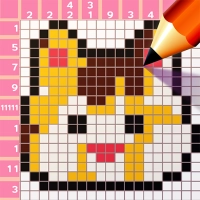
Nonogram Logic Pic: Pictogram is a relaxing yet challenging picture-logic puzzle game built around nonograms, also known as Picross, Griddlers and Picture Cross. Players use numerical clues along the edges of a grid to determine which squares should be filled and which should remain empty. Every completed puzzle reveals a hidden pixel-art illustration.
With puzzles ranging from beginner-friendly levels to expert challenges, themed picture collections, daily levels and offline play, Logic Pic offers an enjoyable experience for fans of brain games. Its simple rules make it easy to start, while its increasingly difficult puzzles reward careful thinking, patience and logical reasoning.
What Is Nonogram Logic Pic?
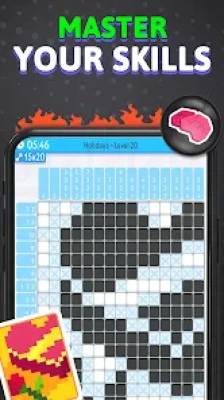
Nonogram Logic Pic transforms number-based logic puzzles into a collection of hidden pictures waiting to be discovered. Each level presents a grid containing numerical clues along its rows and columns. Your task is to interpret those clues and fill the correct squares to reveal the complete image.
Unlike traditional jigsaw puzzles, you do not receive separate picture pieces. Instead, you must work out the solution using deduction. Every number provides information about how many consecutive squares belong to a particular group.
The game starts with relatively simple challenges that introduce the basic rules. As you progress, the grids become more demanding, requiring you to compare several rows and columns before deciding which squares to fill.
The result is a puzzle experience that combines picture discovery with structured logical problem-solving.
Main Game Features
Countless Nonogram Puzzles
Logic Pic offers a large collection of picture-logic challenges with different levels of difficulty. Whether you are new to nonograms or already familiar with Picross puzzles, you can find challenges that match your experience.
Easy-to-Expert Difficulty
The game includes puzzles suitable for beginners as well as more demanding grids for experienced players. This gradual difficulty progression gives you time to understand the rules before tackling complicated patterns.
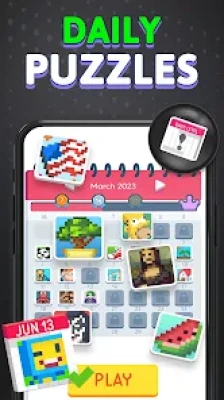
Daily Levels
Daily challenges provide fresh puzzles to solve regularly. They are a useful way to keep practicing and add variety beyond the main puzzle collections.
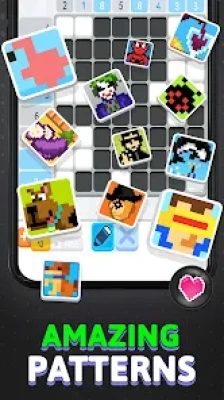
Beautiful Pixel-Art Pictures
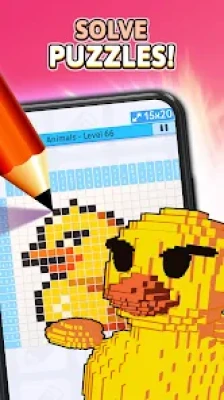
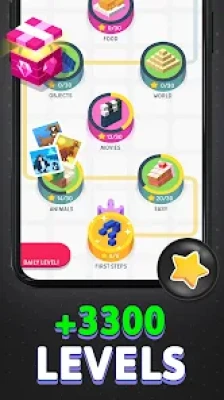
Every completed nonogram reveals a hidden pixel-art illustration. The pictures cover different themes, including:
Animals
Famous landmarks
Everyday objects
Movies
Other themed collections
Completing these pictures gives each puzzle a clear visual reward.
Offline Gameplay
You can solve puzzles without a Wi-Fi connection. This makes Logic Pic suitable for playing during travel, breaks or other moments when internet access is unavailable.
Automatic Save Feature
The game automatically saves your progress, allowing you to return to an unfinished puzzle later instead of starting again.
Beginner-Friendly Tutorial
New players can learn the basic rules through an in-game tutorial. The introduction explains how to read the numerical clues and use them to uncover the hidden pictures.
Single-Player Experience
Logic Pic focuses on individual puzzle-solving. You can take your time, study the clues and work through each grid at your own pace.
How to Play Nonogram Logic Pic
The basic objective is to fill the correct squares in a grid until the hidden picture is revealed.
Numbers appear beside each row and above each column. These numbers describe groups of consecutive filled squares.
For example, a row marked with the numbers 3, 2 must contain:
A group of three consecutive filled squares.
At least one empty square separating the groups.
A second group of two consecutive filled squares.
The groups must appear in the same order as the clues.
You must use the information from both directions to determine the correct pattern. A row may have several possible arrangements on its own, but the column clues help narrow down the solution.
Once every square has been correctly identified, the pixel-art picture becomes complete.
Understanding Nonogram Rules
Filled Squares
Filled squares represent the colored parts of the hidden picture. Each group of numbers tells you how many consecutive filled squares must appear in a particular row or column.
Empty Squares
Empty squares separate different groups and identify spaces that do not belong to the picture.
Marking known empty spaces is important because it helps you understand where the next group can fit.
Number Clues
The numbers are the most important information in every puzzle.
A clue of 5 means five consecutive filled squares. A clue of 2, 3 means one group of two filled squares followed by a separate group of three.
Row and Column Relationships
Rows and columns work together. Every square belongs to both one row and one column, so a deduction made in one direction can help solve the other.
This relationship is the foundation of nonogram gameplay.
Complete Strategy Guide for Nonogram Logic Pic
Start With the Largest Number Clues
The easiest place to begin is usually a row or column containing a large number.
For example, if a row has 10 squares and its clue is 9, there are very few possible arrangements. You can identify several filled squares immediately.
Large clues often provide the strongest starting points because they leave less room for uncertainty.
Use the Overlap Technique
One of the most useful nonogram strategies is identifying squares that must be filled regardless of where a group is positioned.
Imagine a row containing 10 squares with a single clue of 6.
The group could start at the first square or move toward the right. However, the possible arrangements overlap in the middle.
Solve the Most Constrained Rows First
Not every row offers the same amount of information.
A row containing several large groups may have only one or two possible arrangements. Another row with small numbers may have many possibilities.
Focus on the rows and columns with the fewest possible arrangements first. They are more likely to provide useful deductions.
Always Check Both Directions
Never solve the grid by looking at rows alone.
After filling a few squares, examine the corresponding columns. Their clues may reveal additional filled or empty spaces.
Then return to the rows and repeat the process.
This back-and-forth method is one of the most reliable ways to solve complicated nonograms.
Calculate the Minimum Required Space
Every separate group needs at least one empty square between it and the next group.
For example, a clue of 3, 2, 1 requires:
Three filled squares.
One empty separating square.
Two filled squares.
One empty separating square.
One filled square.
The minimum required space is eight squares.
If the row contains exactly eight squares, the solution is completely determined.
Learning to calculate minimum space helps you identify rows that can be solved immediately.
Mark Empty Squares as You Go
When you know that a square cannot contain part of the picture, mark it as empty.
This prevents you from accidentally including it in a group later.
It also makes the grid easier to read because you can distinguish confirmed information from squares that still need investigation.
Avoid Guessing Too Early
Guessing may occasionally seem tempting when a puzzle becomes difficult, but it can create additional problems if the assumption is wrong.
Instead, look for another row or column that provides more information.
A useful deduction in one area may unlock several uncertain squares elsewhere.
Look for Completed Groups
Once you have filled the exact number of squares required by a clue, that group is complete.
You can then use the remaining spaces and neighboring clues to eliminate impossible arrangements.
This is especially helpful in large grids where several groups are close together.
Work From Simple to Complex
Do not spend too much time trying to solve the hardest section first.
Identify easy rows, complete obvious groups, mark confirmed empty spaces and gradually use the new information to solve more complicated areas.
Small deductions often create a chain reaction that makes the rest of the puzzle much easier.
Review the Grid Before Finishing
Before completing a puzzle, check that every row and column agrees with its numerical clues.
A picture that appears visually correct is not necessarily a valid nonogram solution. The number sequences must match the completed grid exactly.
Advanced Nonogram Techniques
Forced Placement
A group may have several possible positions, but another clue can force it into one specific location.
When this happens, use the new information to eliminate conflicting possibilities in the intersecting columns or rows.
Edge Clue Analysis
Rows and columns with groups that must touch one side of the grid can be especially useful.
If a group cannot fit anywhere else because of its length and the available space, its position may become certain.
Group Separation
Remember that different groups cannot touch each other directly.
If a clue contains multiple numbers, there must be at least one empty square between consecutive groups.
This simple rule can eliminate many incorrect arrangements.
Contradiction Checking
If a possible arrangement causes a row or column to exceed its clue, that arrangement must be wrong.
Use contradictions to eliminate uncertain placements rather than continuing with an impossible pattern.
Logical Chains
A single confirmed square can influence its row and column, which may reveal additional squares elsewhere.
Continue following these connections until no more immediate deductions are available.
Daily Challenge Strategy
Daily Levels are a useful way to keep your puzzle-solving skills active.
To get the most out of them:
Begin by checking the largest numerical clues.
Look for rows with very limited possible arrangements.
Use overlap to identify guaranteed squares.
Keep empty spaces clearly marked.
Check columns whenever a row reveals new information.
Avoid rushing when the grid becomes complicated.
Daily puzzles are also a good opportunity to practice techniques that you can use in more difficult puzzle packs.
Common Mistakes to Avoid
Ignoring the Empty Spaces
Some beginners focus only on filling squares. However, empty spaces are equally important because they separate groups and restrict possible arrangements.
Reading Clues in the Wrong Order
The numerical sequence must always be followed from left to right for rows and from top to bottom for columns.
Changing the order can produce an incorrect picture.
Filling Squares Without Checking Columns
A placement may seem correct when looking at a row but conflict with the corresponding column clue.
Always verify both directions.
Forgetting Group Separation
Two separate groups cannot touch each other. Missing the required empty square between them is a common source of mistakes.
Guessing Instead of Deducting
Random placements can make a puzzle more confusing. Look for guaranteed squares and use the available clues before making uncertain decisions.
Rushing Through Difficult Levels
Larger puzzles require more attention. Taking a moment to review the grid is often faster than correcting several mistakes later.
Tips for Improving Your Puzzle-Solving Skills
Practice regularly: Solving a few puzzles every day helps you recognize common patterns.
Learn overlap: This technique is especially useful when groups are large and grids are nearly full.
Start with easy deductions: Completing simple rows and columns gives you information for more difficult areas.
Use both clues: Rows and columns must always be considered together.
Keep your grid organized: Clearly marking confirmed empty squares reduces confusion.
Increase difficulty gradually: Build confidence with smaller puzzles before moving to expert challenges.
Take breaks: If you cannot find another logical move, briefly stepping away can help you notice patterns you previously overlooked.
Is Nonogram Logic Pic Good for Brain Training?
Nonogram puzzles encourage several useful thinking skills, including logical deduction, pattern recognition, attention to detail and systematic problem-solving.
Players must interpret numerical information, compare possibilities and eliminate arrangements that cannot work.
Although playing puzzles should not be considered a guaranteed way to improve intelligence or treat cognitive conditions, the game offers a practical and entertaining way to exercise logical thinking.
Can You Play Nonogram Logic Pic Offline?
Yes. The Google Play description confirms that the game supports offline puzzle-solving, so a Wi-Fi connection is not required for its core gameplay.
This makes it convenient for short sessions while traveling or during breaks.
Is Nonogram Logic Pic Free?
Nonogram Logic Pic is free to download and play on Android. However, the game contains advertisements and optional in-app purchases. Some additional content or extras may require payment.
Who Should Play Nonogram Logic Pic?
This game is suitable for players who enjoy:
Nonogram and Picross puzzles
Picture Cross challenges
Number-based logic games
Pixel-art illustrations
Brain-teasing activities
Sudoku-style deduction
Daily puzzle challenges
Relaxing single-player games
Offline puzzle experiences
It is especially appealing to people who prefer thoughtful gameplay over fast reactions or complicated controls.
Frequently Asked Questions
What is Nonogram Logic Pic?
It is a picture-logic puzzle game where players use numerical clues to fill grid squares and reveal hidden pixel-art illustrations.
What is another name for a nonogram?
Nonograms are also known as Picross, Griddlers, Picture Cross and Hanjie.
How do you solve puzzles in Logic Pic?
Read the numbers beside each row and column, determine the required groups of consecutive filled squares and use logic to identify the correct positions.
Does Logic Pic have daily puzzles?
Yes. The Daily Levels feature provides additional challenges to solve regularly.
Can beginners play Nonogram Logic Pic?
Yes. The game includes a tutorial and puzzles with different difficulty levels, making it accessible to newcomers.
Can you play without internet access?
Yes. The game supports offline gameplay.
Does the game save your progress?
Yes. Its automatic save feature allows you to return to unfinished puzzles.
What pictures can you discover?
Themed collections include illustrations of animals, famous landmarks, everyday objects, movies and other subjects.
Who developed Nonogram Logic Pic?
The game is published by Aliens L.L.C-F.Z.
Is Nonogram Logic Pic a multiplayer game?
The Google Play listing describes it as a single-player puzzle experience.
Final Verdict
Nonogram Logic Pic: Pictogram is an enjoyable choice for anyone who likes solving picture-based logic puzzles. Its straightforward rules make it easy to understand, while its increasingly challenging grids provide plenty of opportunities to develop better deduction strategies.
The combination of daily levels, themed pixel-art collections, offline gameplay and automatic progress saving makes it suitable for both short puzzle sessions and longer periods of focused play.
Its biggest strength is the way it turns numerical clues into satisfying visual discoveries. Every completed grid rewards careful thinking with a recognizable picture, giving players a reason to continue exploring new challenges.
If you enjoy Picross, Griddlers, Picture Cross or other number-based brain games, Nonogram Logic Pic offers a rewarding puzzle experience with plenty of variety.
Game details are based on the Google Play listing. Availability of individual puzzle packs and optional extras may vary.
Rate the Game
User Reviews








Popular Games














 Android
 iOS
 Windows
 Xbox