
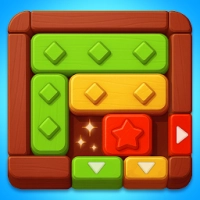


Latest Version
May 12, 2025
MeeGame Studio
Puzzle
Android
0
com.wood.blockjam.color.slidepuzzle
Report a Problem
More About :game
The goal is to clear the entire board while using smart movements rather than blindly sliding blocks around. Every level gives you a new arrangement to study, making Wood Block Jam a good choice for players who enjoy logic puzzles, brain teasers, and relaxing games that gradually become more challenging.
According to its Google Play listing, the game includes hundreds of unique levels and special mechanics such as arrow blocks, layer blocks, freeze blocks, and lock blocks.
What Is Wood Block Jam?
Wood Block Jam is a color-matching block puzzle where you must move pieces through a board and send them to their corresponding exits. The challenge comes from deciding which block should move first.
A block that looks ready to leave may actually be blocking another piece. Likewise, moving the wrong piece too early can reduce your available space and make the puzzle much harder.
The game combines:
- Color-matching puzzles
- Sliding block mechanics
- Logic and spatial reasoning
- Obstacles and special blocks
- Increasingly complicated layouts
- Short, satisfying puzzle sessions
- Hundreds of puzzle challenges
The Google Play listing describes the game as easy to learn but increasingly challenging as new mechanics appear.
How to Play Wood Block Jam
The basic controls are straightforward.
1. Study the Board
Before making your first move, look at the entire puzzle. Identify the color of every block, locate its matching exit, and check which pieces are blocking the available paths.
Don't immediately start swiping.
A few seconds of planning can prevent several unnecessary moves.
2. Match Each Block With Its Exit
Every colored block needs to reach the corresponding destination.
Look at the distance between a block and its exit, then determine whether another piece must be moved first.
3. Create Space
Some blocks cannot reach their destinations immediately because another block is occupying the required path.
Move the blocking piece only when you know where it should go.
4. Watch the Obstacles
Later puzzles introduce additional mechanics that can change how you approach the board.
Arrow blocks, layer blocks, freeze blocks, and lock blocks can affect movement and the order in which pieces should be cleared.
5. Clear the Entire Board
The level is completed when all required blocks have been successfully moved to their matching destinations.
Wood Block Jam Strategy Guide
The biggest mistake beginners make is treating every move independently.
Instead, think of each puzzle as a sequence.
Plan Several Moves Ahead
Before moving a block, ask:
"What will this move allow me to do next?"
A good move should either clear a path, open space, or prepare another block for its exit.
If a move does none of those things, it may be unnecessary.
Start With the Most Restricted Blocks
Some blocks have very limited movement because of surrounding pieces or obstacles.
These are often more important than blocks that have plenty of open space.
Look for pieces that have:
- Only one practical route
- A blocked exit
- Several neighboring obstacles
- A narrow path
- Another block directly behind them
Solving these restrictions early can make the rest of the board much easier.
Don't Always Move the Closest Block First
A block being close to its exit does not necessarily mean it should be moved first.
Sometimes a nearby block is blocking the route of another piece. In that situation, moving the "easy" block first can actually create a more complicated position.
Think about the whole board rather than one color at a time.
Use Empty Space Carefully
Open areas are extremely valuable.
Don't fill a useful empty space with a block unless doing so helps the puzzle progress.
Before every move, consider where the block will end up and whether that position will interfere with another route.
Identify the Chain Reaction
Some puzzles can be solved through a sequence such as:
Move Block A → Open Path B → Move Block B → Free Block C → Clear the Exit
When you recognize this pattern, the solution becomes much more predictable.
Be Careful With Special Blocks
Special mechanics are designed to make the puzzles more interesting.
When you encounter an arrow, freeze, lock, or layered block, don't treat it like an ordinary piece.
First determine what restriction it creates and whether another block needs to be moved before interacting with it.
Tips for Difficult Wood Block Jam Levels
Tip 1: Pause Before the First Move
Hard levels are usually easier when you spend time studying them first.
Look for the most constrained route instead of immediately experimenting.
Tip 2: Work Backward From the Exit
If you don't know where to start, choose one exit and work backward.
Ask:
- Which block needs this exit?
- What is blocking that block?
- Where must the blocking piece move?
- What needs to happen before that?
This backward approach can reveal the correct order.
Tip 3: Avoid Random Swiping
Random movements may appear useful early in a level, but they can quickly create a crowded board.
Make purposeful moves.
Tip 4: Keep Important Routes Open
If a particular corridor appears to be the only route for a block, avoid filling it unnecessarily.
Tip 5: Solve the Bottleneck
Every difficult puzzle usually has one or more bottlenecks.
A bottleneck might be:
- A narrow passage
- A blocked exit
- A locked area
- A frozen block
- A layered obstacle
- Several blocks competing for the same space
Find that bottleneck first.
Tip 6: Think About Order, Not Speed
Fast swiping is not the key to solving a difficult puzzle.
The correct sequence is more important than making moves quickly.
Tip 7: Learn From Failed Attempts
If a move creates a dead end, don't simply restart without thinking.
Identify why it failed.
Was the wrong block moved first? Did you occupy an important space? Did you block another exit?
Understanding the mistake makes similar puzzles easier later.
Wood Block Jam Special Blocks
As the puzzles become more complicated, special mechanics add additional layers of strategy.
Arrow Blocks
Arrow blocks can introduce directional restrictions or influence how you approach a particular route.
Before moving one, examine the direction involved and make sure the resulting position does not block another important path.
Layer Blocks
Layer mechanics can require you to think beyond the visible position of a block.
Look carefully at what must be cleared or moved before the underlying route becomes available.
Freeze Blocks
Frozen pieces can restrict movement until the relevant condition is resolved.
Instead of repeatedly trying to move them, look for the action that allows the board to progress.
Lock Blocks
Locked pieces add another obstacle to the puzzle.
When you see a locked area, identify the requirement for opening or clearing it before spending moves elsewhere.
These mechanics are specifically listed among the game's later puzzle elements on Google Play.
Best Way to Approach a New Level
Use this simple routine:
1. Scan the board
Find all colors, exits, obstacles, and special blocks.
2. Find the restricted pieces
Identify blocks with the fewest available routes.
3. Check the exits
Determine which exits are immediately accessible and which require preparation.
4. Find the bottleneck
Look for the single position that prevents several other moves.
5. Plan the sequence
Decide which block must move first, second, and third.
6. Preserve open space
Don't unnecessarily occupy useful areas.
7. Execute carefully
Make each move with the next one already in mind.
Common Mistakes in Wood Block Jam
Moving Every Block That Can Move
Just because a block can move doesn't mean it should move.
A legal move can still be strategically bad.
Blocking an Exit
Moving one block into the wrong location can make another color impossible to reach its destination.
Always consider the next route.
Ignoring the Whole Board
Focusing on a single color can cause you to miss a blockage elsewhere.
Look at the complete puzzle before committing to a sequence.
Using Trial and Error Too Much
Experimentation can help, but difficult levels are usually easier when you understand the board first.
Forgetting Special Mechanics
A puzzle may look like a normal sliding challenge until a special block changes the available options.
Pay attention to every unusual piece.
Wood Block Jam Beginner Strategy
If you're just starting, don't worry about solving every puzzle perfectly.
Concentrate on learning three things:
Space: Where can each block move?
Order: Which block needs to move first?
Access: What must be cleared before another block can reach its exit?
Once these three ideas become natural, more complicated boards become much easier to read.
Wood Block Jam Advanced Strategy
For advanced players, try to minimize unnecessary movements by planning the entire solution before starting.
Look for dependencies between blocks.
For example, if Block A cannot reach its exit until Block B moves, and Block B cannot move until Block C is cleared, then the real solution begins with Block C.
This creates a hierarchy:
C → B → A
Thinking this way is especially useful on crowded levels with multiple obstacles.
Is Wood Block Jam Difficult?
Wood Block Jam starts with an accessible sliding puzzle concept, but the challenge increases as the board layouts become more complicated and additional mechanics appear.
The game is therefore suitable for players who enjoy both relaxing puzzle sessions and more demanding logic challenges.
Google Play currently lists the game in the Puzzle category, with an Everyone content rating.
Is Wood Block Jam Good for Short Play Sessions?
Yes. The core gameplay is based around solving individual puzzles, so it works well when you want to play for a few minutes or continue through multiple levels.
The simple swipe-based controls also make it easy to understand without a lengthy tutorial.
Wood Block Jam Features
- Color-matching block puzzles
- Sliding gameplay
- Hundreds of levels
- Increasing puzzle difficulty
- Arrow blocks
- Layer blocks
- Freeze blocks
- Lock blocks
- Obstacles and blocked routes
- Bright, colorful visuals
- Smooth puzzle interactions
- Single-player puzzle gameplay
The official Google Play listing confirms the game's core sliding, matching, obstacle, and special-block mechanics.
Wood Block Jam Game Information
Game: Wood Block Jam
Developer: MeeGame Studio
Genre: Puzzle
Platform: Android
Content Rating: Everyone
Monetization: Ads and in-app purchases
Google Play Rating: 4.6 stars at the time of checking
Downloads: 1M+ on Google Play
Gameplay: Single-player sliding block puzzles
The rating and download figures can change over time as more players review and install the game.
Wood Block Jam Pros and Cons
Pros
- Simple controls
- Easy-to-understand core objective
- Increasingly challenging puzzles
- Color-based gameplay
- Several special block mechanics
- Suitable for short puzzle sessions
- Plenty of levels to work through
Cons
- Some later puzzles can require significant planning
- Special mechanics can make certain boards considerably more complicated
- The game contains advertisements and optional in-app purchases
Frequently Asked Questions
What is Wood Block Jam?
Wood Block Jam is a color-matching sliding puzzle game where players move blocks across a board and guide them toward their matching exits.
How do you play Wood Block Jam?
Swipe and slide blocks around the board, match each colored block with its corresponding exit, avoid obstacles, and clear the entire puzzle.
Is Wood Block Jam easy to play?
The basic controls are simple, but the puzzles become more challenging as additional mechanics and more complicated layouts are introduced.
Does Wood Block Jam have special blocks?
Yes. The Google Play description mentions arrow blocks, layer blocks, freeze blocks, and lock blocks among the game's special mechanics.
How can I solve difficult Wood Block Jam levels?
Start by studying the entire board, identify restricted blocks and bottlenecks, then determine the correct order for clearing paths. Avoid moving pieces randomly.
What is the best strategy for Wood Block Jam?
The most useful approach is to think several moves ahead. Protect open spaces, identify blocked routes, and solve the most restrictive part of the puzzle before making unnecessary moves.
Is Wood Block Jam suitable for beginners?
Yes. The basic sliding and color-matching concept is straightforward, while the later mechanics provide additional challenges for experienced puzzle players.
Final Thoughts
Wood Block Jam takes a straightforward color-matching idea and turns it into a progressively more demanding logic puzzle. The controls are simple, but solving crowded boards requires patience, spatial awareness, and good timing.
The most important lesson is to plan before you slide. Look for restricted blocks, preserve useful space, identify bottlenecks, and think about the order in which pieces need to move. Once you start viewing each puzzle as a sequence rather than a collection of individual blocks, difficult levels become much easier to understand.
For players who enjoy block puzzles, color matching games, sliding puzzles, brain games, logic challenges, and relaxing puzzle games, Wood Block Jam offers a straightforward but increasingly challenging experience.
Rate the Game
User Reviews








Popular Games



















 Android
 iOS
 Windows
 Xbox