
Latest Version
November 17, 2026
Oakever Games
Puzzle
iOS
0
Report a Problem
More About :game
Game Overview and Introduction
Twindoku is a logic-based mobile puzzle game developed by Oakever Games. It combines the familiar appeal of number-free Sudoku-style puzzles with the strategic mechanics of binary logic games such as Takuzu, Binairo, and Binoxxo.
Instead of filling a grid with numbers, players use two symbols: a sun and a moon. The objective is to place these symbols in the correct empty cells while satisfying every rule displayed for the current level.
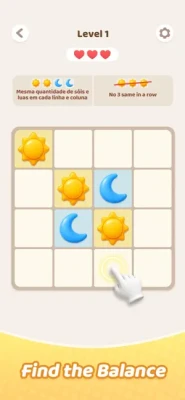
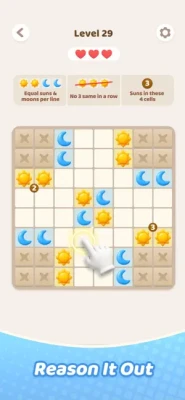
Although the concept sounds simple, solving each puzzle requires concentration, careful observation, and logical thinking. Every row and column must maintain a balanced number of suns and moons, and players must avoid placing three identical symbols consecutively.
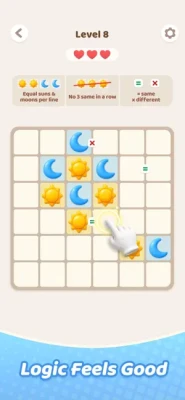
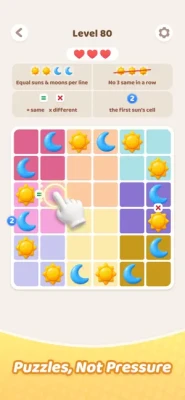
As the game progresses, additional rules introduce more complicated challenges. Some neighboring cells must contain matching symbols, while others must contain opposite symbols. Colored regions, blocked cells, edge numbers, and junction clues add further layers of difficulty.
One of Twindoku's most appealing features is that every puzzle has exactly one valid solution. The game is designed so that players can always find at least one logically provable move instead of relying on random guesses.
The built-in hint system also explains why a particular symbol belongs in a specific cell, helping players understand the reasoning behind each solution.
Whether you enjoy Sudoku, binary puzzles, brain teasers, or relaxing logic games, Twindoku provides an engaging experience that rewards patience and intelligent decision-making.
Specific Game Features and All Important Information
Two-Symbol Puzzle System
The central mechanic revolves around two symbols: suns and moons. Every empty cell must receive one of these symbols while following the rules displayed above the puzzle board.
This simple concept creates a wide range of interesting logical challenges.
Balanced Rows and Columns
Every row and column must contain an equal number of suns and moons.
For example:
A 6×6 grid requires three suns and three moons in every row and column.
An 8×8 grid requires four suns and four moons in every row and column.
Players must constantly monitor the remaining spaces to ensure that every line reaches the correct balance.
No Three Identical Symbols in a Row
Another important rule prevents three identical symbols from appearing consecutively.
You cannot place three suns or three moons directly next to each other horizontally or vertically.
Diagonal combinations do not count, so players only need to check horizontal and vertical sequences.
Matching and Opposite Symbols
Some puzzles introduce special markers between neighboring cells.
An equal marker means that both connected cells must contain the same symbol. A cross marker means that the connected cells must contain opposite symbols.
These relationships help players determine the correct values of multiple cells.
Colored Regions
Certain levels contain colored areas that introduce additional balancing requirements.
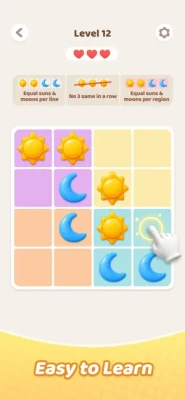
Each colored region must contain an equal number of suns and moons. This means players must consider not only individual rows and columns but also the composition of each highlighted area.
Blocked Cells
Some boards contain cells that cannot be filled.
These blocked spaces do not count toward the balance of their rows or columns. They also interrupt consecutive-symbol sequences, which changes how players interpret the no-three-in-a-row rule.
Edge Numbers
Edge numbers provide information about the first sun appearing in a particular row or column.
These clues help narrow down possible symbol arrangements and can determine several cells when combined with other rules.
Junction Numbers
Junction numbers indicate how many suns must appear within the surrounding 2×2 group of cells.
For example, a junction marked 0 means that none of the four surrounding cells can contain a sun. A junction marked 4 means that all four must contain suns.
These clues can solve several connected cells at once.
Unusual Board Shapes
Twindoku does not restrict players to traditional square grids.
Some puzzles feature unusual outlines, including:
Diamonds
Wide crosses
Hearts
Bow ties
Octagons
Window frames
Cells outside the board's outline are simply background. They cannot be selected and do not contribute to any puzzle rule.
Helpful Hint System
The hint system is particularly useful when a puzzle becomes difficult.
Rather than randomly revealing an answer, the hint tool identifies a cell that can be solved logically and explains which rule proves the correct symbol.
Players can review the explanation and apply the suggested move. This makes hints useful for learning new solving techniques.
Three-Heart Mistake System
Each level provides three hearts. Placing an incorrect symbol costs one heart, and the game identifies the rule that was violated.
If all hearts are lost, players can revive with their previous move undone or restart the level.
This system encourages careful decisions while allowing players to learn from mistakes.
Simple Controls and Accessible Gameplay
Playing Twindoku requires only a few taps.
Tap an empty cell to open its symbol picker, then select a sun or moon. Tap again to switch the selection when necessary.
The straightforward interface allows beginners to concentrate on the logic instead of learning complicated controls.
Complete Strategy Guide for Twindoku
Understand the Basic Rules First
Before attempting difficult puzzles, become comfortable with the two fundamental rules: balanced rows and columns, and the prohibition against three identical symbols appearing consecutively.
These rules form the foundation of almost every puzzle.
Always check both horizontal and vertical lines before selecting a symbol.
For example, if a row already contains two suns and two moons on a 6×6 board, the remaining two cells must contain one sun and one moon.
If the no-three rule eliminates one possible arrangement, the remaining arrangement becomes certain.
Start With Pre-Filled Cells
Every puzzle provides some pre-filled symbols that serve as starting clues.
Examine these cells before making your first move.
Look for rows or columns that already contain several identical symbols, as well as lines that are close to reaching their maximum number of suns or moons.
Pre-filled cells often create opportunities to determine nearby empty positions immediately.
Use the No-Three Rule to Find Certain Moves
This is one of the most useful techniques in Twindoku.
Whenever two identical symbols appear next to each other, the third consecutive cell cannot contain that same symbol.
For example, if two neighboring cells contain suns, the next cell in that sequence must contain a moon.
The same principle applies when two identical symbols have one empty cell between them. Filling that gap with the same symbol would create three consecutive identical symbols, so the empty cell must contain the opposite symbol.
Check both horizontal and vertical sequences frequently.
Use Balance to Complete Nearly Full Rows
Rows and columns become easier to solve when only one or two cells remain empty.
On a 6×6 board, if a row already contains three suns and two moons, the last empty cell must be a moon.
The same technique applies to columns.
Make it a habit to count symbols whenever a line approaches completion. These simple deductions can unlock several additional moves.
Combine Balance and Sequence Rules
The strongest basic strategy is to use both fundamental rules together.
Sometimes balance alone does not determine an empty cell. However, combining the balance requirement with the no-three rule may leave only one possible option.
Imagine that a row needs one more sun and one more moon. If placing a sun in the first empty position would create three consecutive suns, that position must contain a moon.
The remaining position must then contain a sun.
This is the foundation of efficient binary puzzle solving.
Follow Equal and Cross Markers
When special relationship markers appear, use them to transfer information between neighboring cells.
If two connected cells must match, determining one cell automatically determines the other.
If they must be opposite, a sun in one cell means the neighboring cell must contain a moon.
These relationships are particularly useful when one cell belongs to a nearly completed row and the other belongs to a different column.
A deduction in one part of the board can therefore unlock another area.
Solve Colored Regions Separately
Colored regions introduce additional balancing conditions.
Treat each region as a smaller puzzle within the larger grid.
Count the suns and moons already placed inside the region, then calculate what the remaining cells must contain.
For example, if a region has six usable cells, it needs three suns and three moons.
When only one or two cells remain, the correct symbols may become obvious.
Always remember that a cell can belong to a row, a column, and a colored region simultaneously. A move must satisfy all applicable rules.
Master Blocked Cells
Blocked cells require players to pay attention to the actual structure of the board.
They cannot contain symbols and are excluded from row and column balance calculations.
They also break consecutive sequences.
For example, two suns separated by a blocked cell do not form a three-symbol sequence, even if another sun appears on the opposite side.
Do not treat blocked spaces as ordinary empty cells. Understanding their special role prevents unnecessary mistakes.
Use Edge Numbers to Determine Symbol Positions
Edge clues provide useful information about where the first sun appears in a particular row or column.
Read these numbers carefully and identify the possible positions of the first sun.
Then combine that information with the balance and no-three rules.
Sometimes an edge clue will eliminate several possible arrangements immediately.
Understand Junction Numbers
Junction clues are especially powerful because they can determine four cells simultaneously.
A junction marked 0 means all four surrounding cells must be moons.
A junction marked 4 means all four must be suns.
For numbers 1, 2, and 3, players must determine the correct combination while checking the surrounding rows, columns, and other special rules.
Always revisit junction clues after solving nearby cells because new information may make their remaining possibilities much easier to understand.
Approach Irregular Boards Carefully
Unusual board shapes can initially appear confusing because some rows and columns contain fewer usable cells than others.
Start by identifying the actual playable cells.
Ignore the background outside the board outline and count only the spaces that belong to the puzzle.
Then apply the usual balancing rules to the relevant rows and columns, taking blocked cells into account.
Pay particular attention to corners and narrow sections because they often provide useful deductions.
Work From the Most Restrictive Clues
When several possible moves are available, prioritize the clues that leave the fewest possibilities.
A nearly complete row, a junction marked 0 or 4, or a colored region with only one empty cell can provide an immediate deduction.
Solving these restrictive areas first often reveals information that helps with less obvious parts of the board.
This approach is much more efficient than randomly selecting empty cells.
Use Hints as Learning Opportunities
The hint system is more valuable when you focus on its explanation rather than simply applying the suggested answer.
When a hint identifies a cell, read which rule proves the symbol is correct.
Try to understand the relationship between that cell and the surrounding symbols.
Over time, you will begin recognizing similar patterns independently, reducing your dependence on hints.
Protect Your Three Hearts
Mistakes are part of learning, but losing all three hearts can interrupt your progress.
Before selecting a symbol, check whether it satisfies every relevant condition.
If you are uncertain, inspect the connected row, column, colored region, and special markers.
Avoid making assumptions based on only one rule.
When a mistake occurs, pay attention to the rule identified by the game. Understanding the error is more useful than simply changing the symbol.
Recheck the Entire Board After Every Important Deduction
A single correct symbol can influence several other cells.
For example, completing a row may determine the balance of a column. That column might then reveal a forced symbol in a colored region.
After each important move, scan the surrounding area again.
This creates a chain of logical deductions that gradually reveals the entire solution.
Advanced Tips and Tricks to Become a Better Twindoku Player
Think in Possibilities, Not Guesses
When a cell is unclear, consider both possibilities: sun or moon. Then check which option would violate an existing rule. If one possibility creates an impossible arrangement, the other must be correct.
Look for Forced Moves
A forced move is a cell that can only contain one valid symbol. These are the most valuable opportunities in Twindoku because they allow you to make progress without guessing.
Check Intersections Between Rows and Columns
A cell belongs to both a horizontal row and a vertical column. Information from either direction can determine its correct symbol.
Use Small Groups to Simplify Large Puzzles
Concentrate on a few connected cells rather than trying to solve the entire board simultaneously. Small deductions often reveal larger patterns.
Remember the Balance Requirement
Keep track of the remaining suns and moons in every row and column. When one symbol reaches its required maximum, all remaining playable cells in that line must contain the opposite symbol.
Combine Multiple Special Rules
The most challenging puzzles require several rules to work together. A cell might be influenced by a colored region, an equal marker, and a column balance requirement. Look for opportunities where different clues support the same conclusion.
Avoid Unnecessary Changes
When you discover a logically certain symbol, keep that deduction in mind while solving the rest of the board. Constantly reconsidering already established information wastes time.
Learn From Every Completed Puzzle
After finishing a level, think about which deductions helped you progress. Recognizing recurring patterns will make future challenges easier.
Common Mistakes to Avoid
Ignoring Vertical Sequences
Players sometimes concentrate on horizontal rows and forget that the no-three rule also applies vertically. Always check both directions.
Miscounting Suns and Moons
A single counting error can create problems throughout the board. Recount symbols whenever a row or column becomes nearly complete.
Forgetting Colored Regions
A row can be balanced while its colored region remains incorrect. Every applicable rule must be satisfied.
Treating Blocked Cells as Empty Spaces
Blocked cells cannot receive symbols and are excluded from relevant calculations. Remember that they also interrupt consecutive sequences.
Overlooking Special Markers
Equal and cross markers create relationships between neighboring cells. Ignoring them can cause players to miss easy deductions.
Using Hints Without Understanding Them
Hints are designed to explain logical solutions. Simply applying them without learning the reasoning limits their educational value.
Rushing Through Difficult Levels
Twindoku rewards careful thinking. Taking a moment to inspect the board is often more effective than making several uncertain moves.
How to Improve Your Logical Thinking With Twindoku
Twindoku offers an enjoyable way to practice several important mental skills.
Pattern Recognition
Repeatedly identifying pairs, sequences, and symbol arrangements helps players recognize familiar patterns more quickly.
Logical Deduction
The game encourages players to evaluate possibilities, eliminate incorrect options, and identify conclusions supported by the available clues.
Spatial Awareness
Irregular board shapes require players to understand how different cells are positioned and connected.
Concentration
Keeping track of multiple rules simultaneously encourages sustained attention and careful observation.
Problem-Solving Skills
More complicated puzzles require players to combine several deductions into a complete solution.
The best way to improve is to play consistently, understand the reasoning behind each move, and gradually tackle more complicated levels.
Is Twindoku Worth Playing?
Twindoku is an appealing choice for anyone who enjoys logic puzzles and brain-training games.
Its two-symbol system makes the gameplay easy to understand, while the additional rules provide enough variety to keep experienced puzzle enthusiasts interested.
Unlike traditional number-based puzzles, it uses suns and moons to create a different style of logical challenge. The combination of balanced rows, consecutive-symbol restrictions, special markers, and unusual board shapes provides plenty of opportunities to think creatively.
The guaranteed single solution is another important advantage. Players can approach every level with confidence that the answer can be discovered through logical deductions.
The hint system also makes the game suitable for beginners because it explains the reasoning behind correct moves instead of simply revealing answers.
Overall, Twindoku is a worthwhile option for players who want a relaxing but mentally engaging mobile puzzle game.
Frequently Asked Questions
What is Twindoku?
Twindoku is a binary logic puzzle game developed by Oakever Games. Players fill empty grid cells with suns and moons while following different logical rules to complete each puzzle.
How do you play Twindoku?
Tap an empty cell, select a sun or moon, and continue filling the board until every cell satisfies the displayed rules. You must balance symbols across rows and columns and avoid three identical symbols appearing consecutively.
Is Twindoku similar to Sudoku?
Yes, Twindoku shares Sudoku's logical problem-solving approach, but instead of numbers, it uses two symbols. Its mechanics are also closely related to Takuzu, Binairo, and Binoxxo.
What are the main rules in Twindoku?
The two basic rules require equal numbers of suns and moons in every row and column, and prohibit three identical symbols appearing consecutively horizontally or vertically.
Can you solve Twindoku without guessing?
Yes. Every level is designed with exactly one valid solution and at least one logically provable move available at every stage of the solving process.
What do the equal and cross markers mean?
An equal marker means two neighboring cells must contain identical symbols. A cross marker means they must contain opposite symbols.
What are colored regions used for?
Colored regions introduce additional balancing rules. Each region must contain equal numbers of suns and moons.
What do blocked cells do?
Blocked cells cannot be filled and do not count toward row or column balance. They also interrupt consecutive-symbol sequences.
What do junction numbers mean?
Junction numbers indicate how many suns must appear in the surrounding 2×2 group of cells. A 0 requires four moons, while a 4 requires four suns.
How does the hint system work?
The hint system identifies a cell that can be solved through logical deduction, highlights it, and explains which rule proves the correct answer. Players can then apply the suggested move.
How many mistakes can you make in Twindoku?
Each level provides three hearts. Every incorrect symbol costs one heart. Players can revive after losing all hearts with their last move undone or restart the puzzle.
Does Twindoku have different puzzle shapes?
Yes. In addition to traditional grids, the game features diamonds, crosses, hearts, bow ties, octagons, and window-frame shapes.
Is Twindoku suitable for beginners?
Yes. Its simple controls and clearly displayed rules make it accessible to beginners. The progressive introduction of additional mechanics provides more advanced challenges as players improve.
Who developed Twindoku?
Twindoku was developed by Oakever Games and is available for iPhone and iPad. The App Store listing requires iOS 15.0 or later for iPhone compatibility.
Final Verdict
Twindoku brings a refreshing approach to mobile logic puzzles by replacing traditional numbers with two simple symbols: suns and moons. What begins as an easy-to-understand grid challenge gradually becomes a deeper test of observation, logical reasoning, and pattern recognition.
Its variety of rules, unusual board shapes, special markers, and helpful explanations make each level an opportunity to develop better puzzle-solving techniques.
The ability to solve every challenge through logical deductions rather than guessing gives the game a particularly satisfying feeling of progression.
Whether you are a fan of Sudoku, Takuzu, Binairo, or other brain-training games, Twindoku is an enjoyable puzzle experience worth exploring.
Rate the Game
User Reviews






Popular Games



















 Android
 iOS
 Windows
 Xbox