

Latest Version
November 17, 2026
Pine Games
Puzzle
iOS
0
Report a Problem
More About :game
Official Game Title: Number Paint: Sudoku Twist
Developer: Pine Games
Publisher: Pine Games Teknoloji Anonim Sirketi
Category: Casual, Puzzle, Brain Training
Platform: iOS
Supported Devices: iPhone and iPad
Game Mode: Single-player puzzle experience
Price: Free to download with optional in-app purchases
Age Rating: 4+
Main Gameplay: Sudoku-inspired number puzzles combined with arithmetic cage challenges.
Core Mechanics: Number placement, mathematical calculations, logical deduction, and puzzle completion.
Main Objective: Solve number grids and gradually complete beautiful pixel-art paintings.
Main Features: 1,000 handcrafted levels, 51 paintings, daily challenges, 365 collectible daily pictures, notes mode, hints, rewards, and streak chests.
Languages: 34 supported languages.
System Requirements: iOS 17.0 or later.
All About Number Paint: Sudoku Twist
Number Paint: Sudoku Twist introduces an enjoyable variation of traditional Sudoku by combining number-placement rules with mathematical challenges and creative artwork. Instead of simply completing a standard Sudoku board, players must solve interconnected number puzzles while discovering the mathematical relationships hidden inside each grid.
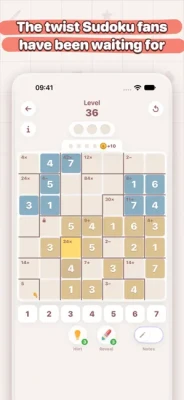
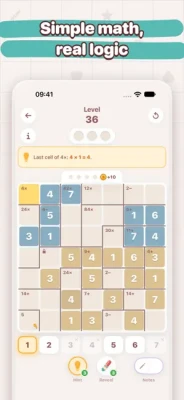
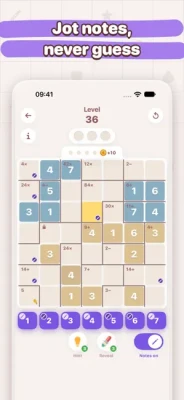
The main objective is to fill every row and column with the correct numbers. However, the game introduces an additional layer of difficulty through special groups of cells called cages. Each cage contains a mathematical target that must be reached using addition, subtraction, multiplication, or division.
This combination creates a puzzle experience that rewards both mathematical understanding and logical reasoning. You do not need advanced mathematics to enjoy the game because the calculations are simple. The real challenge comes from identifying the correct number combinations and understanding how each cell fits into the larger grid.
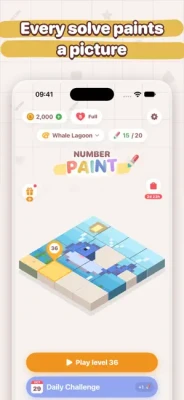
One of the most appealing features of Number Paint: Sudoku Twist is its connection between puzzle-solving and artwork. Every completed board contributes to a larger pixel-art painting. As you finish individual levels, the artwork gradually becomes visible, giving you a satisfying visual reward for your progress.
The game includes 1,000 handcrafted levels distributed across 51 paintings. These collections feature different charming themes, including cottages, whales, castles, rockets, and owls.
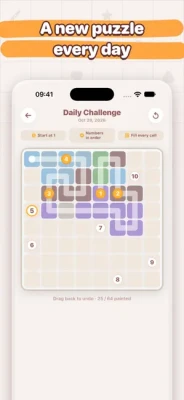
Daily challenges provide another reason to return. Each day introduces a fresh puzzle and an opportunity to collect additional artwork. Across the daily challenge collection, players can discover 365 pictures.
The experience is designed to be accessible to beginners while offering enough complexity to keep experienced number-puzzle fans interested. Early levels introduce the basic mechanics gradually, while later challenges require more careful planning and consideration.
Number Paint also includes a notes mode that allows players to record possible numbers in individual cells. This feature is particularly useful when several options remain possible and you need to compare different combinations before making a decision.
Hints and Reveal options provide assistance when a puzzle becomes difficult. However, the game encourages players to solve challenges through reasoning rather than guessing.
Relaxing sounds, music, and haptic feedback contribute to the overall atmosphere. Players can also adjust these effects according to their preferences.
Whether you enjoy classic Sudoku, mathematical brain teasers, or relaxing coloring games, Number Paint: Sudoku Twist combines these elements into one entertaining puzzle adventure.
Main Features of Number Paint: Sudoku Twist
Sudoku-Inspired Number Puzzles
The foundation of the gameplay is based on placing numbers correctly in each row and column. Every number must appear exactly once in its respective row and column.
Mathematical Cage Challenges
Special groups of cells contain numerical targets. Players must use the indicated mathematical operation to make the numbers inside each cage produce the required result.
1,000 Handcrafted Levels
The game offers a large collection of carefully designed puzzles, providing plenty of opportunities to improve your problem-solving abilities.
51 Beautiful Pixel-Art Paintings
Every completed level contributes to a larger artwork. Completing all the associated puzzle pieces gradually reveals an entire picture.
Daily Challenges
Fresh daily puzzles offer additional opportunities to test your skills and collect new artwork.
365 Daily Pictures
The daily challenge collection gives players a long-term reason to return and continue solving puzzles.
Notes Mode
Players can write down possible numbers in empty cells without receiving a penalty. This makes complicated grids easier to manage.
Hints and Reveal Assistance
Helpful tools provide support when you encounter a particularly difficult puzzle.
Locked Clues and Combos
Additional mechanics introduce variety and require players to pay attention to more than just basic number placement.
Perfect-Level Bonuses
Completing levels successfully can provide additional rewards and encourage accurate puzzle-solving.
Daily Rewards and Streak Chests
Regular participation offers opportunities to collect rewards and maintain progress.
Relaxing Audio and Haptic Effects
Music, sound effects, and optional vibrations create a comfortable atmosphere while solving puzzles.
Simple and Accessible Mathematics
The game focuses on straightforward calculations rather than complicated mathematical formulas. Logical thinking is the most important skill.
Full Strategy Guide for Number Paint: Sudoku Twist
Understanding the Main Objective
Before attempting advanced puzzles, it is important to understand the two fundamental rules of Number Paint.
The first rule involves traditional Sudoku-style number placement. Every row and every column must contain each permitted number exactly once.
The second rule involves mathematical cages. Each cage has a target value and an operation that determines how its cells must combine.
You must satisfy both conditions simultaneously.
A number may appear mathematically correct for a particular cage but still be invalid because it duplicates another number in the same row or column.
Successful puzzle-solving requires balancing these two rules throughout the entire investigation.
Learn the Basic Number Placement Rules
Start by examining the grid and identifying the available numbers.
Look across every row and down every column before entering a number.
If a particular number already appears in a row, you cannot use it again in that same row. The same restriction applies to columns.
This simple rule eliminates many incorrect possibilities.
For example, if a grid uses numbers from 1 to 4 and a particular row already contains 1, 2, and 4, the missing number must be 3.
Learning to recognize these obvious situations will help you complete easier sections quickly.
Understand Mathematical Cages
Mathematical cages are what make Number Paint different from traditional Sudoku.
Each cage contains a target number and an arithmetic operation. Your task is to select numbers that satisfy the displayed condition.
The four main operations are:
Addition (+)
The numbers inside the cage must add up to the target.
For example, if a cage has a target of 7, possible combinations might include 3 and 4 or 1, 2, and 4, depending on the available grid rules.
Subtraction (−)
The difference between the relevant numbers must equal the target.
For example, 5 and 2 produce a difference of 3.
Multiplication (×)
Multiply the numbers inside the cage to reach the target.
For example, 2 multiplied by 3 produces 6.
Division (÷)
Divide the relevant numbers to produce the target.
For example, 8 divided by 2 produces 4.
Always consider the number-placement restrictions when evaluating these combinations. A mathematically correct combination may still be impossible if it violates a row or column rule.
Begin with the Easiest Cages
One of the most effective strategies is to avoid starting with the most complicated part of the grid.
Instead, examine cages with only one cell or very limited possible combinations.
A single-cell cage is especially useful because its target directly determines the number that belongs in that position.
Once you identify these values, check their corresponding rows and columns.
Every confirmed number reduces the possibilities for neighboring cells and may help solve other cages.
This creates a chain reaction in which one easy answer makes several additional answers possible.
Prioritize Small Mathematical Combinations
Some cages are much easier to solve than others.
For example, a multiplication cage with a target of 2 has very limited possibilities when using positive integers. Similarly, a division cage with a target of 1 requires equal values mathematically, although row and column restrictions may rule out such combinations.
Look for targets that have only a few possible number combinations.
Solving these cages first can significantly reduce the complexity of the remaining grid.
Do not spend too much time analyzing a large cage when several smaller cages are easier to complete.
Use Rows and Columns to Eliminate Possibilities
The most important technique in Number Paint is combining arithmetic information with Sudoku restrictions.
Suppose a cage could contain either 2 and 4 or 1 and 5 according to its mathematical target.
Instead of guessing, inspect the corresponding rows and columns.
If one of the possible numbers already exists in a relevant row or column, that combination may be eliminated.
Continue checking the remaining possibilities until only a valid arrangement remains.
This process is called logical elimination, and it becomes increasingly important in advanced levels.
Master Addition Cages
Addition cages are often among the easiest mathematical challenges to understand.
Begin by identifying the target and counting the number of cells in the cage.
Then consider which available numbers could produce the required total.
For example, a three-cell cage with a target of 6 could potentially contain 1, 2, and 3.
However, you must still check whether these values can occupy the relevant positions without creating duplicates in any row or column.
A useful technique is to calculate the minimum and maximum possible totals before considering individual combinations.
If the target is very close to the minimum possible total, the cage probably requires smaller numbers. If it is closer to the maximum, larger numbers become more likely.
Master Subtraction Cages
Subtraction cages can become confusing because the order of the numbers matters when performing subtraction.
Start by identifying the target difference and listing the available number pairs that can produce it.
For example, a difference of 2 could come from 3 and 1 or 4 and 2.
Next, examine the row and column restrictions to determine which pair can actually fit.
Avoid choosing a combination based only on arithmetic. The grid must also remain consistent.
Master Multiplication Cages
Multiplication cages are easier when you understand the possible factors of the target.
For example, a target of 12 could be produced by:
2 × 6
3 × 4
1 × 3 × 4
The actual possibilities depend on the numbers permitted in the grid and the number of cells in the cage.
Factorization is particularly helpful because it quickly removes combinations that cannot reach the target.
If the target is a prime number, the available combinations are generally more restricted when using positive whole numbers.
Use this information to narrow down the possibilities before entering any numbers.
Master Division Cages
Division cages require special attention to the relationship between their numbers.
Start with the target result and identify number pairs that produce it.
For example, a target of 2 could be produced by 4 divided by 2 or 6 divided by 3.
Check whether the numbers are allowed in the corresponding rows and columns.
Division cages are often easier to solve when you already know the possible values of one of their cells.
Use previously confirmed numbers to eliminate combinations and avoid unnecessary calculations.
Use Notes Mode Effectively
Notes mode is one of the most useful features for complicated levels.
When you are unsure about a cell, record the possible numbers instead of immediately committing to one answer.
For example, an empty cell might initially allow 2, 3, or 4.
After solving another cage, you may discover that 2 is impossible. Remove that possibility and continue narrowing down the remaining options.
This approach helps you maintain a clear picture of the puzzle without relying on memory.
Notes are especially valuable when several cages overlap with the same rows and columns.
Solve the Grid from Multiple Directions
Do not restrict yourself to solving the puzzle from left to right or from top to bottom.
A useful clue might appear anywhere in the grid.
Examine individual cages, complete rows, and complete columns. Move between these areas whenever new information becomes available.
For example, solving a cage near the bottom of the board might reveal a number that makes an upper-row cage much easier.
The best approach is to follow the strongest available clues rather than a fixed direction.
Understand Locked Clues
Locked clues introduce another layer of complexity because they restrict how certain parts of the puzzle can be approached.
When you encounter these challenges, carefully examine which information is already available and which parts of the grid depend on solving another section.
Avoid treating locked information as an isolated problem.
Instead, solve the accessible cages and use their results to establish the conditions needed for the remaining sections.
Patience is particularly important when the puzzle introduces several interconnected restrictions.
Use Combos to Your Advantage
Combo mechanics add variety to the puzzle experience.
When these features appear, pay attention to how the relevant cells interact and how their mathematical conditions affect possible number placements.
Avoid focusing on a single cell without considering the surrounding group.
Understanding the relationship between connected clues can help you identify combinations more efficiently.
Preserve Your Three Attempts
Each level gives you three tries, and an incorrect number costs one attempt.
This makes accuracy especially important.
Before entering a number, check three things:
Does the number satisfy its cage's mathematical target?
Is the number allowed in its row?
Is the number allowed in its column?
If all three conditions are satisfied, you have a much stronger reason to make the selection.
Do not use attempts simply to test random possibilities.
The game is designed around logical deduction, so a careful solution is generally more effective than guessing.
How to Earn Perfect-Level Bonuses
Perfect-level bonuses reward accurate performance and encourage players to complete puzzles carefully.
The best way to improve your chances is to solve straightforward cages first, use notes when necessary, and verify each number before entering it.
Avoid unnecessary mistakes by checking all relevant conditions.
If you reach a difficult section, take your time rather than rushing to finish the board.
Consistent accuracy is more valuable than completing a puzzle a few seconds faster.
Complete Daily Challenges Regularly
Daily challenges are an important part of long-term progression.
They introduce fresh puzzles and provide opportunities to collect additional pictures.
Make them part of your regular playing routine.
Even when you do not have time for several regular levels, completing a daily puzzle gives you another opportunity to practice your skills.
Pay attention to your streak progress and available rewards.
Maintaining a consistent routine can help you build a larger collection of daily artwork.
Collect Paintings Efficiently
The artwork collection provides a visual goal beyond simply completing individual puzzles.
Each completed board contributes to a larger painting.
If you want to complete more artwork, focus on steady level progression rather than repeatedly playing the same easy puzzles.
Check your current painting progress and identify which levels remain unfinished.
Completing groups of related levels allows you to enjoy the gradual transformation of each picture.
The collection of 51 paintings provides a substantial long-term objective.
Manage Hints and Reveals Carefully
Hints and Reveal options are useful when you encounter a puzzle that seems impossible to solve.
However, it is better to attempt the logical solution first.
Start by checking single-cell cages, then examine restricted rows and columns. Use notes to record remaining possibilities.
If you still cannot find a valid move, consider using a hint.
Treat assistance as a learning opportunity. Try to understand why the suggested move works instead of simply copying it.
This will improve your ability to recognize similar patterns in future levels.
Make Daily Rewards Part of Your Routine
Daily rewards and streak chests provide additional progression incentives.
Check the available reward system whenever you open the game.
Collect rewards consistently and consider how you want to use any accumulated currency.
Avoid spending resources without understanding the available options.
A little planning can make it easier to access useful assistance and additional content later.
Best Strategy for Advanced Levels
As the difficulty increases, the number of possible combinations can become more difficult to manage.
For advanced puzzles, follow a structured method.
Start with single-cell cages and cages with very limited mathematical possibilities.
Next, complete rows and columns that already contain several confirmed numbers.
Use notes to record candidates in uncertain cells.
Compare arithmetic combinations with row and column restrictions.
Look for cells that appear in multiple useful relationships and use each confirmed value to eliminate other possibilities.
Finally, review the entire grid before submitting your remaining answers.
This method reduces unnecessary guessing and makes even complicated levels easier to approach.
Common Mistakes to Avoid
Ignoring Sudoku Rules
A number may satisfy a cage's mathematical target but still be invalid because it already appears in the same row or column.
Forgetting the Cage Operation
Always check whether the cage requires addition, subtraction, multiplication, or division.
Guessing Too Early
Random guesses waste attempts and can make the puzzle more confusing. Look for stronger clues first.
Ignoring Single-Cell Cages
These cages provide direct answers and should usually be among your first priorities.
Failing to Use Notes
Keeping several possible numbers in your memory becomes difficult on complicated boards. Use notes to stay organized.
Rushing Through the Puzzle
A quick but incorrect selection can cost an attempt. Verify every number before entering it.
Forgetting Previous Results
Every confirmed number can influence other cages. Revisit the grid after solving an important section.
Using Hints Before Trying Different Approaches
Examine the rows, columns, and arithmetic combinations before relying on assistance.
Advanced Tips to Become a Better Number Paint Player
Develop Strong Number Recognition
Learn to identify possible number combinations quickly. Understanding basic factors, sums, and differences makes mathematical cages easier to solve.
Think About the Entire Grid
Never consider a cage completely separate from the rest of the board. Its cells also influence their corresponding rows and columns.
Use Elimination Instead of Guessing
When several answers appear possible, remove combinations that violate the rules rather than randomly selecting one.
Start with the Most Restricted Cells
Cells with fewer possible values are generally easier to solve. Prioritizing them can reveal information about the rest of the grid.
Review Difficult Puzzles Carefully
If a level becomes frustrating, pause and examine the grid again. A fresh perspective may reveal a combination you previously overlooked.
Practice Daily
Regular challenges help you become more familiar with the puzzle mechanics and improve your ability to recognize useful patterns.
Enjoy the Artwork
Do not focus exclusively on completing levels as quickly as possible. The pixel-art collection is an important part of the experience, so enjoy watching each painting take shape.
Is Number Paint: Sudoku Twist Worth Playing?
Number Paint: Sudoku Twist is an excellent option for players who enjoy Sudoku, mathematical puzzles, and relaxing casual games.
Its biggest strength is the combination of traditional number-placement rules with arithmetic cages. This creates a different experience from ordinary Sudoku while keeping the basic mechanics accessible.
The pixel-art painting system also provides a meaningful reward for completing puzzles. Instead of simply moving from one level to another, players gradually build a collection of colorful artwork.
The 1,000 handcrafted levels offer plenty of content, while daily challenges and collectible pictures encourage regular participation.
Features such as notes mode, hints, and Reveal assistance make the game approachable for different skill levels. Beginners can learn the mechanics gradually, while experienced players can enjoy the challenge of solving more complicated grids.
The game is also suitable for short gaming sessions. Individual puzzles provide a convenient way to enjoy a little mental exercise during a break or relaxing evening.
The free-to-play model includes advertisements and optional in-app purchases, so players should keep that in mind.
Overall, Number Paint: Sudoku Twist successfully combines logic, mathematics, and creativity into an enjoyable puzzle experience.
Final Verdict
Number Paint: Sudoku Twist offers a refreshing take on traditional Sudoku by combining number placement, arithmetic challenges, and beautiful pixel-art rewards.
Its carefully designed levels encourage logical thinking, while the painting collection gives every completed puzzle a satisfying purpose. With daily challenges, helpful tools, hundreds of levels, and relaxing presentation, the game provides plenty of reasons to keep playing.
Whether you are an experienced Sudoku enthusiast or someone looking for a relaxing brain-training game, Number Paint: Sudoku Twist is worth exploring.
Study the clues, calculate your possibilities, fill every row and column correctly, and turn your puzzle-solving achievements into beautiful artwork.
Rate the Game
User Reviews













Popular Games



















 Android
 iOS
 Windows
 Xbox