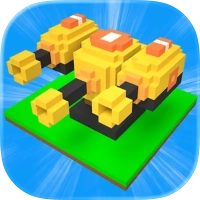
Toy Attack takes robot combat in an unusual direction. Instead of directly controlling your machine during a fight, you build the robot beforehand and decide how it should behave.
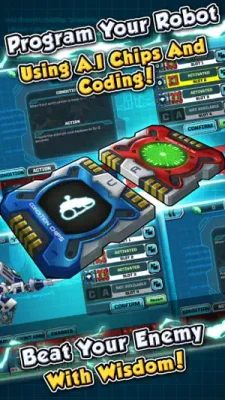
You can assemble different robot parts, tune its performance, select AI chips, and use a simple block-based programming system to create behavioral rules. Once the battle begins, your robot follows the instructions you created and fights automatically.
The result is part robot builder, part strategy game, part AI programming experiment, and part multiplayer spectator combat experience.
The most distinctive feature is that you program the robot rather than manually controlling it during combat.
For example, you can create rules that tell your robot to defend a vulnerable body part after taking damage or charge toward an opponent at a particular moment. Your strategy therefore depends on anticipating situations and creating appropriate responses before the battle starts.
This makes every fight partly a test of engineering and programming.
Your first task is to create a mechanical fighter capable of surviving the arena.
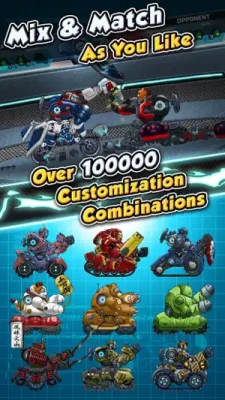
Robot construction involves mixing and matching components and weaponry to create a configuration that fits your preferred strategy.
You can experiment with different combinations rather than relying on a single fixed robot design.
The goal is to discover a combination of parts that gives your machine the right balance of offensive power, durability, and tactical behavior.
Toy Attack gives players considerable freedom when assembling their mechanical gladiator.
You can:
The App Store specifically highlights the ability to collect and combine parts to find powerful combinations.
The block-based coding system is the game's defining mechanic.
Instead of writing conventional programming code, you create behavioral instructions using an accessible block-based interface.
This system is designed to introduce basic programming concepts while remaining understandable to players without previous coding experience. Animoca Brands described it as an introduction to coding principles suitable for different ability levels.
The concept is similar to creating a simple decision tree:
Situation → Condition → Robot Response
For example:
The exact strategy you create determines how your robot behaves once combat begins.
Toy Attack uses game mechanics to introduce fundamental programming ideas.
Players can experiment with:
You do not need to be a professional programmer to experiment with the system.
The appeal is in creating a rule, watching the robot behave, identifying what went wrong, and then changing the program for the next battle.
AI chips provide another way to modify your robot's behavior.
Players can slot different AI chips into their machines to alter how their robotic creation behaves in battle.
This means robot development isn't limited to physical parts. The software controlling the machine is also part of your build.
Building a robot is only the beginning.
Toy Attack allows you to tune your machine so you can squeeze more performance from your configuration.
Careful tuning can help transform an ordinary collection of parts into a more effective combat machine.
This creates a useful development loop:
Build → Tune → Program → Battle → Analyze → Improve.
Collecting components is an important part of progression.
Different parts can influence how your robot performs, while weapon choices affect its offensive capabilities.
The game encourages experimentation because the strongest robot is not necessarily the one with the most powerful individual component. The combination of parts, tuning, and AI behavior can be equally important.
Once your robot enters combat, you become a spectator.
You do not directly control the robot's movements during the fight. Instead, you watch your programmed creation execute the strategy you designed.
This makes battles particularly interesting because the result can reveal whether your AI instructions actually work under pressure.
A successful fight feels like the payoff for good preparation.
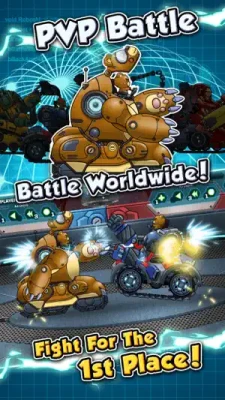
Toy Attack uses a real-time physics engine to simulate the clashes between robots.
The result is designed to make battles feel physical rather than simply displaying health bars and predetermined attacks.
The App Store describes the game as featuring realistic robot destruction through a real-time physics engine.
Toy Attack lets players challenge robots created by other players.
The multiplayer structure focuses on asynchronous-style robot competition: your machine fights based on the configuration and AI strategy you prepared rather than requiring you to manually operate it throughout the match. Animoca Brands' original announcement described the game as featuring asynchronous duels and tournaments.
This gives the game a strong competitive element without requiring players to remain actively controlling a battle from start to finish.
Competitive players can work their way up leaderboards and participate in special events and tournaments.
The original developer announcement highlighted a multi-tier leaderboard system, regular special events, and tournaments.
This gives skilled robot designers a reason to keep refining their machines.
Choose the components and weapons you want to use.
Adjust your robot to get the best performance from its configuration.
Choose suitable AI chips and prepare the robot's behavioral system.
Use the block-based coding system to define how your robot responds to different situations.
Send your robot into a battle against another player's machine.
Observe how your AI behaves and whether the robot follows your intended strategy.
Identify weaknesses in your robot's equipment or programming.
Change parts, tuning, AI rules, or chips and try again.
The biggest mistake new players can make is focusing entirely on the robot's physical strength.
A powerful robot can still lose if its AI behaves poorly.
Start with a simple strategy and test it repeatedly. Once you understand how your robot responds, gradually add more sophisticated rules.
Think of every battle as an experiment.
If the robot loses because it fails to protect a damaged component, modify the AI. If it waits too long to attack, adjust the relevant behavior. If the equipment isn't performing well, try another combination.
Decide what you want your robot to do before selecting every component.
Use programming rules that recognize when important body parts are taking significant damage.
More rules do not automatically mean better AI. Conflicting instructions can make behavior unpredictable.
When improving your robot, change one major variable whenever possible. This makes it easier to understand why the next battle produced a different result.
The best strategy considers both physical components and AI behavior.
A robot designed for aggressive attacks may struggle against a defensive opponent. Consider how your AI responds to different situations.
Toy Attack combines several progression systems:
This creates a progression loop in which every battle can provide information about how to improve the machine.
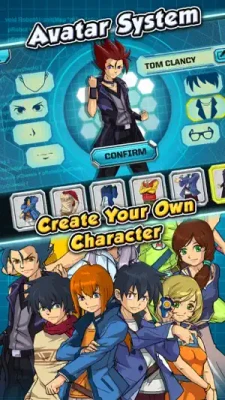
Beyond the robot itself, players can customize the appearance of their anime-style avatar.
This allows you to create a personal identity around your robotic fighter instead of using only the default appearance.
Send your programmed machine into combat against another robot.
Challenge robots belonging to other players.
Compete in organized competitive events.
Climb rankings by improving your robot and winning battles.
Collect parts and experiment with different mechanical configurations.
Create behavioral instructions using the block-based coding system.
Toy Attack's most unusual control philosophy is that the player does not directly control the robot during combat.
Instead, your main interaction happens before the battle:
Once combat begins, the robot follows its programmed strategy while you watch the battle unfold.
The basic robot-building system is accessible, but mastering the AI programming system requires experimentation.
The difficulty comes from understanding how different conditions interact and designing instructions that remain effective when the battle does not unfold exactly as expected.
This gives Toy Attack a different kind of challenge from traditional action games.
You are not primarily testing your reflexes—you are testing your planning and problem-solving skills.
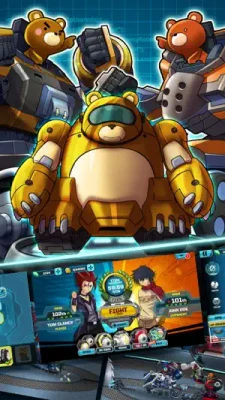
Toy Attack combines cute character design with mechanical combat.
The robots are deliberately designed as approachable mechanical gladiators rather than intimidating realistic war machines. The result is a colorful contrast between playful robot designs and destructive arena battles.
The presentation emphasizes the mechanical clashes and arena spectacle.
Because the player is watching rather than directly controlling the fight, visual feedback is particularly important: you need to understand what your robot is doing and recognize where your strategy succeeds or fails.
One of Toy Attack's most interesting qualities is its introduction to basic programming logic.
The block-based system can help players understand concepts such as:
Animoca Brands specifically presented the game as a way to familiarize players with coding principles through robot behavior.
Toy Attack occupies an unusual space between several genres.
It has the:
Customization of a robot-building game.
Strategy of a competitive battler.
Programming of a beginner coding tool.
Collection of a progression game.
Spectacle of an arena combat game.
The combination is what gives Toy Attack its identity.
Toy Attack is best suited to players who enjoy experimenting rather than simply pressing attack buttons.
The satisfaction comes from building a machine, creating an AI strategy, watching it fight, identifying its weaknesses, and then returning to the editor to make improvements.
The current U.S. App Store listing shows a 3.0/5 rating from 191 ratings, indicating a mixed player response.
That rating should be considered alongside the game's unusual design: Toy Attack is not a conventional robot fighting game, and its appeal depends heavily on whether players enjoy programming and watching automated battles.
Toy Attack is particularly suited to players interested in:
It is especially interesting for players who enjoy creating systems and seeing how those systems behave.
Traditional robot fighting games usually give players direct control over movement, attacks, dodges, and special abilities.
Toy Attack takes the opposite approach.
You prepare the robot before the fight and allow your programmed AI to control its behavior.
This changes the player's role from fighter to engineer and strategist.
Coding games often focus entirely on solving programming puzzles.
Toy Attack makes programming part of a larger competitive experience.
Instead of programming a character simply to reach a destination, you create behavioral rules that determine how a mechanical fighter reacts during combat.
That makes the coding system more immediately visual and entertaining.
Robot-building games generally emphasize collecting parts and creating visually impressive machines.
Toy Attack adds another layer: the robot's behavior matters just as much as its appearance and equipment.
A well-built robot with poor programming can still lose, while an intelligently programmed machine can potentially overcome an opponent with a different configuration.
Game: Toy Attack
Developer: Animoca Brands Limited
Genre: Strategy
Platform: iPhone, iPad, iPod touch
Price: Free with in-app purchases
Age Rating: 13+
App Size: 109.2 MB
Languages: English, French, German, Italian, Japanese, Korean, Portuguese, Russian, Simplified Chinese, Spanish, Traditional Chinese, Vietnamese
iOS Requirement: iOS 8.0 or later
iPad Requirement: iPadOS 8.0 or later
Apple Vision: Requires visionOS 1.0 or later
Game Center: Supported
Achievements: Supported
In-App Purchases: Available
The current App Store listing includes optional gem and bundle purchases, ranging from small gem packages to larger premium packs.
Toy Attack is therefore free to download but uses optional purchases as part of its progression economy.
The App Store lists version 1.9 dated April 4, 2018 as the game's latest numbered update. That update added new battlegrounds, improved the battle-screen interface with clearer indicators for triggered code blocks, optimized loading times, added text-to-speech support, and made battleground cycles tier-specific.
Earlier updates introduced achievements, tutorials for coding and tuning, new robots, graphics improvements, and the original block-based coding feature.
The current App Store page also notes an Apple compatibility update for newer watchOS compatibility without new gameplay features.
The current App Store listing states that the developer has not indicated specific accessibility features. However, the version history notes that text-to-speech support was added in version 1.9.
Robot Building: 9/10
AI Programming: 9/10
Strategy: 8.5/10
Customization: 9/10
Combat Presentation: 8/10
Accessibility: 8/10
Replay Value: 8/10
Overall: 8.5/10
Toy Attack is an unusually creative robot combat game because it asks players to become the engineer behind the fighter rather than the fighter itself.
You build the machine, choose its components, tune its performance, select AI chips, and program its responses using an approachable block-based system. Then you sit back and watch your creation enter a physics-based battle against another player's robot.
Its biggest strength is the relationship between programming and combat. Every battle can teach you something about your robot's behavior, giving you a reason to return to the editor and improve the design.
For players searching for a robot strategy game with AI programming, customization, multiplayer battles, and beginner-friendly coding mechanics, Toy Attack offers a concept that remains distinctive.
Toy Attack is a strategy robot combat game where players build, customize, tune, and program mechanical fighters before sending them into automated battles.
Yes. The game features a block-based programming system that allows players to define how their robots respond to different situations.
No. The robot follows its programmed AI during battles, making the player's preparation and strategy especially important.
Yes. Players can challenge robots created by other players, with competitive leaderboards and tournament-style activities.
Yes. Players can collect and combine robot parts and weapons, tune their machines, and modify their AI behavior.
AI chips can be installed in your robot to alter its behavior and complement the block-based programming system.
It includes coding mechanics designed as an introduction to programming concepts. Its block-based system allows players to create behavioral rules for their robots.
Yes. The game uses a real-time physics engine to simulate robot clashes and destruction.
Yes. The game supports Game Center achievements.
Yes. Toy Attack is free to download with optional in-app purchases.
Toy Attack was developed by Animoca Brands Limited.
The current App Store listing supports iPhone, iPad, and iPod touch, with compatibility information also listed for Apple Vision.