

Latest Version
December 13, 2025
Supercent, Inc.
Puzzle
iOS
0
Report a Problem
More About :game
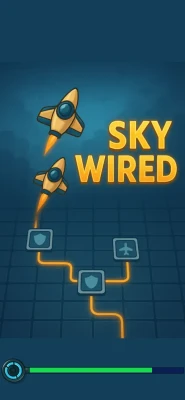
Sky Wired is a sci-fi puzzle-strategy game developed by Gameloops for iPhone and iPad. Instead of relying entirely on traditional shooting controls, the game challenges players to manage battlefield energy and construct laser networks that power their aircraft.
Every encounter combines two different skills: solving a spatial puzzle and preparing an effective fighting force. You must direct energy through the available grid, activate the right launch points, and build a system capable of responding to enemy attacks.
The result is a mix of tactical planning, resource management, and real-time aerial action. Players who enjoy strategy games with a puzzle-solving twist may find Sky Wired particularly appealing.
Main Features of Sky Wired
Laser Network Construction
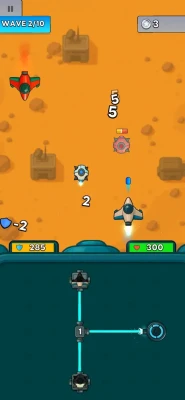
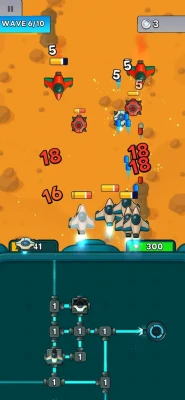
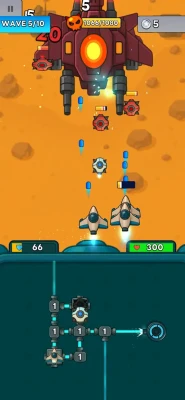
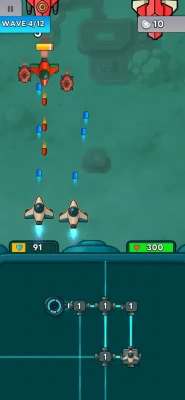
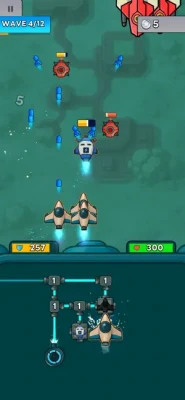
The laser system is central to the gameplay. Players position and connect components such as laser nodes, mirrors, and launch pads to direct energy across the battlefield. A well-organized network helps activate the facilities needed to deploy aircraft.
Aircraft Deployment
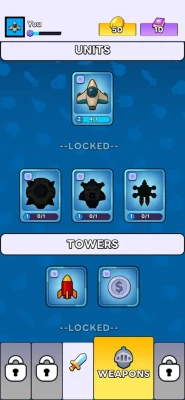
Sky Wired features multiple types of aircraft with different combat roles. Scout Jets are described as rapid-fire units, while Nova Falcons bring explosive attacks. Choosing suitable aircraft for each encounter is an important part of building a capable defense.
Tactical Grid Puzzles
Each level requires players to think about positioning, energy flow, and available space. The challenge is not simply to connect components but to create a useful arrangement that supports combat.
Automated Aerial Battles
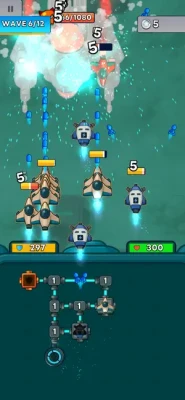
Once aircraft are activated, the battlefield becomes a fast-moving confrontation. Planes launch, weapons fire, and enemies approach in waves. Your preparation determines how effectively your aerial forces can respond.
Upgrades and Progression
The game includes aircraft upgrades, evolving units, and additional technology to unlock. Improving your available options can help you deal with more demanding encounters as the difficulty increases.
Missions and Leaderboards
Time-limited missions offer additional challenges, while a global leaderboard gives competitive players a reason to improve their performance and refine their strategies.
Futuristic Visual Effects
Glowing laser beams, energy grids, aircraft launches, and combat explosions give the game a distinct science-fiction atmosphere.
How to Play Sky Wired
The main objective is to establish an effective energy network and use it to deploy aircraft against incoming enemies.
Examine the grid. Identify your energy source, available components, mirrors, and launch pads before placing anything.
Connect the laser network. Arrange the necessary components so energy can reach the intended destinations.
Activate your aircraft facilities. Make sure your network supports the launch pads you want to use.
Deploy suitable aircraft. Select units that fit the demands of the encounter rather than relying on a single approach.
Observe the battle. Watch how your aircraft perform and identify weaknesses in your setup.
Improve your strategy. Adjust your network and invest in useful upgrades as new challenges become available.
The key is to treat the puzzle and the battle as parts of the same system. A network that looks neat is not necessarily effective if it fails to activate the facilities you need.
Complete Sky Wired Strategy Guide
1. Study the Grid Before Placing Components
Avoid moving components immediately without understanding the layout. First, locate the energy source and the launch pads you want to activate. Then consider which mirrors or nodes are needed to establish a working connection.
Planning the route in advance reduces unnecessary rearrangement and helps you recognize possible bottlenecks.
2. Prioritize Functional Connections
Your first priority should be making the energy network work reliably. Decorative-looking or complicated arrangements offer no advantage if they do not deliver energy to the correct destination.
Check the direction of each beam and pay attention to how mirrors change its path. When a connection fails, inspect the route one section at a time instead of rebuilding the entire grid.
3. Build Around Your Aircraft Choices
Different aircraft serve different purposes, so think about your preferred combat approach before configuring launch facilities.
Scout Jets are presented as rapid-fire aircraft, making them a natural option to consider when consistent offensive pressure is useful. Nova Falcons are associated with explosive attacks, so they may be worth prioritizing when concentrated damage is needed.
These are starting points rather than guaranteed solutions for every level. The best configuration depends on the enemies, available resources, and objectives in the current encounter.
4. Balance Immediate Defense With Long-Term Progression
It can be tempting to focus entirely on unlocking more powerful aircraft. However, a stronger unit is only useful if you can deploy it effectively.
Improve the parts of your setup that are currently limiting performance. If your network struggles to activate launch pads, address its layout first. If your aircraft are deployed consistently but fail to deal with tougher enemies, consider whether an upgrade or different unit would help.
5. Learn From Each Enemy Wave
Watch where your setup performs well and where it begins to struggle. Pay attention to whether aircraft are launching at the right time, whether your chosen units can handle the incoming threats, and whether a particular energy connection is limiting your options.
Use these observations to make one or two deliberate changes at a time. Changing everything simultaneously makes it harder to determine which adjustment actually improved the result.
6. Keep Your Laser Layout Practical
A complicated network can be difficult to troubleshoot. Whenever possible, favor a clear arrangement in which you can easily follow the beam from its source to the intended launch facility.
Before making a change, consider whether it could interrupt another connection. A small, carefully planned adjustment may be more useful than a complete redesign.
7. Approach Time-Limited Missions Carefully
Time-limited challenges place additional pressure on your decisions. Use your familiarity with the basic mechanics to avoid wasting time on unnecessary placements.
Prioritize the connections required for your immediate objective, then expand or refine your setup when the situation allows. If a mission proves difficult, identify the main cause of failure before attempting it again.
8. Upgrade With a Purpose
Rather than upgrading randomly, focus on improvements that address a specific weakness. If your current aircraft selection struggles during combat, investigate the available unit upgrades. If you are consistently unable to establish a reliable launch network, improve your planning and component placement.
A useful upgrade should solve a problem or make your preferred strategy more effective.
9. Improve Your Leaderboard Performance
Competitive progress comes from consistency as much as experimentation. Learn which layouts work well, remember successful aircraft combinations, and avoid repeating mistakes that have already cost you a run.
When comparing attempts, pay attention to the result of each change. This creates a more reliable path toward better performance than relying on random placements.
10. Troubleshoot Failed Strategies
If your approach is not working, use a simple diagnostic process:
Aircraft do not launch: Check whether the necessary energy connections are complete.
A laser does not reach its destination: Inspect the direction of the beam and the position of any mirrors.
Enemies overwhelm your defense: Review your aircraft selection and available upgrades.
A previously successful layout stops working: Check whether the current level introduces different requirements.
Progress feels slow: Focus on the immediate obstacle instead of making unrelated changes.
These checks are practical troubleshooting suggestions based on the game's described mechanics, rather than a claim that every failure has the same cause.
Beginner Tips for Sky Wired
Take a moment to inspect the grid before placing laser components.
Learn how mirrors and nodes affect energy routing.
Make sure your launch facilities receive the energy they need.
Experiment with different aircraft rather than assuming one unit is best everywhere.
Observe enemy waves before deciding which part of your setup needs improvement.
Make small, deliberate adjustments so you can judge their effects.
Use upgrades to address specific weaknesses.
Revisit successful configurations when facing similar challenges.
Practice the core mechanics before attempting to optimize leaderboard performance.
Advanced Tactics and Strategic Thinking
Once the basics become familiar, focus on improving the relationship between your energy network and your combat plan.
Plan for the full encounter. Think beyond the first aircraft launch and consider whether your arrangement will continue to support your intended strategy as the battle develops.
Reduce unnecessary complexity. A straightforward network is often easier to understand and repair than one with many unnecessary connections.
Match your setup to the objective. A time-limited mission may call for a different approach from a challenge where surviving successive waves is the main concern.
Evaluate performance objectively. Identify whether the problem comes from energy routing, aircraft selection, or progression. Solving the actual weakness is more productive than making random changes.
Experiment systematically. Test a new arrangement, observe the outcome, and keep the changes that genuinely improve performance.
Is Sky Wired Difficult?
Sky Wired combines accessible puzzle concepts with increasingly demanding strategic decisions. Understanding how to connect a laser is only the first step; the larger challenge is building an arrangement that supports effective aerial combat.
New players should concentrate on understanding the grid and activating launch pads. More experienced players can then work on improving aircraft combinations, handling enemy waves, and completing timed challenges.
The difficulty will depend on the level and the player's familiarity with the mechanics. It is best approached as a game of learning, testing, and refinement rather than one with a single universal winning strategy.
Graphics, Sound, and Atmosphere
Sky Wired uses a futuristic visual style built around luminous laser beams, technological components, aircraft, and explosive combat effects. The glowing grid gives the puzzle portion of the game a clear identity, while the aerial battles add movement and energy.
The presentation supports the game's central contrast: carefully arranging a tactical system before watching it operate in a hectic battle.
Is Sky Wired Worth Playing?
Sky Wired is worth considering if you enjoy puzzle games that require planning, strategy games with upgrade systems, and science-fiction combat built around unusual mechanics.
Its main appeal is the combination of energy routing and aircraft deployment. Instead of treating puzzle-solving and combat as separate activities, it connects them into one gameplay loop.
Players looking for a conventional flight simulator or a game based entirely on direct shooting may prefer a different experience. Sky Wired is more focused on tactical preparation, grid logic, and managing the systems that make combat possible.
Sky Wired Game Information
Game title: Sky Wired
Developer: Gameloops
Genre: Puzzle, strategy, sci-fi action
Platform: iPhone and iPad
Price: Free, according to the listed App Store information
Language: English
Minimum operating system: iOS 15.0 or later; iPadOS 15.0 or later for iPad
Game size: Approximately 250 MB; the installed size may vary
Age rating: 13+ in the US App Store listing
Core mechanics: Laser routing, grid puzzles, aircraft deployment, automated combat, upgrades, and missions
Competitive features: Global leaderboard and time-limited challenges
Availability, compatibility, age ratings, and app requirements may vary by region and future updates.
Frequently Asked Questions
What type of game is Sky Wired?
Sky Wired is a science-fiction puzzle-strategy game that combines laser-routing mechanics with aircraft deployment and automated aerial combat.
Who developed Sky Wired?
Sky Wired was developed by Gameloops.
Is Sky Wired available on iPhone and iPad?
Yes. The App Store listing identifies support for iPhone and iPad, subject to the stated operating-system requirements.
Is Sky Wired free to play?
The US App Store listing identifies the game as free. Check the current store listing for any changes to pricing or optional purchases.
How does combat work in Sky Wired?
Players create laser networks to power aircraft launch pads. Once activated, aircraft enter combat against incoming enemy waves, making preparation and unit selection important parts of each encounter.
Which aircraft are available in Sky Wired?
The game's description names Scout Jets and Nova Falcons as examples of aircraft with different combat roles. Other units and options may be available as the game progresses.
How can beginners improve in Sky Wired?
Start by learning the laser-routing system, building reliable connections, and understanding how your aircraft perform. Make small changes after each battle and use upgrades to address clear weaknesses.
Does Sky Wired have competitive features?
Yes. Its listed features include a global leaderboard and time-limited missions.
Can Sky Wired be played on Android?
The listing referenced for this guide is the iOS version. Android availability should be confirmed separately rather than assumed.
Is Sky Wired suitable for players who enjoy puzzle games?
It may suit players who enjoy spatial reasoning and logical planning but also want a combat element. The game combines grid-based problem-solving with the challenge of deploying aircraft effectively.
Final Thoughts
Sky Wired offers a distinctive blend of laser puzzles, tactical planning, and futuristic aerial combat. Its strongest idea is the way each puzzle affects the battle that follows: the energy network you build determines how you bring your aircraft into action.
For the best results, learn the grid mechanics first, choose aircraft with a clear purpose, and treat every unsuccessful encounter as an opportunity to refine your approach. Whether you are exploring the game for the first time or aiming to improve your leaderboard performance, thoughtful preparation is the foundation of a stronger strategy.
Rate the Game
User Reviews














Popular Games



















 Android
 iOS
 Windows
 Xbox