




Latest Version
December 28, 2025
MoonDrip FZ-LLC
Sports
iOS
0
Report a Problem
More About :game
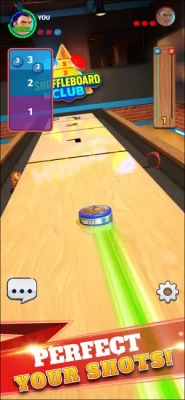
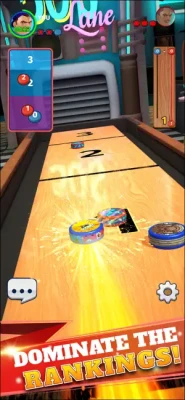
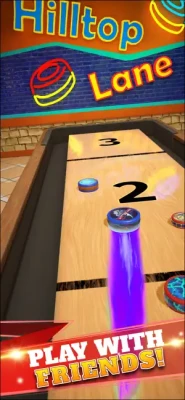
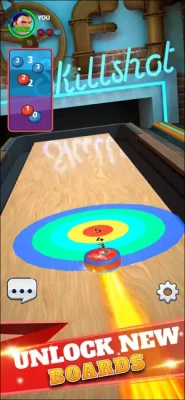
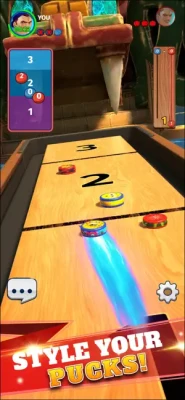
The game combines traditional shuffleboard mechanics with modern multiplayer progression. Players can customize avatars and pucks, unlock rewards, participate in special events, complete daily missions, and work their way up global leaderboards. Different arena designs also give matches a changing visual atmosphere, ranging from classic wooden boards to futuristic settings.
What Is Shuffleboard Club: PvP Arena?
Shuffleboard Club: PvP Arena turns the classic shuffleboard concept into a fast multiplayer competition. Instead of simply trying to score points, you have to consider where your opponent's pucks are positioned and decide whether your next shot should focus on scoring, defense, or knocking an opposing puck away.
The basic controls are easy to understand, but consistent success depends on learning the game's physics. Small changes to your aim and shot strength can determine whether a puck reaches a scoring zone, stops short, slides too far, or pushes another puck out of position.
The App Store describes the game as a real-time PvP experience with customizable avatars, puck designs, special events, Battle Pass rewards, global leaderboards, and competitive progression.
Game Information
Game: Shuffleboard Club: PvP Arena
Developer: MoonDrip FZ-LLC
Genre: Sports / Multiplayer
Main Mode: Real-time PvP shuffleboard
Platforms: iPhone and iPad; the Android version is also listed on Google Play
Age Rating: 13+ on the U.S. App Store
Business Model: Free with in-app purchases
App Size: Approximately 370 MB on iOS
Languages: English plus 32 additional languages
Controller Style: Touch-based aiming and puck launching
Online Play: Real-time multiplayer
Progression: Rewards, customization, events and competitive rankings
The current iOS listing requires iOS 15 or later and supports iPhone and iPad. The Android listing reports 500K+ downloads and a 4.6-star rating at the time checked.
Core Gameplay
Aim Before You Shoot
Every shot starts with positioning your aim. Avoid treating each turn as a simple power challenge. The angle of your shot determines the path your puck takes, while the amount of force determines how far it travels.
A small change in either direction can dramatically change the result.
Before launching a puck, look at:
- Your intended scoring position
- The location of your opponent's pucks
- The available space around the scoring area
- The amount of force needed
- Whether another puck can block your route
Taking an extra moment to read the board can prevent unnecessary mistakes.
Control Shot Strength
One of the most important skills in Shuffleboard Club is learning how much power to use.
A powerful shot may look attractive because it can travel farther or knock an opponent away, but excessive force can send your puck beyond the useful scoring area.
Use different power levels for different situations:
Low power:
Useful when your puck is already close to a scoring area or when precision is more important than distance.
Medium power:
A good choice for controlled scoring attempts and positioning shots.
High power:
Best reserved for long-distance plays, aggressive knockouts, or situations where you need to move another puck.
The goal isn't to use maximum power. The goal is to use the minimum force necessary to accomplish the shot.
Shuffleboard Club Strategy Guide
1. Learn the Board Before Playing Aggressively
New players often try to score immediately. That isn't always the safest approach.
Spend your first matches learning how the puck behaves at different strength levels.
Pay attention to:
- How quickly the puck loses speed
- How much the puck curves or changes direction
- How collisions affect its path
- How much force is needed to reach scoring zones
- How close you can safely get to the edge
Once these behaviors become familiar, your shots become much more predictable.
2. Don't Chase Every High-Value Position
A high-value scoring position can be tempting, but reaching it isn't useful if your puck is likely to slide away or be knocked out.
Sometimes a safer position is better.
Think about the board in terms of risk versus control:
Safe shot:
Place your puck in a reliable scoring position.
Pressure shot:
Move closer to a valuable zone while accepting greater risk.
Attack shot:
Target an opponent's puck and attempt to remove it.
Knowing when to switch between these approaches is one of the most important competitive skills.
3. Use Knockout Shots Carefully
Knocking an opponent's puck away can completely change a match.
However, don't attack automatically.
A knockout attempt can fail in several ways:
- You miss the opposing puck.
- Your own puck leaves a useful position.
- You accidentally improve the opponent's position.
- You use too much force and lose control of the board.
Attack when the opponent has created a position that threatens your score.
If their puck isn't particularly dangerous, keeping your own puck safe may be the better tactical decision.
4. Think About the Final Position
Don't judge a shot only by where the puck starts moving.
Judge it by where the puck is likely to finish.
This sounds obvious, but it is one of the easiest mistakes to make in physics-based sports games.
Before every launch, ask:
"Where will this puck stop if my shot is slightly too strong?"
Then consider:
"Where will it stop if I'm slightly too weak?"
The best shot is often the one that still produces a useful result even when your timing isn't perfect.
5. Use Defensive Positioning
Shuffleboard isn't always about attacking.
A well-positioned puck can make the opponent's next shot considerably more difficult.
Defensive positioning can:
- Occupy a valuable scoring area
- Force the opponent to change their angle
- Block an easy route
- Create a difficult collision
- Protect your strongest scoring position
When you're ahead, reducing unnecessary risk can be more valuable than attempting spectacular shots.
Advanced Puck Control
The Precision Shot
A precision shot uses controlled power and a carefully selected angle.
Use it when:
- You already have a good scoring position.
- You need to avoid another puck.
- The scoring area is close.
- A strong shot would create unnecessary risk.
Precision should become your default approach as you become more experienced.
The Bump Shot
A bump shot deliberately contacts another puck.
It can be used to:
- Push an opponent away
- Improve your own position
- Change the layout of the board
- Create a scoring opportunity
Don't think only about the first collision. Think about what happens afterward.
A successful bump should ideally leave your puck in a useful location.
The Recovery Shot
Mistakes happen.
If your puck stops in a poor position, don't immediately attempt a desperate shot.
Look at the remaining board and determine whether you can recover through:
- A controlled scoring attempt
- A defensive position
- A collision
- A blocking maneuver
- A safer setup for the next turn
Good players aren't perfect. They recover from bad positions more consistently.
Multiplayer Strategy
Shuffleboard Club is built around real-time PvP, so playing against another person requires more than simply learning the controls.
Watch Your Opponent's Habits
After several shots, you may notice patterns.
For example, an opponent may:
- Prefer powerful shots
- Avoid collisions
- Always target high-value areas
- Use similar angles repeatedly
- Play defensively when ahead
Recognizing patterns helps you anticipate what kind of shot may come next.
Don't Copy Your Opponent
If another player makes an impressive shot, it doesn't mean you should immediately attempt the same thing.
Their position may be different.
Their puck may have different characteristics.
The board may have changed.
Treat every turn as its own puzzle.
Progression and Customization
Shuffleboard Club includes more than individual matches. The App Store listing highlights puck and avatar customization, Battle Pass rewards, special events, daily missions, guilds, Mystery Rewards, exclusive offers, and global leaderboards.
Customize Your Puck
Puck customization gives players ways to personalize their setup and progression.
When experimenting with different equipment, pay attention to how the game describes each item rather than assuming that a cosmetic change automatically makes you better.
Your biggest improvement still comes from learning:
- Aim
- Timing
- Power control
- Positioning
- Collision angles
Daily Missions
Daily missions can provide another reason to return to the game and collect progression rewards.
A useful approach is to work toward several objectives at once whenever possible.
Instead of completing each task independently, look for matches where one game can contribute toward multiple objectives.
Special Events
Special events add temporary goals and rewards to the normal multiplayer experience.
Check event requirements before spending resources. If an event has a limited duration, prioritize objectives you can realistically complete rather than trying to unlock everything immediately.
Battle Pass
The Battle Pass provides another progression path with seasonal rewards.
If you're playing regularly, keep track of available challenges and missions so your normal matches contribute toward your seasonal progress.
The game's App Store history specifically mentions seasonal rewards, Battle Pass content, special events, daily missions, Lucky Wheel rewards, guilds, and Mystery Rewards.
How to Improve Quickly
Practice Power First
Before worrying about advanced trick shots, learn your basic power levels.
Try to develop an instinct for:
- Short shots
- Medium shots
- Long shots
- Collision strength
The more familiar these become, the less time you'll spend guessing.
Practice Angles
Aiming directly at the target isn't always the best solution.
When another puck is blocking the route, experiment with indirect angles.
Your objective is to understand how changing the starting angle changes the final position.
Stop Overusing Maximum Power
Maximum strength is useful, but it should not become your default.
A controlled shot gives you more opportunities to predict the result.
Use strong shots when you have a specific reason for doing so.
Common Mistakes to Avoid
Shooting Too Hard
A powerful shot can quickly turn a promising position into a wasted turn.
Ignoring Opponent Pucks
Always inspect the entire board before shooting.
Attacking Without a Plan
Knocking an opponent away is useful only when the resulting position benefits you.
Going for Style Instead of Safety
A spectacular shot isn't necessarily a successful shot.
Spending Resources Too Quickly
Take time to understand your progression options before investing heavily.
Forgetting Defensive Play
Protecting a good position can be just as important as creating one.
Tips for Winning More PvP Matches
- Start with controlled shots.
- Learn how much power different distances require.
- Watch how your opponent plays.
- Protect valuable scoring positions.
- Use knockouts when they have a clear tactical purpose.
- Avoid unnecessary high-risk shots.
- Think about the puck's final position, not just its direction.
- Use events and daily missions to build progression efficiently.
- Keep practicing angles and collision shots.
- Adapt your strategy instead of using the same shot every turn.
Honest Gameplay Impressions
Shuffleboard Club: PvP Arena takes a simple tabletop sport and gives it a modern competitive structure. The core appeal comes from the combination of straightforward controls and increasingly difficult decisions.
The basic concept is easy to understand: aim, choose your strength, launch the puck, and try to finish in a useful position. The deeper challenge comes from controlling the puck accurately and responding to the opponent's positioning.
The game also has a substantial progression layer, with customization, events, seasonal content and leaderboards adding reasons to keep playing.
Player feedback is mixed on some aspects of the experience. Recent App Store reviews include positive comments about the game's accuracy-focused gameplay, while other reviews mention issues such as glitches or progression concerns. These are individual player reports rather than independent testing, so they should be treated as user experiences rather than universal characteristics.
Atmosphere and Presentation
The game moves beyond the traditional image of a wooden shuffleboard table by presenting matches in multiple arena styles.
The App Store describes environments ranging from classic wooden boards to futuristic neon arenas. This gives the otherwise traditional sport a more contemporary multiplayer-game presentation.
The result is a mixture of casual sports-game accessibility and competitive online presentation.
Features at a Glance
- Real-time PvP shuffleboard matches
- Online multiplayer competition
- Multiple arena designs
- Puck customization
- Avatar customization
- Global leaderboards
- Battle Pass progression
- Seasonal rewards
- Special events
- Daily missions
- Lucky Wheel
- Guild features
- Mystery Rewards
- Competitive ranking
- Touch-based aiming and shooting
These features are based primarily on the current App Store listing and version history.
Updates and Current Version
The iOS version history shows continued maintenance and optimization. Version 1.8.5 is listed with improvements to gameplay and bug fixes, while earlier 2026 updates also focused on bug fixes, optimizations, and performance improvements.
The game's progression features have also expanded through earlier updates, including seasonal content, Battle Pass rewards, daily missions, guilds, Mystery Rewards and special events.
Frequently Asked Questions
Is Shuffleboard Club: PvP Arena multiplayer?
Yes. The game is designed around real-time PvP matches where players compete against other players online.
Is Shuffleboard Club free to play?
Yes. The iOS version is listed as free with optional in-app purchases.
Can I customize my character?
Yes. The game includes avatar customization as well as customizable puck designs.
Does Shuffleboard Club have leaderboards?
Yes. Global leaderboards and a ranking system are listed among the game's features.
Does the game have seasonal content?
Yes. The game includes seasonal rewards and special events. The App Store currently lists seasonal event content as well.
Does Shuffleboard Club have a Battle Pass?
Yes. Battle Pass progression and seasonal rewards are part of the game's progression system.
What is the most important skill in Shuffleboard Club?
Accurate control of aim and shot strength is fundamental. Once you understand puck movement, positioning and collisions, you can begin using more advanced tactical shots.
How do I get better at shuffleboard?
Practice controlled shots first. Learn how different power levels affect distance, then work on angles, defensive positioning and knockout shots.
Final Strategy Checklist
Before every important shot, ask yourself:
Where do I want my puck to finish?
How much power is actually necessary?
Can my opponent benefit from my shot?
Can I safely knock their puck away?
What happens if my shot is slightly too strong?
What happens if it is slightly too weak?
If you consistently answer those questions before launching, your accuracy and decision-making should improve naturally.
Shuffleboard Club: PvP Arena is ultimately a game of precision. The controls are accessible, but the competitive side comes from understanding positioning, power, angles and risk. Master those fundamentals before attempting complicated trick shots, and you'll have a much stronger foundation for online PvP matches.
Rate the Game
User Reviews












Popular Games



















 Android
 iOS
iOS Windows
 Xbox
Xbox