

Latest Version
October 04, 2026
Gryphon Games UG
Sports
iOS
0
Report a Problem
More About :game
The game combines idle progression, sports management, athlete collection, equipment upgrades, and competitive events into a simple system designed for both short play sessions and longer progression sessions.
What Is Track Star - Team Manager Idle?
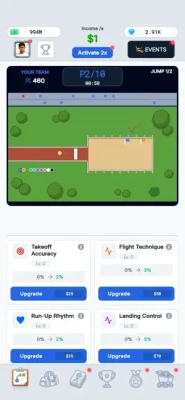
Track Star - Team Manager Idle puts you in charge of an athletics empire rather than controlling individual athletes during every competition.
Your job is to build a stronger team, train your athletes, improve equipment, increase earnings, and progress through increasingly challenging league levels.
The game currently features six sporting events:
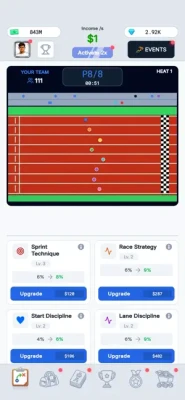
100m Sprint
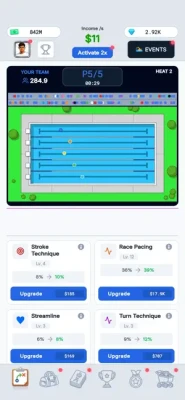
Swimming
Javelin
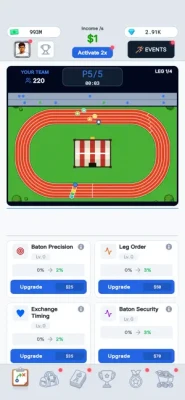
Relay
Cycling
Long Jump
Each event has its own team to develop, which gives the game a broader progression system than a single-event sports game.
The basic gameplay loop is straightforward:
Train → Upgrade → Earn → Unlock → Compete → Collect Rewards → Repeat
Track Star Gameplay Overview
The appeal of Track Star comes from its combination of active upgrades and idle income.
You can tap to train and improve your team, then leave the game and return later to collect accumulated rewards.
This means you don't have to remain in the game constantly to make progress.
Instead, successful progression depends on making smart decisions about where to invest your resources.
The Six Sports Events
100m Sprint
The 100m sprint is one of the most recognizable athletics events and provides a natural starting point for building your sports empire.
Focus on improving:
Athlete training
Sprint-related gear
Income generation
Team progression
League performance
Don't spend everything on one upgrade immediately. A balanced team can provide more reliable progression than a single heavily upgraded component.
Swimming
Swimming gives the game a different sporting environment while following the same general management philosophy.
Look for upgrades that improve your team's overall earning potential and help you progress efficiently through competitions.
Swimming-specific equipment can also become an important part of your long-term progression.
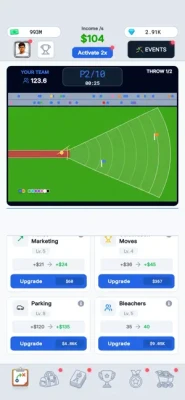
Javelin
Javelin adds a field-event style challenge to the collection of sports.
As with the other events, your objective is not simply to upgrade everything as quickly as possible.
Instead, identify the upgrades that provide the strongest improvement for your current stage.
Relay
The relay is particularly interesting because it represents a team-based event rather than relying on a single athlete.
Building a strong relay team means thinking about the strength of your roster as a whole.
When resources are limited, prioritize improvements that strengthen the overall team rather than concentrating exclusively on one athlete.
Cycling
Cycling expands the sports empire beyond traditional track and field.
The same idle-management principles apply:
Upgrade → increase earnings → reinvest → progress.
Pay attention to the cost of upgrades compared with the additional income or performance they provide.
Long Jump
Long Jump completes the game's current six-event lineup.
Like the other events, it has its own team to develop and perfect.
The best approach is to treat every event as its own investment opportunity while maintaining enough resources to keep your overall progression moving.
Best Beginner Strategy
When starting Track Star, it can be tempting to spend every available resource immediately.
A better approach is to establish a simple priority system.
Step 1: Train Regularly
Training is one of the fundamental ways to strengthen your athletes.
Whenever you return to the game, check which training improvements are available.
Step 2: Upgrade Your Income
Increasing your earnings is critical because future upgrades become progressively more expensive.
The stronger your income engine becomes, the easier it is to afford future improvements.
Step 3: Improve Your Athletes
Use your resources to develop the athletes who contribute most strongly to your current progression.
Step 4: Upgrade Equipment
Gear provides another layer of athlete development.
Step 5: Push Through the Leagues
As your team improves, aim to climb the league structure and collect better rewards.
The Most Important Rule: Don't Upgrade Randomly
One of the easiest mistakes in an idle sports game is buying whichever upgrade happens to be available.
Instead, ask:
"What will give my team the biggest improvement right now?"
For example, if your income is too low to afford meaningful athlete upgrades, increasing income may be more valuable than improving a minor stat.
Likewise, if your athletes are already earning efficiently, investing in their performance may help you progress through competitions faster.
How to Earn Money Faster
Track Star is built around an idle economy.
Your athletes continue earning while the game is closed, so the goal is to create a strong income engine before leaving the game.
The App Store specifically describes the game as having "idle income" that continues while the game is closed.
Before Going Offline
Try to:
Collect available rewards.
Purchase worthwhile upgrades.
Improve your main athletes.
Equip useful gear.
Check your strongest event.
Leave the game running its idle progression.
When you return, collect the accumulated rewards and reinvest them.
Idle Income Strategy
Idle income becomes increasingly important as upgrade costs rise.
A strong idle-game routine is:
Return → Collect → Upgrade → Compete → Upgrade again → Leave
Don't allow large amounts of currency to sit unused if there is an upgrade that substantially improves your earning potential.
At the same time, avoid spending every resource on tiny improvements if you are close to an important unlock.
Athlete Collection Guide
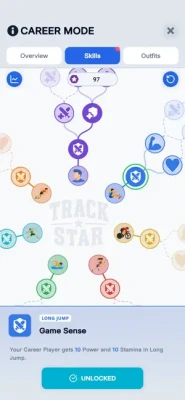
One of Track Star's major progression systems is collecting Star Athletes.
The game allows players to unlock unique athletes with special stats and customize them with different skins.
This gives the roster system two purposes:
Improving your competitive potential
Building a collection of unique athletes
Athlete Strategy
When you unlock a stronger athlete, don't immediately assume that every older athlete should be ignored.
Consider:
Their stats
Their event
Their current upgrade level
Your available resources
The event you are focusing on
A strong athlete in the wrong place isn't necessarily more useful than a well-developed athlete who directly supports your current progression.
Gear Upgrade Strategy
Track Star includes dozens of pieces of sports equipment.
Examples mentioned by the developer include:
Running spikes
Singlets
Swimming caps
Relay batons
Cycling helmets
These upgrades provide another way to strengthen your sports empire.
Best Gear Strategy
Don't treat equipment as cosmetic decoration alone.
When deciding where to spend resources, look at which gear provides the most meaningful improvement to the athlete or event you're currently developing.
If two pieces of equipment are available, prioritize the one that supports your strongest source of progression.
How to Choose Your Main Event
Because Track Star has six different events, you may eventually find yourself deciding where to concentrate resources.
A useful strategy is to identify your main event.
Your main event should generally be the one that:
Produces strong income
Has well-developed athletes
Has affordable next upgrades
Provides reliable league progress
Has useful gear available
Once your primary event is performing well, begin investing more heavily into your weaker events.
This creates a more balanced athletics empire.
League Progression Guide
Track Star lets you climb through leagues, win trophies, and compete for higher rankings.
League progression is an important indicator of how effectively you're developing your team.
Before Trying to Advance
Check:
Athlete strength
Gear
Training upgrades
Event progression
Available resources
If the next league feels significantly harder, don't simply keep attempting it without improving your roster.
Use the previous stage to strengthen your team and increase your earning power.
Trophy Strategy
Trophies provide a visible measure of your team's competitive progression.
Instead of focusing only on collecting trophies quickly, use them as a signal that your upgrades are working.
If progression slows down, return to the management side of the game:
Athletes → Gear → Training → Income → Competition
Daily Rewards
Track Star includes daily rewards and free rewards that can provide useful resources for your progression.
Make collecting them part of your normal routine.
Daily Routine
When opening the game:
Collect idle income.
Collect daily rewards.
Check free rewards.
Check available training.
Review upgrades.
Check competitions.
Look for event rewards.
Spend resources strategically.
This takes little time but helps maintain steady progression.
Lucky Draw Strategy
The game includes a Lucky Draw alongside its daily rewards and limited-time offers.
If you have access to a free or earned draw, use it when appropriate.
However, don't build your entire progression strategy around random rewards.
Your core progression should come from:
Training + Athletes + Gear + Income + League Progression
Random rewards should supplement that progression rather than replace it.
Sport Rush Event Guide
One of the newer additions to Track Star is Sport Rush, a weekly event where players compete in a unique sport, climb a leaderboard, and earn rewards.
This gives the game an additional competitive layer beyond the normal league system.
Sport Rush Strategy
Before pushing hard in a weekly event:
Collect available resources.
Upgrade your strongest athletes.
Improve relevant gear.
Check the event requirements.
Avoid wasting resources on unrelated upgrades.
Focus on actions that directly improve your event performance.
Because Sport Rush is time-limited, resource efficiency becomes more important than normal.
Best Sport Rush Approach
Don't immediately spend every valuable resource when the event begins.
First determine what contributes most strongly to the event.
Then concentrate your resources around those mechanics.
A good event strategy is:
Prepare → Enter → Identify the best progression path → Invest → Push the leaderboard
The weekly format means you can treat each event as a separate competitive challenge.
How to Build a Strong Athletics Team
A successful team requires more than one powerful athlete.
Think about your roster as a complete system.
Build Around Three Areas
Athletes
Your roster determines the competitive strength of your team.
Gear
Equipment helps improve the effectiveness of your athletes.
Economy
Income allows you to keep upgrading both.
If one area falls too far behind, progression can slow.
Best Upgrade Order
There is no universal upgrade order that will always be optimal because your available upgrades and resources change as you progress.
However, this general priority works well:
Early Game
Income → Training → Athletes → Gear → Competition
Mid Game
Best Athlete → Income → Gear → Event Development → League Progression
Advanced Game
Highest-value Event → Star Athletes → Gear → League Push → Sport Rush
Use this as a framework rather than a rigid formula.
Resource Management Tips
The most important resource-management principle is simple:
Don't spend resources simply because you have them.
Save resources when you are close to:
A major athlete unlock
An important gear upgrade
A league milestone
A new event opportunity
A high-value event reward
Small upgrades can be useful, but several small upgrades are not always better than one major progression milestone.
Common Mistakes to Avoid
1. Ignoring Idle Rewards
The game is specifically designed around offline earnings.
Collect your accumulated rewards regularly.
2. Upgrading Everything Equally
Not every event needs the same investment at every moment.
3. Ignoring Gear
Athlete development and equipment should work together.
4. Spending Valuable Resources on Low-Impact Upgrades
Always consider the return you get from an upgrade.
5. Forgetting Daily Rewards
Free resources can add up significantly over time.
6. Ignoring Sport Rush
The weekly event provides another source of rewards and competitive progression.
7. Chasing the League Too Early
If your team isn't ready, strengthen it first.
8. Depending Too Much on Random Rewards
Lucky Draw rewards are useful, but your main progression should come from consistent upgrades.
Advanced Strategy: Build an Income Engine
The strongest long-term approach is to think like a sports business manager.
Your athletes are not just competitors.
They are part of an income-generating system.
Your goal is therefore:
More income → better athletes → better gear → stronger competitions → better progression → more income
This creates a positive feedback loop.
Once your income becomes strong enough, expensive upgrades become easier to purchase and your entire team can progress faster.
Advanced Strategy: Focus Before You Expand
Having six events available does not mean you should develop all six equally from the beginning.
A focused approach can be more efficient.
Choose one or two strong events and develop them aggressively enough to establish a reliable income base.
Then use that income to strengthen the remaining events.
This approach can reduce the feeling of being stretched across too many upgrades.
Advanced Strategy: Know When to Diversify
After your main event becomes strong, start investing in weaker events.
Why?
Because a balanced sports empire gives you more opportunities to participate in different competitions and events.
The ideal progression is therefore:
Focus early → build income → diversify later
Is Track Star - Team Manager Idle Worth Playing?
Track Star is a good fit for players who enjoy sports games but don't necessarily want a traditional real-time sports simulation.
It combines sports management with idle progression, meaning you can build a team without needing to control every race, throw, jump, or lap manually.
The current App Store listing has a 4.6/5 rating from 79 ratings, while Google Play lists the game at 4.2 stars with more than 100,000 downloads.
Player feedback is mixed in the usual ways for an idle game: some reviewers praise the simple and entertaining progression, while others criticize slow upgrade costs and monetization pressure.
Track Star - Team Manager Idle Features
Idle sports management
Offline income
Six sporting events
100m Sprint
Swimming
Javelin
Relay
Cycling
Long Jump
Athlete training
Star athlete collection
Athlete stats
Custom athlete skins
Sports equipment upgrades
Daily rewards
Free rewards
Lucky Draw
Limited-time offers
League progression
Trophy collection
Sport Rush weekly event
Global leaderboard
Casual progression
These features are documented in the current App Store and Google Play listings.
Game Information
Game: Track Star - Team Manager Idle
Developer: Gryphon Games UG
Genre: Sports
Platforms: iPhone, iPad, Android and Windows via Google Play Games
Age Rating: 9+ on the U.S. App Store
Business Model: Free with in-app purchases and advertising
iOS Requirement: iOS 15.0 or later
App Size: Approximately 392.2 MB on the current U.S. App Store listing
Languages: English, French, German, Japanese, Korean, Simplified Chinese, Spanish and Traditional Chinese
The game also includes advertising, in-app purchases and loot boxes according to the App Store listing.
Track Star - Team Manager Idle Pros and Cons
Pros
Six different sports events
Simple and accessible management gameplay
Offline income
Large upgrade system
Athlete collection
Custom athlete skins
Numerous equipment items
League progression
Trophy system
Daily rewards
Weekly Sport Rush event
Suitable for short play sessions
Cons
Progress can become slower as upgrade costs increase
Idle gameplay may feel repetitive for players who prefer active sports games
Some progression systems rely on incremental upgrades
Advertising and optional purchases may not appeal to every player
Random-reward mechanics are part of the monetization system
Recent App Store reviews reflect both sides: some players describe the game as fun and easy to learn, while another recent review complains about slow upgrades and perceived monetization pressure.
Frequently Asked Questions
What is Track Star - Team Manager Idle?
Track Star is an idle sports management game where you build an athletics team, train athletes, upgrade gear, earn income, and compete across six sporting events.
How many sports are in Track Star?
There are currently six events: 100m Sprint, Swimming, Javelin, Relay, Cycling, and Long Jump.
Does Track Star earn money while offline?
Yes. Athletes continue earning income while the game is closed, allowing you to return later and collect accumulated rewards.
Can I collect different athletes?
Yes. Track Star includes unique Star Athletes with special stats and customizable skins.
What is Sport Rush?
Sport Rush is a weekly event where players compete in a specific sport, climb a leaderboard, and earn rewards.
How do I progress faster?
Focus on your strongest income source, improve the athletes and gear that matter most, collect idle and daily rewards, and avoid spending resources on low-impact upgrades.
Is Track Star free?
Yes. The game is free to download, with advertising and optional in-app purchases.
Does Track Star have a league system?
Yes. Players can climb through leagues, win trophies, and compete for higher rankings.
Final Verdict
Track Star - Team Manager Idle takes the familiar idle-game formula and places it inside an athletics management setting.
Its biggest strength is variety. Instead of building one sports team around a single discipline, players can develop six different events, collect specialized athletes, upgrade authentic sporting equipment, earn offline income, and work toward higher leagues and trophies.
The most effective strategy is not simply to upgrade everything as quickly as possible. Build a strong income foundation, identify your most valuable event, develop your best athletes and gear, and gradually expand your athletics empire.
For players searching for a sports manager game, idle sports game, athletics management game, or relaxing team-building game, Track Star offers a straightforward progression system with enough collection and competitive features to keep the experience moving.
Rate the Game
User Reviews












Popular Games















 Android
 iOS
iOS Windows
 Xbox
Xbox