

Latest Version
September 06, 2024
Rasu Games
Sports
0
com.rasugames.pls
Report a Problem
More About :game
The game combines fluid movement, directional passing, accurate shooting, curved shots and physics-based ball control with a career structure built around leagues, domestic cups, continental competitions and national-team tournaments.
Whether you prefer building a successful club or leading a national team to a major trophy, Pro League Soccer offers a straightforward football experience with plenty of matches and progression goals.
What Is Pro League Soccer?
Pro League Soccer is a football simulation game developed by Rasu Games.
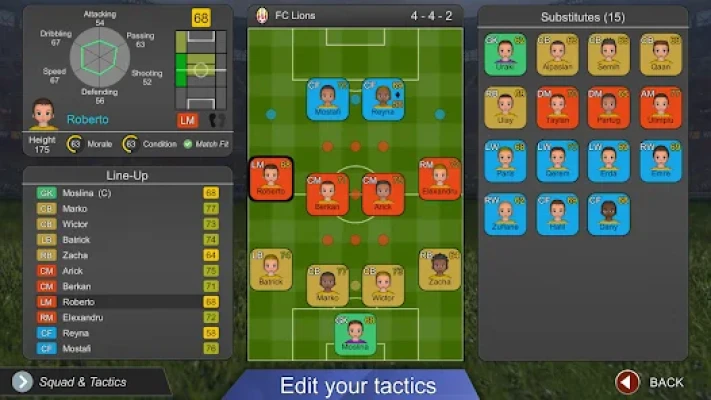
Its central progression system revolves around selecting a club and improving its competitive position. You can start in a lower league and work toward promotion, compete for domestic cups and eventually reach higher-level competitions.
The game also expands beyond club football. National-team competitions include a Nations League-style structure and international cups, giving you another path to pursue trophies.
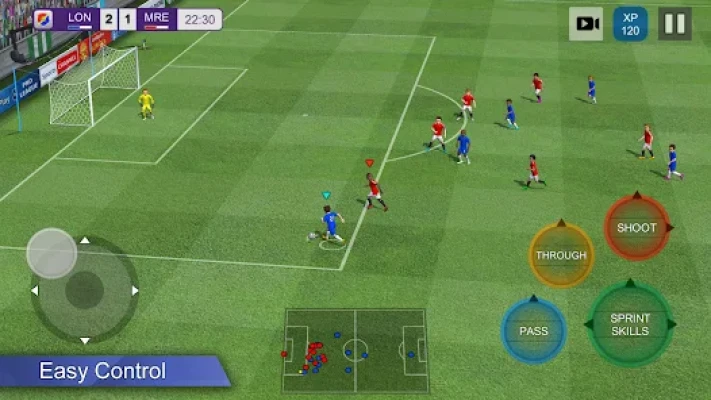
The gameplay emphasizes direct control. Players can move freely around the pitch, make directional passes and attempt different types of shots using timing and positioning.
Main Features
Club Career Progression
Choose a club and work through the league system. Success over multiple seasons can lead to promotion into stronger divisions and more prestigious competitions.
League Competitions
The game features club leagues across several football regions, including European, American and Asian competitions.
Domestic Cups
Each season can include national club cup competition, giving your team another opportunity to win silverware.
Continental Competitions
Successful clubs can reach higher-level competitions and compete against stronger opponents.
National Teams
Pro League Soccer also lets you compete with national teams rather than limiting the experience to club football.
Nations Competitions
National teams can participate in league-style international competitions and fight for major trophies.
Directional Passing
Passing is designed around direction and timing, allowing you to move the ball into useful spaces rather than relying entirely on automatic passing.
Accurate Shooting
Shooting requires attention to direction and timing. Learning how much power and which angle to use can make a major difference.
Curved Shots
The ball-physics system allows players to attempt curved shots, giving attacking players more options around the penalty area.
360-Degree Movement
Player movement provides flexibility around the pitch, making positioning important in both attack and defense.
Challenging AI
Computer-controlled opponents attempt to exploit mistakes and create scoring opportunities, making defensive positioning an important part of the game.
Team and Player Editing
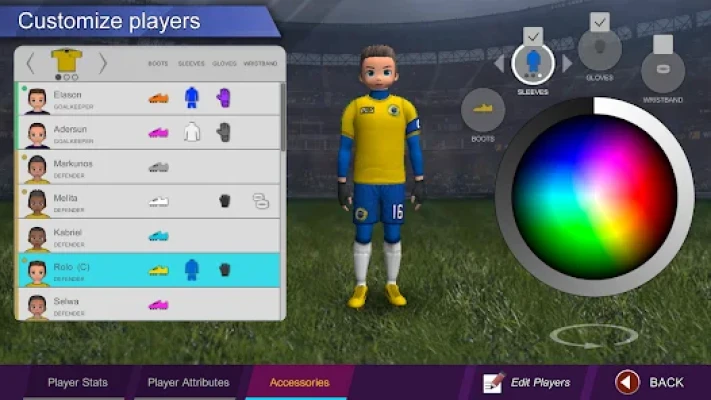
The game provides extensive editing options for competition, club and player names, allowing players to customize the football world to their preferences.
How to Play Pro League Soccer
The basic match strategy can be divided into five stages:
Build possession.
Move the opponent's defense.
Create space.
Select the right pass or shot.
Defend intelligently after losing possession.
The most effective players do not constantly attack at full speed. They control the tempo and wait for opportunities.
Full Pro League Soccer Strategy Guide
1. Learn the Controls Before Starting a Career
Before focusing on trophies, spend time becoming comfortable with movement, passing and shooting.
You should be able to:
Move naturally around opponents
Pass accurately
Change direction quickly
Control the ball under pressure
Shoot without rushing
Defend without abandoning your position
Good controls are more valuable than an aggressive strategy you cannot execute consistently.
2. Keep Possession Under Pressure
Don't immediately send the ball forward whenever you receive it.
If an opponent is pressing, use a short pass to a nearby teammate and move into space.
Possession gives you time to reorganize the attack and prevents unnecessary turnovers.
3. Use Directional Passing
Directional passing is one of the most important mechanics in Pro League Soccer.
Instead of simply passing toward the nearest teammate, think about where you want the receiver to go next.
A good pass should ideally:
Move the ball away from pressure
Advance the attack
Find an open teammate
Create space
Start a combination
4. Avoid Forced Through Balls
A forward pass can be tempting when you see a striker running into space.
However, if defenders have already closed the passing lane, forcing the ball forward can immediately give possession away.
When the forward route is blocked, recycle possession and look for another angle.
5. Use the Wings
Wide areas can be useful when the middle of the pitch becomes crowded.
Move the ball toward the wing to stretch the defense.
Once defenders move toward the side, you can look for:
A cross
A return pass
A diagonal run
A central passing lane
A late-arriving teammate
6. Don't Shoot Too Early
A common mistake is shooting as soon as the goal becomes visible.
Instead, consider your angle and the goalkeeper's position.
If there is time to move closer or create a better shooting angle, use it.
7. Master Curved Shots
Curved shots can be particularly useful when a direct shooting line is blocked.
Instead of aiming directly at the goalkeeper, use the ball's curve to attack an open area of the goal.
Practice is important because successful curved shots depend on direction, timing and distance.
8. Shoot With Purpose
Not every attack needs to end with a shot.
A low-quality attempt from a poor position can simply return possession to the opponent.
If the defense is still organized, continue building the attack.
9. Watch the Goalkeeper
The goalkeeper's position should influence your shooting decision.
Look for situations where the keeper has moved away from the center of the goal.
Instead of shooting directly toward the goalkeeper, target the available space.
10. Attack After Winning the Ball
When you recover possession, the opposing team may be temporarily disorganized.
This can be an excellent moment to move forward quickly.
However, don't confuse a counterattack with blindly rushing.
The best counterattack combines speed with one or two accurate passes.
Passing Strategy
Short Passing
Short passes are useful for maintaining possession and escaping pressure.
Use them when several teammates are nearby.
Long Passing
Longer passes can change the point of attack and exploit open space.
They are especially useful when the opponent has concentrated players in one area.
Diagonal Passing
Diagonal passes can be effective because they move the ball across defensive lines while changing the direction of the attack.
Passing Before Receiving
Think about your next pass before the ball reaches your player.
This reduces hesitation and allows you to move the ball quickly.
Shooting Strategy
Shoot From Good Angles
The closer you are to a favorable angle, the more dangerous the attempt becomes.
Avoid repeatedly taking low-percentage shots simply because the goal is visible.
Use Timing
The game's shooting system rewards controlled timing.
Try not to rush your shot immediately after receiving the ball.
Vary Your Finishing
Use different shooting directions depending on the goalkeeper's position.
Mixing shot placement makes your attacks less predictable.
Don't Overuse Curved Shots
Curved shots are useful, but they should not become your only finishing method.
A straightforward shot may be better when you already have a clear angle.
Defensive Strategy
Stay Between the Ball and the Goal
Your first defensive priority should be protecting the dangerous area.
Don't immediately chase the player with the ball if doing so opens a large space behind you.
Protect the Center
The central area near the penalty box is usually more dangerous than a harmless wide position.
Keep your defensive shape compact whenever possible.
Don't Pull Defenders Out Too Early
If you move a defender forward aggressively, the opponent may pass into the space you just created.
Wait for the right moment to challenge.
Track Dangerous Runs
Watch attacking players away from the ball.
A defender who focuses only on the player carrying the ball can easily miss a dangerous run from another attacker.
Recover Quickly
After losing possession, immediately consider whether you can press the ball carrier or whether it is safer to fall back.
How to Beat Difficult AI
The AI can punish predictable attacks.
If the opponent repeatedly stops your forward passes, change your approach.
Try:
Switching play
Using wider positions
Keeping possession
Passing backward temporarily
Attacking from another angle
Using quick combinations
Don't keep repeating the same attack after the AI has already adapted to it.
Career Mode Strategy
Start With Realistic Objectives
If you are beginning in a lower league, focus first on establishing consistent results.
You don't need to win every match by a large margin.
Promotion is usually more important than spectacular scorelines.
Protect Your League Position
When facing a stronger opponent, a controlled match may be preferable to an overly aggressive approach.
A disciplined performance can keep you competitive.
Treat Cup Matches Differently
Cup competitions are an opportunity to progress beyond your normal league position.
Take difficult cup matches seriously because one elimination ends that competition for the season.
Build Momentum
A successful run of league results can make the overall career progression feel much easier.
Avoid unnecessary losses against weaker opponents.
National Team Strategy
Club football and international football require slightly different thinking.
With a national team, you may have less familiarity with the squad, so focus on:
Simple passing
Defensive organization
Efficient attacks
Avoiding unnecessary turnovers
Taking advantage of individual quality
International tournaments also create additional pressure because knockout matches can eliminate you immediately.
Tournament Strategy
Group or League Matches
Consistency is extremely important.
A team that collects points regularly can put itself in a strong position before the decisive matches.
Knockout Matches
Don't take unnecessary risks early.
A single mistake can end a cup run.
Final Matches
In a final, patience matters.
Avoid abandoning your defensive shape simply because you haven't scored early.
Club Progression Strategy
Focus on Promotion
When starting from a lower division, promotion should be one of your primary objectives.
Build a consistent approach rather than relying on occasional big victories.
Improve Match Consistency
Winning some matches by large margins while losing others heavily is less useful than producing reliable results.
Learn From Losses
After a defeat, identify the actual problem.
Was it:
Poor finishing?
Too many risky passes?
Weak defending?
Losing possession?
Leaving too much space?
Rushing attacks?
Correcting one recurring mistake can improve your results significantly.
Best Match Habits
Before Attacking
Check where your teammates are positioned.
During Possession
Look for space rather than simply moving toward the goal.
Near the Penalty Area
Slow down and choose your final pass or shot carefully.
After Losing the Ball
Decide whether to press or retreat.
Near Your Own Goal
Avoid unnecessary risks.
Beginner Mistakes to Avoid
Passing Without Looking
Blind passes often give the opponent easy possession.
Shooting From Every Position
A shot is only useful if it has a reasonable chance of success.
Constant Sprinting
Moving quickly all the time can make ball control and positioning more difficult.
Defending Aggressively Everywhere
Chasing the ball can create gaps.
Ignoring Wide Players
Leaving the wings unprotected can give the opponent easy attacking routes.
Repeating the Same Attack
If the AI has stopped one attacking pattern, change your approach.
Editing and Customization
One of the game's distinctive features is its editing system.
Players can customize various competition, team and player names according to their preferences.
This gives the game a flexible community-driven feel and allows players to create a football environment closer to their preferred leagues and teams.
Leagues and Competitions
The game includes club competitions representing several football regions.
The listed club-league structure includes countries such as:
England
Spain
Italy
Germany
France
Portugal
Netherlands
Turkey
Russia
Brazil
Argentina
Mexico
United States
Japan
South Korea
Indonesia
The broader competition structure also includes domestic cups, continental leagues and national-team competitions.
International Competitions
National-team gameplay includes regional and international competitions.
The available competition structure includes:
European Nations competitions
American Nations competitions
Asian Nations competitions
National Cup
World Cup
European Cup
American Cup
Asian Cup
African Cup
Graphics and Gameplay Feel
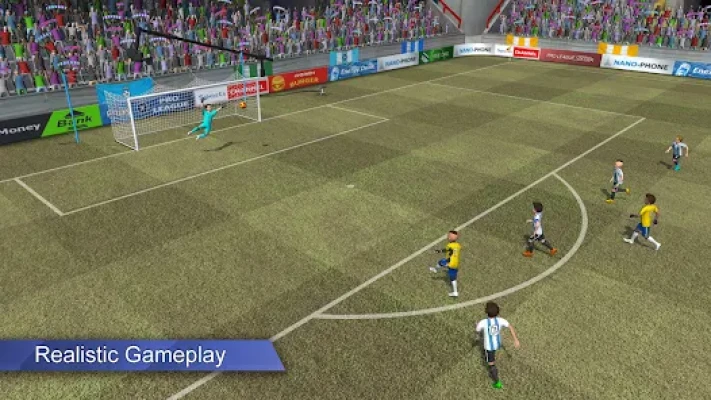
Pro League Soccer focuses more on direct football control than on elaborate presentation.
Its strongest gameplay elements are movement, ball control, passing and shooting.
The 360-degree movement system gives you considerable freedom when controlling players, while the ball physics create opportunities for different types of shots.
Difficulty
The game can feel very different depending on your experience with mobile football controls.
Beginners may need time to become comfortable with:
Player movement
Directional passing
Shooting
Defensive positioning
Ball control
Higher difficulty settings can expose weaknesses in your decision-making, particularly if you rely on predictable attacking patterns.
Common Problems Players Should Expect
Player feedback frequently praises the core football gameplay while also pointing to areas that could be improved, including shooting difficulty, goalkeeper behavior, controls, player-name accuracy and roster updates.
This means that new players should not expect every shot to work immediately. Learning the game's shooting and passing system is part of the experience.
Pros and Cons
Pros
Club career progression
Promotion through leagues
Domestic and international cups
National-team competitions
360-degree player movement
Directional passing
Curved shots
Physics-based ball control
Challenging AI
Extensive team and player editing
Large variety of leagues and competitions
Straightforward football gameplay
Cons
Shooting can take time to master
Some matches may feel difficult to score in
AI and controls can occasionally feel inconsistent
Rosters and player information may not always stay fully current
Presentation is more focused on gameplay than realism in every area
Pro League Soccer Game Information
Game: Pro League Soccer
Developer: Rasu Games
Package: com.rasugames.pls
Genre: Sports / Football
Mode: Single-player football matches and career progression
Gameplay: Club football and national-team competitions
Controls: 360-degree movement, directional passing and shooting
Ball System: Physics-based control and curved shots
AI: Competitive computer-controlled opponents
Customization: Team, competition and player-name editing
Content Rating: Everyone
Monetization: Contains ads
Frequently Asked Questions
What is Pro League Soccer?
Pro League Soccer is a mobile football game where you select and develop a club, compete in leagues and cups, and progress toward higher-level competitions.
Can you get promoted to higher leagues?
Yes. Career progression allows clubs to advance from lower leagues toward higher divisions.
Can you play as a national team?
Yes. National-team competitions form an important part of the game's tournament structure.
Does Pro League Soccer have realistic ball physics?
The game emphasizes ball physics, directional passing, shooting and curved shots as part of its gameplay system.
Can you edit teams and players?
Yes. The game provides editing options for competition, club and player names.
Is there a career progression system?
Yes. The club progression system is built around seasons, leagues, promotion opportunities and cup competitions.
Does the game have AI opponents?
Yes. Matches can be played against computer-controlled opponents designed to challenge the player.
What is the best way to score?
Create space before shooting, use accurate directional input, watch the goalkeeper's position and avoid rushing low-percentage attempts.
How can I improve at defending?
Stay between the attacker and goal, protect central areas and avoid pulling defenders out of position unnecessarily.
Final Verdict
Pro League Soccer is a straightforward mobile football game built around club progression, direct controls and a broad range of competitions.
Its biggest strength is the amount of football progression packed into a relatively focused experience. You can begin with a club in a lower division, work toward promotion, compete for cups and eventually challenge for major continental or international trophies.
The gameplay rewards players who learn to control space rather than simply rushing toward the opponent's goal. Accurate passing, patient buildup, well-timed shooting and disciplined defending are the keys to consistent results.
For fans of mobile football games, soccer career modes, football simulation, club management, league progression, cup competitions and tactical match gameplay, Pro League Soccer is a compelling option that is especially worth exploring for players who prefer direct on-pitch control.
Rate the Game
User Reviews














Popular Games



















 Android
 iOS
iOS Windows
 Xbox
Xbox