


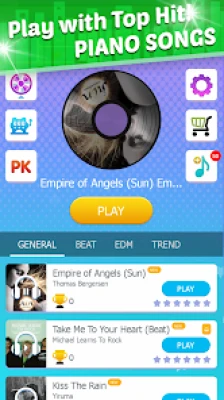




Latest Version
August 19, 2025
SSN Publishing
Music
Android
0
Report a Problem
More About :game
Magic Tiles Hop is a music-focused arcade experience centered on a bouncing ball and a sequence of musical tiles.
The basic concept is easy to understand: keep the ball moving from tile to tile while following the rhythm. As the music becomes faster or the tile path becomes more demanding, players must react quickly and maintain accurate movement.
This style of gameplay is closely associated with music ball games, piano rhythm games, magic tiles games and Tiles Hop-style arcade games. Similar games in this genre use touch, hold and drag controls to guide a ball onto rhythm-based platforms.
Game Theme & Atmosphere
Magic Tiles Hop focuses on colorful musical environments, rhythmic movement and fast visual feedback.
Rather than telling a traditional story, the game creates its atmosphere through:
- Music-driven movement
- Colorful tiles
- Bouncing-ball animations
- Changing visual effects
- Increasing rhythmic intensity
- Fast arcade-style challenges
The combination of music and movement makes every level feel like a small interactive performance.
Gameplay Overview
The main objective is simple: follow the music and keep the ball on the tiles.
Players control the ball as it moves through a musical path. The position of upcoming tiles determines where the ball needs to travel.
A successful run requires three things:
- Good timing
- Fast reactions
- Accurate finger movement
The concept is similar to other popular rhythm-ball games, where every platform corresponds to part of the musical sequence.
How to Play
Step 1: Start a Song
Choose an available music level and begin the run.
Step 2: Watch the Tiles
Look ahead rather than concentrating only on the ball's current position.
Step 3: Move the Ball
Use your finger to guide the ball toward the next tile.
Step 4: Follow the Beat
Try to synchronize your movements with the music.
Step 5: Avoid Missing Tiles
A missed platform can interrupt the run and force you to replay the section.
Step 6: Chase a Higher Score
Once you understand the level, replay it to improve accuracy and score.
Games in this category commonly use touch, hold and drag controls to move the ball across music tiles.
Main Features
Rhythm-Based Gameplay
The most important feature is the relationship between movement and music. Instead of simply moving a ball through an obstacle course, players need to anticipate movements according to the rhythm.
Magic Music Tiles
The tiles form the actual gameplay path. Their positioning determines where the ball must travel.
Simple Touch Controls
The control concept is designed to be easy to learn, making the game accessible to casual players.
Piano Music Experience
The piano-game theme gives the title an appealing connection to piano tiles and music-game fans.
Fast Reflex Challenges
As the patterns become more demanding, players need increasingly precise reactions.
High-Score Chasing
Replay value comes from trying to improve performance, complete more of a song and achieve better scores.
Colorful Visual Feedback
The changing tiles and movement effects help synchronize what players see with what they hear.
Controls & Interface Guide
Magic Tiles Hop is designed around touchscreen interaction.
Basic controls:
- Touch: Begin interacting with the game.
- Hold: Maintain control during continuous movement.
- Drag: Move the ball toward upcoming tiles.
- Release: Finish a movement when appropriate.
The one-finger control style is common among Magic Tiles Hop-style games and makes the basic mechanic quick to understand.
Game Progression
Progression in this type of rhythm game is primarily based on musical skill rather than character development.
Players improve by:
- Completing songs
- Learning tile patterns
- Improving timing
- Increasing accuracy
- Memorizing difficult sections
- Replaying levels
- Chasing higher scores
- Mastering faster sequences
The more familiar you become with a song, the easier it becomes to predict the next movement.
Music & Rhythm
Music is the heart of Magic Tiles Hop.
Every tile movement should feel connected to the rhythm. This gives the game a different feel from conventional endless runners because sound becomes part of the gameplay rather than simply background decoration.
For fans of piano games, rhythm games, music games, ball games and magic tiles, this combination can make short play sessions surprisingly engaging.
Difficulty
Overall Difficulty: Easy to Hard
| Stage | Difficulty |
|---|---|
| Learning controls | Easy |
| First songs | Easy |
| Intermediate patterns | Moderate |
| Faster songs | Hard |
| High-score mastery | Very Hard |
The controls themselves are simple. The challenge comes from maintaining accurate movement as the speed and complexity increase.
Beginner's Guide
New players should resist the temptation to move the ball too aggressively.
Beginner Tips
Look ahead.
The next tile is more important than the tile you have just landed on.
Follow the rhythm.
The music can help you anticipate movement.
Keep movements smooth.
Small controlled movements are generally easier to manage than sudden swipes.
Learn the level.
If you miss the same section repeatedly, concentrate on that specific pattern.
Don't chase speed immediately.
Accuracy should come before fast reactions.
Advanced Strategy
Experienced players can improve their scores by learning the rhythm structure of each song.
1. Anticipate Instead of Reacting
Don't wait until the ball reaches the edge of the current tile. Start preparing for the next movement early.
2. Memorize Difficult Sections
If a particular sequence causes repeated failures, replay it until the movement becomes automatic.
3. Use the Music as a Guide
Rhythm provides useful timing information. Listen for repeated beats, transitions and changes in tempo.
4. Minimize Unnecessary Movement
Large swipes can make it harder to maintain control. Precise movement is usually more reliable.
5. Replay for Mastery
Completing a song once is only the beginning. Replaying it can reveal opportunities for better timing and higher scores.
Why Music Makes the Gameplay Better
A rhythm game becomes more engaging when the player's actions feel connected to the soundtrack.
In Magic Tiles Hop, the ball movement and tile placement create that relationship. Similar rhythm-ball games describe each tile as part of the song, making timing central to the experience.
This gives the player a simple but satisfying objective:
Hear the beat → anticipate the tile → move the ball → continue the song.
Game Modes
Depending on the current version of the game, the available experience may revolve around individual music levels and replay-based score improvement.
Typical Magic Tiles Hop-style gameplay can include:
- Music levels
- Piano rhythm challenges
- Ball-running stages
- High-score attempts
- Increasing-difficulty songs
- Endless or extended challenges
Because the supplied Google Play listing could not be independently retrieved, these should not be presented as confirmed mode names unless they appear in the current version of the app.
Characters & Ball Customization
Unlike story-driven games, the focus of Magic Tiles Hop is on the musical ball and its movement rather than traditional characters.
In comparable Tiles Hop games, players can encounter different ball skins or characters as cosmetic customization options.
For this specific title, cosmetic options should be confirmed against the current in-game version before being described as guaranteed features.
Items & Collectibles
The gameplay emphasis is primarily on tiles, movement, music and scoring rather than weapons or conventional RPG items.
If the game includes coins, gems, skins or other unlockable objects in its current version, these can provide an additional layer of progression without changing the core rhythm mechanic.
Accessibility
The simple touch-based design makes the basic concept easy to understand.
Players do not need to learn a complicated control scheme. The main challenge is visual tracking, timing and reaction speed.
For players sensitive to fast animations or flashing effects, reducing device brightness or taking regular breaks may make longer sessions more comfortable.
Offline Gameplay
Comparable Magic Tiles Hop and music-ball games are frequently listed with offline functionality.
However, because the exact supplied Google Play listing could not be retrieved, offline availability for this particular package should be verified in the current app version.
Player Experience
Magic Tiles Hop-style games appeal to players who enjoy short, repeatable challenges.
A typical session can last only a few minutes, making this type of game suitable for:
- Quick breaks
- Casual gaming
- Music fans
- Rhythm-game enthusiasts
- Reflex practice
- Score chasing
- Replaying favorite songs
The strongest part of the experience is the immediate connection between the soundtrack and the player's movements.
Pros & Cons
Pros
- Simple touch controls
- Easy to understand
- Music-driven gameplay
- Fast arcade action
- Suitable for short sessions
- Encourages replay
- Combines piano and ball-game mechanics
- Accessible to casual rhythm-game players
Cons
- Can become difficult at higher speeds
- Repeated levels may feel familiar
- Success depends heavily on timing
- Music-game enjoyment varies according to personal taste
- Exact feature availability may vary by version
Magic Tiles Hop vs Traditional Piano Games
Traditional piano-tile games usually ask players to tap specific notes or tiles at the correct time.
Magic Tiles Hop-style gameplay changes the formula by putting a ball at the center of the experience.
Instead of simply tapping stationary piano keys, players guide a moving ball across a sequence of musical platforms.
That creates a hybrid between:
Piano game + rhythm game + ball runner + reflex arcade game
This combination is one of the main reasons the Tiles Hop formula has become recognizable within mobile music games.
Similar Games
Players who enjoy Magic Tiles Hop may also be interested in:
- Tiles Hop: Music & Ball Game
- Magic Tiles 3
- EDM Rush: Magic Tiles Hop
- Piano Tiles
- Music Ball games
- Dancing Line
- Going Balls
The broader Android music-game category currently includes major rhythm titles such as Magic Tiles 3 and Tiles Hop Music & Ball Game, both of which use music-driven gameplay.
Expert Rating
Overall Rating: 7.8/10
| Category | Rating |
| Gameplay Concept | 8/10 |
| Controls | 8.5/10 |
| Music Integration | 8/10 |
| Replay Value | 7.5/10 |
| Accessibility | 8.5/10 |
| Challenge | 8/10 |
| Visual Appeal | 7.5/10 |
| Overall | 7.8/10 |
This is an editorial rating based on the described Magic Tiles Hop gameplay concept rather than an official player rating.
Who Should Play Magic Tiles Hop?
This game is a good match for players who enjoy:
- Piano games
- Magic tiles games
- Rhythm games
- Music games
- Ball-running games
- Fast arcade challenges
- Reflex games
- Casual Android games
- Music-based mobile games
It is especially suitable for people who prefer straightforward gameplay that can be learned within minutes but still becomes challenging with practice.
Final Verdict
Magic Tiles Hop combines the accessibility of a casual ball game with the timing and concentration of a piano rhythm game.
The controls are simple, but mastering the game requires players to look ahead, react quickly and understand the relationship between music and movement.
Its strongest appeal is the immediate gameplay loop:
Listen → Move → Land → Keep the rhythm → Improve your score.
For fans of Magic Tiles, Tiles Hop, piano games and rhythm games, it offers a familiar but entertaining style of mobile arcade action.
Frequently Asked Questions
What is Magic Tiles Hop?
Magic Tiles Hop is a mobile rhythm-style game centered around guiding a bouncing ball across musical tiles.
How do you play Magic Tiles Hop?
You guide the ball toward upcoming tiles using touchscreen movement while trying to stay synchronized with the music.
Is Magic Tiles Hop a piano game?
Yes, the game is built around a piano/music rhythm concept, although its central mechanic uses a bouncing ball and musical tiles.
Is Magic Tiles Hop easy to play?
The basic controls are easy to learn. However, faster songs and more complicated tile patterns can make advanced gameplay challenging.
Is Magic Tiles Hop suitable for beginners?
Yes. The fundamental mechanic is straightforward, making the genre accessible to new rhythm-game players.
Does Magic Tiles Hop require fast reactions?
Yes. Timing and reaction speed become increasingly important as the musical sequences become more demanding.
What makes Magic Tiles Hop different from piano-tile games?
Traditional piano-tile games generally focus on tapping notes. Magic Tiles Hop adds ball movement, requiring players to guide a moving object across musical platforms.
Can you improve your score by replaying songs?
Replay is an important part of rhythm games because learning the pattern and improving timing can lead to better performances.
Rate the Game
User Reviews












Popular Games


















 Android
 iOS
iOS Windows
 Xbox
Xbox